

.png)
Summary
- Traditional insurance sales training fails because reps forget over 70% of material without reinforcement and managers can't provide consistent coaching at scale.
- The key to performance isn't just knowing the script, but building the muscle memory to handle objections and close deals under pressure.
- "Revenue Activation" bridges this gap by turning the winning habits of your top closers into repeatable, daily practice for the entire team.
- AI Sales Roleplays provide the engine for this, helping teams cut ramp time by over 50% and giving every agent unlimited, pressure-tested practice.
If you've spent any time selling insurance, you know the emotional math. Fifty rejections in a row, and you're supposed to think: a sale is that much closer. The Reddit community of insurance agents is refreshingly honest about this reality — many talented people leave the industry not because they couldn't sell, but because they took every "no" personally until it broke them.
That's not a character flaw. That's a training gap.
Success in insurance sales is, as veterans put it, "a numbers AND a skill development game." But here's the uncomfortable truth most sales leaders don't want to say out loud: the traditional insurance sales training model is built to teach the playbook — not to build the muscle memory to execute it under pressure, call after call, rejection after rejection.
So the real question isn't just "what should agents learn?" It's this: what actually changes performance when it counts?
Part 1: The Cracks in Traditional Insurance Sales Training
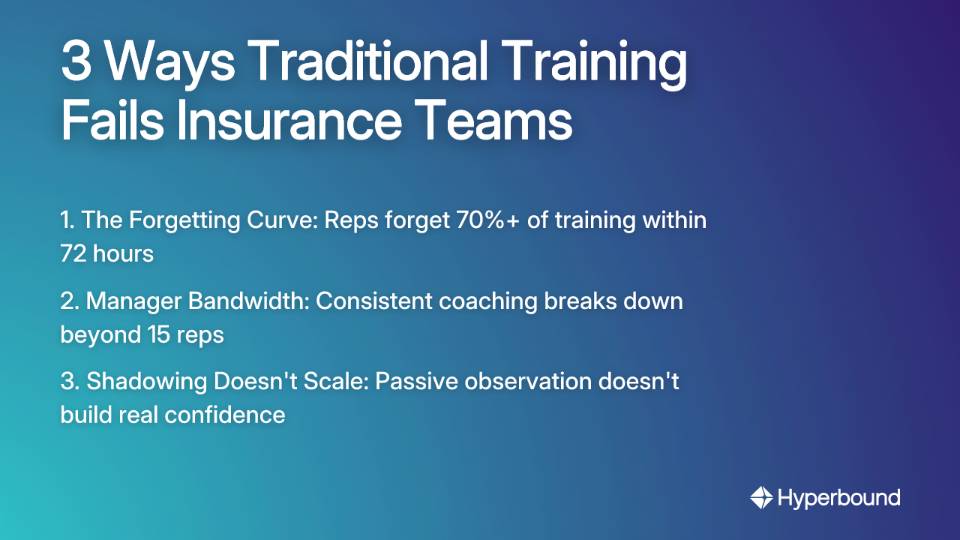
Traditional insurance sales training has a recognizable shape. There's usually an onboarding bootcamp or masterclass, some form of shadowing a senior agent, weekly coaching calls with a manager, and a static LMS course reps are supposed to work through on their own time. Traditional training programs have formalized this model — and it can provide genuine value. Agents learn product fundamentals, compliance requirements, and the structure of a good script.
But when it comes to scaling performance, three failure modes consistently undermine the investment.
Failure Mode 1: The Forgetting Curve Hits Hard
Here's a statistic that should make every sales leader uncomfortable: research shows reps forget training material within 72 hours if it isn't reinforced through active practice. That weekend bootcamp, that intensive two-day workshop — by Wednesday, most of it is gone.
Insurance agents face some of the most challenging objection-handling scenarios in any sales role. Prospects question pricing, timing, and their existing providers. A rep who learned the rebuttal on Monday but hasn't practiced it since can't deploy it naturally when a skeptical prospect pushes back on a live call. They hesitate. They stumble. They lose the deal.
Failure Mode 2: Managers Can't Coach 15 Agents Consistently
Even the best frontline sales manager runs out of bandwidth. Managerial coaching typically struggles to maintain consistent, quality support beyond 15 agents at a time. In a growing agency — one that's actively hiring and scaling — that ceiling is hit fast.
What this means in practice: the reps who speak up get coached. The quieter ones, or those who've just missed their numbers for two consecutive weeks, slip through. Coaching becomes reactive and inconsistent, applied to whoever's most visibly struggling rather than building systematic skill development across the team.
Failure Mode 3: Shadowing Doesn't Scale
Shadowing a senior closer is genuinely valuable — when it works. A new agent who sits in on five strong closes with a top performer learns pacing, tone, and objection flow that no script can fully capture.
But here's the paradox: the best senior agents are the ones most in demand, and therefore the least available to shadow. And even when shadowing happens, it's passive learning. A new rep might observe ten calls and not hear the specific objection they personally struggle with. They learn by watching, not by doing. Real confidence — the kind that holds up when a prospect goes cold or raises a price objection mid-close — only comes from repetition under pressure.
Part 2: Introducing Revenue Activation — The Missing Link
Training gives agents the playbook. But knowing what to do and being able to execute it fluently in a high-stakes conversation are two very different things. The gap between them is where deals are lost.
This is the problem that the concept of Revenue Activation is designed to solve.
Revenue Activation is what happens when teams stop just analyzing call data and start using it to change outcomes. Rather than sitting on recordings of your top closers' best calls, you extract the specific behaviors — the exact phrasing used to overcome a price objection, the questioning technique that opens up a hesitant prospect, the closing sequence that converts — and you turn those into repeatable, daily practice for your entire team.
In short, Revenue Activation involves analyzing the behaviors of top closers and embedding those actions into coaching practices to drive consistent performance. It's not about more training hours. It's about building a system where the best behaviors your team already produces become the standard everyone practices toward.
Data alone doesn't close deals. Activated data does.

Part 3: AI Roleplay Practice — The Engine of Revenue Activation
So what does Revenue Activation look like in practice for an insurance sales team? It looks like every rep getting unlimited, realistic, pressure-tested practice on the exact conversations that determine whether a deal closes — without burning manager time and without waiting for the perfect shadowing opportunity to appear.
That's where AI roleplay practice enters the picture, and where Hyperbound Practice has built something meaningfully different from the tools that came before it.
Why Generic Roleplay Tools Fall Short
Most static roleplay tools present a scripted scenario with a predictable "buyer" response tree. Agents figure out the pattern quickly, and the practice stops feeling real. They're drilling a puzzle, not a conversation.
Hyperbound's AI buyer personas are built from analysis of 2M+ hours of real B2B sales conversations — not generic scripts. This means the AI pushes back the way a real skeptical prospect would, raises the objections that real buyers actually raise, and responds to what the agent actually says, not a predetermined branch. For insurance agents working through cold calls, discovery conversations, and price-sensitive closes, that realism is what makes the practice transfer to performance.
Features that Directly Solve the Three Failure Modes
Beating the Forgetting Curve: Hyperbound's AI roleplays and Bitesized Roleplays are designed for continuous reinforcement — short, targeted sessions that agents can complete before a calling block, between meetings, or embedded directly in their existing LMS. Instead of one intense training day that evaporates by Wednesday, reps are practicing the specific skills they need, exactly when they need them.
Scaling Coaching Without Adding Headcount: AI Scorecards deliver instant, objective feedback after every roleplay — tracking talk ratio, methodology adherence, objection handling quality, and key selling moments. A manager no longer has to sit in on every call or review every recording to know where each agent is struggling. The scorecard surfaces it automatically, so coaching conversations become targeted and efficient rather than generic and reactive. One manager can now meaningfully develop 30 agents with the kind of precision that used to require twice the staff.
Replacing the Luck of Shadowing: With Multiparty Roleplays, agents can practice complex insurance calls involving multiple stakeholders — say, a business owner and their financial advisor — repeatedly, until navigating that dynamic feels natural. They're not waiting for the right shadowing scenario to come up organically. They're manufacturing thousands of repetitions of the hardest conversations they'll face.
AI-powered simulations help reps overcome the fear of pitching and objection handling — building the confidence that separates agents who freeze under pressure from those who close through it.
Part 4: The Head-to-Head — What the Metrics Actually Say
This isn't a philosophical debate. The outcomes speak for themselves.
Traditional insurance sales training produces foundational knowledge. Agents learn product details, compliance, and the structure of a good script. But without a reinforcement mechanism, execution is inconsistent. Agents know what to say. Under pressure, many still struggle with how — and that's where closings are won or lost.
AI roleplay practice produces measurable, repeatable skill development. Here's what that looks like in practice with Hyperbound:
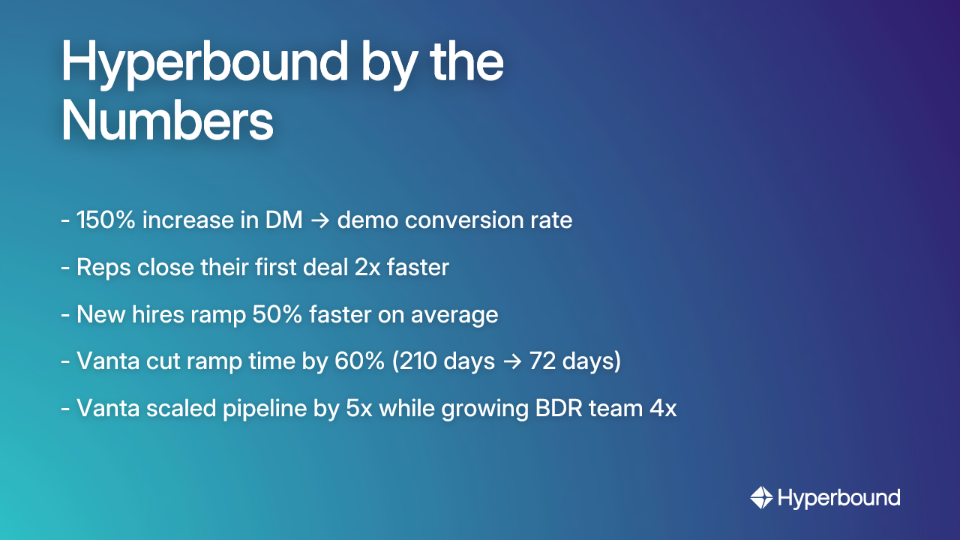
- Teams using Hyperbound see a 150% increase in DM → demo conversion rate
- Reps close their first deal 2x faster than those trained without structured roleplay practice
- New hires ramp 50% faster on average
The Vanta case study brings this to life most vividly. Vanta's CRO Stevie Case deployed Hyperbound Practice across their sales team and cut ramp time by 60% — taking new reps from 210 days to full productivity in just 72 days, while simultaneously scaling their BDR team by 4x and growing pipeline by 5x.
That's not a marginal improvement. That's a structural change in how quickly a sales organization reaches full capacity.
For insurance agencies — where ramp time directly correlates to commission costs, management overhead, and revenue predictability — this kind of acceleration has a very concrete dollar value. A new agent who reaches performance benchmarks in 72 days instead of 210 represents weeks of productive selling, not just weeks of training expense.
Stop Training. Start Activating.
Traditional insurance sales training provides the foundation — and it still matters. Agents need to understand products, compliance frameworks, and core sales methodology. That knowledge doesn't go away.
But knowledge without practice is just information. And inconsistent practice — the kind that depends on manager availability, shadowing luck, or a rep's willingness to self-direct — produces inconsistent results.
The teams closing more deals aren't the ones who trained harder. They're the ones who practiced smarter — who turned the behaviors of their best closers into daily repetition for every agent on the team, until those behaviors stopped being techniques and became instincts.
That's Revenue Activation. And it's available, at scale, right now.
Frequently Asked Questions
What is Revenue Activation in insurance sales?
Revenue Activation is a strategy that turns insights from top-performing sales calls into repeatable, daily practice for your entire team. Instead of just analyzing call data, it involves extracting the specific phrases, questions, and techniques your best closers use and embedding them into AI-powered roleplay simulations, ensuring every agent can master the behaviors that actually drive sales.
Why does traditional insurance sales training often fail to improve performance?
Traditional insurance sales training often fails because of three key issues: the "forgetting curve," where agents forget most training within days without practice; limited manager bandwidth, which makes consistent, personalized coaching impossible to scale; and the inefficiency of shadowing, which relies on passive observation rather than active skill-building.
How does AI roleplay help insurance agents overcome call reluctance?
AI roleplay helps agents overcome call reluctance by providing a safe, repeatable environment to practice high-pressure conversations without fear of losing a real deal. By engaging in hundreds of realistic simulations against AI personas that raise common objections, agents build muscle memory and confidence. They learn to handle rejection and navigate difficult scenarios instinctively, which reduces anxiety and improves performance on live calls.
What's the difference between Hyperbound and other sales training software?
The key difference is that Hyperbound's AI is built on analysis of over 2 million hours of real B2B sales conversations, not generic scripts. This means its AI buyer personas provide uniquely realistic, unscripted pushback that mirrors real-world prospect behavior. While other software focuses on knowledge transfer (the playbook), Hyperbound focuses on performance activation—turning that playbook into muscle memory through lifelike practice.
How can AI-powered training scale coaching for a growing insurance agency?
AI-powered training scales coaching by automating personalized feedback for every agent on every practice call. Tools like AI Scorecards instantly analyze performance on metrics like objection handling, talk ratio, and methodology adherence. This frees up managers from having to listen to every call, allowing them to focus their time on targeted, high-impact coaching sessions based on data-driven insights, effectively coaching a much larger team without a loss in quality.
Can experienced insurance agents benefit from AI roleplay practice?
Absolutely. AI roleplay is not just for new hires; it's a powerful tool for experienced agents to refine their skills and adapt to new challenges. Veteran agents can use it to practice handling new objections, master the messaging for a new insurance product, or sharpen their skills for navigating complex, multi-stakeholder deals. It provides a platform for continuous improvement and mastery, even for seasoned professionals.

Ready to see how your insurance sales team performs when every rep practices like your top closer? Explore Hyperbound Practice →
Book a demo with Hyperbound


