.png)


.png)
Summary
- Generic objection handling fails because buyer context is key; an objection like "it's too expensive" means something different to a SaaS buyer (ROI focus) than a healthcare administrator (patient outcomes).
- A universal 5-step framework (Acknowledge, Pause, Clarify, Reframe, Validate) provides a structured approach to handling any objection before tailoring your response.
- With only 41% of reps feeling prepared for objections, consistent practice is essential for building the confidence and muscle memory needed to perform under pressure.
- Master industry-specific scenarios by practicing with AI Sales Roleplays that simulate realistic buyer conversations, allowing your team to build skills in a risk-free environment.
Why Your Generic Objection Handling Script Is Failing
"What do you sell? These wouldn't work at all for me."
If that thought crossed your mind while reading yet another generic sales advice article, you're not alone. As one sales professional noted on Reddit, the effectiveness of objection handling is often "industry driven," and what works perfectly in SaaS might fall completely flat in healthcare.
An objection like "it's too expensive" takes on radically different meanings depending on your buyer's context:
- In SaaS: "This doesn't align with our quarterly initiatives."
- In Financial Services: "I don't trust that your value will outweigh your fees long-term."
- In Healthcare: "I can't justify this cost to the board without clinical data proving superior patient outcomes."
Generic scripts fail because they ignore the single most important factor in sales: your buyer's industry context. This guide moves beyond one-size-fits-all advice to provide tailored frameworks for handling objections in three major B2B sectors.
The Universal Framework: 5 Steps to Handle Any Objection
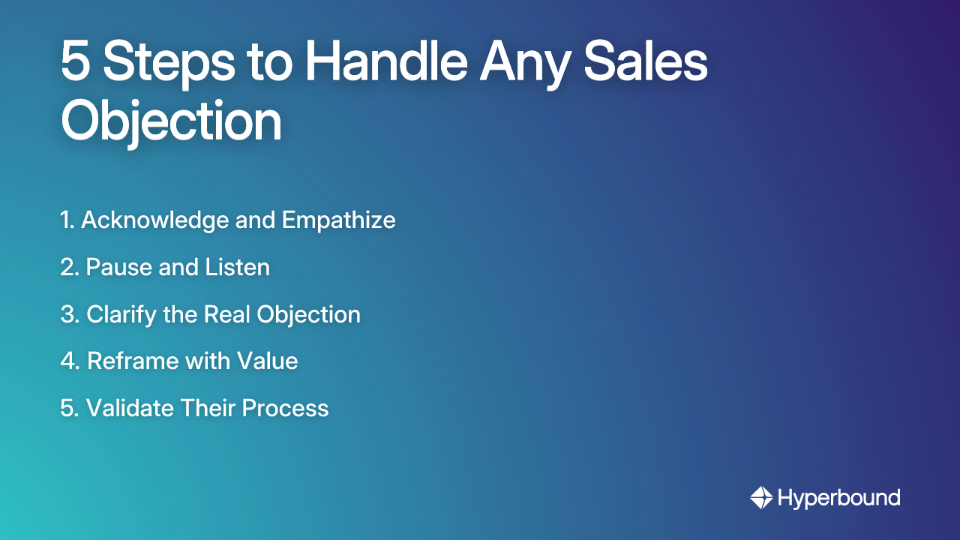
Before we explore industry-specific approaches, let's establish a foundation. According to industry research, only 41% of sales reps feel prepared to respond to objections. A structured framework prevents defensive reactions and builds confidence:
- Acknowledge and Empathize: Show you're listening and validate their concern. "I understand why you'd feel that way" or "That's a fair point."
- Pause and Listen: As one salesperson on Reddit advised, sometimes the best strategy is to "just stop talking. Let them walk themselves through objections." Silence invites the prospect to elaborate.
- Clarify the Objection: Ask diagnostic questions to uncover the real issue. Never assume you know what "too expensive" means. "When you say it's 'too expensive,' could you tell me more about what you mean by that?"
- Reframe with Value: Shift from cost to outcomes. Connect your solution directly to a pain point they've shared, articulating your value proposition in their language.
- Validate Their Process: Confirm you've addressed their concern and explore next steps. "Does that help clarify things? What would you need to see to feel confident moving forward?"
SaaS — Selling to the Logic of ROI and Integration
The SaaS Buyer Context
SaaS buyers are typically tech-savvy and focused on efficiency, scalability, and ROI. According to SaaStr, purchases are often tied to pre-planned annual initiatives, making budget constraints a function of priority, not just price.

Common SaaS Objections and Responses
1. Price/Budget: "It's too expensive" or "Not in the budget this quarter"
The Real Meaning: "This wasn't a planned strategic initiative for this year, so I have no pre-allocated budget for it." In software, where CFOs often have the final say in purchases, the business case must be airtight.
Response Framework:
- Clarify: "I understand. To make sure I'm on the right page, is the issue the overall cost, or that it's an unbudgeted expense for this quarter?"
- Pivot to Value vs Price: "Let's set the price aside for a moment. If we could solve [Problem X] and generate [Y amount] in new revenue or savings, what would that be worth to the business?"
- Find the Discretionary Budget: "What is the top priority for your team right now? There might be an opportunity to align with that initiative."
2. Need/Complacency: "We're happy with our current solution"
The Real Meaning: The pain of switching seems greater than the pain of staying. This is classic complacency.
Response Framework:
- Validate, Don't Argue: "That's great you have a process that's working for you. Many of our best customers said the same thing initially."
- Introduce the Cost of Inaction: "They found that while their old system worked, it was costing them an average of [X hours per week / $Y in missed opportunities]. What would need to happen for you to explore a more efficient approach?"
- Present Case Studies: "Here's how a company just like yours improved efficiency by 30%."
3. Complexity: "This seems too complicated to implement"
Response Framework:
- De-risk the Decision: "We have a dedicated implementation team that handles everything from data migration to user training."
- Offer a Trial: "The best way to see the simplicity is to experience it firsthand. We can set you up with a no-obligation trial so you can see for yourself."
Financial Services — Selling to the Emotion of Trust and Security
The Financial Client Context
Financial decisions are deeply personal and emotional, revolving around trust, risk, and future security. Your value proposition must be framed around peace of mind and long-term partnership.
Common Financial Services Objections and Responses
1. Price/Fees: "Your fees are too high"
The Real Meaning: "I don't trust that the value you provide will be greater than the money I'm paying you."
Response Framework:
- Acknowledge and Reframe to ROI: "That's a very important consideration. The goal is to ensure the value you get from a solid financial plan far outweighs the cost. Let's look at a projection of how our management can lead to potential gains over 10 years, even after fees."
- Break Down the Value: Be transparent about what the fee covers: ongoing monitoring, rebalancing, advisory access, tax optimization, etc.
2. Trust: "I need to think about it" or "I was burned before"
The Real Meaning: "I don't trust you or your firm yet."
Response Framework:
- Listen Fully and Empathize: "Thank you for sharing that. It's completely understandable to be cautious, especially with your financial future. Can you tell me a bit more about what's on your mind?"
- Build Credibility with Social Proof: "Many of my clients felt the same way at first. Here are a few testimonials from people in a similar situation who have been with me for over five years."
3. Timing/Risk: "I'm not ready to invest right now"
The Real Meaning: "I'm afraid of market volatility," or "The timing feels wrong."
Response Framework:
- Educate, Don't Sell: "That's perfectly fine. The most important thing is that you feel comfortable. Perhaps I can share some resources on the benefits of long-term investing and the principle of compound interest, which can help illustrate why starting sooner is often advantageous."
- Focus on the Process, Not the Product: "Let's start with creating a financial plan, which doesn't require any investment decisions today. This gives you a roadmap so when you are ready to invest, you'll have clear direction."
Healthcare — Selling to the Standard of Patient Outcomes and Compliance
The Healthcare Buyer Context
As noted by Medical Sales Training, decisions in healthcare are high-stakes because they directly impact patient outcomes. The decision maker is often a committee, and all claims must be backed by clinical evidence. Compliance (e.g., HIPAA) is non-negotiable.
Common Healthcare Objections and Responses
1. Privacy/Security: "I'm concerned about HIPAA compliance and patient data"
The Real Meaning: This is a non-starter if not addressed perfectly. "Prove to me that you will not create a massive liability for my institution."
Response Framework:
- Acknowledge and Align: "Protecting patient data is our absolute top priority, as it should be. We are fully HIPAA compliant."
- Provide Immediate, Concrete Proof: "I can send you our full security and compliance documentation right after this call, including our SOC 2 Type II report and details on our data encryption protocols."
2. Authority/Committee: "I need to consult with the medical team/board"
The Real Meaning: "This is not my decision alone. I need to build consensus with other stakeholders who have different priorities (clinical, financial, IT)."
Response Framework:
- Enable Your Champion: "That makes perfect sense. To make that conversation as productive as possible, what information would be most valuable for the team? We have clinical studies for the medical staff, an ROI analysis for the board, and a security whitepaper for IT."
- Offer to Help: "Would it be helpful if I joined for 15 minutes of your next team meeting to answer any questions directly?"
3. Need/Efficacy: "Our current protocol works fine"
The Real Meaning: "You haven't proven that the benefit of changing outweighs the risk to patient care and the cost of disruption."
Response Framework:
- Lead with Clinical Data: "I understand your current protocol is reliable. I'd like to share a peer-reviewed study that shows our device led to a 15% reduction in recovery time for patients with [condition]. Would you be open to reviewing it?"
- Frame Everything Around the Patient: "This feature streamlines the process, which means clinicians can spend less time on documentation and more time on patient care."
From Theory to Mastery: Practice Industry-Specific Scenarios
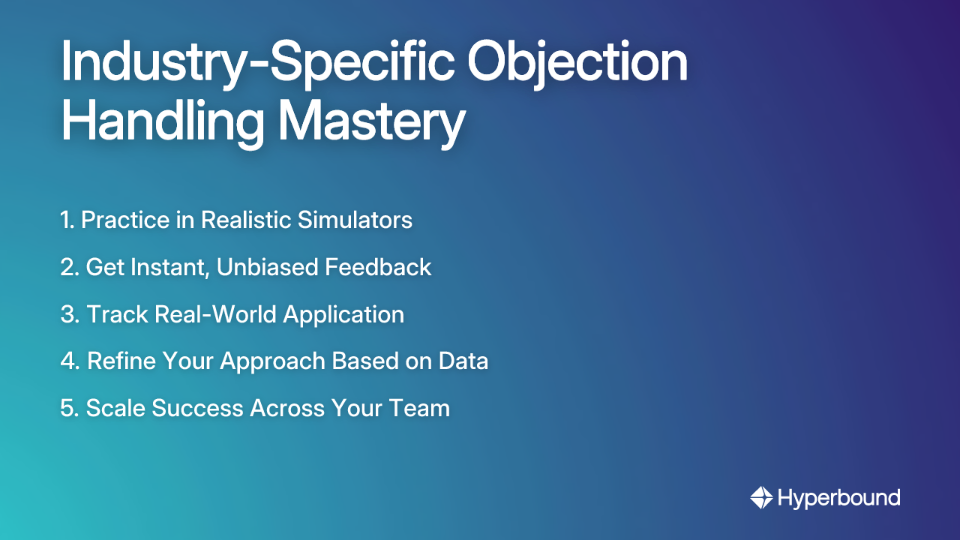
Reading about objection handling is one thing, but performing under pressure is another. Sales reps often worry about their tone of voice and fear that asking clarifying questions will sour the conversation. Consistent practice is the only way to build muscle memory and confidence.
Hyperbound offers an innovative solution with their AI Sales Coaching platform, which creates a risk-free environment to master industry-specific objection handling. Here's a three-step approach to mastery:
- Practice in a Realistic Simulator: Stop using generic scripts. With Hyperbound's AI Sales Roleplays, you can create custom AI buyer personas that mimic the exact challenges of your industry:
- SaaS Rep: Roleplay with an AI CFO who relentlessly questions the ROI and demands a detailed implementation plan.
- Financial Advisor: Practice calming an AI client who is panicking about a market downturn.
- Med-Tech Rep: Face an AI Hospital Administrator who grills you on HIPAA compliance and demands clinical data.
- Get Instant, Unbiased Feedback: After each roleplay, Hyperbound's AI Coaching provides instant, personalized feedback aligned with your company's sales methodology, analyzing talk tracks, word choice, and even helping reps refine their tone of voice.
- Ensure Real-World Application: Take the skills from practice to reality with Hyperbound's AI Real Call Scoring, which can integrate with your call recording systems to automatically score real customer conversations against your industry-specific playbooks.
Objections Aren't Roadblocks, They're Signposts
The difference between a stalled deal and a closed one often comes down to how you handle objections. Generic approaches fail because they ignore the single most important factor: your buyer's industry context.
By understanding the unique pressures and priorities of buyers in SaaS, finance, and healthcare, you can transform objections from deal-breakers into opportunities to build trust and demonstrate value.
Remember, reading about responses to sales objections is just the first step. The next is to put it into practice. Equip your team with the tools to master these critical conversations through consistent, industry-specific practice that builds both confidence and competence.
Frequently Asked Questions
Why do generic objection handling scripts often fail?
Generic scripts fail because they ignore the buyer's industry context, which is the most critical factor in sales. An objection like "it's too expensive" means something different to a SaaS buyer focused on quarterly ROI than it does to a healthcare administrator concerned with patient outcomes. Effective objection handling requires tailoring your response to the specific pressures, priorities, and language of your buyer's industry.
What is the best framework for handling any sales objection?
The best framework is a five-step process that moves from listening to resolving: 1) Acknowledge and Empathize to validate their concern, 2) Pause and Listen to allow them to elaborate, 3) Clarify the Objection to uncover the real issue, 4) Reframe with Value to connect your solution to their pain points, and 5) Validate Their Process to confirm resolution and discuss next steps. This structured approach prevents defensive reactions and builds trust.
How should I handle the "it's too expensive" objection?
You should first clarify what "too expensive" actually means before trying to respond. The real issue is rarely the price itself but rather a concern about value, budget timing, or trust. Ask clarifying questions like, "When you say it's too expensive, could you tell me more about what you mean by that?" Once you understand the root cause, you can reframe the conversation around the value and outcomes your solution provides.
How can I adapt these techniques for an industry not listed here?
The core principles apply to any industry: start by deeply understanding your buyer's context. Research the unique challenges, priorities, compliance requirements, and decision-making processes of their sector. By identifying their primary metrics for success and key stakeholders, you can tailor the universal 5-step framework to address their specific version of common objections.
What's the difference between a true objection and a brush-off?
A true objection is a genuine concern that indicates the buyer is engaged but has a barrier to overcome, such as a question about price or implementation. A brush-off, like "Just send me an email," is often a tactic to end the conversation quickly. The best way to tell the difference is to gently probe using the clarification step. A buyer with a true objection will often elaborate, while someone giving a brush-off will likely disengage.
How can AI help my team get better at handling objections?
AI provides a safe, scalable, and personalized environment for sales reps to practice and master objection handling. AI sales coaching platforms like Hyperbound allow teams to roleplay against custom AI buyer personas that mimic their specific industry challenges. This allows reps to build muscle memory, receive instant, unbiased feedback, and refine their approach without risking live deals, building the confidence needed to handle any real-world objection.
.png)
Book a demo with Hyperbound


