

.png)
Summary
- Reviewing your own sales calls is often ineffective due to personal bias, but tracking key metrics like talk-to-listen ratio and objection handling success is crucial for growth.
- Start by using a simple manual scorecard to systematically analyze your calls, or adopt an AI-powered tool to automate the process and get objective insights at scale.
- The most effective way to improve is to create a continuous loop: use AI call analysis to identify weaknesses and then use targeted AI Sales Roleplays to practice and master those skills.
Ever finished a sales call, tried to review it, and thought to yourself, "I'm biased!"? You're not alone. The struggle to objectively evaluate your own performance is real, and it's holding back your sales growth.
Maybe you've explored call intelligence platforms but felt overwhelmed by the complexity or price tags. Perhaps the idea of manually transcribing every call just to feed it into a GPT tool feels like a non-starter, especially if you're outside the US looking for affordable solutions.
The good news? Call analytics has evolved from an enterprise luxury to an accessible necessity for sales professionals at every level. By moving beyond subjective gut feelings to data-driven insights, you can pinpoint exactly which skills are holding you back and take targeted action to improve them.
In this guide, we'll walk you through how to leverage call analytics effectively—whether you're starting with a simple DIY approach or ready for advanced AI-powered solutions.
Why Manual Call Review Isn't Enough
Before diving into solutions, let's understand why traditional approaches to call review fall short:
The Bias Blindspot: When reviewing our own calls, we're inherently biased. We miss our own filler words, awkward pauses, or flawed objection handling because we know what we meant to say. As one sales rep noted on Reddit, "I thought about [self-review], but I'm biased!"
The Time Sink: Managers are overwhelmed, often able to review only a handful of calls per rep each month. This means feedback is based on a tiny, potentially unrepresentative sample size. Manual scoring is not only subjective but incredibly time-consuming.
Lack of Scalable Data: Without technology, spotting team-wide trends becomes nearly impossible. Are all new reps struggling with the pricing objection? Is a new competitor popping up in conversations? Manual review simply can't detect these patterns.
Inconsistent Feedback: Different managers may score calls differently, leading to contradictory coaching and confusion for reps trying to improve.
The Foundation: Key Metrics to Track in Your Sales Calls
Before using any tool, you need to know what to look for. These metrics are the vital signs of a healthy sales call:
.png)
Talk-to-Listen Ratio
What it is: The ratio of your talking time versus the prospect's.
Why it matters: A high ratio suggests you're monologuing, not discovering. According to research from Analytics-365, top performers maintain a balanced ratio (around 60:40) that fosters rapport and allows them to identify customer needs.
Weak Skill Indicator: Poor discovery skills, lack of active listening, inability to ask effective open-ended questions.
Call Duration
What it is: The average length of your calls.
Why it matters: Context is key. Ideal lengths vary by call type: introductory calls (5-10 minutes), discovery calls (15-30 minutes). Consistently short calls might indicate poor engagement, while overly long calls can signal a lack of control or clear direction.
Weak Skill Indicator: Inability to build rapport (too short) or control the conversation (too long).
Objection Handling
What it is: How effectively you respond to and resolve prospect objections.
Why it matters: This is a critical skill that directly impacts conversion rates. Analytics can track both the frequency of common objections and your success rate in overcoming them.
Weak Skill Indicator: Fumbling responses, giving up too easily, not having prepared talk tracks for common pushback.
Sentiment Analysis
What it is: Using natural language processing to analyze the emotional tone and verbal cues from both you and the prospect throughout the call.
Why it matters: It reveals moments of frustration, excitement, or confusion that might otherwise be missed. A dip in positive sentiment after you mention pricing is a clear signal that your value proposition needs work.
Weak Skill Indicator: Poor rapport-building, inability to de-escalate tension, ineffective value communication.
Conversion Rate & Next Steps
What it is: The percentage of calls that result in a desired outcome (e.g., demo booked, trial started).
Why it matters: This is the ultimate measure of effectiveness. According to Analytics-365, the average conversion rate on qualified leads hovers around 20%. It's crucial that calls end with clear, committed next steps.
Weak Skill Indicator: Weak closing skills, failure to establish value, unclear call-to-action.
A Practical Guide: How to Start Analyzing Your Calls
Now that you know what to look for, let's explore two approaches to implementation: a DIY method for those just starting out, and an automated approach for scaling your analysis.
The Manual Scorecard Method
This approach directly addresses the need for a structured evaluation framework that several sales professionals have requested online.
Step 1: Record Your Calls. Use your dialer, Zoom, or a third-party tool. You can't analyze what you don't capture.
Step 2: Build Your Scorecard. Create a simple spreadsheet with the following categories, scored on a scale of 1-5:
- Opening: Did I clearly state the purpose of the call? Was my tone confident and conversational?
- Discovery: Did I ask open-ended questions? Did I uncover a clear pain point? (Track your talk-to-listen ratio here)
- Pitch/Value Proposition: Did I tailor my pitch to the pain point? Was it concise and compelling?
- Objection Handling: Did I acknowledge the objection before addressing it? Did I use a framework (e.g., Feel, Felt, Found)?
- Closing & Next Steps: Did I ask for a specific next step? Was it time-bound and clearly defined?
Step 3: Review and Score. Listen back to your calls (or have a peer review them) and score honestly. Add notes on specific phrases that worked well or fell flat.
While this method is still somewhat time-consuming and not entirely free from bias, it's a massive step up from no analysis at all. It creates a structured framework to identify patterns in your performance.
The Automated AI-Powered Method
As sales technology has evolved, AI-powered call analysis has become more accessible and sophisticated. Here's how modern tools are transforming the process:
How it Works:
- Speech Recognition & Transcription: Automatically converts audio to text, eliminating the tedious manual transcription that many users dread.
- Natural Language Processing (NLP): Goes beyond words to understand customer sentiment, identify keywords, and measure adherence to proven scripts or methodologies.
The Power of AI Platforms:
Modern platforms solve the core problems of manual review by providing:
- Objective Analysis: Tools like Hyperbound use AI-Powered Scorecards to automatically score calls against your specific methodology, removing personal bias from the equation.
- Time Efficiency: Instead of re-listening to entire calls, you can use AI Deal Summaries to immediately extract key moments, objections, and buying signals. Hyperbound's AI Real Call Scoring capabilities, for example, can analyze 100% of your calls, not just a small sample.
- Data-Driven Insights: These tools identify patterns across your entire team, helping leadership refine sales techniques and playbooks based on what's actually working in the field.
Closing the Loop: From Insights to Actionable Improvement
Finding your weaknesses is only half the battle. The critical question becomes: once you've identified a skill gap, how do you effectively close it?
The Problem with Traditional Practice
Traditional role-playing with a manager is valuable but comes with significant limitations:
- It's infrequent due to manager bandwidth constraints
- It often feels artificial or stilted
- The feedback can be delayed or inconsistent
- It's difficult to practice the same scenario repeatedly to master it
Enter AI-Powered Practice
This is where modern technology offers a compelling solution. Once call analytics identifies that you struggle with, say, handling pricing objections, you need targeted practice opportunities.
Platforms like Hyperbound offer AI Sales Roleplays where you can practice those exact scenarios in a safe, repeatable environment:
- Hyper-Realistic Scenarios: Practice with AI buyer personas that respond dynamically to your talk tracks. Need to get better at discovery calls specifically for your ideal customer profile in the finance industry? There's a simulation for that.
- Instant, Objective Feedback: After each roleplay, you receive immediate scoring and personalized coaching feedback, highlighting what went well and what needs work. This creates a continuous learning loop that doesn't rely solely on manager availability.
- Repetition Without Embarrassment: The beauty of AI practice is that you can fail privately and repeatedly until you master a skill. There's no awkwardness about asking a manager to run through the same objection handling scenario for the fifth time.
This modern approach directly tackles the challenge of scaling effective coaching and can dramatically reduce new hire ramp time.
The Modern Sales Improvement Loop
The new standard for sales skill development isn't a one-time analysis but rather a continuous cycle:
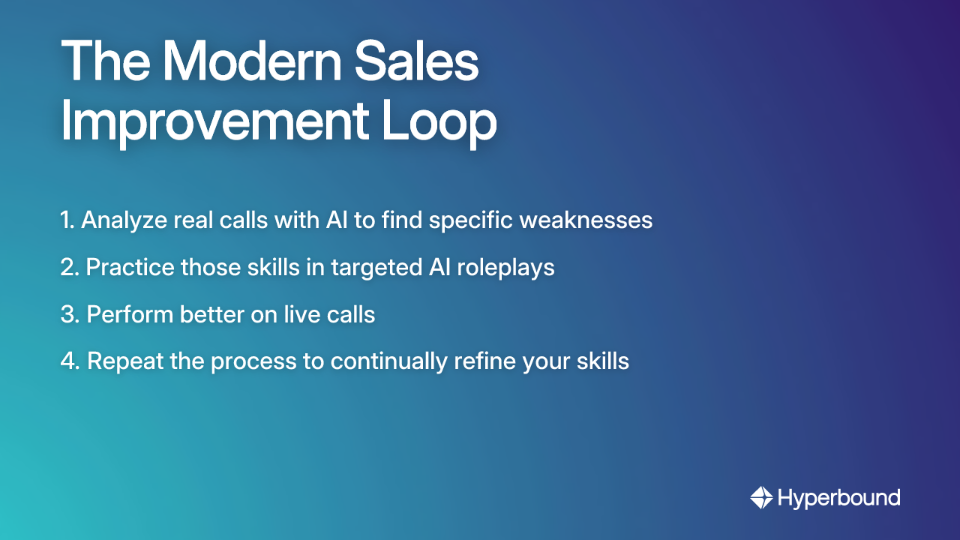
- Analyze real calls with AI to find specific weaknesses
- Practice those skills in targeted AI roleplays
- Perform better on live calls
- Repeat the process to continually refine your skills
This data-driven approach takes the guesswork out of sales coaching and creates a measurable path to improvement.
Conclusion
The days of relying solely on gut feel and biased self-assessment are behind us. Whether you start with a simple DIY scorecard or implement a comprehensive AI-powered solution like Hyperbound, the key is to move from subjective opinions to objective data.
By identifying your specific sales skill gaps through call analytics and closing those gaps through targeted practice, you can transform your performance in measurable ways. The technology to accomplish this is more accessible than ever before, regardless of your location or budget constraints.
Stop guessing where you need improvement. Start measuring, start practicing, and watch your sales results transform.
Frequently Asked Questions
Why is analyzing sales calls important for improving performance?
Analyzing sales calls is crucial because it replaces subjective gut feelings with objective data, revealing specific areas for improvement like objection handling or discovery skills. Without analysis, it's easy to be biased about your own performance and miss repeated mistakes. Data-driven insights pinpoint exact weaknesses, allowing for targeted coaching that leads to faster skill development and better sales outcomes.
What are the most important metrics to track in a sales call?
The most important metrics to track are the talk-to-listen ratio, objection handling effectiveness, sentiment analysis, and whether clear next steps were established. These KPIs provide a comprehensive view of a call's health. A balanced talk-to-listen ratio indicates good discovery, effective objection handling directly impacts conversions, sentiment reveals engagement, and clear next steps are essential for moving a deal forward.
How can I start analyzing my sales calls without an expensive tool?
You can start analyzing your calls by using a manual scorecard method. This involves recording your calls and scoring them against a simple spreadsheet based on key criteria you want to improve. Create a scorecard with categories like Opening, Discovery, Pitch, Objection Handling, and Closing. While not as scalable as AI, this provides a structured framework to begin identifying patterns in your performance.
How does AI improve upon manual call analysis?
AI improves upon manual analysis by eliminating human bias, saving significant time, and providing scalable insights across all calls, not just a small sample. AI platforms automatically transcribe and score 100% of your calls against a consistent rubric, providing completely objective feedback and identifying team-wide trends that are impossible to spot manually.
What is the difference between call analysis and AI sales roleplaying?
Call analysis identifies your weaknesses from real-world conversations, while AI sales roleplaying provides a safe, repeatable environment to practice and improve those specific skills. The two work together in a continuous improvement loop: analysis tells you what to fix, and roleplaying gives you a tool to actively practice that skill with an AI buyer until you master it.
How can AI help with new sales hire ramp-up?
AI significantly shortens new hire ramp-up time by providing immediate, consistent feedback and unlimited practice opportunities, reducing the reliance on limited manager availability. New hires can use AI roleplays to practice core talk tracks and objection handling dozens of times before their first live call, helping them reach full productivity much faster than traditional methods.
Ready to take your sales calls to the next level with AI-powered analysis and practice? Learn more about Hyperbound's AI Sales Coaching platform and discover how it can transform your team's performance through objective call scoring and personalized AI coaching.
Book a demo with Hyperbound


