.png)


.png)
You have hours of call recordings sitting in your CRM. Your reps are having dozens of conversations daily. But are you any closer to understanding the real skill gaps holding your team back?
If you're like most sales leaders, the answer is a frustrating "no." Traditional call reviews are time-consuming, subjective, and fundamentally unscalable. You're left relying on gut instinct rather than data to coach your team.
This is where AI is transforming the sales coaching landscape—turning the art of coaching into a science powered by real evidence rather than intuition.
In this guide, we'll walk through how AI can automatically detect skill gaps across your team's sales calls and, more importantly, how to systematically close those gaps with targeted practice and feedback.
The Limits of Traditional Sales Coaching: Why We Need a New Playbook
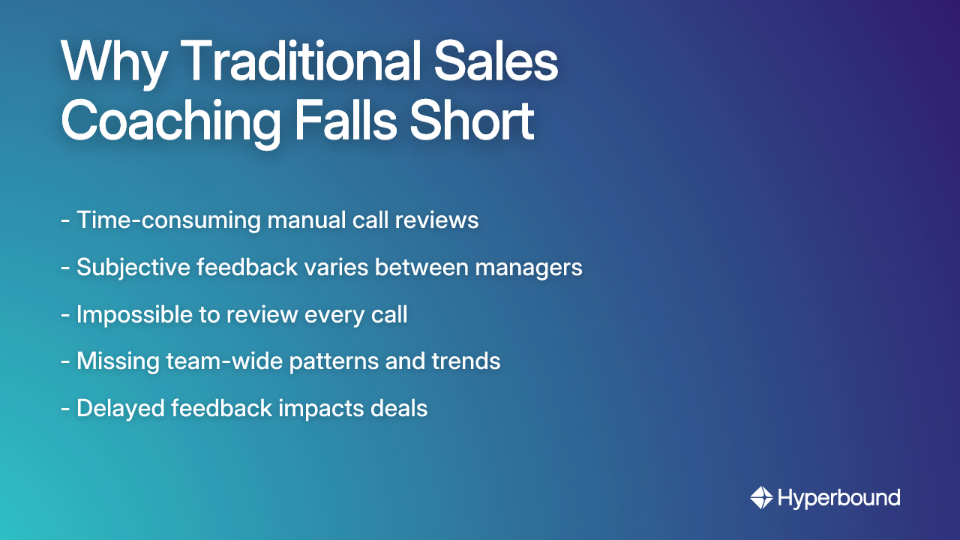
Before diving into AI solutions, let's understand why traditional coaching methods fall short:
Time-Intensive & Unscalable
Even the most dedicated sales manager simply doesn't have the bandwidth to review every call. At best, you might listen to 2-3 calls per rep per week—missing countless coaching moments and delaying critical feedback.
This bandwidth limitation means coaching becomes reactive rather than proactive, with managers only addressing issues after they've impacted deals.
Subjectivity and Inconsistent Feedback
Manual reviews inherently introduce bias. What one manager considers a "good call" might be viewed as a "missed opportunity" by another. This inconsistency creates confusion among reps about what "good" actually looks like.
Missing Systemic, Team-Wide Patterns
When reviewing individual calls in isolation, it's nearly impossible to spot team-wide trends. Are all your reps struggling with the same competitor objection? Is your new messaging falling flat across the board? These patterns remain invisible without analyzing data at scale.
Sales professionals on Reddit highlight this exact pain point: "There's a lack of tools to assess and improve representative skill gaps beyond individual calls."
How AI Dissects Sales Calls to Pinpoint Skill Gaps
AI sales coaching platforms use a combination of Natural Language Processing (NLP) and machine learning to analyze and understand conversations at scale. Here's what happens behind the scenes:
The Core Engine: Conversation Intelligence
Modern AI doesn't just transcribe calls—it understands them. Through advanced NLP, these systems can:
- Analyze Keywords & Talk Tracks: Did your rep mention ROI? Did they use the approved value proposition? AI can track specific phrases and terminology to measure playbook adherence.
- Sentiment Analysis: By analyzing tone, pace, and word choice, AI gauges the emotional temperature of both rep and prospect. This helps identify if a rep is building rapport or creating friction.
- Behavioral Metrics: Beyond what's said, AI examines how it's said—measuring talk-to-listen ratios, monologue duration, interruption frequency, and filler word usage (um's, ah's).
- Automated Call Scoring: Perhaps most importantly, AI can evaluate calls against a predefined scorecard based on your company's sales methodology, generating a consistent, objective performance score for every interaction.
A Step-by-Step Guide to Implementing AI for Skill Gap Analysis
Now let's translate these capabilities into a practical framework for identifying skill gaps across your team:
Step 1: Data Collection & Integration
Start by gathering your existing call recordings. Choose an AI platform that integrates seamlessly with your tech stack (your CRM, dialer, or existing conversation intelligence platform).
This integration is crucial—the system should analyze calls automatically without creating additional work for your team. Proper data collection is the foundation for any effective skill gap analysis.
Step 2: Define Your "Gold Standard"
Before you can spot gaps, you need to establish what "good" looks like. Use the AI to analyze calls from your top performers—the 10% of reps who consistently hit or exceed quota.
The system will identify patterns in their approach:
- What questions do they ask during discovery?
- How do they handle common objections?
- What talk tracks drive the highest close rates?
These insights become the foundation for your custom scorecards and benchmarks.
Step 3: Automated Analysis & Pattern Recognition
Once your benchmarks are set, let the AI analyze 100% of your team's calls. The system will process this data and surface patterns like:
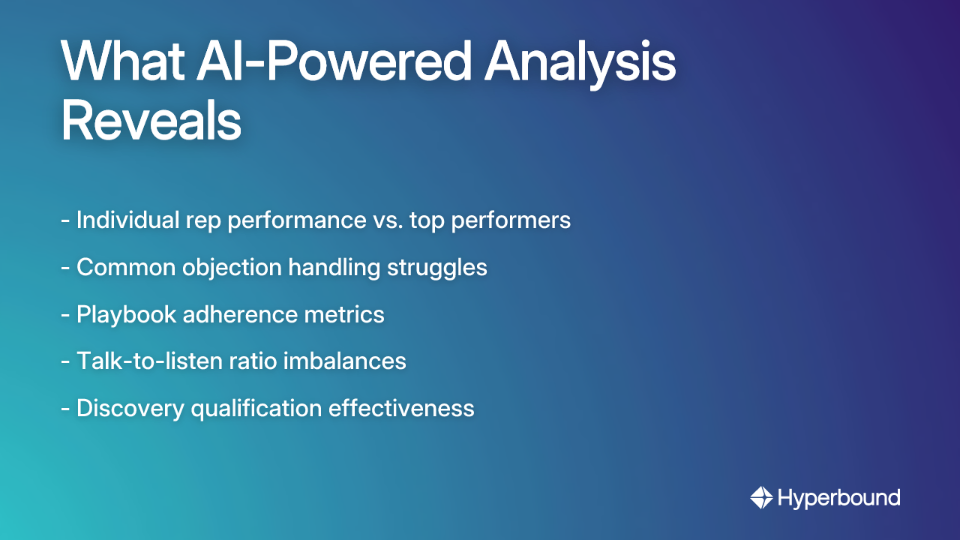
- Skill Disparities: Where do individual reps fall short compared to top performers?
- Common Struggles: What objections or questions consistently trip up your team?
- Methodology Adherence: Is your team executing your sales playbook as designed?
Step 4: From Data to Coaching Plans
The real power of AI is in translating data into actionable coaching plans. Instead of vague feedback like "work on discovery," you get specific insights:
- "John consistently fails to qualify budget on discovery calls"
- "The team's talk-to-listen ratio is 80:20 when it should be closer to 50:50"
- "Only 30% of reps are effectively addressing the new competitor's claims"
This is where platforms like Hyperbound excel. Their AI Real Call Scoring feature automatically creates an AI Deal Summary for each conversation, extracting key moments, objections, and buying signals so managers can review calls in seconds and build targeted coaching plans.
From Detection to Development: Closing Gaps with AI-Powered Practice
Identifying skill gaps is only half the battle. The next challenge is closing them efficiently.
The Problem with Traditional Practice
Traditional role-playing with managers is time-consuming, often feels artificial, and can't be scaled. Reps need a safe, repeatable environment to practice the specific skills they're lacking.
The Solution: AI-Powered Roleplays for Targeted Skill Building
Once a skill gap is identified (e.g., handling pricing objections), you can create specific practice scenarios using AI-powered role-play technology.
For example, Hyperbound's AI Sales Roleplays allow reps to practice with AI buyer personas that respond dynamically and realistically. These virtual customers can be customized to match your Ideal Customer Profile (ICP) and programmed to raise the specific objections your team struggles with.
The key benefits of this approach include:
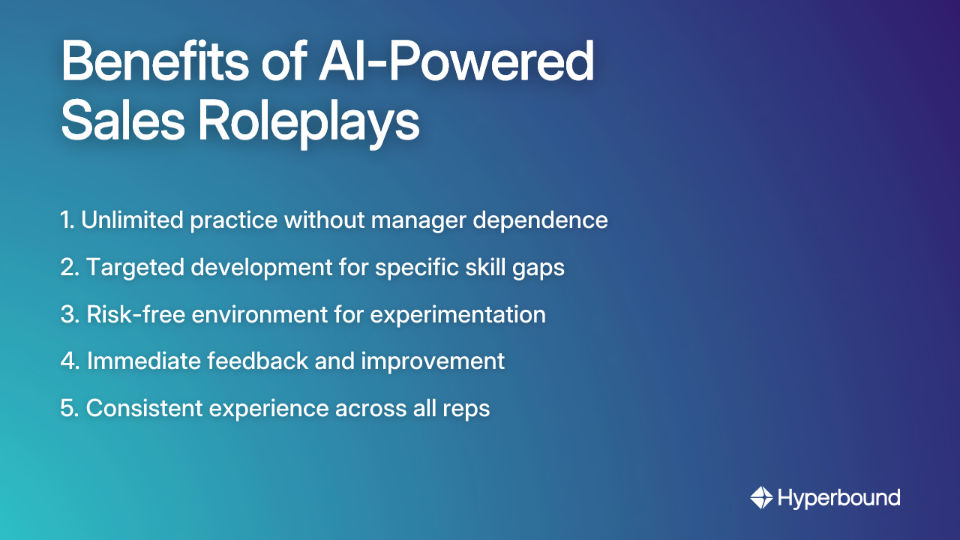
- Unlimited, On-Demand Practice: Reps can practice difficult scenarios repeatedly without waiting for manager availability.
- Targeted Skill Development: Instead of generic training, reps focus on their specific improvement areas.
- Safe Learning Environment: Reps can make mistakes and experiment with new approaches without risking real deals.
Accelerating Learning with Instant Feedback
The power of AI practice comes from the immediate feedback loop it creates. After each roleplay (or real call), AI provides objective feedback via an automated scorecard. It highlights:
- Where the rep went off-script
- Missed discovery questions
- Effective handling of objections
- Areas where they successfully implemented new techniques
This instant feedback is critical for rapid skill development, allowing reps to self-correct without waiting for manager input.
Hyperbound's AI Coaching delivers this personalized feedback aligned with your company's methodology, turning every interaction into a learning opportunity.
Leveraging Game Tapes & Gamified Training
To further accelerate learning, use AI to automatically surface top-performing calls. Share these "game tapes" as best-practice examples for your team.
Many platforms also incorporate leaderboards and scoring to create a competitive, gamified training environment that motivates reps to continually improve their skills.
Avoiding Common Pitfalls (And Addressing the Skepticism)
While AI offers tremendous potential for skill gap detection and coaching, there are pitfalls to avoid:
Pitfall 1: Forgetting the Human Element
Many sales professionals express concern that "AI lacks emotional intelligence" essential to sales. They're right that technology alone isn't enough.
The most effective approach positions AI as a "co-pilot," not a replacement for human coaches. AI handles the data analysis and practice scenarios, freeing managers to focus on strategy, motivation, and the nuanced "art" of sales that technology can't replicate.
Pitfall 2: Data Overload Without Action
Avoid collecting insights without a clear plan for implementation. Focus on improving 1-2 key skills at a time rather than overwhelming reps with feedback on every aspect of their performance.
The biggest failure is neglecting the feedback loop—insights must connect to coaching and practice plans to drive improvement.
Pitfall 3: Lack of Team Buy-In
Ensure there's alignment from leadership down to individual reps. Frame AI coaching not as a "big brother" surveillance system but as a personal performance tool designed to help reps master their craft, hit quotas, and earn more.
The Future of Sales Coaching is Here
AI has transformed sales coaching from a subjective, manual process to a scalable, data-driven system for continuous improvement. It allows you to know—not guess—where your team needs help.
The modern coaching workflow is elegantly simple:
- Analyze all your real calls with AI to automatically identify skill gaps
- Practice with AI roleplays tailored to close those specific gaps
- Measure improvement with objective, data-driven scorecards
Platforms like Hyperbound provide an end-to-end solution, connecting AI Real Call Scoring with AI Sales Roleplays to turn insights into measurable performance improvements.
By implementing this approach, you'll create a continuous improvement cycle that elevates your entire team's performance—transforming B-players into A-players and A-players into sales superstars.
Frequently Asked Questions
What is AI sales coaching?
AI sales coaching is a technology that uses artificial intelligence to analyze sales conversations, automatically identify skill gaps, and provide targeted practice and feedback to help sales representatives improve their performance. Unlike traditional manual reviews, AI platforms can analyze 100% of calls to provide objective, data-driven insights into areas like playbook adherence, objection handling, and talk-to-listen ratios. This allows for a scalable and consistent coaching process across the entire team.
How does AI identify skill gaps from sales calls?
AI identifies skill gaps by using Natural Language Processing (NLP) to analyze call recordings for specific keywords, sentiment, talk patterns, and adherence to a predefined sales methodology. The technology transcribes and dissects every conversation, tracking metrics like talk-to-listen ratios, filler word usage, and whether key value propositions were mentioned. It then compares individual performance against benchmarks set by top-performing reps to pinpoint specific areas for improvement for each team member.
Why is AI coaching more effective than traditional methods?
AI coaching is more effective because it is scalable, objective, and data-driven, overcoming the limitations of time-consuming and subjective manual call reviews. While a manager can only review a few calls per week, AI analyzes every single call, providing immediate feedback and identifying team-wide patterns that would otherwise be missed. This removes manager bias, ensures consistent evaluation, and allows coaching to be proactive rather than reactive.
What are the benefits of using AI for sales roleplays?
The primary benefits of AI-powered sales roleplays are providing a safe, scalable, and on-demand environment for reps to practice specific skills with immediate, objective feedback. Reps can practice handling difficult objections or navigating complex scenarios as many times as they need without requiring a manager's time. This targeted practice helps build muscle memory and confidence in a risk-free setting, leading to faster skill development and better performance on live calls.
Will AI replace human sales managers?
No, AI is not designed to replace human sales managers but to act as a "co-pilot" that enhances their coaching capabilities. AI automates the time-consuming tasks of call analysis and data collection, freeing up managers to focus on high-impact activities like strategic coaching, motivation, and mentoring. The technology provides the data-driven "what," allowing managers to focus on the "why" and the nuanced, human elements of sales.
How can a sales team get started with AI coaching?
To get started, a sales team should integrate an AI coaching platform with their existing CRM or dialer, define what a successful call looks like by analyzing top performers, and then let the AI automatically analyze all calls to surface actionable insights. The first step is data collection. Once the platform is connected, you establish benchmarks (your "gold standard"). The AI then scores calls against these standards and delivers insights through dashboards, which can be used to create personalized coaching and practice plans for each rep.
The question isn't whether you can afford to adopt AI for sales coaching—it's whether you can afford not to while your competitors gain the advantage of data-driven performance improvement.
Book a demo with Hyperbound


