

.png)
Summary
- The optimal talk-to-listen ratio for closing deals is 43% talking and 57% listening, a significant shift from the average rep's 60% talk time.
- Top performers create an interactive dialogue with fewer, higher-quality questions (15-16) rather than interrogating prospects with too many (20+).
- Improve your team's ratio by using AI to establish a baseline, then reinforcing techniques like the "Two-Second Rule" and "Paraphrase & Confirm."
- Manually coaching this is difficult, but an AI Sales Coaching platform can analyze 100% of calls and provide reps with AI roleplays to practice their listening skills.
You're reviewing your sales team's performance data, searching for that elusive pattern that separates your top performers from everyone else. You've listened to dozens of calls, but it's hard to see the forest for the trees. As one sales leader put it, "I am looking for how to improve rep skill gaps not just on a deal or call. Then help me recommend what to change across all rep calls."
What if there was a single metric that could dramatically increase your close rates? According to extensive research spanning millions of sales conversations, there is: the Talk-to-Listen Ratio.
The Gold Standard: Why the 43:57 Talk-to-Listen Ratio Wins Deals
The Talk-to-Listen Ratio (TLR) measures the percentage of time a sales rep spends talking versus listening during a sales conversation. It's a deceptively simple metric with profound implications for your bottom line.
The optimal ratio for success is 43% talking to 57% listening. This isn't just a marginal improvement—it's a game-changer:
- The current average for sales reps is 60% talking and 40% listening
- In closed-won deals, the average improves to 57% talk / 43% listen
- In lost deals, the average jumps to 62% talk
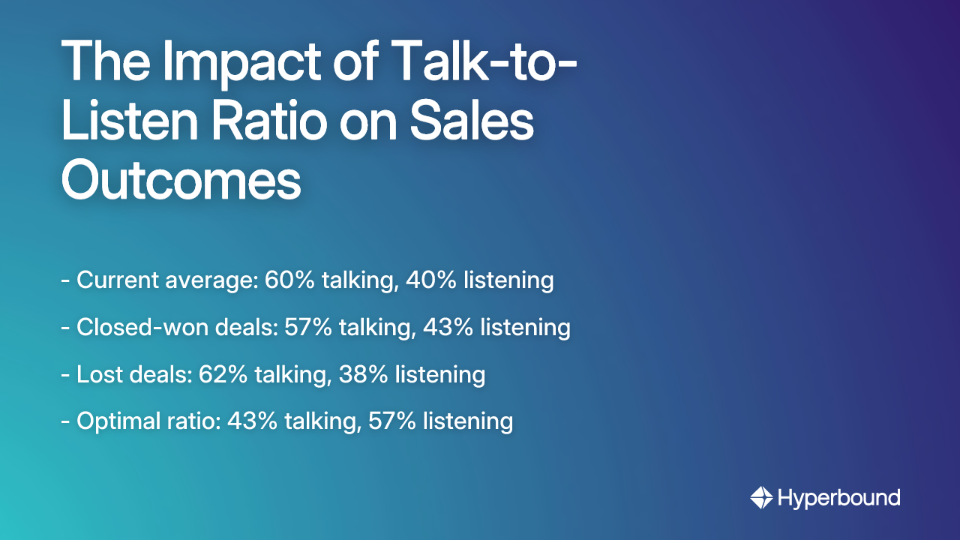
The data is clear: sales professionals who listen more, sell more. But there's a crucial nuance here. It's not just about asking more questions.
In fact, top performers typically ask 15-16 questions per call, while lower-performing reps tend to ask around 20 questions. This counter-intuitive finding reveals that excessive questioning can turn a discovery call into an interrogation rather than a dialogue. Quality trumps quantity.
What really sets winning calls apart is their interactivity. Top performers maintain shorter monologues and foster more back-and-forth conversation, keeping the buyer engaged and creating space for them to fully express their needs and concerns.
The Challenge with Traditional Coaching: Why It's Hard to Fix the Ratio Manually
If improving the Talk-to-Listen Ratio is so important, why isn't every sales team doing it? The answer lies in the limitations of traditional coaching methods:
- Limited sample size: Managers can only review a tiny fraction of calls manually, making it impossible to identify systematic patterns.
- Subjective interpretation: Human coaches bring their own biases to call reviews, leading to inconsistent feedback.
- Delayed feedback: By the time a manager listens to a call and provides coaching, the rep may have had several more conversations, reinforcing problematic habits.
- Fragmented tools and workflows: As one sales professional noted, "The key is to find a solution that connects call analysis, performance metrics, and enablement into one seamless workflow."
Many teams attempt to cobble together solutions, such as "taking a transcript and plugging it into ChatGPT," but as another sales leader admitted, "this is a scrappy and cheap way of doing it." These ad-hoc approaches simply can't scale effectively across an entire sales organization.

A Step-by-Step Guide: Using AI to Master Your Talk-to-Listen Ratio
The good news is that AI-powered tools now provide a scalable, objective solution for improving this critical metric. Here's how to leverage AI feedback to optimize your team's Talk-to-Listen Ratio:
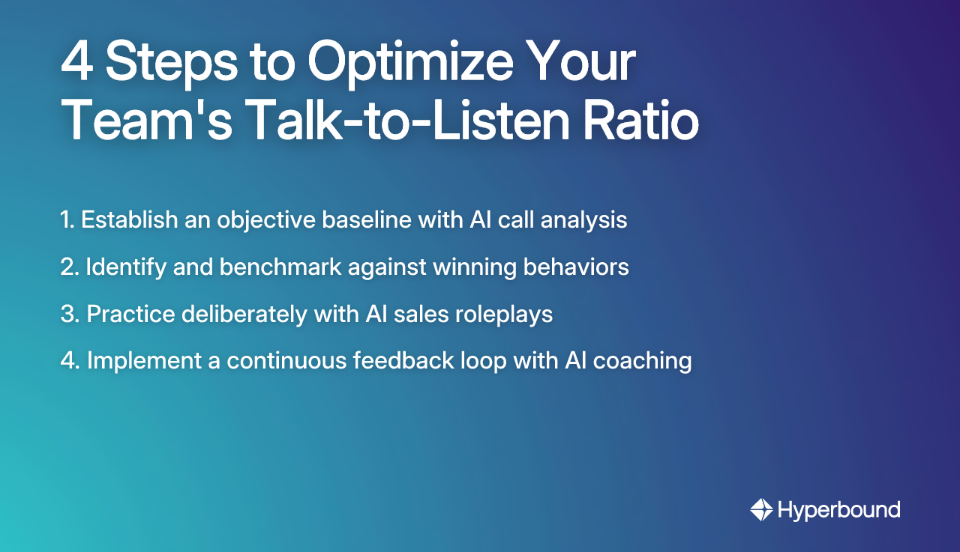
Step 1: Establish an Objective Baseline with AI Call Analysis
First, you need to know where you stand. AI call analysis can process 100% of your sales conversations to provide objective, data-driven metrics on each rep's Talk-to-Listen Ratio.
Unlike manual reviews, AI doesn't get tired, bored, or distracted. It evaluates every conversation with the same level of scrutiny, identifying patterns that might escape even the most attentive manager.
For example, Hyperbound's AI Real Call Scoring automatically analyzes sales conversations and scores them against your custom methodology. It provides an AI Deal Summary that extracts key moments, objections, and buying signals, saving managers countless hours of review time.
"We noticed that many sales teams were struggling with fragmented tools and a lack of clear visibility into what was actually happening across all their calls," explains a Hyperbound user, highlighting how AI solves the fundamental challenge of comprehensive call analysis.
Step 2: Identify and Benchmark Against Winning Behaviors
Once you have baseline data, AI can help you identify what "good" looks like in the context of your specific product and ideal customer profile (ICP).
AI analysis doesn't just give you a number; it surfaces the behaviors of your top reps. You can see exactly what a 43:57 ratio sounds like in actual conversations with your prospects, giving you concrete examples to share with the team.
This benchmarking is crucial because it transforms an abstract goal into tangible, relatable examples. Reps can listen to snippets of successful calls where their colleagues maintained the optimal ratio while effectively moving deals forward.
Hyperbound's AI Coaching facilitates this by surfacing top-performing calls for peer learning, allowing the entire team to learn from the best and see successful techniques in action.
Step 3: Practice Deliberately with AI Sales Roleplays
Knowing your ratio is one thing; changing it is another. This is where AI roleplays become invaluable.
AI-powered roleplays provide a safe, repeatable environment for reps to practice their conversational skills without risking live deals. They can experiment with different approaches, practice active listening techniques, and receive immediate feedback on their Talk-to-Listen Ratio.
Hyperbound's AI Sales Roleplays let reps practice various scenarios—from cold calls and discovery to demos and objection handling—with AI buyer personas that respond dynamically. After each simulation, they receive an objective scorecard that tracks their talk ratio and other key selling moments, creating a gamified learning environment that accelerates skill development.
"You can create scorecards that are aligned with the skills you want your reps to have, ensuring that they are fully analyzed and aligned with your vision," notes one sales leader who implemented AI roleplays as part of their coaching program.
Step 4: Implement a Continuous Feedback Loop with AI Coaching
The final piece of the puzzle is implementing a continuous feedback loop to reinforce good habits and correct problematic ones. AI coaching provides immediate, personalized feedback after each interaction, highlighting moments where the rep dominated the conversation or missed opportunities to listen.
Hyperbound's AI Coaching delivers instant feedback aligned with your company's sales methodology. It helps reps self-correct in real-time, empowering them to own their development and freeing managers to focus on high-level strategy instead of repetitive call reviews.
This approach addresses the pain point expressed by many sales leaders: "I am looking for how to improve rep skill gaps not just on a deal or call. Then help me recommend what to change across all rep calls." AI coaching provides precisely this systematic view, identifying patterns across conversations and recommending specific changes to improve performance across the board.
Putting Theory into Practice: Actionable Techniques Reinforced by AI
While AI provides the infrastructure for improvement, reps still need specific techniques to improve their Talk-to-Listen Ratio. Here are proven approaches that AI can help reinforce:
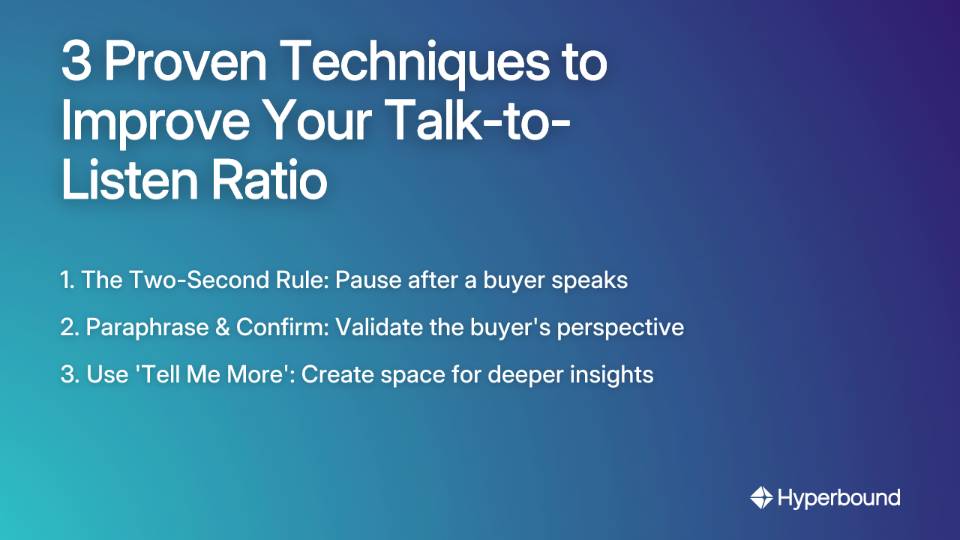
Technique 1: The Two-Second Rule
After a buyer finishes speaking, pause for two full seconds before responding. This simple technique accomplishes two things:
- It ensures you're not interrupting or cutting off the buyer
- The silence often prompts them to elaborate further, revealing additional insights
Sales data shows this technique is particularly effective during discovery calls, where allowing prospects to fully express their pain points is crucial.
AI coaching can track these pauses and provide feedback on how consistently reps apply the Two-Second Rule across their conversations.
Technique 2: Paraphrase & Confirm
One of the most effective ways to demonstrate active listening is to paraphrase what you've heard and confirm your understanding.
For example: "So what I'm hearing is that team efficiency is your top priority, and the current solution is causing bottlenecks in your workflow. Is that right?"
This technique validates the buyer's perspective, ensures you've understood correctly, and naturally increases your listening time while maintaining an interactive dialogue.
AI tools can identify instances of paraphrasing in call transcripts and coach reps to use this technique more effectively.
Technique 3: Use "Tell Me More"
Sometimes the simplest phrases are the most powerful. "Tell me more about that" is a versatile prompt that encourages the buyer to expand on a point without feeling interrogated.
Unlike closed questions that might receive one-word answers, this open invitation creates space for the buyer to share deeper insights, naturally improving your Talk-to-Listen Ratio.
AI coaching can track the use of these and similar phrases, measuring their impact on conversation flow and buyer engagement.
The Future of Sales Conversations: Data-Driven and Buyer-Centric
Optimizing your Talk-to-Listen Ratio isn't just about hitting a number—it's about fundamentally shifting how your team approaches sales conversations. The goal is to create genuine dialogues where prospects feel heard and understood, rather than subjected to a pitch.
By leveraging AI feedback to target the ideal 43:57 ratio, you're embracing a data-driven approach to a deeply human skill: effective conversation.
The benefits extend far beyond individual calls:
- Reduced ramp time: New hires can quickly adopt proven conversational patterns
- Consistent performance: Team-wide adherence to best practices
- Improved metrics: Higher conversion rates and larger deal sizes
- Enhanced buyer experience: Prospects who feel heard are more likely to become loyal customers

As one sales leader put it, "The key is to find a solution that connects call analysis, performance metrics, and enablement into one seamless workflow." AI-powered tools like Hyperbound are making this vision a reality, providing the comprehensive insights needed to transform how sales teams communicate.
By embracing these technologies and techniques, you can help your team master the golden Talk-to-Listen Ratio, turning good conversations into great results.
Frequently Asked Questions
What is the talk-to-listen ratio in sales?
The talk-to-listen ratio (TLR) in sales is a metric that measures the percentage of time a sales representative spends talking compared to the time they spend listening during a conversation with a prospect. It is a key indicator of a rep's ability to engage a buyer, understand their needs, and build the rapport necessary to close deals.
What is the ideal talk-to-listen ratio for closing deals?
The optimal talk-to-listen ratio for closing sales deals is approximately 43% talking and 57% listening. Extensive research on millions of sales calls shows that reps who achieve this balance have significantly higher success rates. This ratio fosters a genuine dialogue, allowing prospects to feel heard and providing the sales rep with deeper insights to tailor their solution.
How can I accurately measure my team's talk-to-listen ratio?
The most accurate and scalable way to measure a team's talk-to-listen ratio is by using AI-powered conversation intelligence platforms. These tools automatically analyze 100% of sales calls and provide objective, data-driven metrics for each representative. This overcomes the limitations of manual call reviews, which are often subjective and cover only a small sample of conversations.
Is talking less always better in a sales call?
Not necessarily; the goal is a balanced conversation, not just silence. While top performers talk less (around 43% of the time), they make their speaking time highly impactful. The quality of interaction is key. For instance, asking too many questions can be counterproductive and turn a call into an interrogation. The focus should be on fostering an interactive dialogue rather than simply reducing talk time.
How can AI help a sales rep improve their listening skills?
AI helps reps improve listening skills by providing a complete feedback and practice loop. First, AI call analysis provides objective data on their current talk-to-listen ratio across all calls. Second, AI coaching identifies specific moments for improvement. Finally, AI sales roleplays offer a safe, repeatable environment to practice active listening techniques and receive immediate feedback without risking live deals.
What are some simple techniques to start improving my talk-to-listen ratio?
Three proven techniques to immediately improve your talk-to-listen ratio are:
- The Two-Second Rule: Pause for two full seconds after a prospect finishes speaking to avoid interrupting and encourage them to elaborate.
- Paraphrase & Confirm: Restate what you heard in your own words (e.g., "So, if I understand correctly...") to show you're listening and ensure alignment.
- Use Open Prompts: Use phrases like "Tell me more about that" to invite deeper insights instead of asking closed questions.
Ready to leverage AI to improve your team's Talk-to-Listen Ratio? Learn more about how Hyperbound's AI Sales Coaching platform can help you analyze conversations, practice key scenarios, and deliver personalized feedback at scale.
Book a demo with Hyperbound


