.png)


.png)
You're sitting on a goldmine of coaching material, but it's buried under an avalanche of data. From NPS surveys and support tickets to call recordings and CRM notes, many sales leaders feel "overwhelmed by the volume of feedback, making it difficult to extract actionable insights," as one manager on Reddit put it.
This is a massive missed opportunity. According to research from Korn Ferry, companies with consistent sales coaching see 32% higher win rates and 28% higher quota attainment. Your customer feedback is the cheat code to achieving these results—if you know how to transform it into targeted coaching prompts that prepare your reps for real-world conversations.
This article will provide a practical, 4-step framework to systematically analyze customer feedback and convert it into powerful coaching opportunities that drive performance.
Why Most Sales Teams Fail to Leverage Customer Feedback for Coaching
Before we dive into the solution, let's understand why this goldmine often remains untapped:
Data Overload & Analysis Paralysis
The sheer volume and disparate sources of feedback make manual analysis a "time-consuming process." As one product manager noted, "It took way too much time pulling all the data together and dumping it in over and over whenever we wanted to look at it."
Lack of a Consistent Process
A staggering 80% of sales leaders admit they lack a consistent coaching process. Without a system, feedback remains as raw data instead of becoming coaching intelligence.
Survivorship Bias
Teams often only analyze feedback from current, happy customers. The real gold is in understanding why deals were lost or why customers churned. Forbes recommends asking former customers why they left to "uncover opportunities for improvement."
Generic Coaching
Without data-driven insights, coaching defaults to generic advice ("be more confident," "ask more questions") instead of focusing on specific, impactful sales behaviors.
The 4-Step Framework for Converting Feedback into Coaching Gold
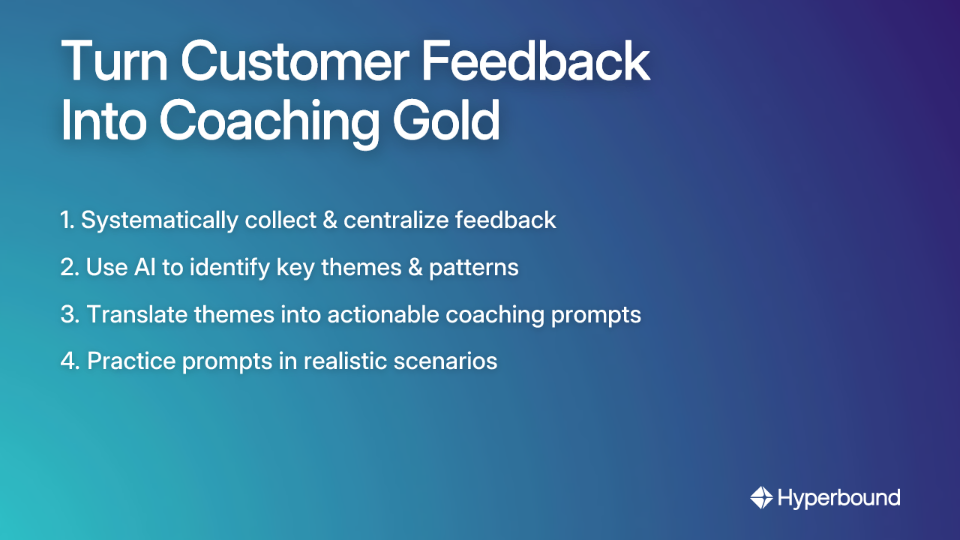
Step 1: Systematically Collect & Centralize Your Feedback
Start by identifying and consolidating your feedback sources:
- Call recordings (from your sales engagement or conversation intelligence platform)
- CRM notes (lost/won reasons)
- NPS surveys and customer reviews
- Support tickets and CSM interactions
- Customer interviews (transcripts)
The key is breaking down data silos. While manual consolidation is possible, specialized tools can automate this process and save significant time.
Step 2: Use AI to Identify Key Themes and Behavioral Patterns
This is where modern AI tools shine. As one Reddit user noted, "you'd be shocked at how good ChatGPT is at organizing the feedback." Instead of manually sifting through hundreds of customer interactions, leverage AI to extract patterns.
Actionable Tip: To get started, use a tool like ChatGPT. Take transcripts from 10-15 recent sales calls and use the following prompt:
"Identify trends in our customer feedback by analyzing these call transcripts. Focus on sales-related topics. List the top 3-5 recurring objections, points of confusion about our value proposition, and features that generated the most excitement. For each point, provide a direct quote from the transcript."
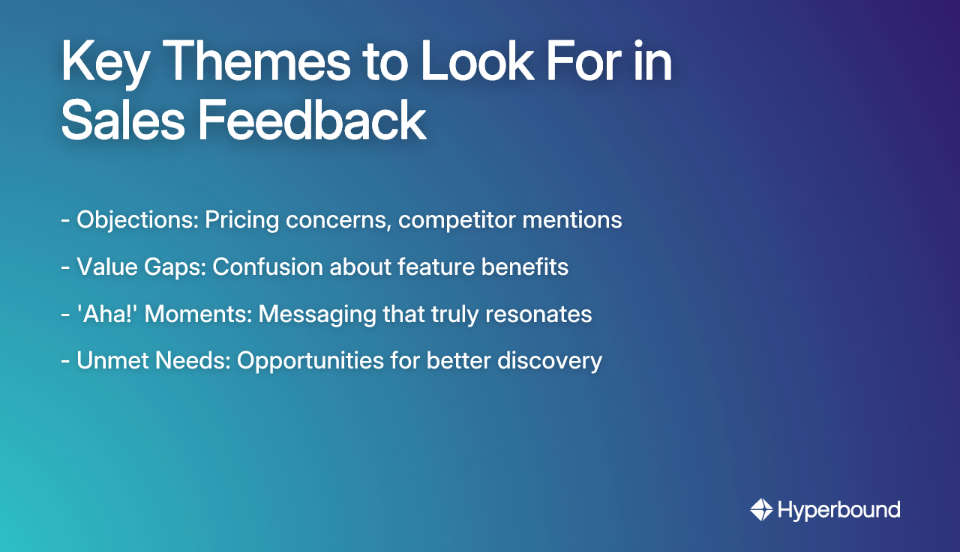
When analyzing feedback, look for these key themes:
- Objections: Pricing concerns, competitor mentions, implementation fears
- Value Gaps: Customer confusion about how specific features solve their problems
- "Aha!" Moments: Positive feedback highlighting what messaging truly resonates
- Unmet Needs: Feature requests that signal opportunities for better discovery questions
Step 3: Translate Themes into Specific, Actionable Coaching Prompts
This is the critical step where most organizations falter. A theme is just an observation; a prompt is a directive for practice. Let's see how to convert common feedback themes into coaching gold:
Scenario 1: Handling a Pricing Objection
- Theme Identified: "Multiple prospects mentioned our solution is 20% more expensive than Competitor X."
- Weak Coaching: "You need to get better at handling price objections."
- Actionable Coaching Prompt: "Let's roleplay this scenario: The prospect says, 'Your price is too high.' Instead of defending the price, I want you to practice pivoting to value. Acknowledge their concern, then ask, 'Putting price aside for one moment, what would be the financial impact on your business if you could solve [problem our solution solves] in the next six months?'"
Scenario 2: Clarifying Value Proposition
- Theme Identified: "Customers don't understand how our 'Dynamic Reporting' feature differs from basic analytics."
- Actionable Coaching Prompt: "In your next demo, when you introduce Dynamic Reporting, use this specific analogy: 'Think of basic analytics as a snapshot photo, while our Dynamic Reporting is like a full-length movie that shows you the story of your data over time.' Let's practice delivering this line."
Step 4: Practice the Prompts in Realistic Scenarios
Creating prompts is only half the battle. Reps need a safe, repeatable environment to practice these scenarios.
Traditional methods include manager-led role-plays and peer coaching, which are valuable but come with limitations:
- Managers have limited time for one-on-one coaching
- Feedback may be inconsistent across different coaches
- It's difficult to scale across large or distributed teams
- There's no objective way to measure improvement
This is where technology becomes essential for making your feedback-driven coaching program scalable and sustainable.
Delivering Feedback-Driven Coaching at Scale with AI
The scalability challenge is real: one-on-one role-playing for every feedback-driven prompt is impossible for busy managers. This is where AI transforms the process from a manual effort into a scalable program.
A platform like Hyperbound becomes a game-changer in this context. Instead of just writing down prompts, you can turn them into interactive, AI-powered roleplay simulations that your entire team can access on-demand.
Remember that pricing objection prompt we created in Step 3? You can build it into a Hyperbound AI Sales Roleplay. Your reps can practice navigating that exact conversation with an AI buyer persona that is programmed to push back on price, providing a realistic and risk-free environment to master the skill.
This creates a virtuous cycle:
- Analyze Real Calls: Use Hyperbound's AI Real Call Scoring to automatically analyze thousands of real customer conversations and surface key themes (objections, competitor mentions) without manual effort. The AI automatically scores calls against custom methodologies and provides an AI Deal Summary to save managers hours of review time.
- Create AI Roleplays: Turn these data-driven insights into customizable scenarios for reps to practice repeatedly.
- Provide Instant Feedback: After each roleplay, reps receive instant, personalized feedback from Hyperbound's AI Coaching, which is aligned with your company's methodology. This identifies missed opportunities and weak responses in real-time, allowing reps to self-correct and improve continuously without waiting for a manager.
The Tangible Impact of a Feedback-Driven Coaching Culture
When you successfully implement this framework, the results can be transformative:
Drastically Reduce Ramp Time: New hires aren't practicing generic pitches; they're training on the real objections and questions they'll face from day one. AI-powered feedback can help new hires increase productivity 15-20% faster, according to Revenue.io.
Boost Win Rates and Quota Attainment: Reps who have practiced handling the top 5 real-world objections are better prepared to win deals. This leads to the 10-15% boost in close rates that effective coaching provides.
Empower Managers to be Strategic Coaches: By automating call analysis and providing reps with self-serve practice tools, managers are freed up to focus on high-level strategy, deal coaching, and career development. According to the Salesforce State of Sales report, improving training is the #1 growth tactic for sales leaders. AI makes this scalable.
Conclusion: Start Small, Think Big
Stop treating customer feedback as a reactive tool for the product team. Start using it proactively as your most powerful asset for sales coaching.
To recap our 4-step framework:
- Collect feedback from all sources.
- Analyze for key themes and patterns (using AI to accelerate).
- Translate themes into specific, actionable coaching prompts.
- Practice these prompts at scale in realistic AI roleplay scenarios.
You don't need a massive project to start. This week, pull the transcripts from five lost deals. Find one recurring reason for the loss, craft a single coaching prompt to address it, and run a roleplay session with your team. The journey to a data-driven coaching culture starts with one prompt.
By systematically turning customer feedback into coaching opportunities, you'll not only improve your sales performance but also create a culture of continuous learning that keeps your team ahead of the competition.
Book a demo with Hyperbound


