.png)


.png)
Summary
- Many sales teams face a coaching bottleneck, with 45% of managers spending less than an hour per week on training, which slows new hire ramp time and creates inconsistent performance.
- A scalable training program moves beyond manager dependency by establishing peer-to-peer learning, creating a self-service knowledge hub, and segmenting training by role.
- AI-powered tools are a force multiplier, automating call reviews and providing reps with unlimited, on-demand practice and instant, objective feedback.
- AI Sales Roleplays from Hyperbound allow reps to practice critical conversations safely, ensuring they are prepared for real-world scenarios without draining manager resources.
You've built a growing sales team, but your management resources haven't kept pace. Your handful of sales managers are stretched impossibly thin, trying to coach dozens of reps while still hitting their own numbers. Meanwhile, new hires are waiting weeks for meaningful feedback, tenured reps are developing bad habits, and your carefully crafted sales methodology is being inconsistently applied.
The painful truth is that you're not alone. According to one report, 45% of sales managers spend a mere 30-60 minutes per week training their reps—nowhere near enough to drive consistent performance or accelerate ramp times.
As one frustrated sales professional put it on Reddit, "I've always been disappointed by the lack of sales training at companies I've worked at. It tends to just be recorded product demonstrations with no real selling experience involved."
This management bottleneck creates a cascade of problems:
- Painfully slow ramp times for new hires
- Inconsistent performance across teams
- Burned-out managers juggling coaching with their own quotas
- Lost deals due to unprepared reps
The good news? A shortage of managers doesn't have to mean a shortage of effective training. By building a scalable coaching system, you can deliver consistent, high-quality training to every rep—regardless of your management bandwidth.
In this article, we'll show you how to break free from the manager-dependent training model and build a system that scales.
The Foundation: 3 Pillars of a Scalable Training Program
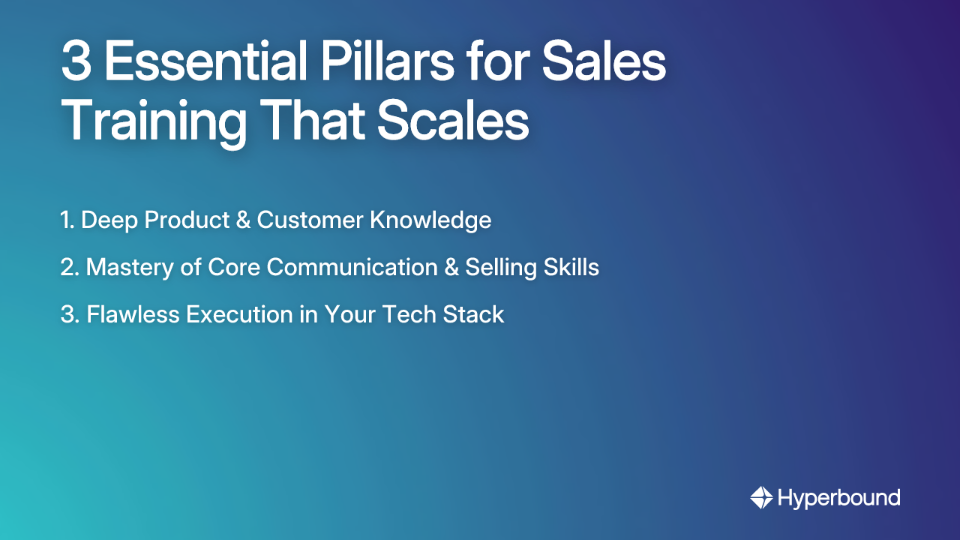
Before we dive into how to deliver training without enough managers, let's clarify what you need to teach. A comprehensive sales training program must cover these three essential pillars:
Pillar 1: Deep Product & Customer Knowledge
Training must go beyond features to focus on how your product solves specific customer problems. As one sales professional aptly put it, "Solve problems, don't sell features."
Your reps need to understand:
- Your customers' pain points and how your solution addresses them
- Which features matter most for different customer segments
- How your product compares to competitors
- Common objections and how to handle them
This matters tremendously to your customers. A Salesforce report notes that 66% of customers expect businesses to understand their unique needs and expectations.
Resource Tip: Create concise product knowledge guides that focus on customer problems and solutions, not just feature lists. Include competitive battle cards that highlight your unique advantages.
Pillar 2: Mastery of Core Communication & Selling Skills
Even the best product knowledge is useless without the ability to communicate effectively. Your training must develop these fundamental skills:
Active Listening: Train reps to listen more than they speak. As one Reddit user noted, "People buy off of emotions and it's important to build rapport." Active listening builds that emotional connection.
Objection Handling & Confident Speaking: Many reps struggle with "maintaining a confident demeanor during sales interactions." Regular practice handling tough conversations builds the confidence needed to be assertive without being aggressive.
Effective Outreach: Teach reps to craft concise, high-impact messages. One sales professional advised, "Initial emails should be no more than 4 sentences" and should always "suggest actionable next steps."
Pillar 3: Flawless Execution in Your Tech Stack
CRM discipline is non-negotiable. As one sales rep bluntly put it: "Keeping CRM notes up to date is underrated and many people neglect this. You are hurting your future self by not keeping decent notes."
Your training must ensure reps:
- Consistently log activities and notes after every interaction
- Understand how to use your tech stack efficiently
- Follow your sales process in the CRM
As another rep advised: "Nobody ever got in trouble for writing too many notes in the CRM."
Scaling Coaching Beyond Managers: Actionable Strategies
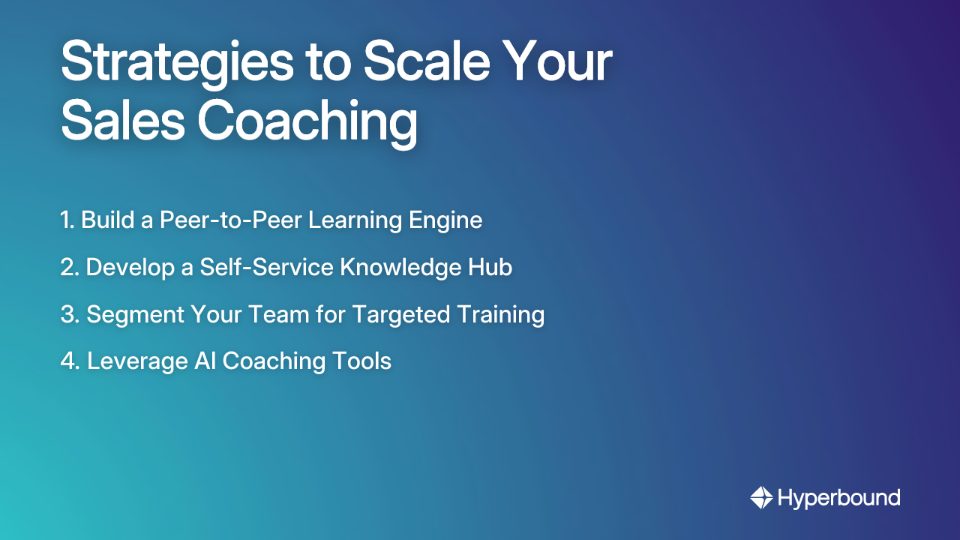
Now that we've covered what to teach, let's explore how to deliver this training without relying solely on managers. These strategies create a self-sustaining learning environment that amplifies your limited management resources.
Strategy 1: Build a Peer-to-Peer Learning Engine
Your best untapped training resource is sitting right in your sales bullpen: your own reps. High performers can significantly lighten the coaching load when you implement a structured peer learning program.
Structured Call Shadowing: Pair new reps with top performers for regular call shadowing sessions. The key is to make this structured, not ad hoc. After each shadowing session, have a brief debrief where the rookie asks questions and the veteran explains their approach.
Curate a Call Library: Create a "greatest hits" collection of recorded calls in a shared drive. Include examples of:
- Outstanding discovery calls
- Masterful objection handling
- Successful closing conversations
- Even failed calls as learning opportunities
This provides the "real selling experience" that so many training programs lack. It's also available on-demand, without requiring a manager's presence.
Peer Role-Play Sessions: Schedule regular sessions where reps practice specific scenarios with each other. For example, when you launch a new product or face a new competitor, have reps take turns playing the customer and salesperson, focusing on the most challenging aspects of the conversation.
Strategy 2: Develop a Self-Service Knowledge Hub
A centralized, well-organized knowledge base dramatically reduces the "where do I find X?" questions that consume managers' time.
Create a single source of truth for all sales materials:
- Sales playbooks and scripts
- Product documentation
- Call recordings library
- Competitive battle cards
- Objection handling guides
- FAQ documents
Tools like Notion, Confluence, or even a well-organized Google Drive can serve as your knowledge hub. The key is consistent organization and regular updates.
Pro Tip: Assign ownership of different sections to team members. This distributes the maintenance workload and gives reps a sense of ownership in the training process.
Strategy 3: Segment Your Team for Targeted Training
A one-size-fits-all approach to training is destined to fail. To be effective, you must divide your team by expertise, roles, and unique needs to tailor coaching effectively.
Create distinct learning paths for:
- New hires (focus on product knowledge and basic skills)
- Tenured AEs (advanced objection handling and closing techniques)
- SDRs (prospecting and qualification skills)
This ensures training is relevant and addresses the pain point that training is often aimed at the "lowest common denominator."
The Ultimate Force Multiplier: How AI Bridges the Coaching Gap
While the strategies above will help you scale your training efforts, there's a revolutionary force multiplier that can truly transform how you coach: artificial intelligence.
AI coaching platforms are no longer futuristic concepts—they're practical tools being adopted by forward-thinking sales organizations. According to Salesforce, 83% of sales teams using AI saw revenue growth, compared to just 66% of teams not using it.
Here's how AI can help bridge your coaching gap:
AI-Powered Roleplays: Practice On Demand
One of the biggest training bottlenecks is providing enough practice opportunities. Managers simply don't have time to roleplay with every rep on every scenario.
AI roleplay platforms like Hyperbound's AI Sales Roleplays solve this by allowing reps to practice any scenario—from cold calls and discovery to demos and renewals—with hyper-realistic AI buyer personas that respond dynamically.
This provides "unlimited, risk-free practice... scaling coaching beyond manager availability." Reps can practice dozens of times, refining their pitch and building confidence without risking a live deal or waiting for a manager's availability.
Instant, Objective Feedback at Scale
Another challenge is providing consistent, objective feedback. Managers often have different coaching styles and criteria, leading to inconsistent development across the team.
Advanced AI coaching tools like Hyperbound's AI Coaching provide immediate, personalized feedback after every practice session or real call. The AI uses scorecards to analyze performance against your specific methodology, tracking metrics like:
- Talk-to-listen ratios
- Questions asked
- Key messages delivered
- Objections handled
This delivers "instant, personalized feedback on every call, enabling reps to self-correct" without waiting for a manager's review.
Automate Call Reviews to Free Up Managers
Perhaps the biggest time drain for sales managers is manually reviewing calls. This task, while valuable, simply doesn't scale.
AI call scoring technology like Hyperbound's AI Real Call Scoring automates this process. It analyzes real customer conversations, scores them against your playbook, and surfaces key coaching moments.
This "automates call review and QA, providing data-driven insights... without manual effort." Managers can then focus their limited time on strategic coaching conversations rather than basic call reviews.
Scale Your Methodology Consistently
When you're short on managers, it's challenging to ensure your sales methodology is consistently applied across the team. Some reps get thorough training, while others receive the bare minimum.
AI coaching platforms can enforce methodological consistency by analyzing calls against your specific framework and playbooks. This ensures every rep, regardless of their manager's bandwidth, receives guidance aligned with your sales approach.
Putting It All Together: Your Action Plan
A lack of managers doesn't have to mean a lack of coaching. Here's a practical action plan to implement these strategies:
- Build Your Foundation (Weeks 1-2)
- Document your core training curriculum across the three pillars
- Create your centralized knowledge hub
- Identify your top performers who can participate in peer coaching
- Launch Your Peer Learning Program (Weeks 3-4)
- Implement structured call shadowing
- Begin building your call recording library
- Schedule regular peer roleplay sessions
- Implement AI Coaching (Weeks 5-8)
- Implement an AI coaching platform like Hyperbound.
- Start with one use case (e.g., discovery calls or objection handling).
- Train your team on how to use the AI tools effectively.
- Measure and Refine (Ongoing)
- Track key metrics: ramp time, conversion rates, win rates
- Gather feedback from reps on the training program
- Continuously update your knowledge base with new materials
Conclusion: The New Competitive Edge
The shortage of sales managers is a reality for many growing companies, but it doesn't have to limit your team's development. By building a scalable training system that combines peer learning, self-service resources, and AI-powered coaching, you can deliver consistent, high-quality training to every rep—regardless of your management bandwidth.
Companies that successfully scale their coaching will gain a significant competitive advantage: faster ramp times, more consistent performance, and higher win rates. They'll also create a more fulfilling work environment where reps feel supported in their development journey.
As you implement these strategies, remember that the goal isn't to replace your managers, but to amplify their impact. By offloading repetitive coaching tasks to peers and AI tools, you free up your limited management resources to focus on what they do best: providing strategic guidance and personalized mentorship.

In today's competitive sales landscape, the ability to scale coaching effectively isn't just a nice-to-have—it's a critical capability that can determine whether your sales organization thrives or merely survives. With the right approach and tools, you can turn your management shortage into an opportunity to build a more resilient, high-performing sales team.
Book a demo with Hyperbound


