.png)


.png)
Summary
- Traditional sales onboarding is slow, taking 3-9 months to ramp new reps and contributing to nearly 50% of them quitting due to insufficient training.
- Shift from passive information dumps to a two-week, practice-focused bootcamp model to get new hires conversation-ready and generating revenue faster.
- Focus on high-volume repetition and real-world simulations in a safe-to-fail environment to build conversational muscle memory and confidence.
- Utilize platforms with AI Sales Roleplays to provide reps with unlimited practice and instant, personalized feedback, accelerating skill development without manager bottlenecks.
You've just hired a promising new sales rep. They show up on day one pumped and full of energy. Then you hand them a 40-page onboarding doc and a playlist of training videos... and watch their enthusiasm visibly deflate.
Sound familiar?
The traditional sales onboarding process is fundamentally broken. The sales training market is worth nearly $4.6 billion, yet the average Account Executive still takes 3.6 to 5.3 months to become fully productive. In some organizations, ramp times stretch from 3 to 9 months depending on sales cycle complexity.
This isn't just a delay—it's lost revenue, missed quotas, and higher attrition. Nearly 50% of new salespeople quit due to insufficient onboarding.
But what if you could get new reps conversation-ready in just two weeks?
This isn't about cramming three months of information into ten days. It's about a strategic shift from passive knowledge transfer to active skill acquisition through a structured, tech-enabled bootcamp. The goal isn't creating product experts overnight—it's equipping reps with the core skills and confidence to handle their first conversations effectively.
The Mindset Shift: From Information Dump to a "First Conversation" Focus
The Old Way is Broken
The traditional approach—overwhelming new hires with product specs, company history, and fragmented training resources—creates a significant gap between training theory and real-world scenarios.
As one sales leader put it on Reddit: "New hires usually show up pumped, full of energy… but when you hand them a 40-page onboarding doc or training videos, their enthusiasm is gone."
The New Way: The Two-Week Bootcamp Model
The two-week bootcamp prioritizes doing over knowing. Yes, sales is "learn on the job," but we can provide a structured, safe environment to do so. The focus is on practical application, not memorization.
Companies with effective sales enablement programs see 32% higher team quota attainment and 23% higher lead conversion rates. Here's how to achieve this with a two-week framework:
Week 1: Building the Foundational Framework (Days 1-5)
Goal for Week 1: Immerse new reps in critical knowledge and immediately transition them to active learning.
Days 1-2: Core Knowledge Immersion
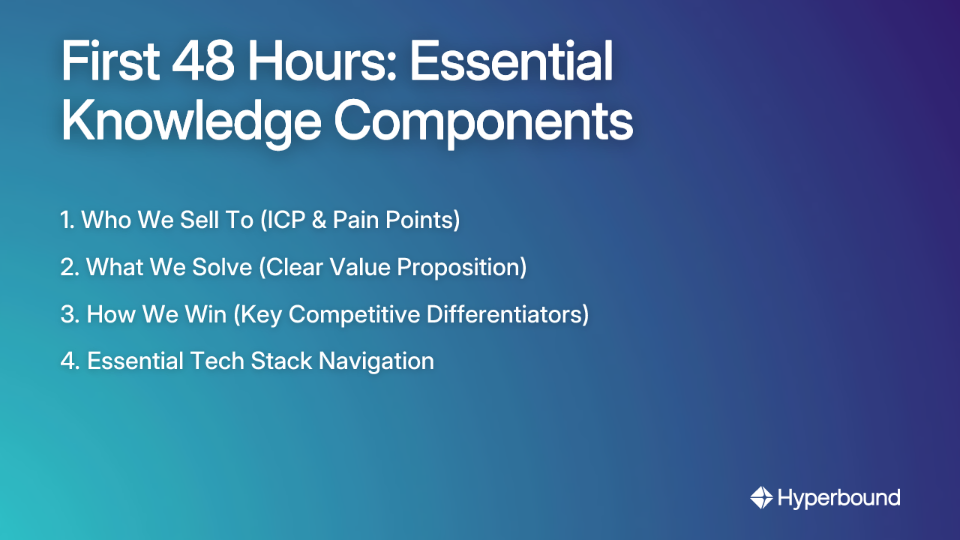
- Who We Sell To (ICP): Deep dive into your Ideal Customer Profile. Focus on their biggest pains, motivations, and the language they use. Avoid internal jargon.
- What We Solve (Value Proposition): Arm reps with a concise 30-second elevator pitch and the top 3-5 value props that directly address ICP pains.
- How We Win (Competitive Landscape): Provide a simple one-pager on the top 2-3 competitors and your key differentiators.
- The Essential Tech Stack: Introduce the CRM not as a compliance tool, but as a "co-seller" that helps them win deals. Provide a checklist for the core functions they'll use daily.
Days 3-5: From Passive Learning to Active Practice
- Listen to the Masters: Instead of generic training videos, curate playlists of real calls from top performers, categorized by call type (cold call, discovery, demo). This approach has been highlighted in sales forums as significantly more engaging than traditional onboarding materials.
- Deconstruct the Playbook: Break down the core talk tracks for cold calling, discovery questions, and handling the top 5 most common objections.
- Introduce Risk-Free Practice: This is where reps stop listening and start doing. Introduce them to a safe-to-fail environment.
- Tools like Hyperbound's AI Sales Roleplays allow reps to practice critical conversations—from cold calls to objection handling—with AI buyer personas that respond dynamically. This provides a safe, repeatable environment to build muscle memory without risking live deals.
Week 2: High-Volume Repetition & Real-World Simulation (Days 6-10)
Goal for Week 2: Build confidence and conversational agility through high-volume, scenario-based practice with instant feedback.
Days 6-8: Mastering Core Scenarios
- The Power of Repetition: This week should be 80% practice, 20% theory. The focus is on volume to make the talk tracks second nature.
- Advanced Role-Playing: Move beyond basic scripts to simulate more complex scenarios.
- With AI-powered platforms, you can tailor roleplays to specific ICPs, products, and sales methodologies. This allows reps to practice handling competitor mentions, navigating conversations with different personas (e.g., the economic buyer vs. the end-user), and mastering discovery questions.
- The Instant Feedback Loop: The key to rapid improvement is shortening the feedback loop from days or weeks to seconds.
- Waiting for a manager's 1:1 is a bottleneck. AI coaching delivers instant, personalized feedback after each interaction, allowing reps to self-correct in real-time.
- For example, Hyperbound's AI Coaching analyzes talk ratios, keyword usage, and adherence to methodology, taking the guesswork out of performance review.
.png)
Days 9-10: Fine-Tuning and "Certification"
- Live Call Shadowing: Have reps shadow high-performing team members on live calls, but with a specific checklist of things to look for based on their training.
- Manager Coaching Evolution: With AI handling the repetitive, foundational feedback, managers can focus their 1:1 time on strategic coaching. They can review AI-surfaced "coachable moments" from roleplays and real calls.
- Final Certification: Before "graduating," have each rep successfully complete a series of challenging roleplay scenarios that test their ability on core competencies like the elevator pitch, handling tough objections, and setting a next step.
Beyond Two Weeks: Maintaining Momentum and Driving Performance
This two-week bootcamp is designed to make reps conversation-ready, not quota-crushing. The foundation is laid, but continuous improvement is key.
A Culture of Continuous Practice
Encourage reps to use AI roleplays for pre-call preparation, practicing tough objections, or warming up before a block of cold calls.
Build a library of best-practice calls using AI call scoring technology, which can automatically evaluate real calls against your custom methodology and surface top-performing examples for peer learning.
As one sales leader on Reddit noted: "They constantly improve with AI coaching that provides new reps with feedback from their very first call."
Data-Driven, Ongoing Coaching
Use analytics to track individual and team progress, identify systemic skill gaps, and tailor future training.
Organizations leveraging this modern, AI-driven approach have seen impressive results. For example, GetAccept partnered with Hyperbound and achieved a 50% faster ramp-up for new sales reps.
From Two Months to Two Weeks
Compressing sales ramp time is possible by fundamentally shifting the onboarding philosophy from passive learning to active, simulated practice.
The formula is straightforward:
- A structured plan focused on core skills
- High-volume repetition in a safe-to-fail environment
- Leveraging AI to provide scalable, instant feedback
This approach addresses the key pain point expressed by a new hire on Reddit: "I learn optimally when following a structured routine and while many are available, many are also scams or charge way too much for their worth."
By implementing this two-week framework, you're not just accelerating ramp time—you're also addressing the concerns that lead to that troubling 50% attrition rate among new sales hires.
As another sales leader noted: "If onboarding takes 4 weeks and the company's usual sales cycle is 4-6 months and Ramp-up is just 90 days, the new hire is disadvantaged from the start and has not been set up to be successful."
The modern sales organization can't afford to wait months for new hires to become productive. With the right structure, technology, and focus on active learning, you can get your new reps having valuable customer conversations in just two weeks.
Ready to stop losing revenue to slow ramp times? Consider how AI-driven platforms like Hyperbound can help you get new reps confident, competent, and conversation-ready in record time.
Frequently Asked Questions
What is a two-week sales onboarding bootcamp?
A two-week sales onboarding bootcamp is an intensive, practice-focused training program designed to get new sales reps conversation-ready quickly. Unlike traditional methods that overload reps with information, this model prioritizes active skill acquisition through a structured framework and technology like AI role-playing to build core conversational skills and confidence.
Why is traditional sales onboarding ineffective?
Traditional sales onboarding is often ineffective because it overwhelms new hires with passive information, leading to long ramp times (3-9 months), low engagement, and high attrition rates. This approach focuses on memorizing product specs rather than practicing real-world conversations, failing to build the practical skills needed for early success.
How can new sales reps be onboarded in just two weeks?
New sales reps can be onboarded in two weeks by shifting the focus from passive knowledge transfer to active skill practice in a structured, tech-enabled environment. The first week covers core knowledge (ICP, value proposition), while the second week is dedicated to high-volume, scenario-based repetition using AI tools that provide instant feedback and build conversational fluency.
What is the role of AI in modern sales onboarding?
AI's primary role in modern sales onboarding is to provide a scalable, safe-to-fail practice environment with instant, personalized feedback. AI-powered simulators allow new reps to practice core conversations 24/7 without risking live deals. The AI provides immediate coaching on performance, shortening the feedback loop from weeks to seconds and freeing up managers for high-level strategic coaching.
How does this bootcamp model improve sales rep retention?
This bootcamp model improves retention by quickly building a new hire's confidence and competence, leading to early wins and greater job satisfaction. A primary reason for high attrition is insufficient onboarding. By equipping reps with the practical skills to succeed within two weeks, the bootcamp model reduces the anxiety and frustration that often lead to quitting.
Is two weeks enough to learn a complex product?
The goal of the two-week bootcamp is not to create product experts, but to make new reps conversation-ready. Deep product knowledge is developed over time. This model equips reps with the essential value propositions and conversational skills needed for initial calls, providing a foundation to build upon with real-world experience.
What are the key benefits of a rapid onboarding bootcamp?
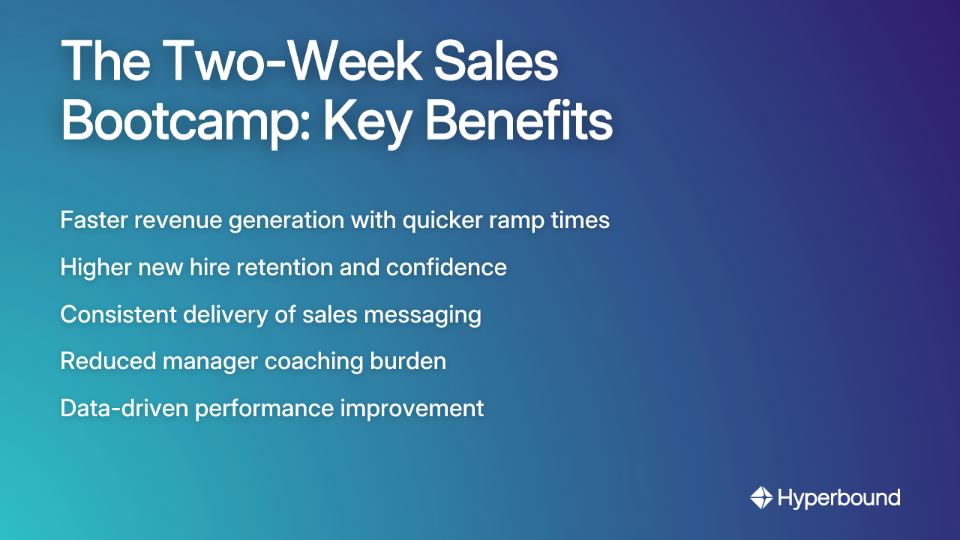
The key benefits are faster revenue generation, higher new hire retention, consistent messaging, and a reduced coaching burden on managers. By getting reps productive sooner, companies shorten the time to first deal. Confident reps are more likely to stay, and a structured program ensures everyone delivers the same core message, while AI handles repetitive feedback.
Note: This article was published by Hyperbound, an advanced AI Sales Coaching platform designed to transform how sales teams learn, practice, and perform. Learn more about how Hyperbound can help reduce ramp time by booking a demo.

Book a demo with Hyperbound


