.png)


.png)
Summary
- Traditional sales onboarding takes 3-7 months, costing businesses revenue and leading to nearly 50% of new reps quitting due to inadequate preparation.
- Instead of overwhelming new hires with lengthy playbooks, focus on "Minimum Viable Knowledge"—the core message, ICP, and common objections needed for a first conversation.
- Implement a 48-hour "Learn-Apply-Coach" model that moves reps from passive learning to active practice on day one, building their confidence and skills immediately.
- Leverage AI-powered sales coaching platforms to provide reps with unlimited, risk-free practice and instant feedback, dramatically cutting ramp time and making managers more strategic coaches.
You've finally hired that perfect sales rep. They arrive on day one full of energy and ready to crush it. Then reality hits: you hand them a 40-page playbook, schedule a week of training videos, and watch their enthusiasm slowly fade as they realize it might be months before they're fully ramped.
Sound familiar?
The traditional sales onboarding process is broken. The average ramp time for an Account Executive is 3.6 to 5.3 months, with some companies reporting it takes as long as 7 months to fully onboard a new rep. That's not just inefficient—it's a profit killer.
But what if you could get your new hires playbook-ready in just 48 hours?
I'm not talking about cramming everything into a two-day boot camp. I'm proposing a smarter, technology-enabled approach that transforms passive learning into active skill development from day one.
The 48-Hour Sales Training Paradox
New hires typically arrive pumped and full of energy, but onboarding feedback shows that enthusiasm quickly evaporates when faced with overwhelming documentation and training videos. This creates what I call the "onboarding paradox": your most motivated employees are often met with the most demotivating processes.
The stakes are high:
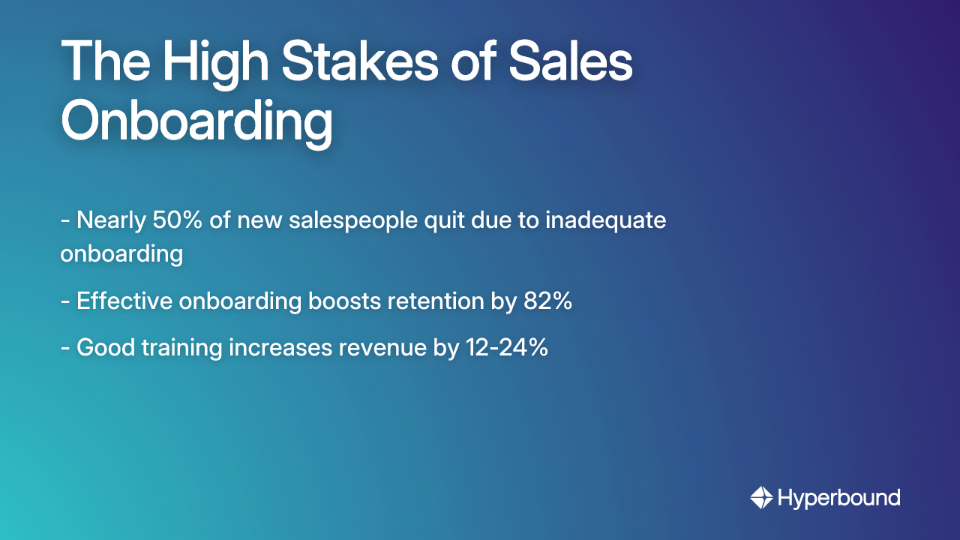
- Nearly 50% of new salespeople quit because onboarding doesn't adequately prepare them.
- Effective onboarding can boost new hire retention by 82% and productivity by over 70% in the first three months.
- Companies with robust training see 12% to 24% increases in revenue.
The solution isn't more content—it's better prioritization and practice.
Foundation: Deconstructing Your Playbook for Rapid Absorption
Before diving into the 48-hour blueprint, we need to extract the essential elements of your sales playbook. You can't teach everything in two days, so focus on what I call "Minimum Viable Knowledge"—just enough for a rep to have an intelligent first conversation.
Priority 1: The Core Message
- Company Mission & Value Prop: The one-sentence answer to "What do you do?"
- The Elevator Pitch: A 30-second version they can recite flawlessly.
Priority 2: The Target Audience
- Ideal Customer Personas: Focus on the top 1-2 personas, their pains, goals, and language.
- Industry Context: Just enough to sound credible in initial conversations.
Priority 3: The Conversation Flow
- Key Sales Process Stages: A simplified map from initial contact to discovery call.
- Essential Scripts & Templates: The first cold call script and follow-up email template.
Priority 4: The First Hurdles
- Top 3-5 Common Objections: Focus on frequent objections ("I don't have time," "We use a competitor," "Send me an email") and approved talk tracks.
The 48-Hour Blueprint: From Zero to Playbook-Ready
Now, let's break down exactly how to structure these 48 hours using a proven "Learn-Apply-Coach" model.
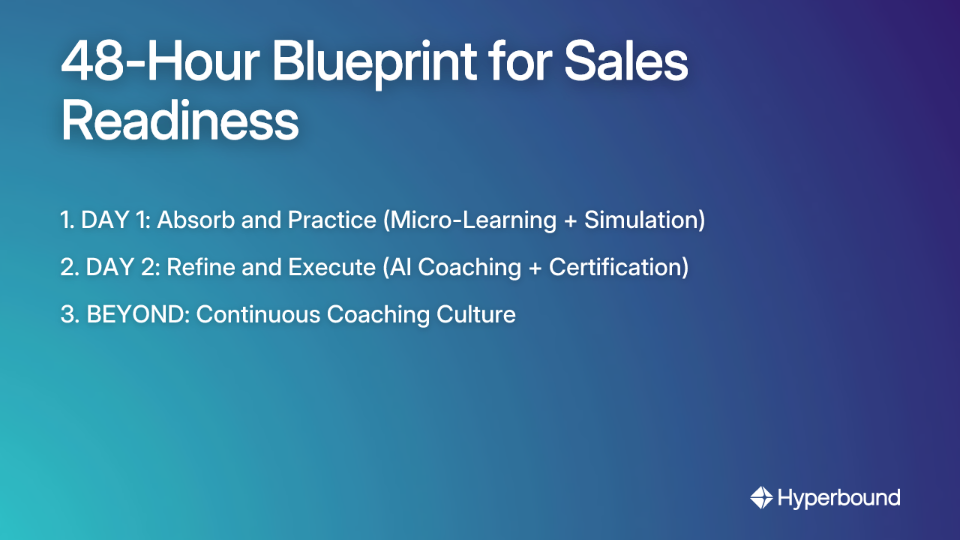
Day 1: Absorb and Practice (Hours 1-24)
Morning (LEARN): Micro-Learning Sprints, Not Marathon Lectures
Break content into digestible "microbursts" to maximize retention:
- Hour 1-2 (Sprint 1: The "Why & Who"): Cover company mission and primary buyer persona through interactive discussion.
- Hour 3-4 (Sprint 2: The "What & How"): Drill the value proposition and core sales process stages.
Afternoon (APPLY): From Theory to Practice in a Safe Environment
This is where traditional onboarding fails. New hires need to start talking immediately.
- Step 1: Listen to the Pros (Hours 5-6)
- Create curated "playlists of real calls" categorized by discovery calls, demo calls, and objection-handling moments. Many organizations already record these calls—now put them to work!
- Step 2: Enter the Simulator (Hours 7-8)
- The challenge here is providing enough practice without burning out your managers. This is where AI-powered tools like Hyperbound's AI Sales Roleplays become invaluable.
- These platforms allow new reps to practice their cold call script, discovery questions, and objection handling against hyper-realistic AI buyer personas. They can run through the exact conversation they'll have tomorrow dozens of times in a risk-free environment.
- As one sales leader noted, "They constantly improve with AI coaching that provides new reps with feedback from their very first call."
Day 2: Refine and Execute (Hours 25-48)
Morning (COACH): Instant Feedback and Targeted Improvement
- Step 1: Get Scored by AI (Hours 9-11)
- The rep continues practicing within the platform, but now the focus shifts to refinement based on data. Hyperbound's AI coaching scores the rep against your company's sales methodology, tracks talk-to-listen ratios, and flags whether key talk tracks were mentioned.
- This replaces subjective feedback with data-driven insights, allowing reps to see exactly where they need to improve.
- Step 2: Strategic Manager Review (Hour 12)
- With AI handling the basics, the manager's role shifts from drill sergeant to strategic coach. Managers can review the AI-generated scores and session highlights, then provide targeted feedback on strategy and tone, rather than basic script adherence.
- This approach addresses a common pain point: "There are so many things that need to be explained, so it requires patience from managers and as much structure as possible around them."
Afternoon (APPLY & CERTIFY): Preparing for Live Fire
- Step 1: Peer Roleplay (Hours 13-14)
- The new hire roleplays with a senior rep. The AI has built their foundational confidence; now they test it against a human who can provide nuanced feedback.
- Step 2: Final Certification (Hour 15)
- Have the rep complete a final "certification" roleplay. Passing a specific score threshold means they are officially "playbook-ready." This gamified approach increases engagement and provides a clear milestone.
- As one sales leader shared in a discussion on onboarding, "I've tried buddy programs, shadowing, certifications and certs have always worked the best for me."
- Step 3: Shadow & Prepare (Hour 16)
- Have them shadow a live call, then prepare for their first block of real prospecting. The goal shifts from learning to executing.
Beyond 48 Hours: Embedding a Culture of Continuous Coaching
The 48-hour sprint is designed to make reps productive quickly, but learning is continuous. Here's how to sustain momentum:
From Onboarding to "Always-boarding"
- Just-in-Time Coaching: Reps can use AI roleplays to prepare for specific calls—a big demo, a tough negotiation, or a renewal conversation. Tools like Hyperbound's AI Post-Sales Roleplays allow reps (and even CSMs) to practice these scenarios without risk.
- Scaling Quality Assurance: Managers can't listen to every call. With a tool like Hyperbound's AI Real Call Scoring, you can automatically score real sales conversations against your custom methodology, highlighting areas of strength and opportunities for improvement without manual effort.
- Continuous Improvement: According to Salesforce's "State of Sales" report, improving training is the #1 growth tactic for sales leaders. Continuous coaching is how you execute that tactic.
Stop Ramping, Start Selling
The shift from a passive, document-heavy onboarding that takes months to an active, practice-driven sprint that takes 48 hours isn't just possible—it's necessary in today's competitive sales environment.
By focusing on the "Minimum Viable Knowledge" and leveraging technology to enable practice and feedback at scale, you can:
- Reduce ramp time from months to weeks
- Increase retention by 82% and productivity by 70%
- Boost revenue by 12% to 24%
Most importantly, you'll stop forcing your energetic new hires to read about selling and give them a platform to actually sell.
The modern sales floor moves too fast for a 7-month ramp time. It's time your onboarding process caught up.
Frequently Asked Questions
What is a 48-hour sales onboarding program?
A 48-hour sales onboarding program is an intensive, practice-focused training sprint designed to equip new sales reps with the "Minimum Viable Knowledge" they need to start selling effectively within two days. Unlike traditional methods that overload reps with documents, this approach uses a "Learn-Apply-Coach" model, leveraging technology like AI roleplays to provide scalable, risk-free practice on core messaging and objection handling, dramatically reducing the typical multi-month ramp time.
Why is traditional sales onboarding ineffective?
Traditional sales onboarding is often ineffective because it is passive, overwhelming, and slow, causing new hire motivation to drop and delaying their time-to-productivity. The average ramp time of 3-7 months is a significant drain on resources. New hires are bogged down with lengthy playbooks and videos, which leads to poor knowledge retention and fails to translate their initial enthusiasm into practical skills.
How can AI help accelerate sales training?
AI accelerates sales training by providing a scalable, consistent, and safe environment for reps to practice real-world sales conversations at any time. AI-powered tools act as a simulator where new hires can practice their pitch and handle objections against realistic buyer personas. The AI provides instant, data-driven feedback on performance, allowing managers to shift from basic drill coaching to high-level strategic guidance.
What is "Minimum Viable Knowledge" for a new sales rep?
"Minimum Viable Knowledge" is the essential, prioritized information a new sales representative needs to conduct an intelligent first conversation with a prospect. Instead of teaching the entire playbook at once, this concept focuses on four key areas for the initial 48 hours: the core company message, the primary target audience, the basic conversation flow, and the top 3-5 most common objections.
What happens after the 48-hour onboarding sprint?
The 48-hour sprint is the launchpad for a culture of continuous coaching, not the end of training. After becoming "playbook-ready," reps transition from "onboarding" to "always-boarding." They can use AI roleplays for just-in-time practice before important calls, and managers can use AI call scoring to monitor performance and provide ongoing, targeted coaching, ensuring skills continue to develop long after the initial training.
Does this accelerated approach replace the sales manager?
No, this approach enhances the sales manager's role by shifting their focus from repetitive drills to high-impact strategic coaching. AI handles the time-consuming task of basic practice and script adherence, freeing up the manager's time. Managers can then review AI-generated performance data to provide targeted, nuanced feedback on strategy and deal execution, making their coaching sessions more effective.
Ready to transform how your team trains and practices? Hyperbound helps sales teams reduce ramp time with AI-powered roleplays, call scoring, and coaching that scales your best practices across the entire organization.
Book a demo with Hyperbound


