.png)


.png)
"My onboarding consisted of a plant tour, and a 'go sell some shit.' Thank god I know my industry, otherwise I'd be completely fucked."
Sound familiar? This Reddit comment captures a painful reality for too many sales organizations. From reps making cold calls on day three with minimal training to others who "completely sucked at my job for 18 months," the "sink or swim" approach to sales onboarding remains distressingly common.
The cost of this approach is staggering. The average ramp-up time for an Account Executive is 5.3 months and for a Sales Development Representative, it's 3.6 months. Every week a rep isn't productive means lost revenue, wasted salary, and potentially, another resignation in the making.
But it doesn't have to be this way. A structured, well-measured onboarding process can reduce ramp-up time by as much as 50% and boost retention by up to 58%. The key is moving beyond gut feelings and surface-level metrics to adopt a comprehensive analytics framework that tracks readiness, competency, and performance.
Why Traditional Onboarding Metrics Fall Short
Most sales organizations rely on lagging indicators like Time-to-First-Sale or Quota Attainment to gauge onboarding success. While important, these metrics tell you what happened in the past but don't explain why.
Consider this real-world scenario from our research: a rep was "only 1 of 2 people above 100% of quota" despite having "nothing sales related" in their training. Was this success due to the onboarding program? Or was it luck, prior experience, or a hot territory?
Traditional metrics fail to measure a rep's actual skill acquisition. Are they following your sales methodology? Can they handle key objections? Do they understand the product's value proposition? Lagging indicators can't answer these crucial questions.
A Modern Framework for Onboarding Analytics
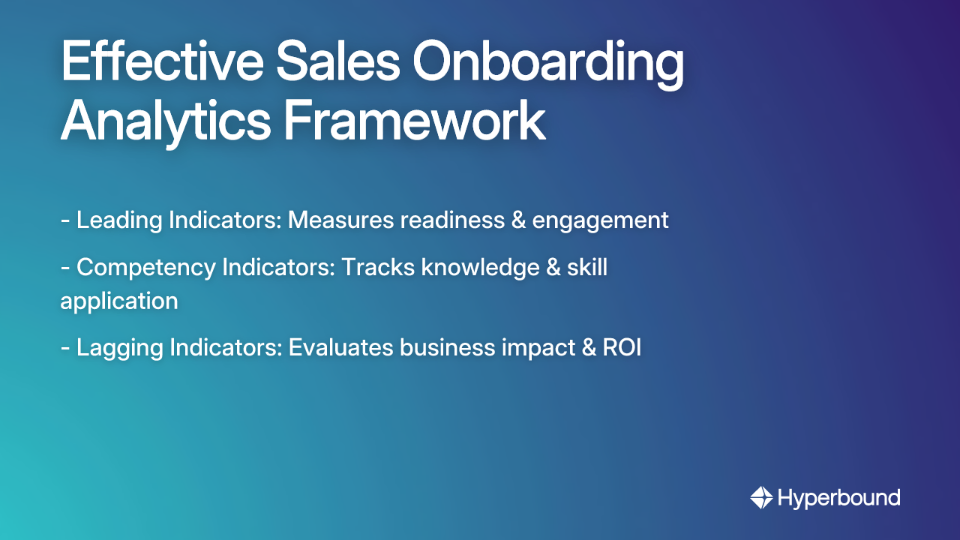
To truly understand and optimize your onboarding effectiveness, you need a multi-layered approach to measurement, broken into three distinct categories:
1. Leading Indicators (Readiness & Engagement)
These metrics tell you if your onboarding program is running efficiently and if new hires are engaged from the very beginning.
Pre-start Readiness:
- Offer-to-start cycle time: Time from offer acceptance to start date
- New-hire kit completion rate: Percentage of reps with all necessary tools on day one
- Pre-boarding content consumption rate: Tracks completion of assigned pre-reading
Onboarding Progress:
- On-time onboarding completion rate: Percentage of reps finishing on schedule
- Curriculum coverage rate: Percentage of the syllabus completed
- Training Completion Rate: Formula:
(New hires completing training / Total new hires) x 100
These metrics help identify operational bottlenecks before they impact a rep's ability to sell. Low scores here often predict struggles later in the process.
2. Competency Indicators (Knowledge & Application)
These are the most critical metrics for predicting future success. They measure if the training is actually sticking and if reps can apply what they've learned.
Knowledge & Certification:
- Onboarding certification pass rate: Percentage of hires passing final assessments
- Knowledge lift: The delta in quiz scores from beginning to end of onboarding
Skill Application (Simulated & Real):
- Simulated call score: This is where you move from theory to practice. It's not enough to know the playbook; reps must be able to execute it.
- Manager coaching cadence compliance: Are scheduled 1:1s and coaching sessions happening?
- Buddy shadow session count: Measures participation in peer-led learning
Of these, the Simulated call score deserves special attention. Platforms like Hyperbound use AI Sales Roleplays to let reps practice key conversations—from cold calls to objection handling—in a safe environment. The AI provides an objective score based on their performance against your custom methodology, giving you a clear, data-driven measure of their practical skills before they ever speak to a real prospect.
3. Lagging Indicators (The Business Impact)
These metrics measure the ultimate business outcomes and ROI of your onboarding program. They validate the success predicted by your leading and competency indicators.
Early Performance & Productivity:
- Time to first logged activity: (e.g., first call, email)
- Time to first opportunity created: How quickly are they building a pipeline?
- Time to first closed-won deal: The classic metric for applied learning
- Ramp-up Time: Total time to become fully productive and consistently hit quota
Retention & Satisfaction:
- Onboarding Satisfaction Score (eNPS): Formula:
% of Promoters - % of Detractors - Early Attrition Rate: Percentage of new hires who leave within 6-12 months
Financial Impact:
- Onboarding cost per hire: Total investment in onboarding each new rep
- Return on Investment (ROI): Connects cost to revenue generated over time
How to Measure What Matters Most: Skill Application
While all three categories of metrics are important, competency indicators—especially those measuring skill application—are often the hardest to capture yet most predictive of future success.
The Challenge of Objective Measurement
Historically, measuring skill application has relied on subjective manager ride-alongs or manual call reviews. These approaches are:
- Time-consuming for already busy managers
- Inconsistent across different reviewers
- Limited to a small sample size of interactions
- Vulnerable to recency bias and personal preferences
The AI-Powered Solution
Modern AI platforms solve this problem at scale. For example, Hyperbound's AI Real Call Scoring analyzes 100% of a new hire's actual customer conversations, automatically scoring them against your sales playbook.
This provides several key benefits:
- Objective, consistent measurement across all reps and conversations
- Comprehensive coverage without increasing manager workload
- Real-time feedback loops that reinforce training immediately
- Granular insights into specific skill gaps (e.g., discovery questioning, handling price objections)
Furthermore, AI Coaching provides reps with instant, personalized feedback after each call. This creates a continuous learning loop that reinforces onboarding lessons in real-time, accelerating their path to proficiency.
Common Pitfalls and How Analytics Can Help You Avoid Them
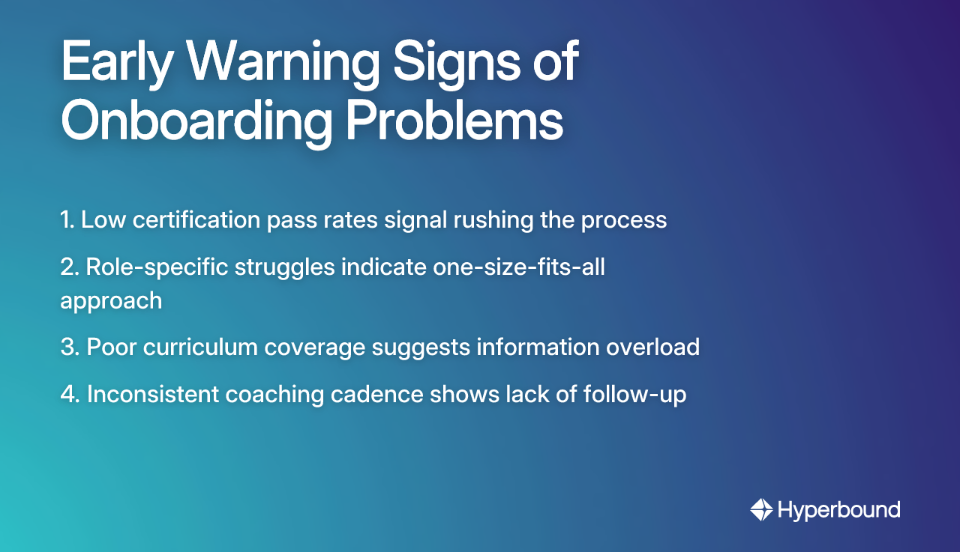
The right metrics serve as an early warning system for common onboarding mistakes:
Pitfall 1: Rushing the Process
Analytics Signal: Low Onboarding certification pass rates or poor Simulated call scores are clear signs that reps aren't ready, even if the calendar says onboarding is "done."
Pitfall 2: One-Size-Fits-All Approach
Analytics Signal: Data from call scoring might show that SDRs struggle with opening statements while AEs struggle with negotiation. This data proves the need for role-specific training modules.
Pitfall 3: Overloading New Hires
Analytics Signal: A low Curriculum coverage rate or negative feedback in the Onboarding Satisfaction Score can indicate that you're delivering too much information too quickly.
Pitfall 4: Lack of Follow-Up and Coaching
Analytics Signal: Tracking Manager coaching cadence compliance ensures accountability. Tools that provide ongoing coaching analytics show whether skills are improving post-onboarding or if reps are reverting to old habits.
Building Your Onboarding Flywheel
Stop thinking of onboarding as a one-time event and start treating it as a strategic, measurable process. Effective measurement isn't about just one KPI; it's about a holistic dashboard of leading, competency, and lagging indicators.
By leveraging analytics and AI-powered tools, you can move beyond the "sink or swim" culture that leaves reps feeling like they need to "fake it till you make it." Instead, you can get objective insights into skill application, provide personalized coaching at scale, and build a predictable engine that turns new hires into top performers faster.
The payoff extends far beyond faster ramp times. According to Federico Presicci, a well-measured and continuously improved onboarding program creates a virtuous cycle:
- Better onboarding leads to faster proficiency
- Faster proficiency leads to higher satisfaction and retention
- Higher retention reduces hiring costs and maintains team knowledge
- This allows for greater investment back into onboarding quality
A great onboarding program doesn't just create productive reps; it builds a foundation for higher retention, a stronger sales culture, and sustainable revenue growth. And it all starts with measuring the right things at the right time.
Get Started Today
Begin by auditing your current onboarding metrics. Are you focused primarily on lagging indicators? Do you have visibility into how well your reps can actually apply what they've learned? Can you objectively measure skill application at scale?
If there are gaps in your measurement approach, consider how AI-powered tools like Hyperbound can help you gain deeper insights into onboarding effectiveness and accelerate the path to productivity for your sales team.
Your new hires shouldn't have to "completely suck at their job for 18 months." With the right analytics framework and tools, they can become confident, competent contributors in a fraction of that time.
Frequently Asked Questions
What are the most important sales onboarding metrics?
The most important sales onboarding metrics fall into three categories: leading indicators (readiness), competency indicators (skill application), and lagging indicators (business impact). While all are necessary for a complete picture, competency indicators—such as simulated call scores and knowledge certification pass rates—are the most predictive of a new hire's future success because they measure if skills are actually being learned and applied.
Why are traditional sales onboarding metrics not enough?
Traditional metrics like "time to first sale" or "quota attainment" are not enough because they are lagging indicators. They only show past results, not the reasons behind them. They can't tell you if a rep has acquired the necessary skills, if they are following your sales methodology, or if their success was due to other factors like luck or a strong territory. This leaves you unable to diagnose and fix underlying issues in your training program.
How long should sales onboarding take?
The average ramp-up time is 5.3 months for an Account Executive and 3.6 months for an SDR, but a well-structured onboarding program can reduce this by up to 50%. The goal is not to hit an arbitrary timeline but to ensure reps are fully competent. By focusing on proficiency milestones (like passing skill simulations) instead of just time, you ensure reps are truly ready to sell effectively, which naturally shortens their path to full productivity.
What is the difference between leading, competency, and lagging indicators?
Leading indicators measure readiness and engagement (e.g., training completion rates), competency indicators measure knowledge and skill application (e.g., certification pass rates, simulated call scores), and lagging indicators measure the final business impact (e.g., quota attainment). A successful program uses leading indicators to monitor efficiency, competency indicators to predict success, and lagging indicators to prove ROI.
How can I measure a sales rep's skills objectively?
You can measure a sales rep's skills objectively by using AI-powered tools for sales roleplays and real call scoring. Unlike subjective manager ride-alongs, AI platforms provide a scalable solution by scoring reps against a consistent, predefined methodology. This allows you to analyze performance across the team, identify specific skill gaps, and provide data-driven feedback without bias.
What is the role of AI in sales onboarding?
AI plays a crucial role in modern sales onboarding by providing a safe environment for practice, delivering objective skill assessment, and offering personalized coaching at scale. AI sales roleplay tools allow new hires to practice key conversations and receive instant feedback before engaging with real customers. AI can also analyze real customer calls to score performance and provide ongoing coaching, reinforcing training and accelerating a rep's path to proficiency.
Book a demo with Hyperbound


