

.png)
You've just spent hours interviewing a passionate candidate for your sales position. They were articulate, confident, and could recite your sales methodology chapter and verse. You hire them, excited about the future—only to watch them struggle when faced with actual prospects three months later.
Sound familiar? You're not alone.
Traditional sales interviews excel at identifying candidates who are good at interviewing, not necessarily at selling. In 2025, innovative sales leaders are abandoning hypothetical questions and gut feelings in favor of something far more predictive: AI-powered sales simulations.
Why Your Current Sales Interview Process Is Costing You Top Talent
The "talk the talk" versus "walk the walk" dilemma is the primary challenge in sales hiring. Many sales assessment experts note that candidates can often eloquently describe sales methodologies but crumble when faced with live objections.
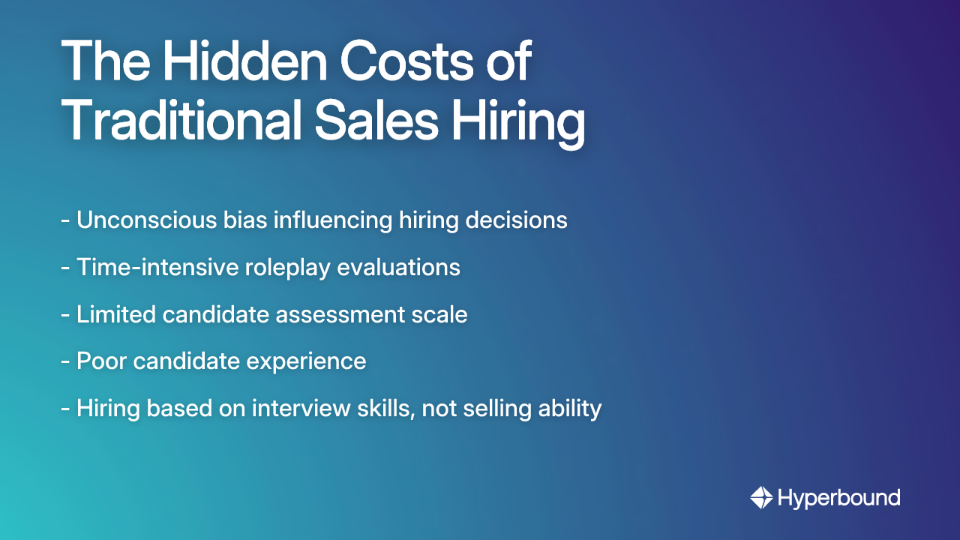
Beyond this fundamental disconnect, traditional interview processes suffer from three critical flaws:
The High Cost of Unconscious Bias
"I've got a good feeling about this one" might be the most expensive phrase in sales hiring. Hiring based on gut feeling introduces inconsistency and bias—a candidate's performance can vary wildly depending on the interviewer's mood, style, or personal preferences.
AI assessments provide consistent, standardized evaluations based on pre-defined criteria, eliminating the human bias that can plague manager-led roleplays.
The Scalability Bottleneck
Let's be honest: conducting effective, in-depth roleplays with every promising candidate is a massive time sink for busy hiring managers. This limits the number of candidates you can thoroughly evaluate, potentially missing hidden gems.
AI simulations allow you to assess a large volume of candidates consistently and efficiently, filtering for top talent early in the process.
The Negative Candidate Experience
A poorly executed, unstructured roleplay can make your organization look disorganized and leave a negative impression on top candidates. In a competitive talent market, this can be the difference between landing your first choice or watching them sign with a competitor.
A strong, tech-forward interview process reinforces your employer brand and creates a positive experience, increasing the likelihood that top talent will accept your offer.
The Rise of AI Sales Simulations: What Are They & Why Now?
AI sales simulations are interactive, conversational roleplays where a sales candidate engages with an AI-powered "buyer" or "prospect." Unlike static scripts, these simulations leverage Generative AI to create dynamic conversations. The AI persona can respond to unexpected questions, raise realistic objections, and adapt its behavior based on the candidate's approach, mirroring a real-world sales call.
The statistics supporting this approach are compelling:
- Widespread Adoption: Gartner predicts that by 2026, a staggering 60% of large enterprises will use AI simulation tools for employee development and hiring.
- Proven Effectiveness: Immersive learning isn't just a trend; it delivers results. A PwC study found that learners using simulation-based training were 275% more confident in applying their skills and completed training four times faster than with traditional methods.
- Business Impact: Companies using AI-driven training have seen productivity improvements of 15-20%.
How to Use AI Simulations to Assess Core Sales Competencies
The power of AI simulations lies in their ability to objectively evaluate skills that traditional interviews can only approximate. Here's how to assess the four critical competencies that predict sales success:
1. Assessing Discovery and Active Listening
How it works: Program the AI buyer persona with specific business pains, needs, and a backstory relevant to your Ideal Customer Profile (ICP). The simulation evaluates not just if candidates ask questions, but what kinds of questions they ask.
What to measure: The AI scorecard can track whether the candidate asks open-ended questions, identifies key pain points, and maintains an appropriate talk-to-listen ratio—going far beyond superficial evaluation to analyze the quality of their discovery technique.
2. Evaluating Objection Handling Under Pressure
How it works: Simulate the most common and difficult objections your team faces (e.g., "Your price is too high," "We're already working with a competitor," "Now isn't the right time.") and watch how candidates respond in real-time.
What to measure: The AI can score the candidate's response against your company's official methodology (e.g., Acknowledge, Isolate, Reframe, Overcome). It provides instant, objective feedback on their technique.
3. Testing Pitching and Value Proposition Delivery
How it works: The simulation requires the candidate to tailor their pitch based on the information gathered during the discovery phase, evaluating their ability to connect product features to specific customer needs.
What to measure: AI scorecards analyze the pitch for clarity, confidence, accuracy, and the inclusion of key value pillars. It can verify if the candidate is sticking to the approved playbook or going rogue with unsupported claims.
4. Measuring the Un-interviewable: Coachability
How it works: This is a game-changer. After the first roleplay, the AI provides instant feedback highlighting areas for improvement. The candidate is then given a chance to attempt the scenario again.
What to measure: You can directly observe how well the candidate incorporates feedback and adapts their approach. This is a powerful predictor of future success and ramp time.
A Step-by-Step Guide to Implementing AI Roleplay Assessments
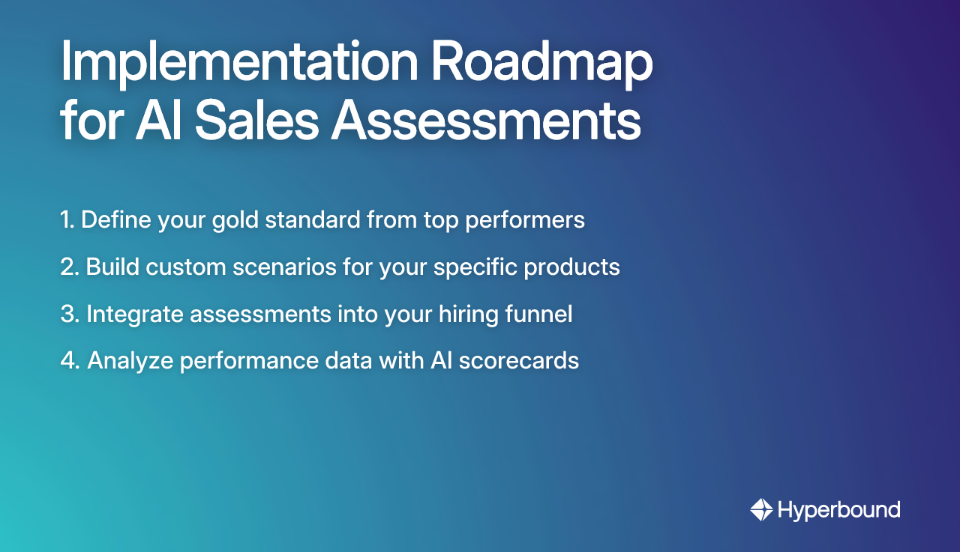
Ready to transform your hiring process? Here's your implementation roadmap:
Step 1: Define Your Gold Standard
Before you build a simulation, define what a great call looks like. Analyze the calls of your top performers to identify winning behaviors, key talk tracks, and successful discovery questions.
Pro-Tip: Modern platforms like Hyperbound can analyze thousands of your actual sales calls to automatically surface these winning behaviors, providing a data-backed foundation for your assessment criteria.
Step 2: Build Your Custom Scenarios
Don't use generic scenarios. Tailor the roleplays to your specific products, ICPs, and competitive landscape.
Create a library of scenarios that test skills across the sales cycle:
- Outbound: Cold calls, gatekeeper navigation
- Inbound: Discovery calls, demo calls
- Post-Sales: Upsell/cross-sell, renewal conversations
Step 3: Integrate the Assessment into Your Hiring Funnel
Top of Funnel: Use a short AI roleplay as a scalable screening tool to replace initial phone screens. This allows you to assess a larger pool of applicants for core skills early on.
Mid/Late Stage: Use a more in-depth simulation as a final practical exam to validate the skills of your top candidates before extending an offer.
Step 4: Analyze the Data with AI Scorecards
Leverage the objective data to make informed decisions. Look beyond a single score and dive into the details: talk ratios, keywords used, questions asked, and specific moments where the candidate excelled or struggled.
Use features like Leaderboards to rank candidates based on performance data, quickly identifying your top contenders.
Choosing the Right Platform & Addressing Common Skepticism
If you've been following discussions about AI sales tools, you've likely encountered some skepticism. Let's address the most common concerns head-on and identify what to look for in a quality platform:
"AI is awful at context-based coaching"
What to Look For: The platform must allow for deep customization. The ability to build roleplays and scorecards around your specific sales methodology, product language, and ICP is non-negotiable. Generic feedback is useless.
The Right Approach: Platforms like Hyperbound solve this by enabling you to tailor every aspect of the simulation. The AI coaching and scoring are aligned with your playbook, ensuring the feedback is always contextual and relevant.
"It's all hype, I get no value out of it"
What to Look For: The value isn't just in the practice; it's in the data. Demand a platform with robust analytics and detailed, objective scorecards. The goal is to move from subjective feedback to data-driven insights.
The Right Approach: Look for quantifiable metrics—talk ratios, key selling moments, and methodology adherence. This data not only helps you evaluate candidates but also identifies skill gaps across your entire team.
"My competitor had more sales training knowledge"
What to Look For: Choose a platform built by and for sales professionals. A generic AI chatbot platform won't understand the nuances of a discovery call or a renewal negotiation. The platform's DNA should be rooted in sales training.
The Right Approach: The platform should support the entire revenue team. Hyperbound, for example, offers specialized roleplays not just for AEs and SDRs, but also for CSMs and Account Managers with scenarios for renewals and upsells, demonstrating a deep understanding of the entire customer lifecycle.
Your Unfair Hiring Advantage in 2025
In 2025, relying solely on traditional interviews is like trying to sell without a CRM—it's an immediate competitive disadvantage. AI simulations are no longer a futuristic concept; they are an essential tool for building and scaling an elite sales force.
The benefits of incorporating AI simulations into your hiring process are transformative:
- Hire Smarter: Make data-driven decisions and reduce costly mis-hires by seeing candidates in action before extending an offer.
- Hire Faster: Reduce time-to-hire by screening more candidates effectively at the top of your funnel.
- Improve Onboarding: The same simulations used for hiring can accelerate new hire ramp time, creating a seamless transition from candidate to productive team member.
- Enhance Candidate Experience: Showcase your company as a modern, data-driven organization that values skills over interview performance.
The best sales teams are built on skill, not just charisma. AI simulations finally give you the tool to see that skill in action before you hire.
As a forward-thinking sales leader in 2025, you have an opportunity to reshape how your organization identifies, evaluates, and selects sales talent. By implementing AI-powered simulations, you're not just modernizing your hiring process—you're creating a sustainable competitive advantage in the war for sales talent.
The question isn't whether you can afford to adopt this approach; it's whether you can afford not to.
Frequently Asked Questions
What is an AI sales simulation?
An AI sales simulation is an interactive roleplay where a sales candidate interacts with an AI-powered "buyer" persona. Unlike scripted roleplays, these simulations use Generative AI to create dynamic, realistic conversations where the AI can raise objections, ask questions, and react to the candidate's approach, effectively mirroring a real-world sales call.
Why is using AI for sales interviews better than traditional methods?
AI-powered sales interviews are better because they replace subjective "gut feelings" with objective, data-driven assessments of a candidate's actual selling skills. This approach reduces unconscious bias, allows you to evaluate more candidates efficiently, and provides a consistent, fair evaluation for everyone, ultimately leading to a higher quality of hire.
How do AI simulations evaluate core sales skills?
AI simulations evaluate skills by placing candidates in realistic scenarios where they must perform key sales tasks. The AI can be programmed to assess specific competencies like discovery (quality of questions asked), objection handling (response to common blockers), value proposition delivery (clarity and relevance of the pitch), and even coachability by providing feedback and measuring improvement in a second attempt.
Can AI really measure something as subjective as coachability?
Yes, AI simulations are uniquely capable of measuring coachability objectively. The process involves a candidate completing a scenario, receiving instant, AI-driven feedback on their performance, and then being given the opportunity to attempt the same scenario again. The platform can then score the candidate's ability to absorb and apply that feedback, providing a powerful predictor of their future success and ramp time.
How can I integrate AI roleplays into my current hiring process?
AI roleplays can be integrated at different stages of your hiring funnel. For top-of-funnel screening, a short simulation can replace initial phone screens to assess a large volume of applicants for core skills. For later stages, a more in-depth simulation can serve as a final practical exam for top candidates before an offer is made, validating their abilities in a high-stakes environment.
Will candidates find an AI simulation impersonal or strange?
On the contrary, a well-designed AI simulation often enhances the candidate experience. It shows that your company is modern, tech-forward, and committed to a fair, skills-based evaluation process. Top candidates appreciate the opportunity to demonstrate their actual abilities rather than just their interviewing skills, making your organization stand out from competitors who use unstructured, inconsistent roleplays.
Ready to see how AI sales simulations can transform your hiring process? Hyperbound offers customizable, data-driven roleplay assessments that help you identify top sales talent with confidence.
Book a demo with Hyperbound


