

Summary
- Losing a deal is a critical learning opportunity; systematically deconstruct the loss to gather competitive intelligence and pinpoint specific weaknesses in your sales process.
- Traditional peer roleplay often fails to prepare reps for real-world complexities. The key is to design hyper-realistic simulations based on the actual objections and scenarios from lost deals.
- Effective practice focuses on high-impact moments, such as articulating unique value against a lower-priced competitor, handling specific objections, and navigating tough negotiations.
- Turn insights into wins by using AI Sales Roleplays to provide reps with a scalable, judgment-free environment to master these challenging conversations before the next live deal.
You've been working a deal for months. You've built rapport, navigated the complex buying committee, and delivered what you thought was a knockout presentation. Then the news lands in your inbox: "We've decided to go with your competitor."
That sinking feeling in your stomach? That's not just disappointment—it's a pivotal learning moment being wasted if you don't capture it correctly.
Traditional advice tells you to roleplay the conversation again with a colleague, but let's be honest—those sessions often feel awkward, superficial, and more like a "theatre production" than genuine practice. As one sales rep noted on Reddit, "Roleplaying often focuses too much on scripted dialogue rather than genuine conversation."
The truth is, losing a deal is an invaluable source of competitive intelligence. By systematically deconstructing the loss and using it to fuel hyper-realistic simulations, you can turn that setback into a powerful tool for winning the next time.
Part 1: The Post-Mortem - Deconstructing the Loss to Fuel Your Simulation
Before you can practice effectively, you need to know what to practice. This means gathering concrete intelligence from the lost deal.
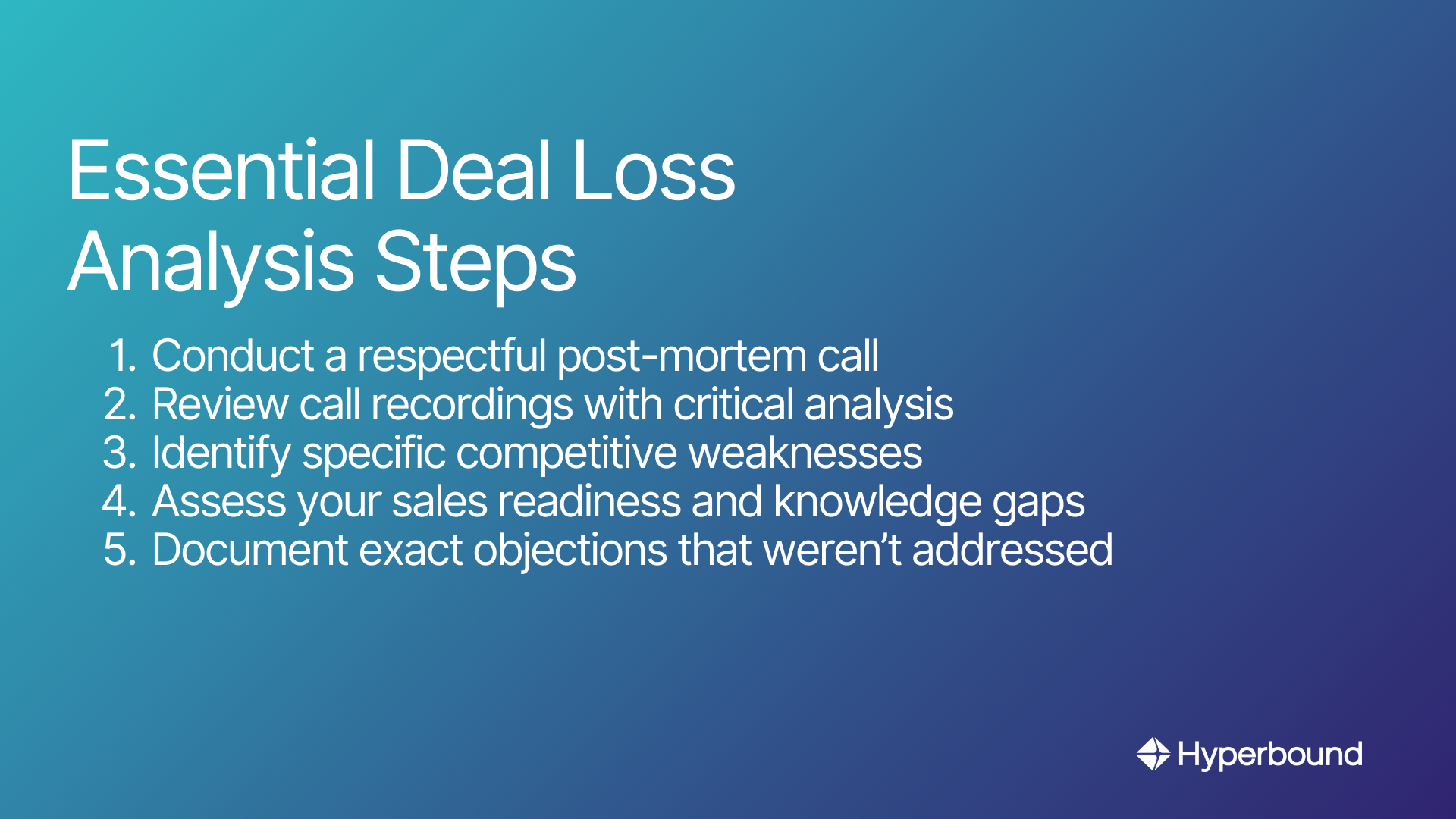
Conduct a Respectful Post-Mortem Call
This isn't about trying to win the deal back. It's about learning.
Reach out to your contact with a zero-pressure approach. Emphasize that you're not trying to win them back, but rather to learn and improve your understanding of their decision-making process.
A simple message might read:
"Hi [Name], I respect your decision to go with [Competitor]. To help us improve, could you share what factors influenced your choice? I'd appreciate your candid feedback."
This approach fosters goodwill and often yields insights you wouldn't get otherwise.
Become a Student of Your Own Tapes
Listen to your call recordings with a critical ear. Review them to analyze your presentation style, cadence, and responsiveness. Listen for vocal cues from leads indicating interest or disinterest.
Ask yourself:
- Where did the conversation shift?
- What objections did I fail to address effectively?
- How did I position against the competitor?
Manually reviewing calls can be time-consuming and subjective. This is where modern tools provide an edge. Platforms like Hyperbound use AI Real Call Scoring to automate this analysis, providing objective, data-driven insights that pinpoint exactly where the conversation went off track.
Audit Your Sales Readiness
Did you have the right content at the right time? Assess your preparedness by asking:
- Were you able to confidently answer tough questions about pricing, functionality, and your competitors?
- Did you have the right sales enablement content (e.g., use cases, feature comparisons) readily available?
- Where were the gaps in your knowledge or materials?
Identify the specific competitive areas where you need more ammunition for next time.
Part 2: Designing the Simulation - Building a Realistic Practice Arena
Use the intelligence from your post-mortem to build practice scenarios that are targeted and challenging. This directly counters a common complaint that simplistic roleplay scenarios fail to prepare salespeople for real-world complexities.
Focus on High-Impact Scenarios
Based on your analysis, choose the most critical moments to practice. High-impact scenarios often include:
- Competition Awareness: Don't just bash the competitor. "Conduct a role play where reps sell against a competitor with lower prices but inferior capabilities." The goal is to master articulating your unique value.
- Objection Handling: Go beyond generic objections like "I need more time." Practice the actual objections you heard in your post-mortem:
- "Your competitor was recommended by our parent company"
- "Their integration with our existing systems is more seamless"
- "Their pricing model is more aligned with our budget structure"
- Negotiation: The deal isn't always lost on features; sometimes it's price. "Simulate a buyer asking for a discount after receiving a competing offer." Practice "give and get" strategies instead of just capitulating.
Craft Your Adversary: Realistic Personas
An effective simulation needs a believable buyer. Define the buyer persona from the lost deal:
- What was their communication style? (Direct, analytical, relationship-driven)
- What were their top business challenges?
- What organizational pressures were they under?
- What biases or preferences did they reveal?
Use this information to create a detailed persona that feels like a real person, not a cardboard cutout. This aligns with recommendations from successful salespeople for specific, detailed scenarios given ahead of time.
Part 3: Executing the Simulation - From Awkward Roleplay to Effective Practice
How you practice matters as much as what you practice. Traditional roleplay is often dreaded for good reason.
The Old Way: Peer-to-Peer Roleplay
Peer roleplaying has its place but comes with significant limitations:
- Dependency on Partner Skill: Your practice is only as good as your partner's ability to simulate a realistic buyer.
- Fear of Judgment: Roleplaying can expose vulnerabilities, leading to discomfort among participants.
- Lack of Consistency: Each practice session varies widely based on who's playing the buyer.
- Limited Scale: You can only practice when someone else has time available.

The New Way: AI-Powered Sales Simulators
AI simulation tools address these limitations by providing a consistent, scalable, and judgment-free practice environment.
Platforms like Hyperbound offer AI Sales Roleplays that solve common practice problems:
- Eliminates "Fear of Failure": AI provides a safe place to practice and prepare for unexpected situations without high stakes. You can fail privately and learn without judgment.
- Creates Realistic Scenarios: Using AI buyer personas and customizable scenarios, you can simulate your specific ICP and the exact competitive situation you lost.
- Delivers Immediate Feedback: AI-Powered Scorecards track talk ratios and key selling moments, giving you objective feedback without waiting for a manager.
- Makes Practice Engaging: Gamified learning and leaderboards motivate continued practice and improvement.
Part 4: From Practice to Performance - Applying Your Learnings
Practice is useless if it doesn't translate to better performance. Here's how to ensure your simulation insights lead to real-world wins.
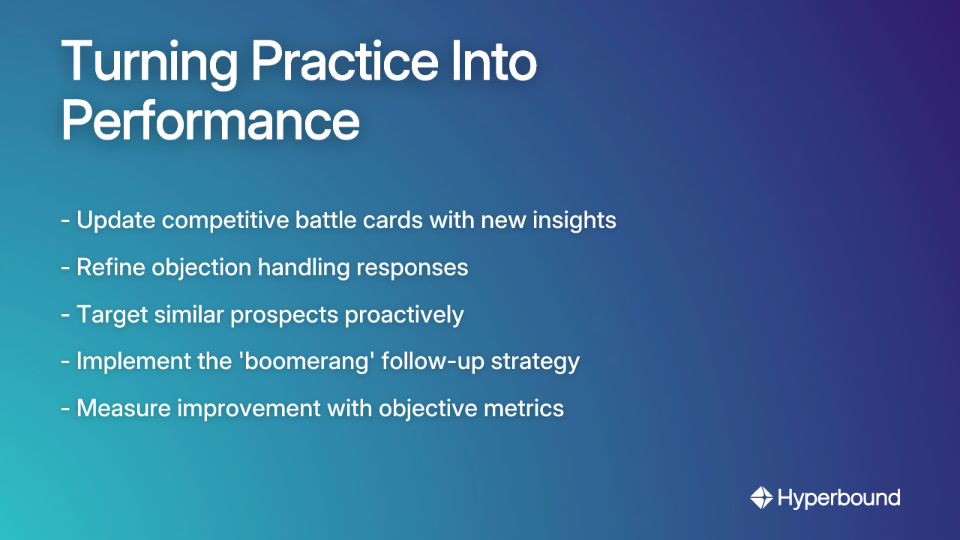
Refine Your Playbook and Talk Tracks
Use the feedback from your simulations to update:
- Your competitive battle cards with more effective differentiation points
- Objection handling responses that address the specific concerns that cost you the deal
- Value messaging that more clearly articulates your advantages
These refined materials become your new foundation for future deals.
Proactively Seek Out Similar Deals
Don't wait for the next similar deal to fall into your lap. Analyze your current pipeline and target companies similar to the lost deal based on size and needs.
Approach these prospects with your newly refined, well-practiced pitch. This proactive strategy turns your loss into an opportunity to win multiple similar deals.
Master the "Boomerang" Strategy
A lost deal isn't always lost forever. Keep communication lines open and revisit and follow up with lost leads after a set period, typically 3-6 months after implementation. They might not be satisfied with their chosen competitor, providing an opportunity to reengage.
When you follow up, reference what you learned from your simulation practice:
"Since we last spoke, we've enhanced our [feature that was a deciding factor]. I'd love to show you how we've addressed the concerns you mentioned about [specific objection]."
This demonstrates you listened, learned, and improved—exactly what a partner should do.
Conclusion
Losing a deal is an event. Failing to learn from it is a choice.
With a structured approach to simulation, every loss can become a strategic investment in your future success:
- Deconstruct the loss through post-mortems and call analysis
- Design realistic simulation scenarios based on what you learn
- Execute practice using modern AI tools to overcome the flaws of traditional roleplay
- Apply your learnings to win future deals
The most successful sales professionals don't just move on from losses—they transform them into their most powerful competitive advantage through deliberate practice.
Frequently Asked Questions
What is a sales simulation based on a lost deal?
A sales simulation based on a lost deal is a targeted practice method where you recreate the specific scenarios, objections, and competitive pressures from a deal you didn't win. This allows you to practice and refine your approach in a realistic, risk-free environment to better handle similar situations in the future.
Why are AI sales simulators more effective than traditional roleplay?
AI sales simulators are more effective than traditional roleplay because they provide a consistent, scalable, and judgment-free practice environment. Unlike peer-to-peer roleplay, which depends on a partner's skill and availability, AI simulators offer realistic buyer personas, immediate data-driven feedback, and the ability to practice challenging scenarios privately and repeatedly.
What is the first step to take after losing a sales deal?
The first step to take after losing a sales deal is to conduct a respectful post-mortem analysis. This involves reaching out to your contact to understand the key factors behind their decision and reviewing your own call recordings to identify critical moments where the conversation may have shifted.
How do you create realistic scenarios for sales practice?
To create realistic scenarios for sales practice, use the intelligence gathered from your deal loss analysis. Focus on high-impact moments like specific competitor mentions, actual objections raised by the prospect (e.g., "Their integration is more seamless"), and negotiation tactics. Craft a detailed buyer persona based on the lost deal, including their communication style, business challenges, and biases.
What questions should I ask a prospect in a post-mortem call?
In a post-mortem call, you should ask open-ended questions that focus on the prospect's decision-making process. A good approach is to say something like, "To help us improve, could you share what key factors influenced your choice to go with [Competitor]?" This non-confrontational question encourages candid feedback about their evaluation criteria, the competitor's strengths, and where your solution fell short.
How can I apply learnings from simulations to win future deals?
You can apply learnings from simulations by updating your sales playbook, refining competitive battle cards with more effective differentiation points, and improving your objection-handling responses. Additionally, you can proactively target prospects similar to the one you lost, using your new, well-practiced pitch to address their likely needs and concerns from the start.
Ready to turn your team's competitive losses into your most powerful coaching moments? Tools like Hyperbound's AI Sales Roleplays provide the scalable, risk-free environment your reps need to master any conversation, especially those challenging competitive scenarios that make the difference between winning and losing.

Book a demo with Hyperbound


