

.png)
Summary
- Only 38% of sales reps receive formal training for new product launches, leaving most teams unprepared to sell effectively from day one.
- While manager-led mock calls are essential for foundational practice, they are time-consuming and difficult to scale across an entire sales team.
- The most effective strategy combines traditional roleplay with AI-powered simulations, which provide on-demand, risk-free practice for every rep.
- To ensure consistent messaging for a new product, sales teams can use AI Sales Roleplays to certify every rep on new talk tracks and objection handling at scale.
You've got a new product ready to launch. Marketing is creating buzz, your developers have squashed the final bugs, and leadership is counting on a successful rollout. There's just one problem: your sales team isn't fully prepared to sell it.
If this scenario sounds familiar, you're not alone. According to Showpad, only 38% of sales reps receive formal training for new product launches, creating a massive readiness gap at the exact moment when your team needs to be at their sharpest.
But how do you prepare them effectively? Some say you need real "at bats with people" and that AI simulations feel "robotic and not realistic." Others believe that roleplaying in front of peers feels "embarrassing or scripted."
The truth is that effective sales call simulation combines the best of traditional methods with modern technology to ensure your team hits the ground running. In this guide, I'll walk you through exactly how to do that—from foundational techniques to scalable solutions that work in the real world.
Why Bother Simulating? The Unmissable Benefits of Practice
Before diving into the how, let's clarify the why. A mock sales call is a training exercise where reps practice their skills and test new strategies in a controlled, risk-free environment. When launching a new product, these simulations are particularly valuable because they:
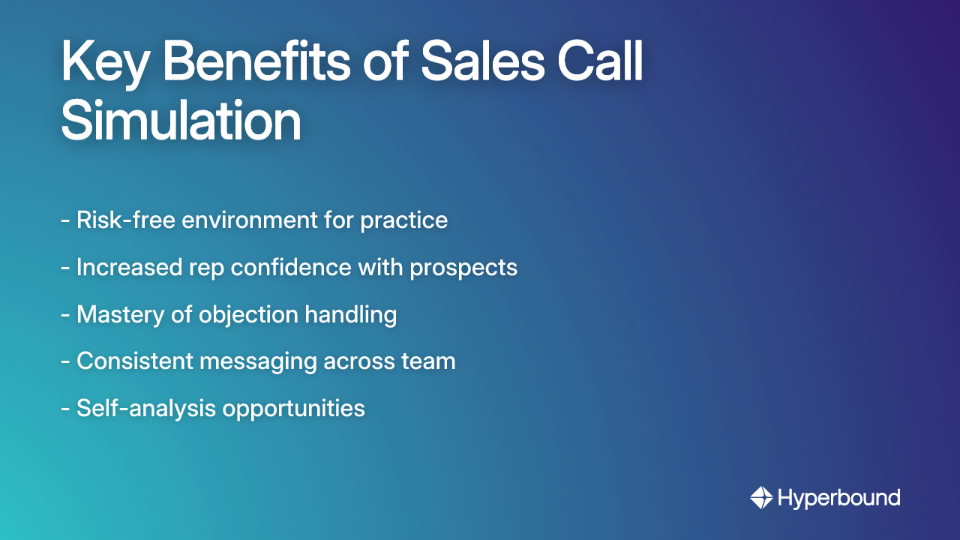
- Prepare Teams Without Risk: Allow reps to practice without potentially jeopardizing real deals, especially crucial when messaging for a new product is still being refined.
- Boost Confidence: Provide a safe space to make mistakes and learn, reducing the anxiety of real-call scenarios. This confidence is immediately apparent to prospects.
- Master Objection Handling: New products face unique objections. Simulation lets reps practice countering specific concerns until responses become second nature.
- Ensure Message Consistency: Align the entire team on the new product's value proposition and talking points, ensuring customers hear the same compelling story regardless of which rep they speak with.
- Enhance Self-Analysis: Recording practice sessions allows reps to review their own performance and identify improvement areas before receiving external feedback.
The goal of mock calling is to help sales reps build confidence and improve their selling skills in a controlled environment. This structured practice is especially critical when your team is navigating unfamiliar territory with a new offering.
The Foundation: Mastering Traditional Manager-Led Mock Calls
Traditional roleplay remains the foundation of effective sales training. Here's a comprehensive 10-step approach to conducting effective mock calls for your new product launch, based on proven methodologies:
- Simulate a Real Call: Recreate the entire experience, from dialing to introduction. For new product launches, this includes practicing the updated pitch and value proposition.
- Remove Visual Cues: Have the rep and "customer" sit back-to-back or be in different rooms to simulate the lack of visual feedback on a real call.
- Get into Character: The manager must fully adopt the prospect persona, including potential objections specific to the new product. Think: "Why should we switch from our current solution?" or "How is this different from what you sold us last year?"
- Record Calls for Review: Use recordings to track progress and objectively analyze performance, focusing on how well the new product's features and benefits are articulated.
- Self-Critique First: Always have the sales rep analyze their own performance before the manager gives feedback. This builds self-awareness and ownership of their development.
- Start with Easier Scenarios: Begin with simple calls (e.g., a warm intro) before tackling more complex objections about the new product.
- Schedule Regular Sessions: Practice must be consistent, not just a one-off during launch week. Block time on calendars for ongoing simulation.
- Focus on One Strategy at a Time: To avoid overwhelming reps, each session should target a single improvement area, like discovery questions or handling pricing objections specific to the new product.
- Elevate Difficulty Gradually: As reps gain confidence, introduce tougher scenarios and more challenging prospect personas who might be resistant to your new offering.
- Include Follow-Up Calls: Train on the entire sales cycle, including follow-up strategies crucial for closing deals with a new product.
For a new product launch, consider creating specific roleplay scenarios such as:
- The "What is this?" Cold Call: Introducing the new product to someone who's never heard of it.
- Overcoming the Status Quo: Dealing with a prospect content with their current solution.
- Handling Pricing Objections: Conveying value to justify the new product's price point.
- Navigating Technical Questions: Confidently answering detailed feature questions.
- The Competitive Takedown: Differentiating from established competitors.
The Scaling Challenge: Where Traditional Roleplay Falls Short
While manager-led roleplay is valuable, it has significant limitations, especially during a fast-paced product launch:
- Time-Consuming for Managers: It's nearly impossible for one manager to provide enough 1:1 practice for an entire team, creating a bottleneck.
- Lack of Objectivity: Feedback can vary widely between managers, leading to inconsistent skill development.
- Difficult to Scale: For large or remote teams, organizing consistent, high-quality mock calls becomes a logistical nightmare.
- Rep Discomfort: Roleplaying in front of peers or managers can feel awkward, preventing authentic practice.
These limitations become particularly problematic during a product launch, when you need your entire team ramped up quickly and consistently.

The Modern Solution: Scaling Readiness with AI Sales Roleplays
This is where technology provides a powerful solution. Modern AI platforms are designed specifically to overcome the challenges of traditional roleplay while maintaining the benefits of practice.
If you're skeptical about AI simulations being "robotic and not realistic," you're not alone. But the technology has evolved significantly. Platforms like Hyperbound go beyond generic chatbots by analyzing your own team's winning sales calls to create hyper-realistic AI buyer personas. This means the AI learns your talk tracks, your customer objections, and your market dynamics.
For a new product launch, advanced AI roleplays offer several key advantages:
- Scale Your New Playbook: Upload your new product's messaging, talk tracks, and competitive positioning into the platform. Hyperbound's AI Sales Roleplays allow you to create customizable scenarios tailored to your product's specific ICPs and methodologies.
- Practice On-Demand: Reps can practice critical conversations—cold calls, discovery, demos, and objection handling for the new product—with an AI persona 24/7, getting unlimited "at bats" without burning out managers or peers.
- Get Instant, Personalized Coaching: The AI provides immediate feedback aligned with your methodology. Hyperbound's AI Coaching identifies missed opportunities or weak responses in real-time, accelerating the learning curve before reps ever talk to a real customer.
- Certify Your Team: Use the platform to ensure every rep has mastered the new messaging before they speak to a single prospect, ensuring consistency across your entire organization.
This approach directly addresses the concern from sales professionals who want to "pre-load our most common objections/obstacles and have the system score them." With AI-powered scorecards, reps receive objective feedback on their performance, tracking key metrics and selling moments without relying solely on manager availability.
A Unified Playbook: Best Practices for Any Sales Simulation
Whether you're using manager roleplay, AI simulation, or a combination of both, these principles are key to successful sales call practice for your product launch:
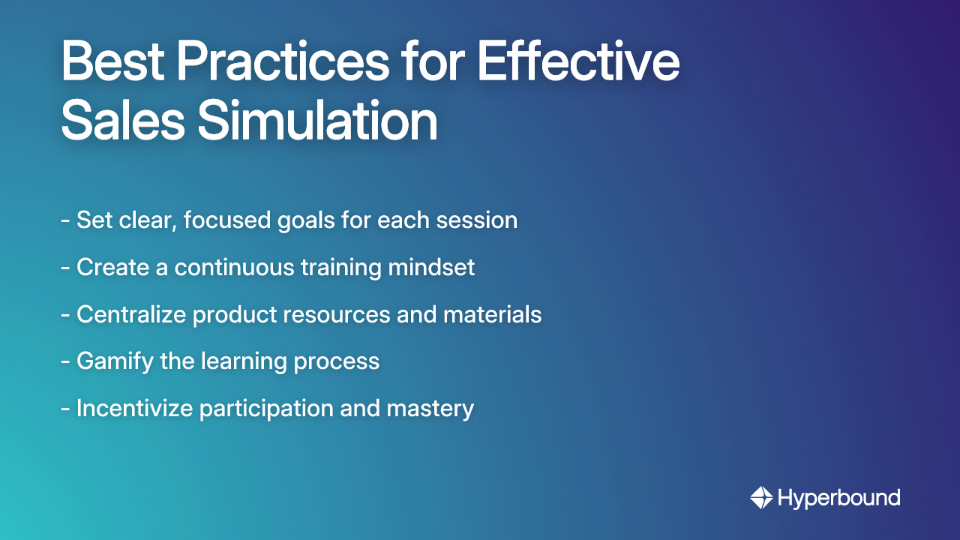
- Set Clear, Focused Goals: Establish specific objectives for each practice session. Don't try to cover everything; focus on one skill at a time. For example, "Today we're practicing handling the price increase objection for our new enterprise tier."
- Create a Continuous Training Mindset: Treat product launch training as an ongoing process, not a one-time event. Schedule regular practice sessions to reinforce messaging and address emerging objections.
- Centralize Your Resources: Ensure all reps have easy access to marketing collateral, sales guides, pricing, and competitive analysis for the new product in a centralized platform.
- Gamify the Process: Use leaderboards, quizzes, and competitions to make learning engaging. This can be done manually or through platforms with built-in gamification features.
- Incentivize Participation: Motivate reps with higher commission rates or prizes for mastering the new product pitch and exceeding early adoption targets.
From Practice to Performance
A new product launch is too important to leave to chance. Your sales team's readiness is the single biggest factor in its success.
Effective preparation requires a blended approach: start with the proven fundamentals of manager-led mock calls to establish a solid foundation, then scale your efforts with modern tools like Hyperbound that provide unlimited, realistic, and data-driven practice.
This combination ensures that every rep becomes a confident expert on your new product from day one—not just understanding its features and benefits, but mastering the art of positioning it effectively to prospects with varying needs and objections.
Ultimately, the goal is to build a culture of continuous improvement where practice isn't seen as a chore, but as the strategic advantage that separates your team from the competition. Because when the pressure is on and that big opportunity is on the line, it's not the product that closes the deal—it's the prepared, practiced, confident rep who knows exactly what to say and when to say it.
After all, in sales, we don't rise to the level of our aspirations; we fall to the level of our training. Make sure your training gives your team—and your new product—the best possible chance to succeed.
Frequently Asked Questions
What is a mock sales call?
A mock sales call is a training exercise where sales representatives practice their selling skills in a controlled, risk-free environment. This simulation allows them to test new strategies, refine their pitch for a new product, and handle objections without jeopardizing a real sales opportunity.
Why is sales call simulation important for a new product launch?
Sales call simulation is crucial for a new product launch because it prepares the entire team to be sharp and consistent from day one. Key benefits include boosting rep confidence, mastering new objection handling, ensuring consistent messaging across the team, and providing a risk-free environment to practice the new value proposition.
How do you conduct an effective mock sales call?
To conduct an effective mock sales call, you should simulate a real call experience, remove visual cues to mimic a phone call, have the manager adopt a realistic customer persona, record the session for review, and have the rep self-critique first. It's also vital to start with easier scenarios and gradually increase the difficulty.
What are the limitations of traditional manager-led roleplay?
Traditional manager-led roleplay can be very time-consuming for managers, making it difficult to provide sufficient practice for an entire team. Other limitations include the potential for subjective or inconsistent feedback, logistical challenges in scaling for large or remote teams, and rep discomfort when practicing in front of peers.
How can AI improve sales call simulations?
AI can improve sales call simulations by providing a scalable, on-demand practice solution that overcomes the limitations of traditional roleplay. AI platforms allow reps to practice anytime, receive instant and objective feedback based on a proven methodology, and help managers certify that the entire team has mastered the new product messaging.
Are AI sales simulations realistic?
Yes, modern AI sales simulations can be highly realistic. Advanced platforms analyze your own team's winning sales calls to create AI buyer personas that learn your specific talk tracks, common customer objections, and market dynamics, ensuring the practice is relevant and not "robotic."
What are the best practices for any sales simulation?
The best practices for any sales simulation, whether AI or manager-led, include setting clear and focused goals for each session, creating a continuous training mindset, centralizing all product resources for easy access, and gamifying the process with leaderboards or incentives to keep reps engaged and motivated.
Book a demo with Hyperbound


