

.png)
You've seen it in every sales organization. The 80/20 rule is alive and well: a small fraction of your sales team consistently delivers the majority of revenue. These top performers seem to have an innate ability to connect with prospects, handle objections effortlessly, and close deals that others can't.
But what if you could clone your A-players? What if every rep could adopt the winning behaviors that make your top performers so successful?
The Scalability Challenge in Sales Excellence
Sales leaders have wrestled with this challenge for decades. As one sales manager lamented on Reddit, there's a "lack of tools to assess and improve representative skill gaps beyond individual calls." Others express frustration with the "difficulty in getting actionable feedback from call transcripts" or note that "ChatGPT lacks the realism in roleplaying difficult sales scenarios."
These pain points highlight a universal challenge: identifying, codifying, and scaling the behaviors that drive sales success.
Fortunately, AI is transforming this landscape. It's no longer just a buzzword but a practical solution to an age-old problem. Consider these statistics:
- 83% of sales teams using AI saw revenue growth this year vs. 66% not using AI (Salesforce)
- The adoption of generative AI has skyrocketed, with 65% of organizations reporting regular use, up from just 33% last year (McKinsey)
This article provides a practical blueprint for how sales leaders can use AI to identify the winning habits of their best reps and systematically scale those behaviors across their entire organization – moving beyond theory to actionable strategy.
Decoding Excellence: What Do Top Performers Actually Do Differently?
Before we can scale top performer behaviors, we need to understand exactly what sets them apart. According to research into top sales behaviors, the differences are often subtle but powerful:
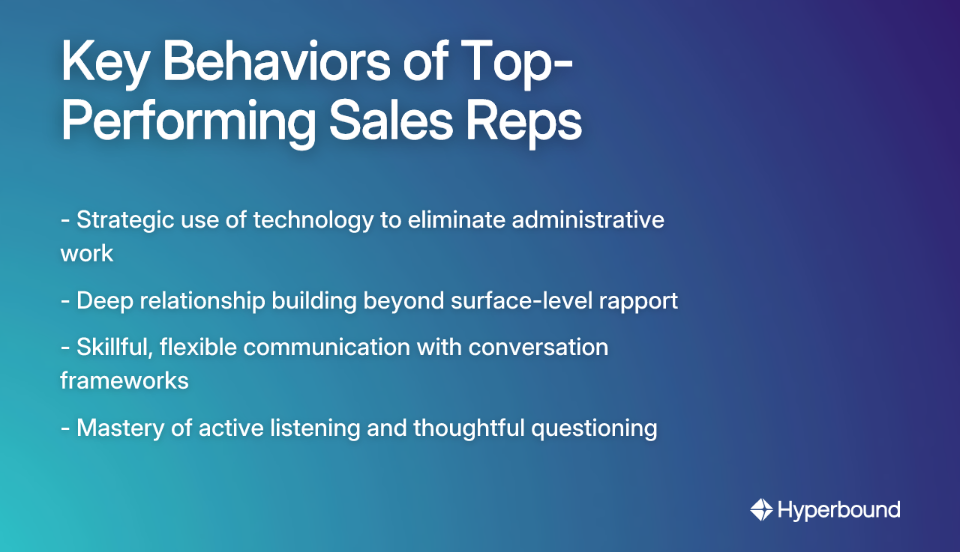
Strategic Technology Usage
Top performers use technology to eliminate low-value administrative work. They leverage tools to automate CRM updates, meeting scheduling, and other tasks that take time away from high-value selling activities.
Deep Relationship Building
A-players go beyond surface-level rapport. They conduct thorough research to understand the prospect's entire business context and find genuine common ground. This preparation allows them to establish trust more quickly and effectively.
Skillful, Flexible Communication
Rather than rigidly following scripts, top performers use flexible conversation frameworks that guide dialogue while allowing for natural exploration. They use focused, concise language tailored to the prospect's specific needs and Ideal Customer Profile (ICP).
Mastery of Active Listening
Elite salespeople allow for thoughtful pauses after a prospect speaks. They take detailed notes and ask clarifying questions to uncover the root of the problem, not just the stated need. This deep listening distinguishes them from average performers who are often just waiting for their turn to talk.
The challenge is that these behaviors are often intuitive and hard to articulate. Top performers might not even recognize why they're successful – they just "do what works." This is precisely where human observation and traditional coaching fall short.
The Traditional (And Broken) Approach to Scaling Sales Excellence
For decades, organizations have relied on conventional methods to spread best practices:
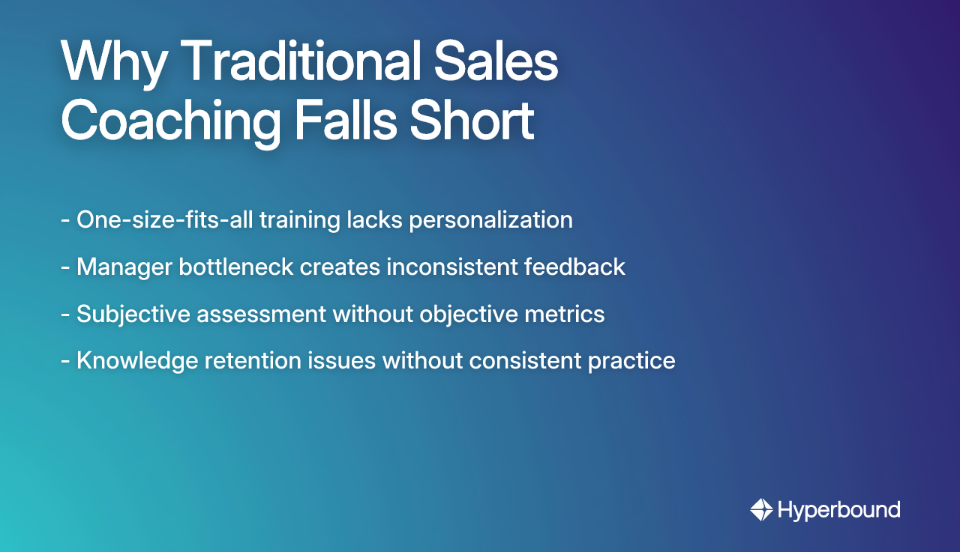
One-Size-Fits-All Training
Traditional training often fails because it's not personalized. A new SDR doesn't need the same coaching as a tenured AE struggling with a new sales methodology like MEDDIC.
Manager Bottleneck
Manual call reviews are incredibly time-consuming. Managers are overwhelmed, leading to inconsistent and infrequent feedback. One sales leader on Reddit described the challenge of providing feedback on call transcripts: "It's difficult to get actionable feedback" at scale.
Lack of Objective Data
Traditional coaching is often based on gut feelings rather than objective metrics. It's hard to prove if coaching is actually working or if a rep is improving when assessment criteria vary between managers.
The "Forgetting Curve"
Most training is forgotten without consistent reinforcement. A one-off workshop on handling objections has little long-term impact unless reps can practice regularly in a realistic environment.
These limitations create a ceiling on how effectively organizations can scale their top performers' behaviors. Fortunately, AI provides a solution.
A Practical Blueprint: How to Scale Top Performer Behaviors with AI
Here's a step-by-step guide to implementing an AI-driven coaching program that can transform your sales organization:
Step 1: Analyze & Codify Winning Behaviors
The What: The first step is to move from anecdotal evidence to data-driven insights. Use AI to analyze thousands of your actual sales calls (both wins and losses) to identify the specific talk tracks, questioning patterns, and techniques that correlate with success.
The How:
- Leverage conversational intelligence platforms that can automatically score real calls against your ideal framework
- Look beyond basic metrics like talk-to-listen ratios to identify if reps are using your approved messaging, asking the right discovery questions, and effectively articulating value propositions
- Extract patterns across multiple calls to identify systemic strengths and weaknesses
For example, platforms like Hyperbound use AI Real Call Scoring to analyze calls against your custom sales methodology. The AI creates an AI Deal Summary, extracting key moments and buying signals, saving managers hours of manual review time while providing objective data on what's working and what's not.
Step 2: Create a Hyper-Realistic Practice Environment
The What: Once you've identified winning behaviors, you need a safe, repeatable way for the rest of the team to practice them. This is where AI roleplay becomes critical.
The How:
- Use insights from Step 1 to build hyper-realistic AI-powered role-play scenarios tailored to your specific products, competitors, and ICP
- Simulate diverse scenarios: Reps should practice everything from cold calls and discovery to demos, objection handling, and even difficult post-sales conversations
- Ensure the AI responses feel authentic and challenging, not generic or oversimplified
As one sales rep noted on Reddit: "Limited realism in AI tools hinders effective preparation for real sales conversations." The key is to find tools that create genuinely realistic interactions that prepare reps for the complexity of real-world sales situations.
Hyperbound's AI Sales Roleplays, for instance, allow you to create customizable scenarios where reps practice with AI buyer personas that respond dynamically based on your actual sales conversations. This provides a risk-free environment to master new talk tracks before speaking to a live prospect.
Step 3: Deliver Instant, Objective, and Scalable Feedback
The What: Practice is useless without feedback. AI can provide immediate, unbiased coaching after every single practice session or real call, breaking the reliance on manager availability.
The How:
- Implement AI that scores every interaction against a predefined rubric based on your top performers' behaviors
- Ensure feedback is instant and specific – for example, flagging when a rep missed a buying signal or failed to counter an objection effectively
- Incorporate gamified training elements like leaderboards to motivate reps and foster healthy competition
With AI Coaching tools like those offered by Hyperbound, reps receive real-time feedback aligned with your company's playbook. They can identify missed opportunities and weak responses instantly, empowering them to self-correct and improve continuously without waiting for a 1:1 with their manager.
As one sales professional shared: "It makes it feel like I'm actually improving" when they can see tangible progress through objective scoring.
Step 4: Reinforce, Certify, and Scale Across the Org
The What: Use your AI-driven system to power all your sales enablement initiatives, ensuring new strategies are adopted quickly and consistently.
The How:
- Onboarding & Certification: Drastically reduce new hire ramp time by having them practice core scenarios until they are certified
- Change Management: When rolling out a new product or pricing, use AI roleplays to ensure every rep can articulate the new messaging flawlessly
- Hiring: Use AI roleplay assessments to screen sales candidates objectively based on their actual selling abilities, not just interview skills
For example, Hyperbound's platform supports these uses cases from onboarding to change management, even offering AI Roleplay Hiring Assessments to identify top talent early in the recruitment process.
Bringing It All Together: The Power of an Integrated AI Coaching Platform
The real power comes from a system that connects all the dots:
- Analyze real calls to find what works (AI Real Call Scoring)
- Build realistic practice based on those findings (AI Sales Roleplays)
- Deliver instant, personalized feedback to drive improvement (AI Coaching)
- Track progress with analytics to measure the impact on business metrics
This integrated approach delivers tangible benefits:
- Reduce Ramp Time: Get new hires productive and quota-achieving faster by providing them with more lifelike practice opportunities
- Drive Consistency: Ensure every rep, regardless of tenure or location, is delivering your message effectively
- Scale Coaching Effectively: Empower managers to coach more strategically by automating call review and providing reps with self-serve practice tools
- Improve Sales Metrics: Increase close rates, book more qualified meetings, and improve overall sales productivity

The Future of Sales iIs Continuous, Data-Driven Improvement
The key to scaling excellence isn't about finding more "A-players"—it's about building a system that elevates the entire team. AI provides the tools to finally make this possible.
We're moving from a world of static, one-off training events to a dynamic, continuous learning journey where every rep gets personalized coaching on every call. The result is a sales organization where excellence isn't the exception but the standard.
It's time to stop relying on outdated methods and start exploring how an AI coaching platform can transform your sales organization. By implementing the blueprint outlined in this article, you can systematically identify what makes your top performers successful and scale those behaviors across your entire team.
The technology is here. The question is: are you ready to use it?
Frequently Asked Questions
What is AI sales coaching and how does it work?
AI sales coaching is a technology-driven approach that uses artificial intelligence to analyze sales conversations, provide personalized feedback, and create realistic practice environments for sales representatives. It works by ingesting real call data to identify successful patterns, using those insights to build hyper-realistic roleplay scenarios, and delivering instant, objective feedback to reps after every interaction, helping them improve continuously without waiting for a manager.
How does AI identify the "winning behaviors" of top sales reps?
AI identifies winning behaviors by analyzing thousands of actual sales calls from both top and average performers. Using conversational intelligence, the AI transcribes and scores calls against a company's specific sales methodology, looking for patterns in language, questioning techniques, objection handling, and talk-to-listen ratios that correlate with successful outcomes like booked meetings or closed deals. This data-driven approach moves beyond anecdotal evidence to codify what truly works.
Why is AI-powered coaching more effective than traditional methods?
AI-powered coaching is more effective because it is scalable, objective, and personalized, overcoming the limitations of traditional methods. Unlike one-size-fits-all training, AI delivers tailored feedback to each rep based on their specific performance. It eliminates the manager bottleneck by providing instant coaching 24/7 and uses objective data rather than subjective opinions, ensuring consistency and measurability across the entire sales team.
How does AI sales roleplay prepare reps for real-world conversations?
AI sales roleplay prepares reps by providing a safe, repeatable, and hyper-realistic practice environment. These platforms use insights from your actual sales calls to create AI buyer personas that respond dynamically and realistically to the rep's approach. This allows reps to master new messaging, practice handling difficult objections, and build confidence in a risk-free setting before ever speaking with a live prospect.
What are the main benefits of implementing an AI coaching platform?
The main benefits of an AI coaching platform include faster new hire ramp-up, improved message consistency across the team, more effective and scalable coaching, and ultimately, better sales metrics. By providing continuous practice and personalized feedback, these platforms help reps become productive more quickly, ensure everyone is aligned with the company playbook, and free up managers to focus on high-level strategy, leading to more booked meetings and higher close rates.
What is the role of a sales manager when using an AI coaching platform?
An AI coaching platform elevates the role of a sales manager from a call reviewer to a strategic coach. Instead of spending hours listening to calls to find coachable moments, managers can use AI-generated summaries and scores to quickly identify systemic issues and individual skill gaps. This frees them up to focus on higher-value activities like deal strategy, career development, and targeted coaching on complex skills, making their 1:1s more impactful.
Looking to implement this blueprint in your organization? Learn more about how Hyperbound's AI Sales Coaching platform can help you analyze winning behaviors, create realistic practice environments, and deliver scalable coaching across your entire sales team.
Book a demo with Hyperbound


