

.png)
Summary
- A single poor interaction can cause 1 in 3 customers to leave, making check-in calls with at-risk accounts critical for retention.
- Proactively identify at-risk customers by monitoring signals like dropping product usage, champion departures, and increased support tickets.
- Master crucial conversations by roleplaying key scenarios, such as handling value objections, re-engaging with new stakeholders, and de-escalating frustrated users.
- Scale this practice effectively with AI Post-Sales Roleplays, allowing teams to master difficult conversations with consistent, on-demand coaching.
You've seen the data—product usage is down, their champion just updated their LinkedIn, and support tickets are piling up. Now you have to make the check-in call. What do you say? How do you turn a potential churn into a saved account without sounding desperate?
The stakes couldn't be higher. According to PwC research, 1 in 3 customers will leave a brand after just one poor interaction, and nearly 90% will leave for good if it happens repeatedly. That single check-in call could be the difference between renewal and churn.
Roleplaying isn't just a cheesy training exercise—it's your critical practice ground for building conversational muscle memory. It's where you develop the empathy, strategic questioning, and value reinforcement skills needed to navigate high-pressure customer situations.
This guide provides a comprehensive framework for Customer Success and Account Management teams to effectively roleplay check-in calls with at-risk customers. We'll cover how to identify at-risk signals, design and execute realistic roleplay scenarios, and leverage modern tools to scale this practice for consistent, team-wide improvement.
The Foundation: Identify At-Risk Signals Before You Roleplay
.png)
You can't practice for a conversation if you don't know what warning signs to look for. Before jumping into roleplays, you need to understand the common indicators that a customer might be headed for the exit.
Define Your Leading At-Risk Indicators
Identifying churn risk requires looking at both quantitative and qualitative data. Relying solely on usage metrics without proactive communication can obscure important warning signs.
Quantitative (Usage-Based) Indicators:
- Sudden or steady drops in product usage or key feature adoption
- Delayed payments or overdue accounts
- Slow or stalled progress during onboarding
- Missed implementation milestones
Qualitative (Relationship-Based) Indicators:
- The Champion Leaves: The departure of your primary contact or internal champion
- Support Ticket Trends: A sudden spike in support tickets, or a shift towards more critical issues
- Negative Sentiment: Low NPS scores or negative feedback during check-ins
- Going Dark: A previously engaged customer stops responding to emails or calls (ghosting)
Understand the Common "Why" Behind Churn
To make roleplays realistic, the "customer" needs authentic motivation. The most common reasons customers churn include:
- Lack of perceived value or ROI
- Poor fit between the client's needs and the product's capabilities
- Internal changes at the client's company (acquisitions, new leadership, new investors)
- Economic downturns impacting the client's budget
- A poor customer experience or friction with the product
When you understand these motivations, you can design roleplays that prepare your team for the real conversations they'll need to have with at-risk customers.

A Step-by-Step Guide to Conducting Effective Roleplays
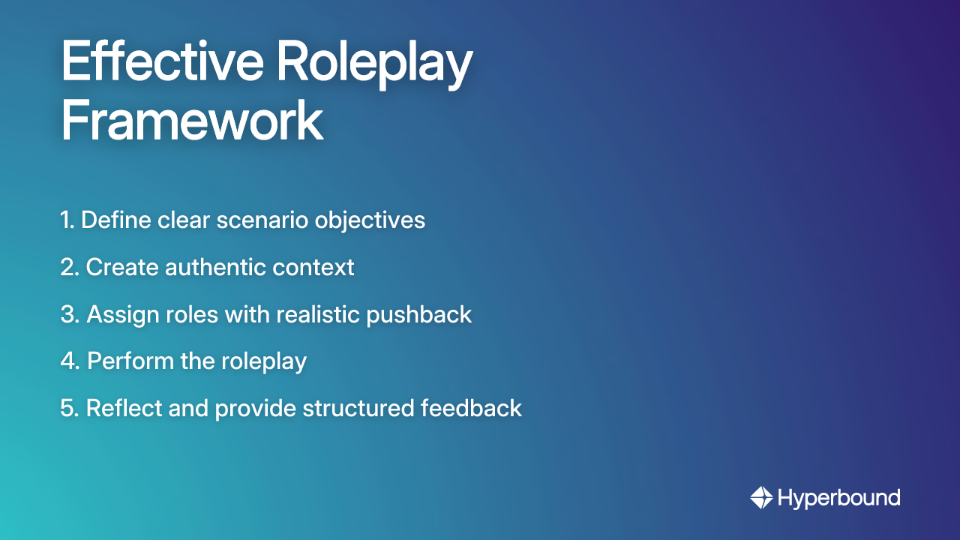
Let's break down the process for running productive roleplay sessions that prepare your team for these critical conversations.
Step 1: Set the Stage (Define the Scenario and Objectives)
Clearly state the goal of the simulated call. Is it to:
- Uncover the root cause of low usage?
- Build a relationship with a new stakeholder?
- De-escalate a frustrated user?
- Secure a follow-up meeting with a decision-maker?
Having a clear objective helps both participants understand what success looks like for the roleplay.
Step 2: Add Rich Context for Authenticity
To avoid unrealistic roleplay scenarios that don't prepare reps for actual conversations, provide detailed context:
Template for a Scenario Brief:
- Customer Profile: ACME Corp, a 500-employee tech company, your ICP
- At-Risk Indicator: Their product usage has dropped by 40% in the last 60 days
- Background Intel: Their main champion, Jane, left the company a month ago. The new VP, Bob, is known for cutting costs
- Customer's Hidden Objection: Bob thinks the platform is a "nice-to-have" and is actively reviewing a cheaper competitor
- Rep's Goal: Secure a 30-minute meeting with Bob to re-establish the platform's value and tie it directly to his departmental goals
Step 3: Assign Roles and Perform the Roleplay
One person plays the Customer Success Manager (CSM), and the other plays the at-risk customer. Encourage the "customer" to escalate and be difficult, mirroring real-life scenarios. The more realistic the pushback, the better prepared the CSM will be when facing actual customer objections.
Step 4: Reflect and Debrief
The most crucial step is the post-roleplay discussion. After the simulation, discuss what happened using guiding questions:
- What went well?
- Where did the conversation get stuck?
- What could the CSM have asked differently?
- Did the CSM successfully de-escalate the situation and establish a clear next step?
This structured feedback process helps participants extract valuable lessons from the experience.
The At-Risk Customer Roleplay Playbook: 5 Scenarios to Master
Here are five common scenarios your team should practice to build confidence and competence in handling at-risk customers:
Scenario 1: The "Value Questioner" - Objection Handling
Customer Says: "We're just not seeing the ROI we expected," or "This is becoming too expensive for what we're getting out of it."
Skills to Practice:
- Probing for the real issue behind the statement
- Reinforcing value by connecting features to their business outcomes
- Handling pricing objections gracefully
Feedback Criteria: Did the rep transition from the objection effectively without getting defensive? Did they successfully pivot to value instead of features?
Scenario 2: The "New Sheriff in Town" - Getting to Power
Customer Says: "Jane Doe was the one who managed this relationship, but she's no longer with the company. I'm taking over for now."
Skills to Practice:
- Quickly establishing credibility
- Re-running a mini-discovery to understand the new stakeholder's priorities
- Re-selling the value proposition from scratch
Feedback Criteria: How effective was the rep in building rapport and securing a follow-up meeting to demonstrate value tailored to the new contact's goals?
Scenario 3: The "Competitor Flirter" - Competitive Defense
Customer Says: "We've been looking at Competitor X, and they offer a similar service for 20% less."
Skills to Practice:
- Highlighting unique differentiators and the total cost of ownership
- Avoiding bad-mouthing the competition
- Re-anchoring the conversation on the customer's specific problems that your solution solves best
Feedback Criteria: Did the rep focus on their product's unique capabilities to solve the customer's specific challenges?
Scenario 4: The "Unhappy User" - De-escalation & Negotiation
Customer Says: "I'm frustrated. The platform was down during a critical report pull, and your support team took 24 hours to get back to me."
Skills to Practice:
- Active listening and sincere empathy
- Staying calm under pressure
- Negotiating a fair resolution (e.g., service credit, a direct line to a senior engineer for their next project)
Feedback Criteria: Did the rep successfully de-escalate the customer's frustration? Did they use "give and get" strategies to find a middle ground?
Scenario 5: The "Silent Treatment" - Proactive Discovery
Indicator: This isn't what the customer says, but what they don't do. Usage is down, they're not responding to emails. The rep needs to initiate the call.
Skills to Practice:
- Opening the call without being accusatory
- Using open-ended discovery questions to uncover hidden challenges
- Creating a reason for them to re-engage
Example Questions: "What are the main challenges you are currently facing?" "What requirements do you have based on your current situation that we might not be aware of?"
Scaling Your Practice and Feedback with AI
While manual roleplay is valuable, it comes with real-world limitations that can hinder your team's growth:
The Challenge with Manual Roleplay
- Time-Consuming: Managers can't be in every practice session
- Inconsistent Feedback: Feedback quality varies from manager to manager and can be subjective
- Lack of Realism: Colleagues may not be able to accurately simulate a truly difficult customer
- No Data for Coaching: It's hard to track improvement over time or identify team-wide skill gaps

The Solution: AI-Powered Roleplay & Coaching
Modern AI tools are transforming how customer success teams practice these critical conversations. Platforms like Hyperbound offer solutions specifically designed to overcome the limitations of traditional roleplays.
Hyper-Realistic Practice: Hyperbound's AI Post-Sales Roleplays allow reps to practice against AI-driven customer personas that can be customized to mirror your actual at-risk customer profiles. This ensures reps are prepared for nuanced, difficult conversations with various customer types and scenarios.
Instant, Objective Feedback: With AI-powered scorecards, each practice session is analyzed against your company's playbook or customer success methodology. Reps get immediate, data-driven feedback on what they did well and where they missed opportunities, removing manager subjectivity from the equation.
Scalable, On-Demand Coaching: Using AI Coaching, every rep can practice these tough scenarios as many times as they need, whenever they want. Managers are freed up to focus on high-level strategy, while the platform handles the repetitive practice and feedback.
Example Use Case: Imagine loading the "Value Questioner" scenario into Hyperbound. Your CSM can practice the call with an AI that's been trained on your top objections. Instantly after the call, Hyperbound's AI Real Call Scoring engine provides a scorecard showing they failed to ask any discovery questions before jumping to a solution, and provides a coaching tip for next time. The manager can then review the patterns across the team and see that "asking discovery questions" is a team-wide skill gap that needs to be addressed in the next training session.
Conclusion
Preventing churn starts long before the renewal date. It begins with proactively identifying at-risk signals and equipping your team with the confidence and skills to navigate these crucial check-in calls. The path to mastery follows a clear progression: identification → scenario design → consistent practice.
Don't let your team's first time handling a high-stakes customer conversation be on a live call. Build their skills in a safe, repeatable environment so they can turn at-risk accounts into loyal advocates.
Frequently Asked Questions
What is roleplaying in customer success?
Roleplaying in customer success is a training method where team members simulate real-world customer conversations in a controlled environment. It allows Customer Success Managers (CSMs) to practice navigating difficult scenarios, such as handling objections from an at-risk customer, without the pressure of a live interaction. The goal is to build conversational skills, test strategies, and improve outcomes like customer retention and satisfaction.
Why is it important to roleplay conversations with at-risk customers?
Roleplaying conversations with at-risk customers is crucial for building the "conversational muscle memory" needed to handle high-stakes situations effectively. It prepares CSMs to respond with empathy, reinforce value, and strategically guide conversations away from churn and toward a positive resolution. This practice turns potentially brand-damaging interactions into opportunities to strengthen customer relationships and save accounts.
How do you identify an at-risk customer?
You can identify an at-risk customer by monitoring a combination of quantitative and qualitative signals. Key indicators include declining product usage, a key champion leaving the company, an increase in support tickets, negative feedback or low NPS scores, and a customer becoming unresponsive ("going dark"). Tracking both usage data and relationship health provides a comprehensive view of churn risk.
What are the key steps to run an effective roleplay session?
An effective roleplay session follows a clear, structured framework. The key steps are: 1) Define a clear objective for the simulated call; 2) Create an authentic scenario with rich context, including the customer's profile and potential objections; 3) Assign roles and perform the simulation, encouraging realistic pushback; and 4) Reflect and debrief with structured feedback to identify strengths and areas for improvement.
What common at-risk scenarios should customer success teams practice?
Customer success teams should practice a variety of common scenarios to be fully prepared. These include handling objections about perceived value or ROI ("The Value Questioner"), building rapport with a new stakeholder after a champion leaves ("The New Sheriff in Town"), defending against competitors ("The Competitor Flirter"), and de-escalating frustrated users with product or support issues ("The Unhappy User").
How can AI improve roleplaying for customer success teams?
AI significantly improves roleplaying by making it scalable, consistent, and data-driven. AI-powered platforms like Hyperbound provide on-demand practice against realistic customer personas, eliminating scheduling conflicts and the need for a manager in every session. They also deliver instant, objective feedback based on your specific playbook, helping to identify skill gaps and track improvement over time in a way that is difficult to achieve with manual roleplay alone.
Ready to transform your team's ability to handle tough customer conversations? Explore Hyperbound's AI Post-Sales Roleplays and see how scalable, objective practice can protect your revenue and delight your customers.
Book a demo with Hyperbound


