.png)


.png)
Summary
- Traditional call coaching is ineffective, with managers reviewing less than 1% of calls, creating huge performance gaps and inconsistent feedback.
- The solution is to shift from random call listening to a targeted strategy where AI analyzes 100% of conversations to identify winning patterns and coachable moments at scale.
- An effective AI coaching framework involves four key steps: analyzing winning behaviors, facilitating active practice, automating call scoring, and delivering instant feedback.
- Platforms like Hyperbound empower sales teams to implement this framework with tools for call analysis, AI-powered roleplays, and automated, objective feedback to scale high-performance coaching.
You're drowning in call recordings but feel like your team's skills aren't improving? You're not alone. Many sales leaders find themselves stuck in a cycle of random call listening, struggling to find truly coachable moments amidst the noise.
While some conversational intelligence tools are powerful, their six-figure price tags put them out of reach for many teams. This has led to legitimate skepticism about the real ROI of AI sales coaching solutions and a desire for more affordable, effective alternatives.
The hard truth? Traditional call review is fundamentally broken. Sales leaders review less than 1% of all sales calls, leaving massive performance gaps and missed coaching opportunities. There's also a huge disconnect: 80% of sales leaders believe their coaching is effective, but only 38% of their reps agree.
The solution isn't to listen to more calls, but to listen smarter. Let's explore how to replace random, time-consuming call reviews with targeted, scalable AI coaching moments that actually move the needle on performance.
Why the Old Model of Call Coaching is Broken
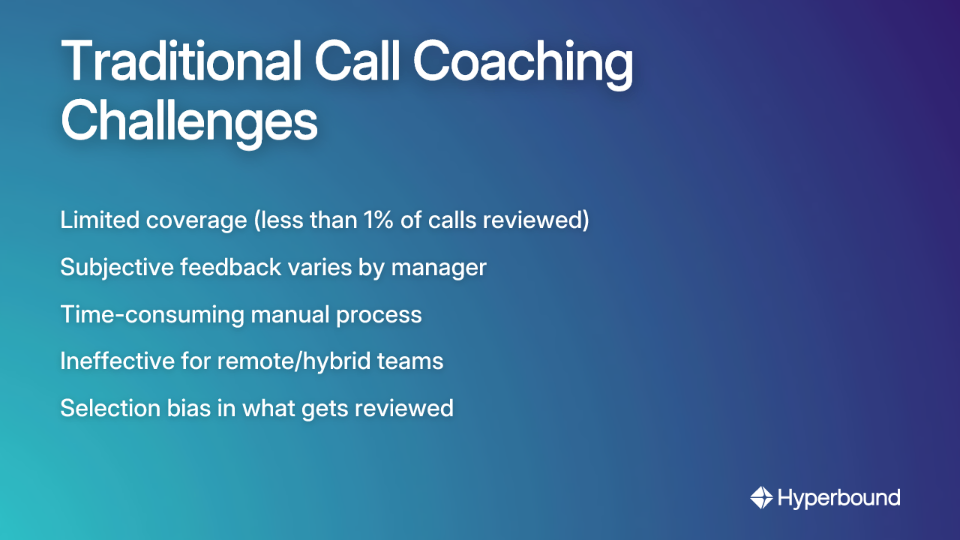
Before diving into solutions, let's understand why traditional call coaching fails to deliver results:
Impossible Coverage & Selection Bias
With managers reviewing less than 1% of calls, coaching is based on a tiny, often unrepresentative sample. Most managers lack a systematic way to prioritize calls, leading to personal bias in what gets reviewed. They might pick the shortest call, the most recent, or one from a favorite rep—not the one with the most critical coaching opportunity.
The Manager Time Sink
Sales managers are already swamped with administrative tasks, CRM analysis, and meetings, leaving little time for deep call reviews. The process is tedious: manually listening to a 30-minute call, taking notes, and preparing feedback can take an hour or more. This makes consistent, thorough coaching nearly impossible.
Subjective and Inconsistent Feedback
Without a standardized scorecard, feedback becomes highly subjective and varies dramatically from manager to manager. One might focus on talk time, another on discovery questions, and a third on closing techniques. This creates a confusing, inconsistent experience for reps trying to improve.
Ineffective for Remote & Hybrid Teams
The "eavesdrop" or "ride-along" coaching model is dead. For remote teams, providing instant feedback is a major challenge, leading to inconsistent coaching quality based on manager availability and time zone differences.
The New Paradigm: Targeted, Data-Driven AI Coaching
AI sales coaching uses artificial intelligence to analyze 100% of sales conversations, identify key moments, and deliver real-time, personalized training and feedback at scale. It's about turning raw conversational intelligence into actionable coaching.
How AI Coaching Works
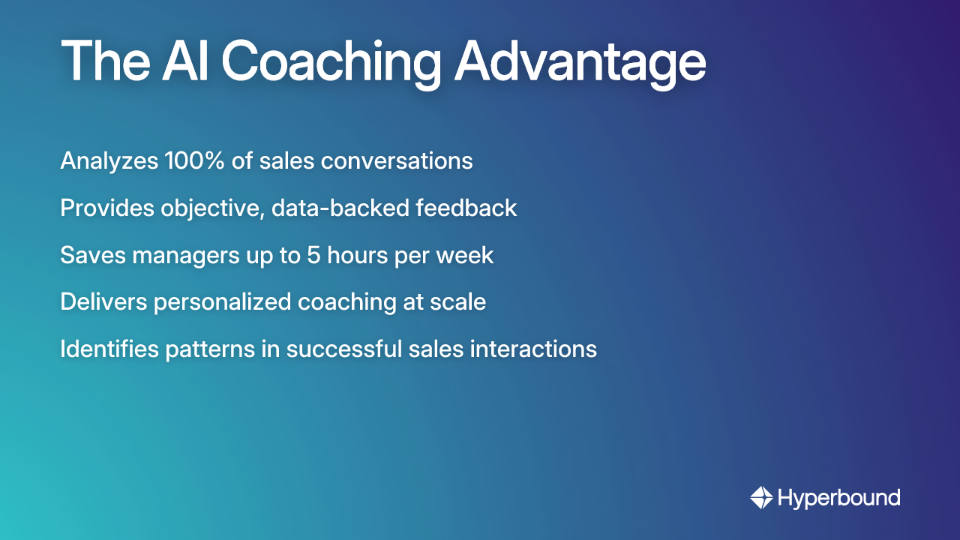
- Data Ingestion: AI gathers data from call recordings (by integrating with your existing call recording platforms and CRMs, or by using its own recorder), CRM data, emails, and other customer touchpoints.
- Analysis: Machine learning algorithms analyze every call against your custom sales methodology. It assesses talk tracks, question quality, pacing, tone, and objection handling techniques.
- Feedback & Insights: The system delivers tailored, objective feedback. It can automatically surface calls that need attention, summarize key moments, and flag missed opportunities.
- Personalized Learning: Based on performance data, AI can suggest personalized coaching plans or targeted exercises to close specific skill gaps.
The result? A system that provides objective, data-backed feedback, frees up manager time (saving up to 5 hours per week), and ensures every rep gets the guidance they need.
A 4-Step Framework to Implement Targeted AI Coaching
Let's move from theory to practice with an actionable framework for sales leaders looking to transform their coaching strategy.
Step 1: Analyze Your Winning Patterns
Problem: You can't coach effectively if you don't know what "good" looks like for your specific product and Ideal Customer Profile (ICP).
Solution: Use AI to analyze thousands of your team's actual sales calls (both wins and losses) to identify the specific talk tracks, questions, and behaviors that correlate with success.
Example in Action: Platforms like Hyperbound can analyze your call library to uncover the techniques of your top reps. This data becomes the foundation for your scorecards and coaching criteria, ensuring feedback is aligned with what actually works in your unique selling environment.
Step 2: Shift from Passive Review to Active Practice
Problem: Listening to a past call is one thing. Preparing for the next one is another. Reps need a safe space to practice and fail without risking live deals.
Solution: Use the insights from Step 1 to build a library of hyper-realistic practice scenarios based on your actual sales conversations.
Example in Action: With AI-powered sales roleplays, reps can practice with AI buyer personas that respond naturally to their approaches. They can run through entire sales cycles: cold calling, discovery, demos, and objection handling. This provides unlimited, risk-free practice that scales far beyond a manager's availability.
Tools like Hyperbound's AI Sales Roleplays offer gamified leaderboards to motivate reps and make practice engaging rather than feeling like homework.

Step 3: Automate Call Scoring for 100% Coverage
Problem: You can't manually review and score every call. It's physically impossible.
Solution: Deploy AI to automatically listen to and score 100% of your team's real customer conversations against your custom sales methodology and scorecards.
Example in Action: AI-powered call scoring can integrate with your existing call recorder and automatically evaluate every interaction. The system flags calls for manager review, provides an AI deal summary with key moments, and can even draft follow-up emails, enforcing sales discipline.
This solves the common pain point of needing "customizable assessment tools to evaluate and align sales rep skills" that many sales leaders express frustration about.
Step 4: Deliver Instant, Actionable Coaching Moments
Problem: Feedback delivered days or weeks after a call loses its impact.
Solution: Leverage AI to provide immediate, personalized feedback after each interaction, allowing reps to self-correct and learn in the flow of work.
Example in Action: AI coaching systems like Hyperbound deliver instant feedback aligned with your playbook. They identify missed opportunities, weak responses, or off-track messaging, giving reps targeted insights they can act on immediately, without waiting for their manager's 1:1.
This empowers reps to own their development and creates a continuous improvement cycle rather than periodic coaching events.
Expanding the Impact: Beyond the Core Sales Team
The principles of targeted AI coaching extend beyond the core sales function:
Post-Sales Teams
Customer Success and Account Managers need to master difficult conversations around renewals, upsells, and handling complaints. Hyperbound's AI roleplays allow these teams to practice navigating pricing objections, identifying expansion opportunities, and de-escalating tense customer situations in a simulated environment, helping to reduce churn and increase net revenue retention.
Improving Your Hiring Process
Identifying top talent is a major challenge. How do you know if a candidate can actually sell, or if they just interview well?
Hyperbound's AI roleplay hiring assessments provide an objective, scalable way to screen candidates. You can put them into realistic selling simulations and get data-driven insights into their actual skills, reducing mis-hires and improving the quality of your sales team from day one.
Stop Guessing, Start Coaching Strategically
The era of random call listening is over. It's inefficient, subjective, and fails to scale. The future of high-performance sales teams lies in a targeted, data-driven coaching strategy powered by AI.
Remember: AI coaching tools aren't here to replace managers. They are here to give them superpowers—freeing them from tedious reviews to focus on high-level strategy, deal coaching, and motivation.
The business impact isn't just theoretical. This shift leads to faster onboarding, consistent playbook execution, and improved sales metrics. Research shows that 63% of teams that adopt AI coaching report increased revenue.
It's time to move from a reactive coaching culture to a proactive one. By leveraging AI to analyze, practice, and provide targeted feedback, you can build a team that is prepared for any conversation and consistently performs at its peak.
Whether you're using a platform like Hyperbound or another AI coaching solution, the key is to be systematic and data-driven in your approach. The days of hoping you catch coaching moments by randomly listening to calls are over. Today's high-performing sales organizations are using AI to ensure every rep gets the right coaching at the right time—every time.
Frequently Asked Questions
What is AI sales coaching?
AI sales coaching is a technology that uses artificial intelligence to analyze 100% of a sales team's conversations, identify key behaviors, and provide personalized feedback and training at scale. Unlike traditional methods where managers can only review less than 1% of calls, AI systems process every interaction to pinpoint coachable moments, track playbook adherence, and uncover the winning patterns of your top performers. This provides objective, data-driven insights to improve the entire team's effectiveness.
How does AI coaching solve the problems of traditional call reviews?
AI coaching solves the key problems of traditional reviews by providing 100% call coverage, objective feedback based on data, and saving managers significant time. It eliminates selection bias by analyzing every call, not just a random sample. It replaces subjective manager opinions with consistent, scorecard-based evaluations. Finally, it automates the tedious process of listening to calls, freeing up managers (saving up to 5 hours per week) to focus on strategic coaching rather than manual review.
Will AI replace sales managers?
No, AI coaching tools are designed to augment, not replace, sales managers. These tools act as a "co-pilot," giving managers superpowers by handling the time-consuming task of reviewing every call. This frees managers to focus on higher-value activities like strategic deal coaching, mentoring, and motivating their team. The AI identifies what to coach, allowing managers to focus on the how and why.
How can we get started with implementing AI sales coaching?
The best way to start is with a four-step framework: analyze your winning patterns, create opportunities for active practice, automate call scoring, and deliver instant feedback. First, use AI to analyze your existing call library to understand what your top reps do differently. Second, use these insights to create realistic AI-powered roleplay scenarios for practice. Third, deploy an AI system to automatically score all live calls against your custom criteria. Finally, leverage the system to deliver immediate, actionable feedback to reps after their calls.
Is AI sales coaching only for core sales teams?
No, AI coaching is highly effective for any customer-facing role, including Account Executives, Customer Success Managers, and even in the hiring process. Post-sales teams can use AI roleplays to practice handling renewals, upsells, and difficult customer complaints. In hiring, AI assessments can simulate realistic selling scenarios to objectively evaluate a candidate's skills, helping you avoid mis-hires and build a stronger team from the start.
What are the main benefits of adopting an AI coaching strategy?
The primary benefits of AI coaching are increased revenue, faster rep onboarding, consistent playbook execution, and improved sales team performance. By providing targeted, data-driven feedback at scale, teams can quickly close skill gaps and ensure everyone follows best practices. This leads to more effective conversations and better sales outcomes. Research indicates that 63% of teams that adopt AI coaching report an increase in revenue.
Book a demo with Hyperbound


