

.png)
You've invested months in a world-class sales playbook. Your new hire has been on the team for 30 days, but your manager is already asking, "Why aren't they showing AMAZING results?" This pressure is familiar to many sales leaders. It stems from a fundamental disconnect: having a great strategy doesn't guarantee great execution.
This is the "knowing-doing gap" in sales enablement. Sales playbooks are critical documents, containing everything from customer personas and selling strategies to scripts and templates. However, traditional reinforcement methods—one-off training sessions, inconsistent manager roleplays—fail to make these strategies stick. The result? Long and painful ramp periods, inconsistent messaging across the team, and high rep turnover due to lack of confidence and support.
Enter AI-powered roleplays: the bridge between theory and practice. They offer a scalable, consistent, and safe way for reps to practice their playbook until it becomes second nature. This isn't just a trend; it's a performance imperative. 65% of organizations now regularly use generative AI. More importantly, 83% of sales teams utilizing AI reported revenue growth, compared to just 66% of teams not using it.
The Playbook Paradox: Why Great Strategies Collect Dust
A playbook is a static document. The real world of sales is dynamic and unpredictable. The primary challenge is translating the playbook into confident, real-time conversations. Traditional reinforcement methods fail for several reasons:
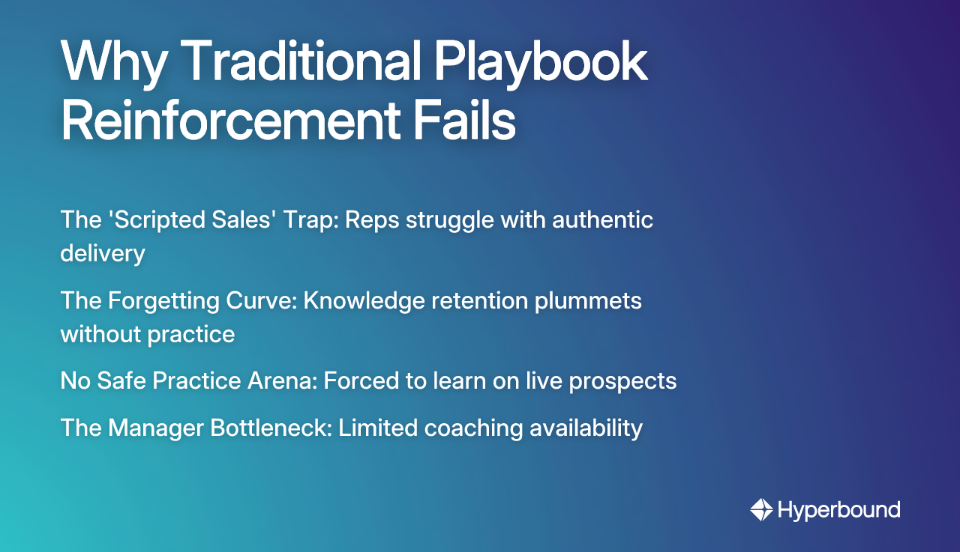
The "Scripted Sales" Trap: Reps struggle to adapt playbook scripts into genuine conversations, preventing them from developing their unique and authentic "sales voice." Many salespeople find it challenging to personalize scripts to create authentic conversations that don't sound robotic or forced.
The Forgetting Curve: Without continuous practice, reps forget the majority of what they learn in training seminars within days. This is a well-documented cognitive phenomenon, not a reflection of your team's capabilities.
Lack of a Safe Practice Arena: Reps are forced to practice on live prospects, risking deals and damaging confidence. There is no space for trial and error. Ongoing practice and reinforcement are crucial for sales skill development but are often lacking in traditional sales environments.
The Manager Bottleneck: Traditional roleplays depend entirely on managers' limited availability. This makes practice infrequent, inconsistent, and impossible to scale across a large or remote team.
Enter AI Roleplays: Bridging the Gap Between Playbook and Performance
AI roleplays are interactive simulations where sales reps practice conversations with an AI buyer persona. These aren't simple chatbots; they are designed to simulate realistic sales scenarios, from cold calls and discovery to objection handling and renewals. AI roleplays transform playbook reinforcement in several key ways:
Unlimited, Scalable Practice: AI provides a roleplay partner that is available 24/7. This allows organizations to easily scale playbooks across large teams, ensuring that all reps are trained consistently, regardless of location or time zone.
A Safe Space to Fail and Grow: Reps can practice difficult conversations, test new messaging, and handle tough objections in a risk-free environment. This is crucial for building the confidence needed to move away from rigid scripts and develop a natural, consultative selling style.
Instant, Objective Feedback: Unlike peer roleplays, which can be subjective, AI provides immediate, data-driven feedback. Platforms like Hyperbound use AI-Powered Scorecards to analyze performance against your specific sales methodology. These tools track metrics like talk-to-listen ratio, the use of key value propositions from the playbook, and how effectively objections were handled. This creates a powerful feedback loop for rapid skill development.
A Step-by-Step Guide: Weaving AI Roleplays into Your Sales Motion
Step 1: Identify and Prioritize Critical Plays
Start small and focus on high-impact areas. Don't try to simulate your entire playbook at once. Good starting points include:
- Your core 30-second elevator pitch
- Handling the top 3-5 most common objections (e.g., price, timing, competitor)
- Executing a specific discovery call framework (e.g., MEDDPICC, BANT)
- Introducing a new product or feature
Step 2: Build Hyper-Realistic AI Scenarios
This is where you bring your playbook to life.
Customize AI Buyer Personas: Use the ICPs from your playbook to create realistic AI personas. Define their industry, title, pain points, and personality. A good platform allows for AI-Driven Customer Personas that respond dynamically.
Define Diverse Scenarios: Set up roleplays that cover the entire sales cycle, from a first cold outreach call to a complex renewal negotiation.
Build Your Custom Scorecard: This is the most critical step. Configure the AI to score the rep based on your playbook's KPIs and methodology.
Example Scorecard Criteria:
- Did the rep clearly state the purpose of the call? (Yes/No)
- Did they ask at least 3 open-ended discovery questions? (Count)
- Did they successfully use the "Value Wedge" talk track when the competitor was mentioned? (Keyword/Phrase detection)
- Did they establish clear next steps? (Yes/No)
This ensures the feedback is "methodology-aligned" and directly reinforces your strategy.
Step 3: Roll Out and Drive Adoption
Integrate into Onboarding: Make AI roleplays a mandatory part of your new hire onboarding. This directly combats the problem of "condensed training periods" that create anxiety for new sales reps. Reps can practice dozens of times, dramatically cutting down ramp time.
Use for Certification & Continuous Training: For tenured reps, use AI roleplays to certify them on new playbook versions or messaging before they go live with customers.
Gamify the Experience: Use leaderboards and scoring to create friendly competition. This motivates reps and encourages regular practice. Gamified learning approaches have been shown to increase engagement and retention.
Step 4: Analyze, Coach, and Iterate
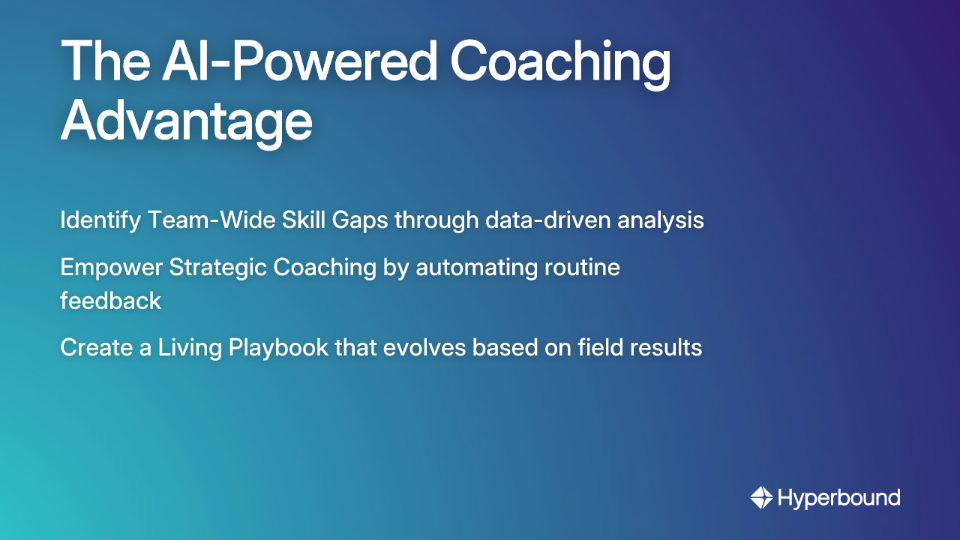
Identify Team-Wide Skill Gaps: Use the platform's analytics to spot trends. If 80% of your team is failing the pricing objection roleplay, you know you have a systemic issue that needs to be addressed in the playbook or in team-wide coaching.
Empower Strategic Coaching: AI automates the repetitive parts of coaching. Managers can use AI Deal Summaries and analysis from both roleplays and real calls to focus their 1:1s on high-level strategy and skill development, not just correcting basic mistakes.
Create a Living Playbook: The insights from AI analysis provide a direct feedback loop to improve the playbook itself, ensuring it evolves based on what's actually working in the field.
The Impact: From Theory to Quota-Crushing Reality
Dramatically Reduced Ramp Time: New hires gain confidence and competence faster, hitting quota sooner. This directly addresses management pressure and justifies the investment in proper onboarding. Long ramp-up periods are often not understood or appreciated by management, but AI roleplays provide concrete, measurable progress that helps bridge this understanding gap.
Unshakeable Message Consistency: Every rep, from the newest SDR to the most tenured AE, is aligned on messaging, value propositions, and objection handling.
Measurable Improvement in Sales KPIs: This isn't just about practice; it's about results. Reinforcing the right behaviors leads to more meetings booked, a healthier pipeline, higher win rates, and increased revenue. (Remember: 83% of AI-using teams see revenue growth).
A Culture of Continuous Improvement: AI coaching tools empower reps to take ownership of their development. They can practice and get feedback on-demand, fostering a proactive learning environment rather than one dependent on manager intervention.
Your Playbook Is Your Map, AI Is the Driving Simulator
A sales playbook provides the strategic map, but it's useless if your team doesn't know how to drive. AI roleplays are the driving simulator—a scalable, data-driven, and safe environment to turn strategy into muscle memory.
By bridging the "knowing-doing gap," you move beyond simply having a playbook to building a team that can execute it flawlessly under pressure. Platforms like Hyperbound are at the forefront of this evolution, providing the tools—from AI Sales Roleplays and Real Call Scoring to AI Coaching—that enable modern sales organizations to scale excellence and turn their playbooks into their single greatest competitive advantage.
When your reps can practice critical conversations dozens of times before facing a prospect, they develop the confidence and competence to move beyond scripted sales to true consultative selling. That's when your playbook truly comes to life—and your competitors won't know what hit them.
Frequently Asked Questions
What is an AI sales roleplay?
An AI sales roleplay is an interactive simulation where a salesperson practices conversations with an AI-powered buyer persona. Unlike a simple chatbot, these platforms create realistic scenarios tailored to your business, allowing reps to practice everything from cold calls to objection handling in a safe, repeatable environment before engaging with actual prospects.
Why are AI roleplays more effective than traditional sales training?
AI roleplays are more effective because they provide unlimited, on-demand practice, instant objective feedback, and a safe space to fail. This directly combats the "forgetting curve" that plagues one-off training sessions and overcomes the "manager bottleneck," where coaching is limited by a manager's availability. It allows for scalable, consistent reinforcement that traditional methods can't match.
How do AI roleplays help with sales playbook adoption?
AI roleplays bridge the critical "knowing-doing gap" by turning your static playbook into an interactive training ground. Reps can practice the specific talk tracks, value propositions, and objection-handling techniques outlined in your playbook until they become muscle memory. This ensures the entire team can execute your strategy consistently and confidently in live conversations.
Will my sales reps find AI roleplays realistic?
Yes, modern AI roleplay platforms can create hyper-realistic buyer personas and dynamic conversation flows. You can customize the AI's industry, title, pain points, and even personality based on your Ideal Customer Profiles (ICPs). This ensures the practice conversations are challenging, relevant, and far from robotic.
How can I measure the ROI of using AI roleplays?
The ROI of AI roleplays can be measured through direct improvements in key sales metrics. Key indicators to track include a reduction in new hire ramp time, an increase in meetings booked per SDR, higher sales pipeline conversion rates, and ultimately, higher quota attainment and revenue growth. Analytics within the platform can also show team-wide skill improvement over time.
How long does it take to implement AI roleplays for my team?
Implementation can be very fast. While building out an entire playbook's worth of scenarios takes time, you can start seeing value within days by focusing on a few high-impact plays first. A good starting point is to build roleplays for your core elevator pitch and the top 3-5 most common sales objections your team faces.
Can AI roleplays be customized to our specific sales methodology?
Absolutely. Effective AI roleplay platforms are designed for deep customization. You can build custom scorecards that track and score reps based on your specific sales methodology (e.g., MEDDPICC, BANT) and playbook criteria. This ensures the AI's feedback is always aligned with your strategy and reinforces the right behaviors.

Book a demo with Hyperbound


