.png)


.png)
Summary
- Effective coaching drives results—teams receiving 3+ hours of coaching per rep monthly exceed quota by 107%, but most managers are too busy with manual call reviews to achieve this.
- To make coaching more efficient, focus on one high-impact skill at a time and cultivate a culture of self-coaching where reps review their own performance.
- AI is the ultimate force multiplier, automating the analysis of 100% of calls to identify patterns and skill gaps, freeing managers to focus on strategic development.
- Platforms like Hyperbound use AI to cut call review time from 30 minutes to 3 and provide scalable roleplays for reps to practice anytime.
You know coaching is crucial for your sales team's success. The data doesn't lie: sales managers who invest over three hours of coaching per month per team member exceed quota by 107%, while teams without coaching only meet 82% of their quota.
Yet there you are, drowning in administrative tasks, call reviews, and endless platform switching. You want to coach more effectively, but who has the time?
"I can't possibly listen to every call," you think as you scan through your calendar, already packed with meetings, one-on-ones, and pipeline reviews. "And even if I did, how would I find the patterns across all my reps to coach effectively?"
Sound familiar? You're not alone.
This coaching paradox—knowing it's critical yet struggling to find the time—represents one of the biggest challenges facing sales leaders today. The traditional coaching model is simply broken, especially in today's high-velocity sales environments.
But there's good news: you can dramatically reduce the time spent on coaching activities while simultaneously increasing your coaching impact. This isn't about cutting corners; it's about working smarter through strategic shifts and leveraging the right technology.
Let's explore how to make that happen.
Why the Traditional Coaching Model is Broken
The coaching approach that most sales organizations still use today was designed for a different era—one where sales cycles were longer, teams were smaller, and managers had fewer administrative responsibilities. Today's reality is vastly different:
The Time vs. Impact Dilemma
Despite research showing that only 26% of reps receive weekly coaching, we know consistent coaching has a massive ROI. This gap exists because managers are constantly choosing between urgent tasks (like closing deals) and important ones (like developing reps).
As one sales leader on Reddit lamented: "Sales managers struggle to find time to manage resources effectively, such as curating and updating a call library." Time constraints make maintaining even basic coaching infrastructure challenging.
The Inefficiency of Manual Call Reviews
The traditional approach to coaching often involves managers spending hours listening to individual calls, hunting for "coachable moments" and providing feedback. This method is:
.png)
- Painfully inefficient: Listening to a 30-minute call to find 2 minutes of valuable coaching moments
- Inherently subjective: Based on what the manager happens to notice
- Impossible to scale: You can only review a tiny fraction of all calls
- Focused on symptoms, not patterns: You miss the forest for the trees
One sales manager expressed this frustration clearly: "There's a lack of tools to assess and improve representative skill gaps beyond individual calls." Without seeing patterns across multiple calls, coaching becomes anecdotal rather than systematic.
The Challenge of Scale and Consistency
As teams grow, providing consistent, personalized coaching becomes exponentially more difficult. Remote and distributed teams further complicate matters. Many managers resort to "drive-by coaching"—random observations without cohesive strategy—simply because they lack the bandwidth for anything more structured.
Foundational Strategies to Make Every Coaching Minute Count
Before we dive into technology solutions, let's establish some foundational strategies that will make your coaching more efficient and effective, regardless of what tools you use:
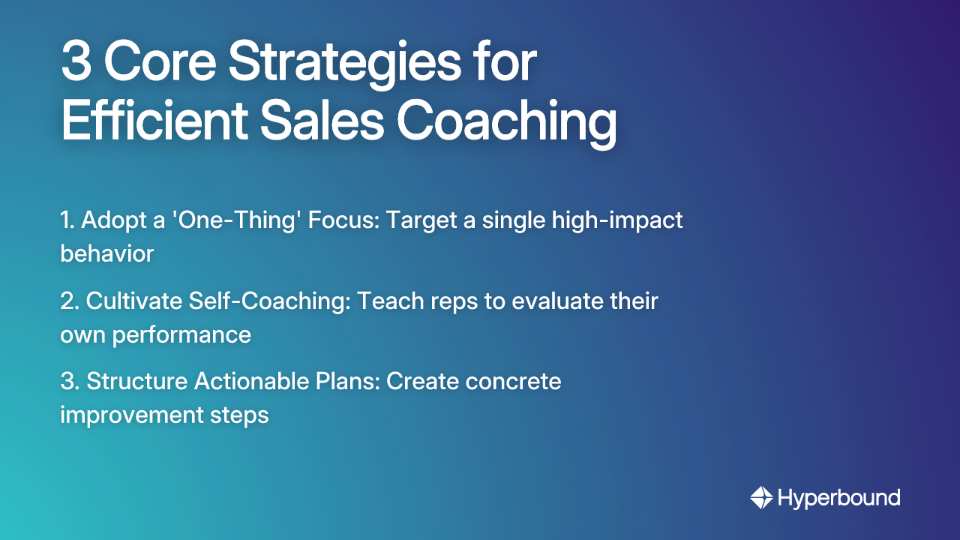
Strategy 1: Adopt a "One-Thing" Focus
Resist the urge to fix everything at once. Instead, focus coaching on a single high-impact behavior at a time:
- Choose one skill or behavior that will move the needle most (e.g., discovery questioning technique or handling a specific objection)
- Coach intensively on just that area until you see improvement
- Then move to the next highest-impact area
This approach prevents overwhelm for both you and your reps while ensuring measurable progress. As one coaching expert puts it: "When you try to fix everything, you fix nothing."
Strategy 2: Cultivate a Culture of Self-Coaching
The most valuable coaching doesn't always come from you—it comes from reps learning to evaluate their own performance:
- Have reps review their own calls before you do and identify what went well and what they'd change
- Ask them to bring these self-assessments to your 1:1s
- Guide them on what to look for, but let them do the initial analysis
This approach not only saves you time but develops their critical thinking skills and increases buy-in. According to sales coaching research, "self-evaluation encourages reps to analyze their performance, fostering self-awareness and confidence."
Strategy 3: Structure Coaching with Actionable Plans
Turn every coaching conversation into a concrete improvement plan:
- End each session with 1-3 specific action items
- Set clear timelines for implementation
- Create accountability mechanisms for follow-through
- Document these plans for easy reference in future sessions
This structure ensures coaching translates into behavior change rather than becoming a series of disconnected conversations.
Automating the Heavy Lifting: How AI Can 10x Your Coaching Efficiency
While the strategies above will help make your coaching more efficient, technology—specifically AI—can be the force multiplier that truly transforms your coaching approach.
Automate Call Review and Pattern Recognition
The biggest time sink for most sales managers is reviewing calls. AI tools can now analyze 100% of your team's calls, automatically identifying patterns, trends, and coaching opportunities.
Hyperbound's AI Real Call Scoring exemplifies this approach by automatically analyzing sales conversations and scoring them against your custom playbook. Instead of spending hours listening to calls, managers get an AI Deal Summary that highlights key moments, objections, and buying signals, cutting review time from 30 minutes to 3.
One sales manager on Reddit described the pain point perfectly: "Sales managers struggle with the lack of analytics tools that offer in-depth analysis across multiple sellers' calls." AI solves this by finding patterns no human could reasonably spot across thousands of interactions.
Provide On-Demand, Scalable Practice
Traditional roleplaying requires significant manager time and coordination. AI-powered simulations offer an alternative that scales:
- Reps can practice whenever they have time, not just when you're available
- They can repeat scenarios until mastery, rather than getting one shot
- The AI provides consistent, objective feedback
- You can track progress across multiple practice sessions
Hyperbound's AI Sales Roleplays allow reps to practice everything from cold calling to renewal conversations with dynamic AI buyer personas. This provides unlimited, risk-free practice without requiring manager time, scaling coaching beyond manager availability and ensuring consistent message delivery.
Deliver Instant, Data-Driven Feedback
The feedback loop in traditional coaching can be days or weeks long. AI coaching provides immediate feedback after every interaction:
- Reps get guidance while the conversation is still fresh
- Feedback is objective and consistent
- Progress can be tracked quantitatively over time
- Coaching becomes continuous rather than episodic
Hyperbound's AI Coaching delivers instant, personalized feedback after every roleplay and real call, aligned with your specific sales methodology. This enables reps to self-correct and improve skills continuously without solely relying on manager availability, directly supporting the self-coaching culture mentioned earlier.
Your Blueprint for Implementing an AI-Powered Coaching Program
Let's get practical. Here's how to implement these concepts in your organization:
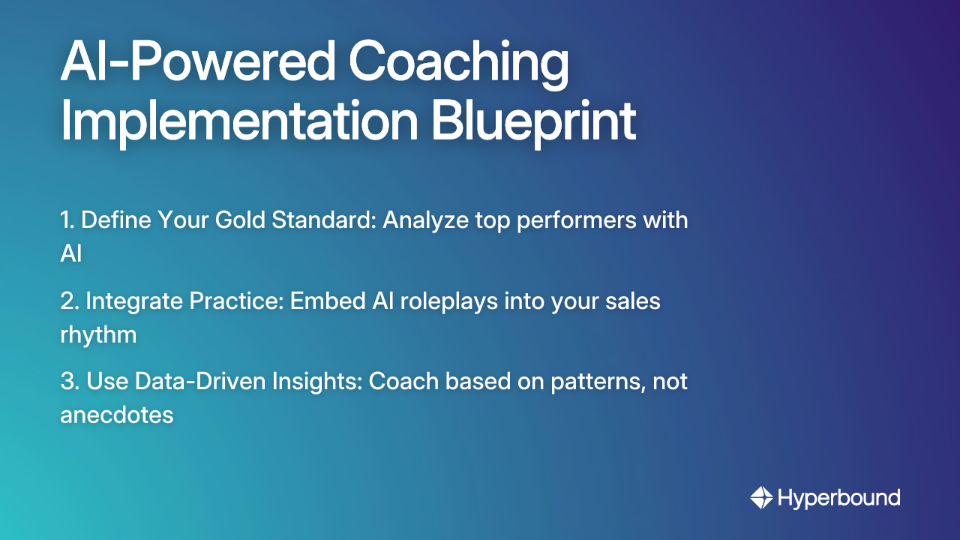
Step 1: Define Your "Gold Standard" by Analyzing Top Performers
Don't coach in a vacuum. Use AI to understand what makes your best reps successful:
- Identify your clear top performers based on outcomes (not just activity)
- Analyze their calls to identify specific behaviors, talk tracks, and techniques
- Codify these into your coaching playbook
- Create scorecards that measure these behaviors
Hyperbound's AI can analyze thousands of your actual sales calls to uncover the specific techniques, talk tracks, and behaviors that make your top sales representatives successful. This insight becomes the foundation for your AI-powered scorecards and roleplay scenarios.
Step 2: Integrate Practice and Feedback into Your Sales Rhythm
Make AI coaching a regular part of your team's routine, not a special event:
For Onboarding:
- Have new hires complete a series of AI roleplays before they ever talk to a real customer
- Create certification requirements using AI scoring to ensure readiness
- Review the data to identify personalized coaching needs from day one
For Weekly Routines:
- Assign specific AI roleplay scenarios focused on current team challenges
- Have reps complete 2-3 practice sessions before weekly team meetings
- Use the aggregate data to guide team coaching moments
For 1:1 Meetings:
- Review AI-generated insights dashboard before each 1:1
- Focus on patterns rather than individual calls
- Use meeting time for strategic coaching rather than call reviews
Step 3: Use Data to Drive Strategic Coaching
Elevate your coaching conversations with data-driven insights:
- Instead of asking "How did that call go?" ask "I see you're consistently struggling with the pricing objection. Let's work through a better approach."
- Use AI-identified patterns to spot skill gaps across the team
- Align coaching priorities with actual performance data rather than gut feel
- Track improvement quantitatively over time
This approach transforms your role from call reviewer to strategic coach. The AI handles the tedious work of finding coaching moments; you focus on helping reps develop solutions and grow their skills.
Become a Strategic Leader, Not a Full-Time Call Reviewer
The goal isn't to eliminate coaching—it's to make it more strategic and impactful while reducing the time-consuming administrative aspects.
By implementing the strategies outlined in this article, you can:
- Coach more reps without increasing your time investment
- Identify patterns that would be impossible to spot manually
- Provide more consistent guidance across your entire team
- Drive measurable improvement through data-driven coaching
- Focus your time on strategic development rather than call reviews
Remember that research shows effective sales coaching can increase sales performance by 8%. But achieving this impact requires evolving beyond the traditional, time-intensive coaching model.
By adopting a focused coaching strategy, cultivating self-coaching skills in your reps, and leveraging AI tools to automate the heavy lifting, you can transform from a full-time call reviewer into a true sales leader—one who drives performance through strategic guidance rather than manual effort.
The future of sales coaching isn't about choosing between quality and efficiency. It's about using technology to remove the administrative burden so you can focus on what really matters: developing your people and driving results.
Frequently Asked Questions
What is AI-powered sales coaching?
AI-powered sales coaching uses artificial intelligence to analyze sales conversations, automate administrative tasks like call reviews, and provide scalable practice and feedback for sales representatives. It acts as a force multiplier for sales managers, handling the heavy lifting of data analysis across 100% of calls. This allows managers to move from random call reviews to identifying team-wide patterns and skill gaps, making their coaching more strategic and data-driven.
Why is the traditional sales coaching model broken?
The traditional sales coaching model is broken because it is painfully time-consuming, impossible to scale effectively, and often relies on subjective feedback from a small sample of calls. Sales managers are often bogged down by manual call reviews, trying to find coachable moments in hours of recordings. This approach fails to identify systemic issues across a team and struggles to provide the consistent, frequent coaching needed in today's high-velocity sales environments.
How can I improve my sales coaching without investing in AI tools yet?
You can immediately improve your sales coaching by adopting three foundational strategies: focusing on one skill at a time, cultivating a culture of self-coaching, and creating structured, actionable improvement plans. Instead of trying to fix everything at once, coach intensively on a single high-impact behavior. Encourage your reps to review their own calls and come to you with their analysis. Finally, ensure every coaching session ends with clear, documented action items to drive real behavior change.
How does AI actually save time on call reviews?
AI saves time by automatically analyzing 100% of your team's sales calls, transcribing them, and highlighting key moments, patterns, and adherence to your sales playbook. Instead of a manager spending 30 minutes listening to a single call to find a 2-minute coaching opportunity, an AI platform can provide an actionable summary in just a few minutes. It surfaces trends like common objections, competitor mentions, and talk track usage across the entire team, eliminating hours of manual work.
What is the first step to implementing an AI coaching program?
The first step is to define your "gold standard" by using AI to analyze the calls of your top-performing sales reps. Before you can coach effectively, you need a clear, data-backed understanding of what "good" looks like in your organization. AI tools can analyze thousands of calls to identify the specific techniques, talk tracks, and behaviors that lead to success. This data then becomes the foundation for your coaching scorecards and practice scenarios.
Will AI sales coaching replace the need for sales managers?
No, AI sales coaching does not replace sales managers; it enhances their capabilities by automating administrative tasks and providing deep, data-driven insights. The goal of AI is to transform managers from full-time call reviewers into strategic leaders. By handling the tedious work of analyzing calls and identifying patterns, AI frees up managers to focus on high-impact activities like strategic guidance, skill development, and building relationships with their team.

Ready to transform your coaching approach? Start by implementing one of the foundational strategies this week, then explore how AI tools like Hyperbound can help you scale your impact without sacrificing your calendar.
Your team deserves great coaching. Now you can deliver it without it consuming all your time.
Book a demo with Hyperbound


