.png)


.png)
Summary
- Generic sales training often fails because it ignores market specifics; research shows that effective training requires customizing 30% of your content to local dynamics.
- Create realistic practice by building scenarios around hyper-detailed buyer personas that include their specific industry, priorities, and common objections.
- Focus practice on essential, market-specific scenarios like handling gatekeepers, overcoming competitor objections, and navigating renewal conversations.
- Scale market-matched training with AI Sales Roleplays that allow reps to practice hyper-realistic scenarios based on your specific buyers and get instant, objective feedback.
You've set up a roleplay with your sales manager. They're playing a "typical prospect" while you walk through your pitch. But something feels off. The objections sound canned. The questions are too easy. And the entire conversation bears little resemblance to the complex, unpredictable calls you face every day with real prospects.
"The best roleplay is making an actual call," you might think. Yet as one sales rep put it: "Real calls offer invaluable experience. However, with the stakes so high, I'm cautious about using real prospects for practice." This creates a frustrating paradox: you need realistic practice, but you can't afford to burn valuable leads.
The solution isn't less practice, but smarter practice that truly matches your market.
The Danger of Generic Sales Scenarios
A one-size-fits-all approach to sales training often fails because it ignores crucial market variations. As one frustrated sales professional noted, "If it doesn't feel real, it defeats the whole purpose."
Generic sales scenarios fall short in several critical ways:
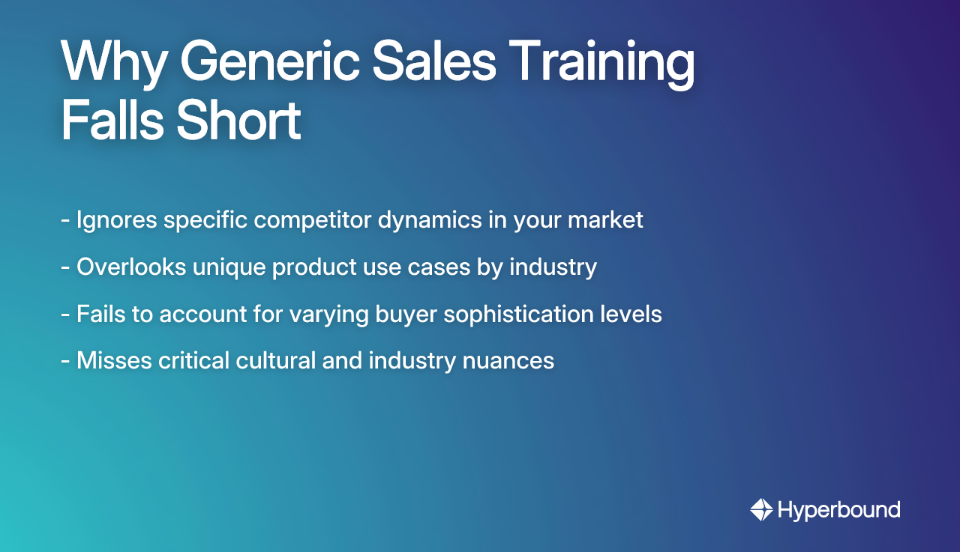
- Competitor Sets: Practicing against a fictional "Competitor X" is useless when your reps are constantly battling specific rivals in their region.
- Product Use Cases: How a customer in manufacturing uses your product is vastly different from one in finance.
- Buyer Sophistication: A buyer in a mature market asks different questions than one in an emerging market.
- Cultural Nuances: Directness, rapport-building techniques, and negotiation styles vary dramatically across cultures and industries.
According to The Brevet Group, the most effective sales training follows a 70/30 global-local customization model. While 70% of your sales methodology can remain core, 30% must be customized for local markets to be effective.
The Framework: Building Market-Matched Sales Scenarios
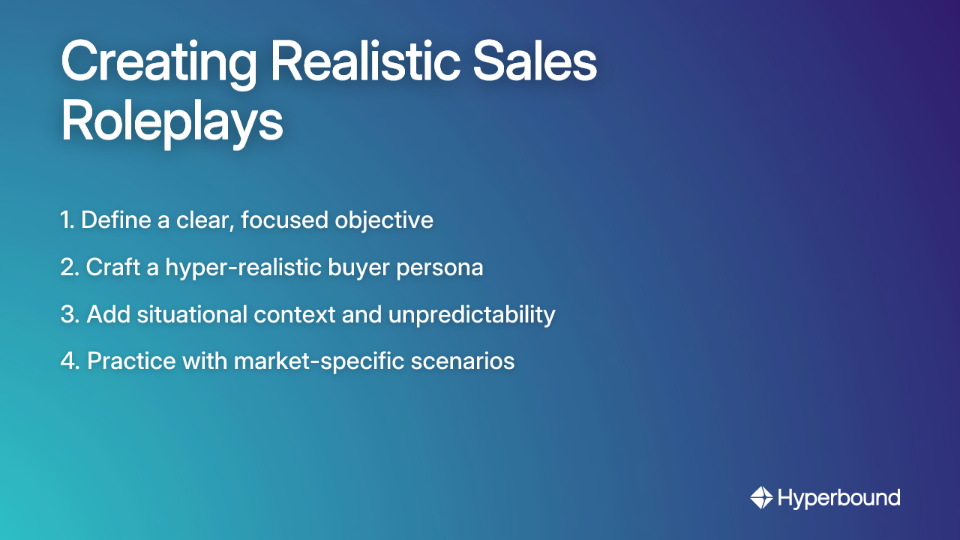
Let's break down how to create scenarios that feel authentically matched to your market:
Step 1: Define a Crystal-Clear Objective
Every roleplay must have a single, clear goal. Don't try to practice everything at once.
Examples:
- Successfully book a discovery call
- Overcome the "we already use a competitor" objection
- Build a business case based on uncovered pain points
Step 2: Craft a Hyper-Realistic Buyer Persona
This is the most critical step. A detailed persona is the foundation of a realistic roleplay.
Include these key components:
- Personal Details: Career path, communication style (e.g., "data-driven and skeptical," "relationship-focused"), personal interests for rapport building.
- Company Details: Industry, size, annual revenue, recent news (e.g., "just received Series B funding").
- Organizational Structure: Who do they report to? Who influences their decisions?
- Buyer Priorities: What are their top 3 professional goals for this quarter?
- General Opinions: Are they risk-averse? An early adopter? Skeptical of new technology?
- Awareness of the Problem: Do they know they have a problem, or do they need to be educated?
- Awareness of Solutions: Are they actively looking for solutions? Have they already spoken to your competitors?
- Existing Solutions: What tools are they using now? What do they hate about their current solution?
Step 3: Add Situational Context and Unpredictability
Context is everything. How did this call start? Is this a warm call following a webinar download, or a cold call to a prospect who has never heard of you?
Importantly, address what one sales rep described as the hardest part of cold calling: "reacting to something completely out of left field in real time." To make your scenarios truly realistic, brainstorm market-specific "left-field" questions or objections to include.
Essential Scenarios to Practice for Any Market
Here are four concrete scenarios that every sales team should adapt to their specific market:
Scenario 1: The Gatekeeper Call
Objective: Get past the gatekeeper to the decision-maker.
Persona: Executive Assistant who is protective of their boss's time.
Key Skills: Rapport building, persuasive dialogue, conveying value quickly.
Scenario 2: The "We're Happy with Competitor X" Objection
Objective: Uncover dissatisfaction with the current provider and secure a follow-up meeting.
Persona: A long-time user of your main competitor who is resistant to change.
Key Skills: Market knowledge, tactful questioning, positioning your unique value.
Example Script Snippet:
- Buyer: "Your competitor offers a 25% discount. Can you match that?"
- Rep: "I appreciate you sharing that. While we don't compete on price, many of our customers switch from [Competitor] because of [Key Differentiator]. Can we explore if that's a priority for you as well?"
Scenario 3: The Price Haggler
Objective: Defend your pricing and reinforce value without giving an unnecessary discount.
Persona: A procurement manager focused solely on getting the lowest price.
Key Skills: Negotiation, justifying price with ROI, confidence.
Scenario 4: The Post-Sales Upsell/Renewal Call
Objective: Identify an expansion opportunity during a regular check-in or secure a renewal against a new competitor.
Persona: An existing customer who is generally happy but unaware of your new product line.
Key Skills: Active listening, aligning new solutions with their evolving business goals.

Scaling Excellence: Using AI to Make Practice Perfect
The framework above is powerful but manually intensive and hard to scale. This is where AI-powered sales coaching platforms like Hyperbound come in.
AI provides a safe, scalable "flight simulator" for sales. Reps can practice anytime, anywhere, without burning manager time or risking live deals.
But there are legitimate concerns about AI roleplay tools that need addressing:
"Management will not buy a tool like this... they see feedback as being the most important element."
Modern platforms aren't just simulators; they are coaching engines. For example, Hyperbound's AI Sales Roleplays provide AI-Powered Scorecards that give instant, objective feedback on every call. The platform tracks key metrics like talk-listen ratio, filler word usage, and whether key talk tracks were mentioned, satisfying the need for data-driven feedback.
"If it doesn't feel real, it defeats the whole purpose."
The key is customization. With a platform like Hyperbound, you can build roleplays based on the exact buyer personas and market-specific scenarios you just designed. You can tailor AI buyers to your specific ICPs, products, and methodologies, ensuring the practice is always relevant to your market.
"Salespeople may feel uncomfortable... speaking to a robot."
Think of it as a private gym. It's a no-judgment zone to warm up, try new things, and fail safely before the main event. Gamified leaderboards can also make it competitive and engaging rather than a chore.
The Feedback Loop: From Real Calls to Better Roleplays
The ultimate way to ensure your practice matches your market is to source your scenarios from reality.
This is where call analysis becomes invaluable. Tools like Hyperbound's AI Real Call Scoring can analyze your existing call recordings (from Gong, Salesloft, etc.) to automatically identify:
- The most common objections your team actually faces
- What your top reps say to win deals in your specific market
- Where the rest of the team is struggling
This creates a powerful, continuous improvement loop:
- Analyze real calls to find what's actually happening in your market
- Build roleplay scenarios based on that data
- Practice those specific scenarios at scale
- Improve performance on real calls
- Repeat
For teams without access to AI tools, a simplified version of this process can still work. Have managers record and review calls, document common objections and effective responses, and build roleplays that reflect those real-world patterns.
Creating a Market-Matched Practice Culture
Regardless of the tools you use, building a culture of targeted, market-specific practice requires:
- Scheduled Practice Time: Dedicate consistent time for roleplays.
- Variety in Scenarios: Rotate through different scenarios regularly. Don't let reps get comfortable with the same conversations.
- Real-World Feedback: After actual calls, have reps document new objections or questions they weren't prepared for, and add these to your scenario library.
- Progressive Difficulty: Start with basic scenarios and gradually increase complexity as reps build confidence.
Stop Rehearsing, Start Preparing
Generic sales practice is ineffective and demotivating. The key to readiness is practicing hyper-realistic scenarios matched to your specific market, competitors, and buyers.
A strong roleplay is built on a detailed buyer persona, clear objectives, and real-world context. Whether you're leveraging advanced AI tools like Hyperbound or running manual roleplays with your team, the principle remains the same: the closer your practice matches your market, the better your results will be.
The goal isn't just to rehearse pitches; it's to build the confidence and adaptability to handle any conversation your market throws at you. By creating market-matched scenarios, you transform practice from a tedious exercise into a powerful competitive advantage.
Your prospects can tell the difference between a rep who's reciting a generic script and one who deeply understands their market. Make sure your team is ready for the real thing.
Frequently Asked Questions
Why is generic sales roleplay ineffective?
Generic sales roleplay is ineffective because it fails to replicate the specific challenges of your market. It often ignores your actual competitors, unique customer use cases, and the cultural nuances of your buyers, making the practice irrelevant to real-world sales calls.
What is the most important element of a realistic sales scenario?
The most important element is a hyper-realistic buyer persona. A detailed persona that includes the buyer's priorities, communication style, existing solutions, and awareness of their problem is the foundation for a roleplay that genuinely prepares reps for actual conversations.
How can I create market-matched sales scenarios without AI tools?
You can create market-matched scenarios without AI by analyzing real-world data. Regularly review recorded sales calls to identify the most common objections, customer questions, and winning talk tracks. Use this information to build your buyer personas and scenario scripts manually.
What are the benefits of using an AI sales roleplay tool?
The primary benefits of using an AI sales roleplay tool are scalability, consistency, and safety. AI platforms allow reps to practice anytime without using manager resources or risking live deals, and they provide instant, data-driven feedback on every session to track improvement over time.
How do you handle unexpected questions in a sales roleplay?
To prepare for unexpected questions, you should deliberately include them in your scenarios. Brainstorm market-specific "left-field" questions or objections based on real calls and add them to your roleplay scripts. This trains reps to think on their feet and improves their adaptability for any situation.
How can I build a culture of effective sales practice?
Building a culture of effective practice requires commitment and structure. You should schedule dedicated, consistent time for roleplays, regularly introduce a variety of new scenarios to avoid monotony, and create a feedback loop where insights from real calls are used to update your practice materials.

Book a demo with Hyperbound


