.png)


.png)
Summary
- With 92% of B2B buyers preferring virtual sales, remote teams struggle to practice effectively, lacking the "osmosis learning" of a physical office.
- Traditional methods fall short remotely: manager-led roleplays are unscalable, and using live calls for "practice" risks burning valuable leads.
- A successful remote practice program uses a blended approach, combining structured peer roleplays with systematic call analysis and AI-powered simulations.
- AI platforms like Hyperbound's AI Sales Roleplays provide a "flight simulator" for reps to master conversations through unlimited, risk-free practice with instant, objective feedback.
You've set up your remote sales team with the right tools, created a solid sales process, and hired talented reps. But there's a problem: without the energy of a bustling sales floor, how do you help your team practice and improve their calls?
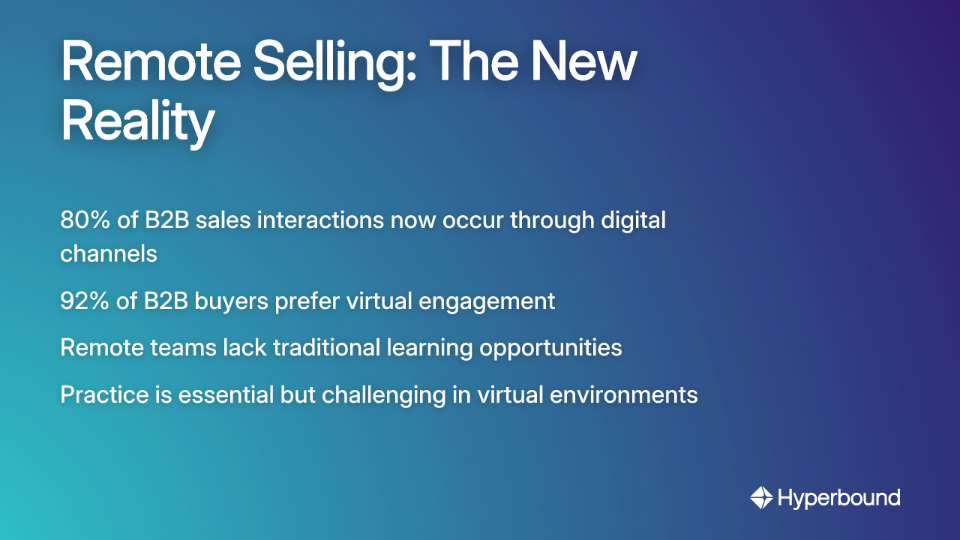
The shift to remote selling is permanent—with 80% of B2B sales interactions now occurring through digital channels and 92% of B2B buyers preferring virtual engagement (Spotio). Yet this evolution has created a fundamental dilemma for sales leaders:
Real calls offer invaluable experience. However, with the stakes so high, using live prospects purely for practice is risky and potentially costly.
This guide will provide a complete blueprint for building a robust sales call practice program for your remote team, from structured peer roleplays to the transformative power of AI-driven simulations.
The Unique Challenges of Practicing Sales Calls Remotely
When your team worked in the same office, sales call practice happened naturally. New reps could overhear experienced colleagues masterfully handle objections. Managers could quickly jump in for impromptu coaching. The transition to remote work has eliminated these advantages and created new challenges:
Loss of "Osmosis Learning"
Without a physical office, reps can't passively learn by listening to the calls of top performers. This informal coaching and knowledge sharing disappears.
Inconsistent & Unscalable Coaching
Manager availability becomes a major bottleneck. One-on-one coaching is difficult to scale for large or growing teams, and coaching quality can vary significantly between managers.
Isolated Onboarding
New hires feel disconnected and take longer to ramp up. They miss out on shadowing live calls and getting immediate feedback, which slows down their path to productivity.
Difficulty Building a Cohesive Team Environment
Establishing trust, camaraderie, and a culture of continuous improvement is much harder without face-to-face interaction.

Traditional Practice Methods & Why They Fall Short Remotely
Method 1: "Just Make More Calls" (Trial by Fire)
Many sales leaders believe "the best roleplay is making an actual call." While real-world experience is invaluable, it's not practice—it's a high-risk, low-feedback way to learn that potentially burns valuable leads and damages brand reputation.
Method 2: Manager-Led Roleplays
Pros: Direct feedback from an experienced coach.Remote Cons:
- Scheduling Nightmare: Coordinating across different time zones is a constant struggle.
- Manager Bottleneck: It's not scalable. A manager can't provide consistent, 1-on-1 roleplay time for their entire team.
- Performance Anxiety: Reps may feel pressured or judged, preventing them from making mistakes, which is the entire point of practice.
Method 3: Studying Scripts and Playbooks
Pros: Essential for building foundational knowledge.Remote Cons:
- Doesn't Build Conversational Muscle: Reading a script is not the same as delivering it naturally.
- Fails to Prepare for the Unexpected: It can't simulate a prospect going off-script. As one salesperson put it, "One of the harder parts of cold calling is reacting to something completely out of left field in real time."
Effective, Actionable Strategies for Remote Sales Practice
Strategy 1: Structured Peer-to-Peer Roleplays
The Process:
- Assign Roles: One person is the sales rep, one is the prospect with a specific persona and objections, and a third person is the observer.
- Use Real Scenarios: Base the roleplay on a recent lost deal, a common objection, or a new messaging rollout.
- Use a Simple Scorecard: The observer gives feedback on specific criteria: Did the rep open effectively? Did they ask good discovery questions? How was their talk-listen ratio?
Benefits: Fosters team culture, provides diverse feedback, and is more scalable than relying solely on managers.
Challenges: Reps might not take it seriously, feedback can be subjective, and scheduling remains a hurdle.
Strategy 2: Systematic Call Recording Analysis
The Process:
- Record Meetings (with permission): Use a tool like Hyperbound's AI Real Call Scoring to record and analyze calls, or other existing software like Gong or Salesloft.
- Self-Review: Each rep reviews one of their "good" calls and one of their "bad" calls each week. They must identify 2-3 things they did well and 2-3 things they would change.
- Team Review: In weekly team meetings, listen to a 2-minute anonymized clip of a call that illustrates a key concept (e.g., effective objection handling, great rapport building). This turns individual learnings into team best practices.
Benefits: Grounded in reality, excellent for self-awareness and identifying patterns.
Challenges: Incredibly time-consuming for managers and reps to sift through hours of recordings. Feedback remains subjective and lacks data-driven objectivity.
The Game Changer: Using AI for Hyper-Realistic, Scalable Sales Practice
AI is the bridge between risky live calls and unrealistic practice. It's essentially a "flight simulator for salespeople," offering a safe, infinitely repeatable environment to master skills.
Some salespeople might be skeptical about "speaking to a robot," but modern AI sales simulation isn't just a simple chatbot. Tools like Hyperbound's AI Sales Roleplays create hyper-realistic scenarios that mirror your exact sales environment—addressing the critical concern that "if it doesn't feel real, it defeats the whole purpose."
Here's how AI transforms remote sales practice:
Hyper-Realistic Scenarios
With advanced AI platforms, you can create simulations that fit the context of your business:
- Practice every stage: cold calls, discovery calls, demos, objection handling, renewals, and upsells
- Customize the AI buyer persona to match your ICPs, ensuring reps practice relevant conversations
- Introduce unexpected scenarios to help reps develop their ability to think on their feet
Instant, Objective Feedback
This is the most critical component—as one sales leader noted, "Management will not buy a tool like this on its own - they see feedback as being the most important element."
- AI-powered scorecards provide objective analysis after every roleplay
- Metrics like adherence to methodology, talk-listen ratio, use of filler words, and handling of key moments are automatically tracked
- This delivers instant, personalized coaching feedback that would be impossible for a manager to provide at scale
Unlimited, Risk-Free Practice
Reps can practice a tough call 10 times before the real meeting, building confidence and muscle memory without burning a single lead. This directly reduces ramp time for new hires and helps tenured reps master new messaging.
A Blueprint for Your Remote Sales Practice Program
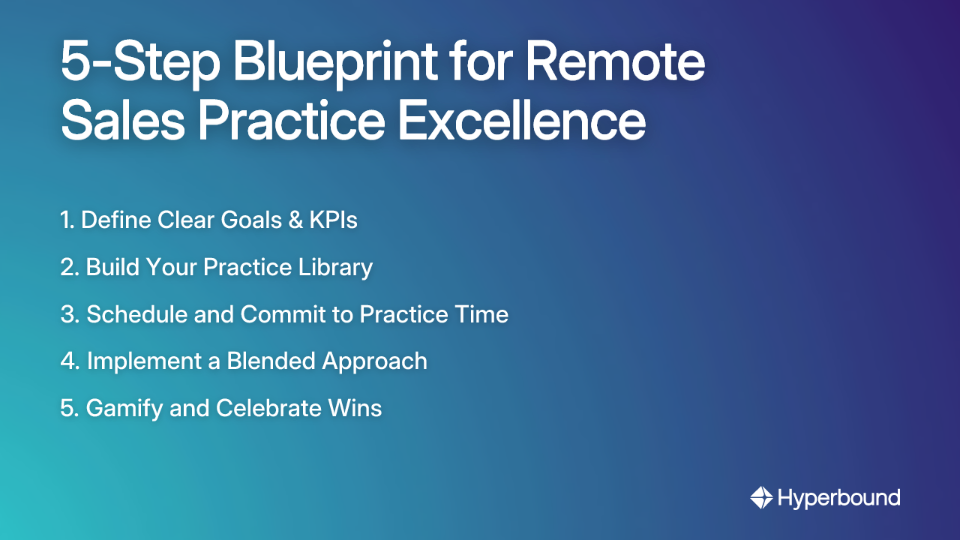
Step 1: Define Clear Goals & KPIs
Don't just "practice." Have specific objectives. Is it to increase meeting booking rates by 15%? Or to improve the team's confidence in handling pricing objections? Setting clear performance expectations and tracking KPIs is essential for remote teams.
Step 2: Build Your Practice Library
Use tools like Hyperbound's AI Real Call Scoring to analyze your team's real calls and identify winning talk tracks from top performers, as well as common stumbling blocks. Use these insights to create a set of core scenarios for both peer roleplays and AI simulations.
Step 3: Schedule and Commit to Practice Time
Block out "Practice & Coaching" time on the team calendar. Treat it with the same importance as prospecting blocks. A good starting point is 60 minutes per week.
Step 4: Implement a Blended Approach
- On-Demand (Daily/Weekly): Reps use AI roleplays to prepare for upcoming calls, practice new messaging, or work on specific weaknesses identified in their feedback.
- Collaborative (Bi-Weekly): Conduct live peer-to-peer roleplay sessions via video conference to build team camaraderie and share qualitative feedback.
- Strategic (Monthly): In team meetings, use insights from analytics to identify team-wide skill gaps and focus coaching efforts. Review a top-scoring call to showcase what "good" looks like.
Step 5: Gamify and Celebrate Wins
Use gamified leaderboards to foster friendly competition around practice scores. Publicly celebrate improvements and wins in your team's Slack or Teams channel to maintain high morale.
Conclusion
The shift to remote work has broken traditional sales coaching models. To stay competitive, teams need to evolve their approach to practice.
A successful remote practice program isn't about choosing one method; it's about building a comprehensive system. It combines the collaborative benefits of peer roleplays with the data-driven insights of call analysis and the scalable, realistic practice provided by AI platforms like Hyperbound.
AI coaching doesn't replace sales managers; it empowers them. By automating repetitive practice and feedback, it frees managers to focus on high-level strategy and deal coaching, ultimately building a more consistent, confident, and successful remote sales team.
Frequently Asked Questions
Why is practicing sales calls so difficult for remote teams?
Practicing sales calls is difficult for remote teams primarily due to the loss of "osmosis learning," where reps passively learn by overhearing colleagues. Without a shared office, new and existing reps miss out on informal coaching, consistent feedback, and the collaborative environment that helps build skills naturally.
What is the best way to practice for sales calls?
The best way to practice for sales calls is by using a blended approach that combines structured peer-to-peer roleplays, systematic call recording analysis, and AI-powered sales simulations. This multi-faceted strategy provides the benefits of team collaboration, real-world examples, and scalable, on-demand practice in a risk-free environment.
How does an AI sales simulator work?
An AI sales simulator acts as a "flight simulator for salespeople," providing a hyper-realistic, interactive environment to practice conversations. Platforms like Hyperbound allow you to customize buyer personas and scenarios, enabling reps to practice cold calls, discovery, and objection handling with an AI that responds realistically, just like a human prospect would.
What kind of feedback can AI provide for sales roleplays?
AI can provide instant, objective feedback that goes beyond subjective human coaching. It uses data-driven scorecards to analyze performance against key metrics such as adherence to a sales methodology, talk-listen ratio, use of filler words, and how effectively specific objections were handled, offering personalized coaching at scale.
Will AI sales coaching replace sales managers?
No, AI sales coaching is designed to empower sales managers, not replace them. By automating the repetitive aspects of practice and providing initial feedback, AI frees up managers' time. This allows them to focus on higher-level strategy, complex deal coaching, and mentoring their team, making their coaching efforts more impactful.
How can I start building a sales practice program for my team?
You can start building a sales practice program by first defining clear, measurable goals, such as increasing meeting booking rates. Next, build a library of common scenarios and objections your team faces. Finally, schedule dedicated practice time on the calendar and commit to a blended approach using peer roleplays and AI tools.

Ready to see how AI can transform your team's sales readiness? Explore Hyperbound's AI Sales Roleplays and provide unlimited, risk-free practice for your entire team.
Book a demo with Hyperbound


