.png)


.png)
Summary
- Transform pre-call anxiety into confidence with a structured 30-minute framework focused on mindset, strategy, and active practice to handle any sales objection.
- Master objection handling by understanding the difference between complaints and true objections, and use the LAER (Listen, Acknowledge, Explore, Respond) framework to guide your conversations.
- Dedicate the final 15 minutes of your prep time to active roleplay, which is crucial for building the muscle memory needed for real-time conversations.
- Utilize on-demand AI Sales Roleplays to practice specific scenarios and receive instant feedback, ensuring you're confident and prepared for any call.
You know that feeling. The calendar notification pops up: "30 minutes until call with [Big Prospect]." Your stomach tightens. You've done the research, you know your product inside and out, but the fear of that one show-stopping objection still lurks in the back of your mind.
What if they say you're too expensive? What if they're already talking to your biggest competitor? What if they dismiss you before you've even had a chance to demonstrate value?
That 30-minute window before a big sales call can be paralyzing. But it doesn't have to be.
In this article, I'll show you how to transform those pre-call jitters into unshakeable confidence with a practical, 30-minute framework that prepares you for any objection. The best part? This isn't about memorizing scripts—it's about building a repeatable system that works for any sales conversation, whether you're an SDR making your first calls or an enterprise AE going into a high-stakes meeting.
Part 1: The Mindset Shift (First 5 Minutes)
Before you dive into preparation tactics, take five minutes to get your head in the right space. How you think about objections fundamentally shapes how you'll handle them.
Understand What You're Really Hearing
The first critical mindset shift is understanding the difference between complaints and true objections—a distinction highlighted by many sales professionals in online discussions:
- Complaints: These are knee-jerk, emotional reactions that often mask the real issue. When a prospect says, "We're too busy for this," or "I get too many sales calls," they're expressing a complaint—not a reasoned objection.
- True Objections: These are logical reasons for disagreeing or expressing opposition. When a prospect says, "Your product is too expensive because our budget has been maxed out for this quarter," that's a true objection with specific reasoning.
The key insight? Behind every complaint is a true objection waiting to be uncovered. Your job isn't to combat the complaint but to use questions to reveal the real concern.
Adopt an Abundance Mindset
The second mindset shift addresses what many salespeople struggle with: the fear of losing the deal. As one sales professional put it in a Reddit thread, "True confidence in sales is having such a full pipeline that it doesn't matter even if you lose a few deals."
For the next 5 minutes, remind yourself:
- This call is about discovering if there's a genuine fit, not forcing a close
- Your goal is to understand their situation, not to "win" an argument
- If this prospect isn't the right fit, that's valuable information that frees you to focus on better opportunities
When you adopt this abundance mentality, you remove the pressure that causes anxiety. You become relaxed, positive, and genuinely curious—the perfect state for handling objections effectively.
Part 2: The Pre-Call Blitz: Anticipate & Strategize (Next 10 Minutes)
With your mindset right, it's time to strategize. According to HubSpot, pre-call planning not only provides direction but also significantly boosts confidence and yields better outcomes. Here's how to maximize those next 10 minutes:
Step 1: Predict the Most Likely Objections
Based on your research of the prospect (their role, company news, LinkedIn activity), quickly jot down the 2-3 objections most likely to come up. Focus on these common categories, which are frequently cited by sales experts:
- Price: "It's too expensive compared to what we're currently using."
- Timing: "This isn't a good time. Our budget is set for the year."
- Need: "We don't need this. Our current solution works fine."
- Competitor: "We're already evaluating [Competitor X]."
- Authority: "I need to run this by my team/boss before making any decisions."
- Trust: "I've never heard of your company. How many clients like us do you have?"
Step 2: Outline Your Response with the LAER Framework
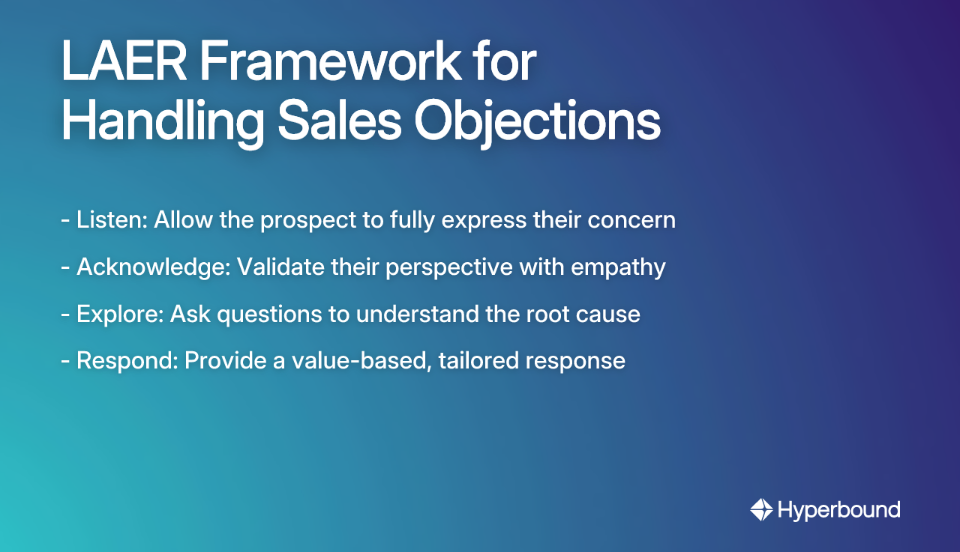
For each predicted objection, create a brief response using the LAER framework, a proven approach highlighted by sales experts:
- L - Listen: Let them fully express their concern without interruption.
- A - Acknowledge: Validate their perspective with a statement like "I understand that budget is a top priority right now."
- E - Explore: Ask an open-ended question to dig deeper. "To better understand your concern, could you share what you're comparing our price to?"
- R - Respond: Provide a thoughtful, value-based response. "That's a fair point. Most of our clients like [Similar Company] initially had budget concerns but found that by consolidating [X and Y], they actually saw a 20% cost reduction within six months."
Remember, you don't need to write a novel. For each objection, just jot down one sentence for each step of the LAER framework.
Step 3: Prepare Proactive Questions
The best defense is a good offense. Instead of waiting for objections, prepare questions that proactively address potential concerns:
- Instead of waiting for a "no need" objection: "I noticed your team is planning to hire five new AEs this quarter. How are you planning to ramp them effectively without slowing down your current managers?"
- Instead of waiting for a "bad timing" objection: "Many teams we work with initially thought timing wasn't right, but I'm curious—if you could solve [specific pain point] without disrupting your current initiatives, would that be valuable?"
These questions demonstrate that you've done your homework and shift the conversation from defensive to collaborative.
Part 3: The Warm-Up: Active Practice & Roleplay (Final 15 Minutes)
This is the most crucial step in your 30-minute prep routine. Moving from mental preparation to muscle memory is what will truly build your confidence.
The Power of Risk-Free Practice
Sales roleplays are a risk-free method for practicing sales skills by simulating realistic scenarios without the risk of losing a deal. It's the only way to make mistakes, refine your tonality, and get comfortable with your talk tracks before the stakes are real.
But the challenge has always been: How do you practice effectively in the 15 minutes before a call when finding a manager or colleague is impossible?
How to Practice: The AI-Powered Advantage
This is where modern technology becomes a game-changer for pre-call preparation. Platforms like Hyperbound are designed for this exact moment, offering AI Sales Roleplays that allow you to jump into a hyper-realistic practice session instantly, on your own.
With Hyperbound's AI-powered roleplays, you can:
- Practice the exact objection scenarios you're worried about—from price and timing to competitor mentions—with an AI buyer persona that responds dynamically
- Receive instant feedback through AI-Powered Scorecards that track key metrics like your talk ratio and how effectively you handled the objection
- Try multiple approaches in a safe environment, refining your response until it feels natural and confident
The most powerful aspect of this approach is that you're not just thinking about your response—you're actually saying the words out loud, building muscle memory, and getting comfortable with the language you'll use.
Here's what a 15-minute practice session with an AI roleplay tool might look like:
- 5 minutes: Run through a quick roleplay focused on your most anticipated objection
- 5 minutes: Review the feedback, noting areas where you could improve your response
- 5 minutes: Run through the scenario again, implementing the changes
By the end of this practice session, you'll have gone from abstract preparation to practical application, building the confidence that comes only from actual experience.

Part 4: Beyond the 30-Minute Sprint: Building Long-Term Mastery
While this 30-minute framework is incredibly effective for pre-call preparation, the most successful sales professionals build objection handling into their ongoing development. Here's how to extend this practice into a system for continuous improvement:
Learn from Every Call
Each sales conversation—whether it results in a win or loss—contains valuable data about the objections you face and how effectively you handle them. But relying on memory or manual notes means missing crucial insights.
This is where tools like Hyperbound's AI Real Call Scoring become valuable. These platforms automatically analyze your sales conversations, scoring how well you handled objections against your company's playbook. By identifying patterns in the objections you face and how you respond, you can systematically improve your approach over time.
Embrace Continuous, Scalable Coaching
Traditional coaching relies on manager availability, which means feedback often comes days or weeks after a call—too late to be truly effective.
AI Coaching tools provide instant, personalized feedback on both practice sessions and real calls, identifying missed opportunities and weak responses in real-time. This empowers you to self-correct and improve continuously, without solely relying on your manager's bandwidth.
According to industry research, sales teams using AI coaching tools have seen a 15-20% increase in win rates and close deals 36% faster—proof that continuous practice and feedback create tangible results.
Conclusion: From Fearing Objections to Welcoming Them
The next time you see that 30-minute warning before a big call, instead of feeling anxiety, follow this proven framework:
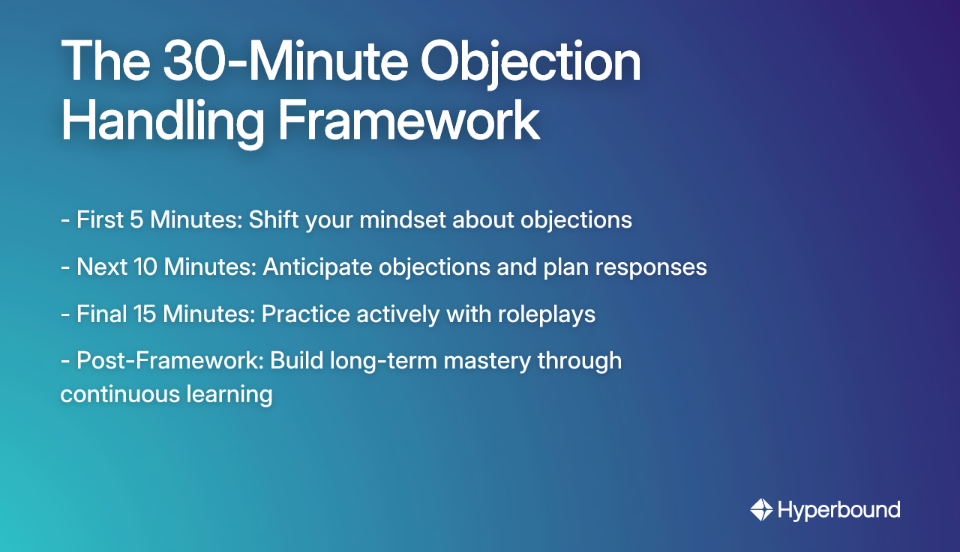
- First 5 Minutes (Mindset): Differentiate complaints from true objections and adopt an abundance mindset.
- Next 10 Minutes (Strategy): Predict likely objections and outline your responses using the LAER framework.
- Final 15 Minutes (Practice): Use AI roleplay tools to actively rehearse and build confidence through repetition.
Remember, objections aren't roadblocks—they're signposts that guide you toward what the prospect truly values. By preparing effectively, you transform these moments from points of friction into opportunities to build trust and demonstrate your expertise.
Make this 30-minute pre-call ritual a habit. Start preparing for your next big call not with anxiety, but with a clear plan for success. Your future self—and your sales numbers—will thank you.
Frequently Asked Questions
What is the most effective way to prepare for sales objections?
The most effective way to prepare is by using a structured, timed framework that combines mindset, strategy, and active practice. A 30-minute pre-call routine is highly effective: spend the first 5 minutes on mindset, the next 10 minutes anticipating objections and strategizing responses (like using the LAER framework), and the final 15 minutes in active roleplay to build muscle memory.
How should I respond to a price objection?
You should respond to a price objection by first listening and acknowledging the concern, then exploring the root cause before providing a value-based answer. This follows the LAER (Listen, Acknowledge, Explore, Respond) framework. For example, after acknowledging their budget concerns, ask, "To better understand, what are you comparing our price to?" This uncovers the context, allowing you to respond with a tailored answer that focuses on value and ROI, not just cost.
What is the LAER framework for handling objections?
The LAER framework is a four-step method for handling sales objections: Listen, Acknowledge, Explore, and Respond. It is a structured communication technique that helps de-escalate tension and get to the core of a prospect's concern. Listen without interrupting, Acknowledge their point of view with empathy, Explore the underlying issue with open-ended questions, and finally, Respond with a relevant, value-focused solution.
Why is roleplaying crucial for objection handling?
Roleplaying is crucial because it moves preparation from a mental exercise to a practical skill, building muscle memory in a risk-free environment. Thinking about a response is different from saying it out loud under pressure. Roleplaying allows you to practice your tonality, refine your wording, and get comfortable with your talk tracks before a real sales call. This active practice is what truly builds the confidence to handle objections smoothly.
How can AI tools help with sales objection training?
AI tools provide instant, on-demand practice and objective feedback, allowing salespeople to train for specific objections anytime without needing a manager. Platforms like Hyperbound offer AI-powered roleplays where you can practice against dynamic buyer personas. These tools provide immediate scorecards on your performance, tracking metrics like talk ratio and how well you handled the objection, enabling continuous and scalable coaching.
What is the difference between a sales objection and a complaint?
A complaint is an emotional, knee-jerk reaction, while a true objection is a logical, reasoned basis for not moving forward. For example, "I get too many sales calls" is a complaint. A salesperson's goal is not to argue with the complaint but to ask questions that uncover the true objection behind it, which might be, "I don't have time because I'm focused on another priority"—a specific concern you can address.

Book a demo with Hyperbound


