.png)


.png)
Summary
- Enterprise deals often stall during multi-party calls with IT and procurement due to their conflicting priorities—security versus cost—and communication breakdowns.
- Success requires a strategic pre-call playbook: understand each stakeholder's unique goals, learn their language, and pre-wire conversations to prevent surprises.
- During the call, your role is to facilitate, not pitch, by guiding the conversation, managing all participants, and establishing clear next steps.
- Master these high-stakes conversations with deliberate practice using AI Sales Roleplays, which allow teams to simulate complex multi-stakeholder scenarios in a risk-free environment.
You've secured the budget, your champion is on board, and your solution is a perfect fit. But now you're facing the procurement and IT gauntlet... and it feels like hitting a brick wall. The dreaded "silent treatment," endless redlines, and newfound security concerns are threatening to derail months of hard work.
Sound familiar?
Multi-party calls with procurement and IT stakeholders represent the final boss battle of the enterprise sales cycle. These high-stakes conversations involve navigating conflicting priorities, managing multiple agendas, and addressing concerns that span from cost and compliance to security and integration.
Success in these critical calls depends on a three-part strategy: deep preparation, flawless execution, and—most importantly—deliberate practice. This article provides a comprehensive playbook for mastering all three.
The Gauntlet: Why Multi-Party Calls with IT & Procurement Derail Deals
To navigate these complex conversations, you first need to understand why they're so challenging. Multi-stakeholder calls often fail due to three fundamental dynamics:
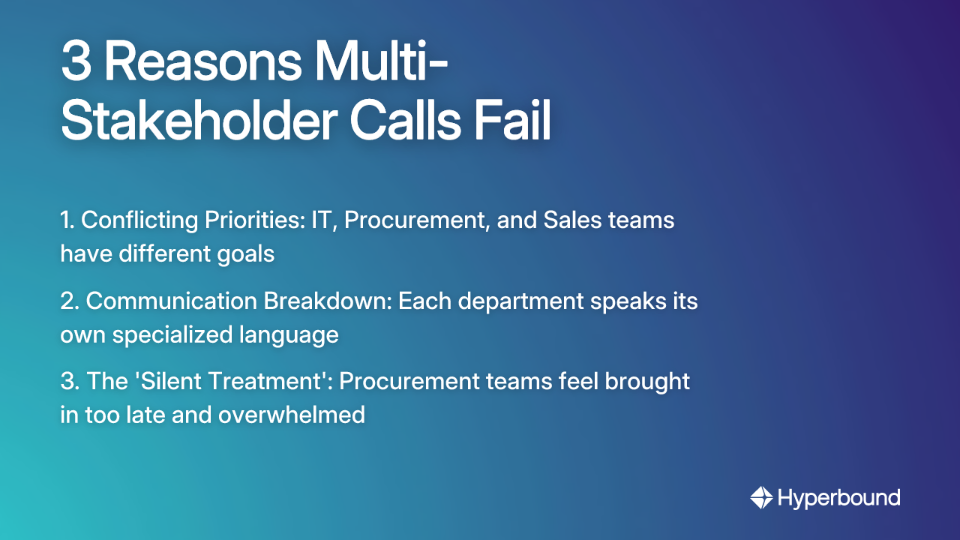
Conflicting Priorities
Each stakeholder enters the call with a distinct agenda, and understanding these competing priorities is the first step:
- IT's Focus: Security, data protection, compliance, and technical feasibility. They're asking, "Will this break anything? Is it secure? How much work will this create for us?"
- Procurement's Focus: Price, Total Cost of Ownership (TCO), contract terms, risk mitigation, due diligence, and vendor consolidation. Their primary concerns are, "Are we getting the best value? Are the terms favorable? Are we protected?"
- Your Focus: Closing the deal efficiently while protecting margin and building a strong relationship for future growth.
These competing priorities create natural tension that, if not managed properly, can grind progress to a halt.
Communication Breakdown & "Speaking Different Languages"
Procurement and IT teams have their own specialized jargon. A sales rep using ambiguous sales-speak will fail to build trust and credibility. It's crucial to avoid procurement jargon when speaking with IT and vice-versa.
The "Silent Treatment" Phenomenon
Many sales professionals report feeling disregarded or "ghosted" after a deal reaches procurement. Understanding the "why" behind this behavior is critical: Procurement teams are often under-resourced, overwhelmed, and brought into deals late, making your request a fire drill they didn't plan for.
According to procurement professionals, their "roles are often misunderstood and held responsible for processes that are bypassed." This lack of early engagement is a primary source of friction that manifests during multi-party calls.
The Pre-Call Playbook: A Strategic Framework for Success
Success in multi-party calls starts long before anyone dials in. Here's your strategic pre-call playbook:
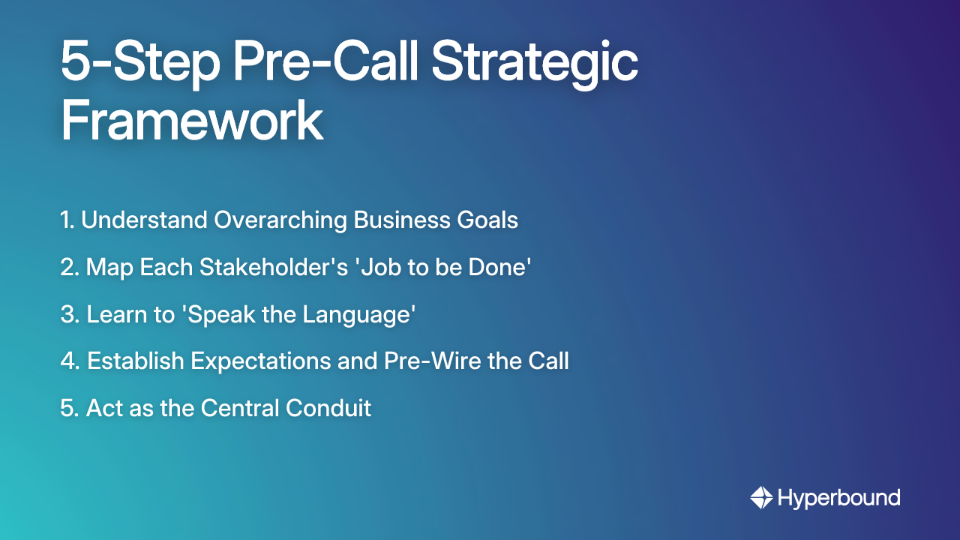
Step 1: Understand the Overarching Business Goals
Move the conversation beyond features by aligning your solution with the organization's overall goals. This creates common ground for all stakeholders by identifying shared priorities and objectives.
Step 2: Map Each Stakeholder's "Job to be Done"
For each participant, understand their specific role, concerns, and what success looks like from their perspective:
- For IT: Prepare to discuss data security, SOC compliance, privacy, and integration APIs. Understand exactly how they will use the product in their existing environment.
- For Procurement: Prepare to discuss pricing models, contract renewal terms, liability, and implementation support. Be ready for the vendor form and know which terms are negotiable versus non-negotiable.
Step 3: Learn to "Speak the Language"
Train yourself on basic IT and procurement terminology. Understanding terms like SaaS, managed services, spend analysis, and supplier relationship management builds credibility instantly. When you can speak their language, you remove a major barrier to trust.
Step 4: Establish Expectations and Pre-Wire the Call
Communicate with stakeholders before the group meeting. Send a clear agenda, share relevant documents, and try to uncover potential objections in 1:1 conversations. This prevents surprises, shows respect for their time, and aligns with recommendations from procurement professionals to engage early and regularly.
Step 5: Act as the Central Conduit
Position yourself as the focal point between InfoSec, Legal, Finance, and IT. Facilitate communication and ensure everyone has the information they need. By serving as this central conduit, you demonstrate leadership and add value beyond your product.
Executing the Call: Mastering Live Multi-Stakeholder Engagement
With proper preparation complete, here's how to execute the multi-party call effectively:
Set the Stage (First 5 Minutes)
Start by greeting all participants, clearly stating the agenda, and defining the desired outcome. Explicitly establish each person's role to ensure clarity. This sets the tone for a productive conversation.
Managing Participants & Flow
Adding Specialists: If you need to bring in a technical specialist or legal expert, do it smoothly. According to best practices for multi-party calls, you should "use Quick Connects option to pull in additional agents or make external calls while the caller is on hold. Greet and explain the purpose of the new addition to the call before formally integrating them."
Facilitation, Not Pitching: Your role is to guide the conversation, not dominate it. Use the agenda to stay on track and actively draw quieter stakeholders into the discussion to ensure all voices are heard.
Control the Conversation: As the host, manage the interaction by directing questions, acknowledging concerns, and keeping time. All participants should feel seen and heard while maintaining forward momentum.
Ending with Clarity
Reserve the last 5-10 minutes to summarize decisions and define clear action items with owners and deadlines. This ensures everyone leaves with a shared understanding of next steps and responsibilities.
From Theory to Mastery: How to Practice for Perfection
Reading about multi-party call strategies is helpful, but execution under pressure is what matters. You can't risk a six-figure deal for "live practice," and internal roleplays often lack realism and are time-consuming for managers.
So how do you develop this critical skill without putting real deals at risk?
The Solution: AI-Powered Sales Roleplays
AI-powered sales roleplays have emerged as a game-changing solution for practicing complex multi-stakeholder conversations. These tools allow sales professionals to simulate realistic scenarios with virtual stakeholders who respond dynamically based on what you say.
These simulations provide a safe environment to practice high-stakes conversations without putting real relationships on the line.
.png)
Bringing It to Life with Hyperbound
Hyperbound's AI Sales Roleplays platform offers specific capabilities for mastering multi-party interactions with procurement and IT stakeholders:
Simulate the Real World: With Hyperbound's Multi-party Roleplays, you can practice a single call with an AI "IT Director" who drills you on security questions and an AI "Procurement Manager" who pushes back on price—all in the same simulation. This directly prepares you for the complexity of these calls.
Get Instant, Objective Feedback: Rather than subjective opinions, Hyperbound's AI-Powered Scorecards provide instant, data-driven analysis on your performance. The system tracks key metrics like:
- Talk ratios (ensuring you're listening enough)
- Objections handled effectively
- Key selling moments leveraged
- Adherence to your company's sales methodology
Scale Coaching and Self-Improvement: With Hyperbound's AI Coaching, sales professionals can identify their mistakes and get guidance on how to improve immediately after a roleplay. This accelerates skill development and frees up managers to focus on high-level strategy instead of repetitive call reviews.
Putting It All Together
Mastering multi-party calls with procurement and IT stakeholders requires a three-pronged approach:
- Strategic Preparation: Understand each stakeholder's priorities, learn their language, and pre-wire the conversation.
- Tactical Execution: Facilitate rather than dominate, manage the conversation flow, and end with clear next steps.
- Deliberate Practice: Use AI-powered roleplays to build muscle memory for handling complex stakeholder dynamics without risking real deals.
By investing in these three areas, you'll transform the procurement and IT "gauntlet" from a deal-killer into a competitive advantage. When your competitors are getting ghosted and delayed, you'll be skillfully navigating these critical conversations and closing deals more efficiently.
Stop leaving your most critical conversations to chance. Start building the muscle memory you need to navigate any stakeholder meeting with confidence and close more enterprise deals successfully.
Frequently Asked Questions
Why do multi-party sales calls with IT and procurement often fail?
Multi-party sales calls often fail due to three main reasons: conflicting priorities between departments, communication breakdowns where each stakeholder speaks a different "language," and a lack of early engagement with procurement teams. IT is focused on security and integration, while procurement prioritizes cost and contract terms. This natural tension, combined with specialized jargon, can lead to misunderstandings and derail the conversation if not managed skillfully.
What is the most important step to prepare for a multi-stakeholder call?
The most crucial preparation step is to understand each stakeholder's specific "Job to be Done" and pre-wire the conversation with them individually before the group call. This involves mapping out the unique concerns, goals, and success metrics for both IT and procurement. By holding brief, 1:1 conversations beforehand to share the agenda and uncover potential objections, you can prevent surprises and build alignment before the high-stakes group meeting.
How can sales reps build credibility with technical and financial stakeholders?
Sales reps can build credibility by learning to "speak the language" of both IT and procurement, moving beyond sales jargon to use terminology they understand. For IT, this means being prepared to discuss technical aspects like data security, SOC compliance, and APIs. For procurement, it means understanding concepts like Total Cost of Ownership (TCO) and contract terms. Using their language demonstrates that you understand their world and respect their role.
What are the key differences between IT and Procurement priorities?
The primary difference is that IT focuses on technical feasibility and security, while procurement focuses on financial value and contractual risk. IT stakeholders ask, "Is this solution secure? Will it integrate with our systems?" Procurement, on the other hand, is concerned with, "Are we getting the best price? What are the long-term costs?" A successful sales professional must address both distinct sets of concerns.
How should you manage the flow of a live multi-party call?
You should act as a facilitator, not just a pitcher. Your role is to guide the conversation, ensure all voices are heard, and keep the discussion on track. Start by setting a clear agenda, manage time effectively, and actively draw quieter stakeholders into the discussion. End the call by summarizing decisions and assigning clear action items with owners and deadlines to maintain momentum.
Why is practicing these calls with AI roleplays more effective than traditional methods?
AI roleplays provide a realistic, risk-free environment to practice navigating the conflicting priorities of different stakeholders, offering objective, data-driven feedback that isn't available in traditional roleplays. Unlike internal roleplays, which can lack realism, AI simulations allow you to practice with virtual IT Directors and Procurement Managers in the same call. The AI provides instant feedback on performance, allowing for rapid skill development without risking a live deal.
Book a demo with Hyperbound


