.png)


.png)
Summary
- Scaling a sales team often causes performance quality to drop due to diluted messaging, inconsistent processes, and longer new hire ramp times.
- To scale successfully, codify your winning sales motion by documenting top-performer strategies into a simple, centralized playbook.
- Effective coaching at scale requires moving beyond manual call reviews and using a data-driven framework to overcome manager bandwidth limitations.
- Hyperbound's AI coaching platform helps maintain quality by providing scalable roleplay practice, automated call analysis, and skill-based hiring assessments.
You've done it. Your startup has hit product-market fit, revenue is climbing, and it's time to scale your sales team. This moment—when you transition from founder-led sales to building a revenue machine—is exhilarating. It's also where many promising companies stumble.
The challenge is clear: as you add headcount, consistency plummets. Your top performers' winning talk tracks get diluted, new hire ramp times skyrocket, and your managers transform from coaches into firefighters. Before you know it, your close rates drop while your Customer Acquisition Cost (CAC) soars.
It doesn't have to be this way. Maintaining sales quality during rapid growth isn't about working harder—it's about building a smarter system. This article provides a blueprint for sales leaders to scale their teams without sacrificing the performance quality that fueled their initial success.
The Foundation: Codify Your Winning Sales Motion
Before hiring a flood of AEs and BDRs, you must define and document your successful sales motion. You can't scale what you don't understand.

Nail It Before You Scale It
Reddit discussions among founders highlight a crucial first step: founders must lead the initial sales efforts to establish Product-Market Fit (PMF). As one founder put it, "If you can't sell it and answer why a customer would buy/switch off a competitor, then it's going to be near impossible for anyone else to sell it."
The founder is the first expert on the product and value proposition. Their early sales efforts create the raw material for the first sales playbook. Don't rush to hire before you've personally validated that customers will buy and why.
Reverse-Engineer Your Top Performers
Once you have early sales success, don't just celebrate it—dissect it. Identify the specific behaviors, talk tracks, and strategies your best reps use.
This is the core of building a scalable playbook. To do this, you must reverse-engineer success by identifying the specific strategies of high-performing reps to guide others.
Modern Conversation Intelligence tools, like those offered by Hyperbound, are essential here for analyzing call patterns at scale:
- What questions do your top performers ask during discovery?
- How do they handle common objections?
- What stories and analogies resonate most with your ICP?
Create a Simple, Adoptable Sales Process
Chaos ensues when a sales process is inconsistent or overly complex. A key challenge many scaling teams face is the inconsistent adoption of their sales process. The solution is to create a process that is simple, effective, and earns the team's trust.
Your sales process should:
- Align with how your customers actually buy
- Have clear stage definitions with entry/exit criteria
- Include specific playbooks for each stage
- Be documented in a way that's easy to reference
Centralize Your Sales Content and Playbook
To maintain message discipline, it's crucial to organize and streamline access to sales materials. A centralized content hub ensures every rep, from a new BDR to a tenured AE, is using the same, up-to-date messaging, case studies, and battle cards.
This prevents message dilution during rapid growth and eliminates the "I can't find that document" excuse that plagues growing teams.
The Engine of Quality: Building a Scalable Coaching Culture
With your foundation in place, it's time to tackle the single biggest bottleneck in scaling quality: manager bandwidth. As your team grows, you need to move from ad-hoc coaching to a systematic, technology-enabled coaching engine.
Acknowledge the Manager Bottleneck
As teams grow, managers can't listen to every call. They spend their time on administrative tasks and deal strategy, leaving little time for skill development. These manager time constraints are a primary bottleneck that reduces the ability to coach effectively.
The math is simple but brutal. When a manager has 5 reps, they might spend 2 hours per week coaching each rep (10 hours total). When they have 15 reps, that same commitment would require 30 hours weekly—an impossibility given their other responsibilities.
Implement a Structured and Data-Driven Coaching Framework
To scale coaching effectively, you need a framework that maximizes impact with minimal time investment:
- Focus on one skill at a time: Avoid overwhelming reps. Outreach.io recommends identifying one specific area for each rep to focus on per coaching session.
- Promote self-evaluation: Encourage reps to assess their own performance to build accountability.
- Set SMART Goals: Use Specific, Measurable, Achievable, Relevant, Time-bound goals for development, e.g., "Increase discovery question count by 15% on calls this month."
Leverage AI to Automate Call Review and Scale Coaching
This is where technology becomes a force multiplier. Instead of managers manually reviewing calls, AI can do the heavy lifting.
Hyperbound's AI Real Call Scoring automates the quality assurance process by analyzing 100% of sales calls and scoring them against your specific methodology. It surfaces key moments, identifies where reps deviate from the playbook, and flags coachable opportunities for managers, saving them hours of review time.
Additionally, Hyperbound's AI Coaching provides reps with instant, personalized feedback after every call, aligned with your company's methodology. Reps no longer have to wait for their 1:1 to get feedback. This creates a "feedback-rich environment" and empowers reps to self-correct and improve continuously.
Practice Makes Permanent: Ensuring Rep Readiness at Scale
Quality isn't just about feedback; it's about preparation. How do you ensure every rep, new or tenured, can confidently execute the playbook under pressure?
The Failure of Traditional Roleplay
Traditional peer-to-peer or manager-led roleplay is time-consuming, not scalable, and often lacks realism. It's one of the first things to get cut when managers get busy. Many sales teams resort to ad-hoc solutions like "voice channels on Discord for roleplay and call coaching," as mentioned in Reddit discussions—hardly a systematic approach to skill development.
The Critical Need for Safe, Repeatable Practice
Reps need a space to practice handling objections, delivering a new value proposition, or navigating a competitive conversation without risking a live deal. This builds muscle memory and confidence.
The problem is stark during growth: long ramp times for new hires are a major challenge, leading to higher CAC. Industry data shows that effective, AI-powered coaching and practice can lead to a significant reduction in ramp time—in some cases by over 50%.
Scale Practice with AI-Powered Sales Roleplays
Hyperbound's AI Sales Roleplays enable reps to practice critical conversations anytime, anywhere against hyper-realistic AI buyer personas. The AI is trained on your company's specific ICP, products, and common objections.
The benefits are substantial:
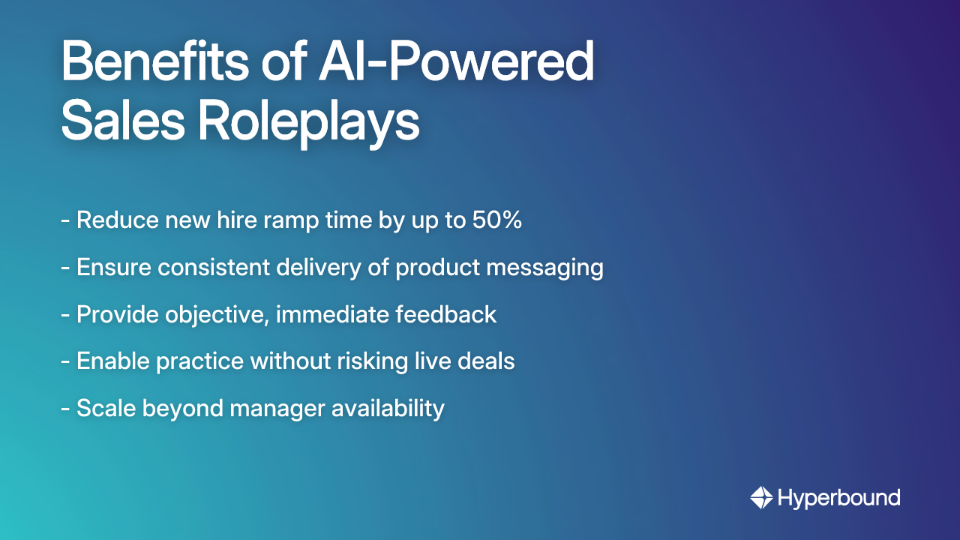
- Reduce Ramp Time: New hires can practice dozens of mock calls in their first week, mastering the playbook before they ever speak to a prospect.
- Drive Consistency: Ensure every rep can articulate new messaging for a product launch or competitive pivot.
- Objective Feedback: Reps receive an instant, AI-powered scorecard on their performance, tracking key metrics and selling moments, allowing for immediate improvement.
This approach directly addresses the challenge of having limited coaching resources, particularly for rapidly growing teams where manager attention is at a premium.
Front-Loading Quality: Hiring and Onboarding the Right People
Quality assurance should begin at the very start of the employee lifecycle: hiring. The best way to maintain quality during growth is to hire people who already demonstrate the skills you need.
Hire for Skill, Not Just a Story
Resumes and interviews can be deceiving. The best way to know if someone can sell is to see them sell. Traditional interviews may reveal charisma and experience, but they rarely show a candidate's ability to actually execute your sales motion.
Use AI Roleplay for Hiring Assessments
Hyperbound's AI Roleplay Hiring Assessments allow companies to screen candidates at scale by having them perform realistic sales roleplays with AI buyers.
This approach delivers several advantages:
- Objective Evaluation: Get data-driven insights into a candidate's actual selling skills, not just their interview charisma.
- Scalable Screening: Assess a high volume of candidates consistently without taking up hiring manager time.
- Reduce Mis-Hires: Identify candidates who lack core skills early in the process, improving the quality of hire and reducing future churn.
When you start with better-qualified candidates, your coaching resources go further, and your quality standards are easier to maintain.
Systematize Quality to De-Risk Your Growth
Maintaining sales quality during rapid team growth comes down to a simple blueprint:
- Codify: Start with a documented, proven sales motion.
- Coach: Use AI to scale coaching beyond manager bandwidth.
- Practice: Enable consistent, on-demand practice with AI roleplays.
- Hire: Screen for skills with objective, AI-driven assessments.
The key insight is that maintaining quality during rapid growth isn't about working harder; it's about building a smarter system. By embedding technology like AI into your coaching, practice, and hiring processes, you create a scalable engine for excellence.
This ensures that as your team doubles or triples in size, your performance and quality scale right along with it. The most successful companies don't just grow—they grow intelligently, with systems that preserve and amplify what made them successful in the first place.
Frequently Asked Questions
What is the first step to scaling a sales team without losing quality?
The first and most critical step is to codify your winning sales motion. Before hiring more reps, you must thoroughly understand, document, and standardize the successful strategies used by your top performers. This involves creating a clear, adoptable sales process, reverse-engineering successful talk tracks, and centralizing all sales content into an accessible playbook. You can't scale what you haven't defined.
Why do sales teams struggle with consistency as they grow?
Sales teams struggle with consistency during growth because successful informal processes break down under scale, and manager bandwidth becomes a major bottleneck. As headcount increases, the winning talk tracks of top performers get diluted, new hire ramp times increase, and managers become too busy with administrative tasks to provide effective coaching. Without a systematic approach to training and reinforcement, each new hire introduces variability, leading to inconsistent performance.
How can sales managers effectively coach a rapidly growing team?
Sales managers can effectively coach a growing team by leveraging technology, specifically AI-powered tools, to automate call reviews and provide scalable feedback. The traditional model of managers listening to calls is not scalable. AI Conversation Intelligence tools can analyze 100% of sales calls, score them against a predefined methodology, and surface coachable moments automatically. This frees up managers to focus on high-impact, strategic coaching instead of manual review.
What's wrong with traditional sales roleplay for training?
Traditional sales roleplay is often ineffective because it is time-consuming, difficult to scale, and frequently lacks the realism needed for meaningful practice. Peer-to-peer or manager-led roleplays are often the first activity to be cut when schedules get busy. They can also suffer from inconsistent feedback and a lack of psychological safety, as reps may not feel comfortable failing in front of their peers or manager.
How can AI improve the sales hiring process?
AI can improve sales hiring by providing an objective, scalable way to assess a candidate's actual selling skills, rather than relying solely on interviews and resumes. AI-powered roleplay assessments allow hiring managers to see how candidates perform in a simulated sales scenario. This data-driven approach helps screen a high volume of candidates efficiently, reduces bias, and significantly lowers the risk of making a mis-hire by identifying skill gaps early.
What are the main benefits of using AI for sales readiness?
The main benefits of using AI for sales readiness are significantly reduced new hire ramp time, consistent message delivery across the entire team, and scalable, on-demand practice and coaching. AI tools allow new hires to master the playbook faster in a safe environment. They ensure every rep, new or tenured, can consistently articulate key messaging and scale the best practices of your top performers and managers.
Ready to build a scalable system for sales quality? See how Hyperbound's AI Sales Coaching platform helps fast-growing teams reduce ramp time, drive playbook consistency, and ensure every rep performs like your best.

Book a demo with Hyperbound


