

.png)
Summary
- Your CRM is likely a passive system of record; transform it into an active performance engine by integrating skill development directly into its workflows.
- Before automating, map your sales process by defining each stage and identifying the critical conversations that move deals forward.
- Integrating AI-powered practice and call scoring can lead to a 30% faster ramp time and 20% higher quota attainment by creating a continuous feedback loop.
- Use platforms like Hyperbound to automatically trigger practice scenarios from CRM events and score real calls to scale coaching effectively.
Your CRM is packed with customer data, interaction history, and pipeline metrics—but is it actually making your sales team better at selling? For many organizations, CRMs have become sophisticated systems of record rather than systems of readiness. They track what happens in the sales process, but do little to improve how those critical conversations unfold.
"I would like to create a decision tree automation for the entire process of the business so that the system will be followed to the T every time," writes one sales leader on Reddit. This common desire reflects a crucial gap: Most CRMs excel at managing data but fall short in developing the skills that actually close deals.
The solution? Integrating sales practice directly into your CRM workflow. By embedding tools for practice, feedback, and coaching into your existing systems, you can transform your CRM from a passive database into an active performance engine that drives consistent, high-level execution across your team.
The Blueprint: Why Process Mapping is Your Non-Negotiable First Step
Before diving into automation, heed this wisdom from an experienced CRM user: "Whatever CRM you go for, it's definitely worthwhile mapping out every step of your processes before you start setting up in any CRM." This insight is gold—automating a flawed or undefined process only scales your problems.
Start with these key steps:
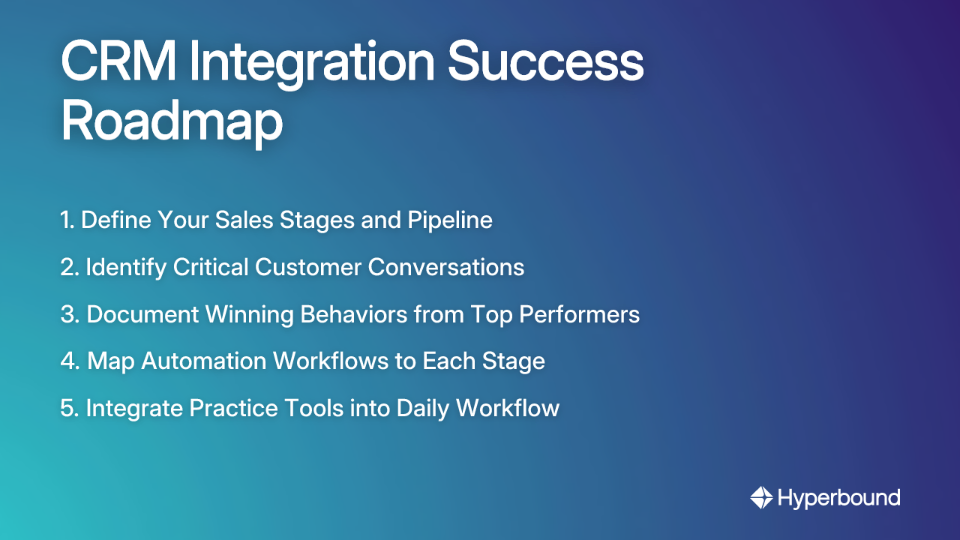
- Define Your Sales Stages: Clearly outline each stage in your pipeline management process (e.g., Lead, Qualified, Discovery, Demo, Negotiation, Closed-Won/Lost).
- Identify Critical Conversations: For each stage, pinpoint the key conversations that determine success. What specific interactions move deals forward? Is it the first cold call? The discovery call? Handling the "it's too expensive" objection?
- Document Winning Behaviors: Study your top performers. What talk tracks do they use? What questions do they ask? How do they handle objections? These patterns become the gold standard for your playbook.
This process map serves as both the blueprint for your CRM workflow automation and identifies the exact scenarios your team needs to practice to excel.
Foundational Integration: Automating Actions with CRM Workflows
With your process mapped, you can build the foundational layer of CRM integration—automating routine actions to streamline processes, reduce manual entry, and ensure data accuracy.
Common use cases for CRM automation include:
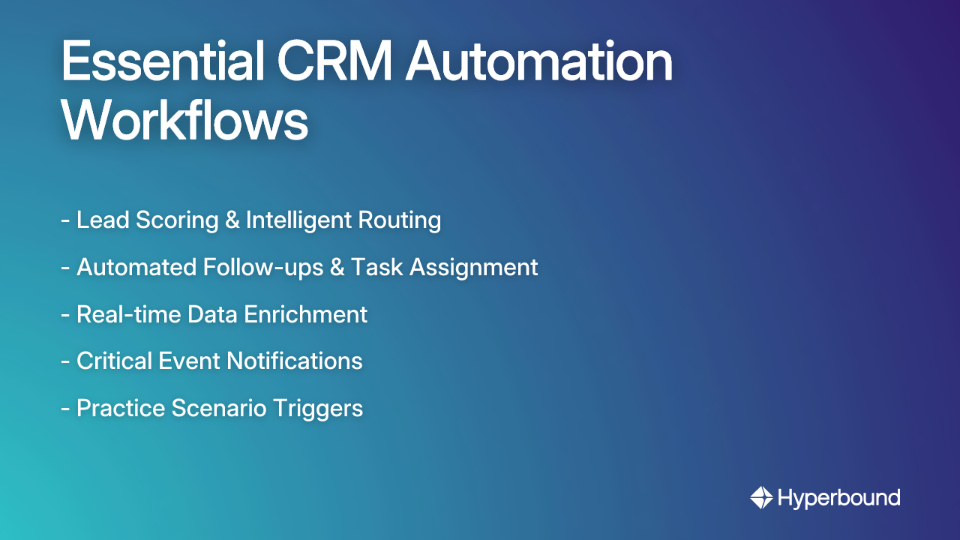
- Lead Scoring and Routing: Use algorithms and decision tree logic to score leads based on interaction data and automatically route them to the right sales rep.
- Automated Follow-ups and Task Assignment: Trigger email sequences and create tasks based on CRM events. For example, when a deal moves to "Proposal Sent," automatically schedule a follow-up task for 3 days later.
- Data Enrichment: Update customer records by automatically pulling in relevant data from sources like LinkedIn or Clearbit.
- Notifications and Alerts: Set up automated Slack or email alerts for key events, such as a high-value deal closing or a deal stalling in a stage for too long.
Modern CRMs like HubSpot and Zoho offer user-friendly, drag and drop workflow builders that help avoid the "headache" of complex setups that many users dread.
Advanced Integration: Embedding a Practice Ground into Your CRM
While automating data flows is valuable, the next level of integration focuses on automating skill development. The goal is to make practice a seamless part of the daily workflow, not an isolated training event.
Traditional roleplay has significant limitations—it's often forced and unnatural, feedback is inconsistent, and scheduling is a nightmare due to time constraints. This is where AI-powered sales practice offers a breakthrough solution.
AI Sales Roleplay: Practice Without the Pressure
AI roleplay provides a judgment-free environment that's accessible 24/7 and delivers objective, data-driven coaching. It allows reps to fail and learn in a safe space before a live deal is on the line.
Here's how to integrate AI roleplay with your CRM:
- Trigger Practice from CRM Stages: Create a workflow where moving an opportunity to a new stage (e.g., "Demo Scheduled") automatically assigns a relevant practice scenario to the rep.
- Use CRM Data for Realistic Scenarios: The most effective AI roleplay platforms can integrate with your CRM to pull real-life scenarios. This means reps can practice against custom buyer personas that mirror their actual prospects, using product details and objections logged in your CRM.
- Log Performance Back to CRM: After each practice session, automatically record the rep's performance score in their CRM user record or attach it to the relevant opportunity.
Hyperbound's AI Sales Roleplays, for example, enables you to build a library of hyper-realistic scenarios based on your team's winning conversations. Reps can practice critical moments—from cold calls and discovery to demos and objection handling—with AI buyer personas that respond dynamically based on what's said.
Closing the Loop: Creating a Continuous Feedback Cycle with AI Call Scoring
The final piece of the integration puzzle addresses a universal challenge: managers are bottlenecks for feedback. Manual call review is subjective, time-intensive, and limited in scope, meaning only a fraction of calls ever get reviewed.
AI-powered call scoring technology solves this by analyzing 100% of sales calls. Using speech recognition, natural language processing, and machine learning, these tools evaluate conversations against your custom methodology and track key metrics:
- Script Adherence: Did the rep cover key talk tracks and value propositions?
- Talk-to-Listen Ratio: Is the rep dominating the conversation or actively listening?
- Customer Sentiment: Gauges the customer's tone and emotional state
- Agent Engagement: Assesses soft skills like empathy and clarity
To create a closed-loop system with your CRM:
- Attach Scores to CRM Records: Automatically link the call recording, transcript, and AI-generated scorecard directly to the corresponding opportunity or contact record.
- Create Automated Coaching Triggers: If a call scores below threshold on specific skills (like objection handling), create a workflow that automatically assigns a coaching task to the manager and a targeted AI roleplay to the rep.
- Automate CRM Note-Taking: Use AI to generate summaries of key moments, objections, next steps, and buying signals, and sync them to the notes field in your CRM—saving reps hours of admin time.
Solutions like Hyperbound's AI Real Call Scoring integrate with your call recording systems and CRM to automate the entire review process, providing unbiased scoring on every call and generating actionable insights for personalized coaching.
The Fully Integrated Workflow in Action: From Lead to Coached Rep
Let's see how this integration works in practice with a concrete example that delivers on the "decision tree automation for the entire process" that many sales leaders desire:
Step 1: Lead Assigned in CRM
An SDR receives a new Marketing Qualified Lead (MQL) through an automated assignment rule in the CRM.
Step 2: Automated Practice Trigger
The CRM automatically assigns a "New MQL - Cold Call Practice" simulation in the integrated AI roleplay platform, tailored to the lead's industry and pain points (pulled from CRM data).
Step 3: Rep Practices & Gets Feedback
The SDR completes the AI Sales Roleplay and receives an instant score on their messaging, discovery questions, and objection handling—all logged back to their user record in the CRM.
Step 4: Live Call & Automated Scoring
The SDR makes the live call. An AI Call Scoring system analyzes the conversation in real-time against the company's sales methodology.
Step 5: CRM Record Updated
The call recording, transcript, and AI-generated scorecard showing that the rep struggled with a competitor mention are automatically attached to the opportunity in the CRM. An AI-generated summary of next steps is added to the notes field.
Step 6: Targeted Coaching is Triggered
The low score on "competitive positioning" automatically creates a task for the sales manager to review that specific section of the call and assigns the rep a tailored AI roleplay focused on handling competitor objections.
This closed-loop system ensures that CRM data triggers practice, real-world performance is automatically measured, and targeted coaching is delivered—all within the workflow reps use every day.
.png)
Transform Your CRM into Your #1 Performance Driver
Integrating sales practice into your CRM is the key to closing the gap between your playbook and your team's performance. It moves your CRM from being a simple database to the central hub of a continuous learning and improvement culture.
Organizations that successfully implement this approach see tangible results:
- 30% faster ramp time for new hires and 20% higher quota attainment across the team
- More consistent execution of your sales methodology
The integration of AI-powered practice tools like Hyperbound's AI Coaching platform can be particularly powerful. By delivering personalized feedback after each interaction, these solutions help reps identify and correct mistakes in real-time, accelerating their learning curve and freeing managers from repetitive call reviews.
Getting Started
Begin by mapping your sales process. Identify the one or two critical conversations that have the biggest impact on your pipeline. Then, explore how integrating AI-powered practice and feedback tools can help your team master those moments.
Remember what one CRM user wisely noted: "When you need those branching workflows, it really comes down to having a CRM that doesn't make the setup a headache." Look for solutions that offer simple integrations with your existing CRM and provide clear value from day one.
By combining the data management power of your CRM with the skill development capabilities of modern sales coaching platforms, you can build a system that doesn't just track deals—it actively helps your team win them.
Frequently Asked Questions
What is CRM sales practice integration?
CRM sales practice integration is the process of embedding skill development tools, such as AI-powered roleplays and call coaching, directly into your Customer Relationship Management (CRM) system. Instead of being just a database for customer information, this transforms your CRM into an active performance engine that uses triggers—like a deal moving to a new stage—to automatically assign relevant practice scenarios to sales reps.
Why is it important to integrate sales coaching with our CRM?
Integrating sales coaching with your CRM is important because it connects skill development directly to real-world sales activities, ensuring that training is relevant, timely, and consistently applied. This approach moves training from isolated events to a continuous part of the daily workflow, helping to close the gap between your sales playbook and your team's on-the-ground performance.
How do I get started with integrating sales practice into my CRM?
The best way to start is by mapping out your existing sales process before implementing any new tools. First, clearly define your sales stages. Then, identify the critical conversations at each stage that most impact deal success. This blueprint will serve as the foundation for automating workflows and identifying the exact scenarios your team needs to practice.
What are the main benefits of using AI for sales roleplay?
The main benefits of using AI for sales roleplay are providing a scalable, consistent, and judgment-free practice environment that is available 24/7. Unlike traditional roleplay, AI offers objective, data-driven feedback without scheduling challenges. It also allows reps to practice hyper-realistic scenarios based on actual customer data pulled from your CRM.
How does AI call scoring work and is it accurate?
AI call scoring works by using natural language processing (NLP) to analyze 100% of your team's sales calls against a custom scorecard, and it is highly accurate for measuring objective criteria. The technology evaluates metrics like script adherence, talk-to-listen ratio, and customer sentiment, providing a level of insight that is impossible to achieve through manual call review.
What results can we expect from a fully integrated CRM and sales coaching system?
Organizations that successfully integrate their CRM with sales coaching platforms can expect tangible improvements in team performance, including faster new hire ramp times and higher overall quota attainment. On average, companies see results like a 30% faster ramp time and a 20% increase in reps hitting their quota because the system creates a continuous feedback loop that ensures consistent execution of the sales methodology.
Ready to transform your CRM from a system of record into a system of readiness? Learn more about how Hyperbound can integrate AI-powered sales roleplays, call scoring, and coaching into your existing workflow.
Book a demo with Hyperbound


