

.png)
Summary
- Sales teams using AI see significantly higher revenue growth (83% vs. 66% for non-users), making it a critical tool for modern sales coaching.
- Instead of rigid scripts, build a playbook of flexible "talk tracks" by analyzing the conversational patterns of your top-performing reps.
- Start by manually reviewing calls for key moments, then use AI to scale this analysis across thousands of conversations to uncover what truly works.
- Enable your team to master these talk tracks with unlimited, realistic practice using AI Sales Roleplays to turn insights into instinct.
You've seen it happen countless times. Your top sales rep effortlessly navigates a tough objection that leaves others stammering. They consistently close deals while using language that somehow perfectly resonates with prospects. Meanwhile, the rest of your team struggles to find their confidence with rigid scripts that never quite feel natural.
"I have had to rewrite most scripts in my own language in order for me to feel confident with things," admits one sales rep in a recent discussion. This gap between your best performers and everyone else isn't just frustrating—it's costing you revenue.
The difference often comes down to talk tracks: those flexible, structured conversation outlines that guide your best reps through complex sales situations without making them sound like robots. Unlike rigid call scripts, talk tracks provide a framework while allowing for natural conversation flow and personality.
But how do you capture the "magic" of your top performers and make it a repeatable playbook for everyone else? This article provides a systematic process to identify winning conversational patterns, document them into powerful talk tracks, and use AI-driven tools to help your entire team master them.
The Foundational Framework: Manually Extracting Your First Winning Talk Tracks
Before diving into advanced technology, start with a manual approach to build a solid foundation and understanding of what actually works on your calls.
Step 1: Identify Key Topics and Moments to Analyze
Don't try to boil the ocean. Focus on high-impact areas where reps struggle or top performers excel:
- Common Objections: Price ("It's too expensive"), timing ("Call me next quarter"), competitor ("We're already using X").
- Complex Feature Explanations: How do your best reps simplify technical concepts?
- Discovery Call Flows: What questions do they ask, and in what order, to uncover deep pain points?
- Product Demo "Wow" Moments: How do they frame the value proposition during demos?
Step 2: Analyze Customer Interactions (The Hard Way)
Yes, this part can be painful, but it's invaluable. As one sales professional bluntly put it on Reddit: "Jesus Christ, listen to your own calls. I learn something every single time I do, even though doing so is a bit painful."
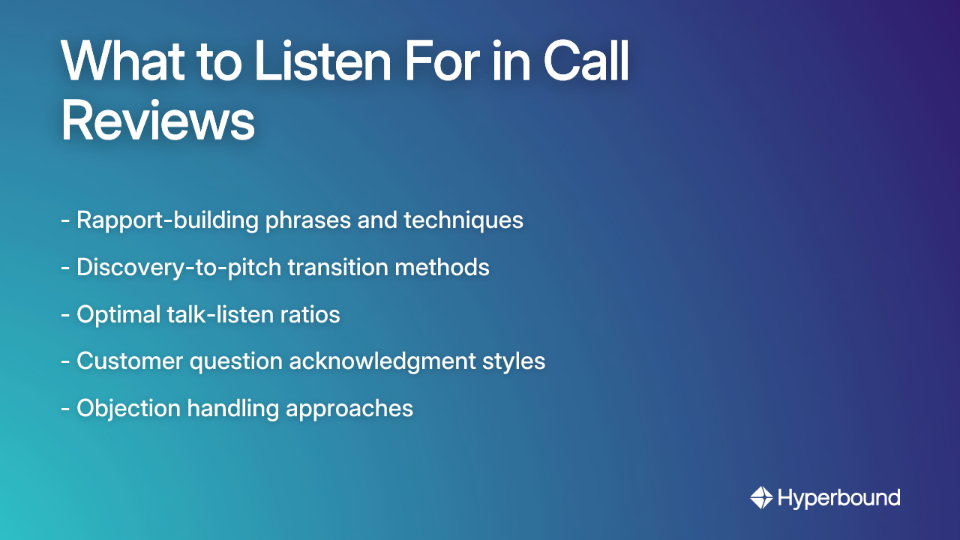
Listen to recordings from both your top and average performers, looking for patterns:
- What specific phrases do top reps use to build rapport?
- How do they transition from discovery to pitch?
- What is their talk-listen ratio?
- How do they acknowledge and validate customer questions? ("That's already just a great thing to do in general to let people know you're listening to them.")
Step 3: Collaborate with Your Reps and Document Everything
Involve your senior reps in this process. This not only yields better insights, but it also builds trust—a critical factor for new managers. As one sales leader noted, "You'll need to invest time with each of your BDRs to convince them to both trust you and that you genuinely want to help them."
Create a central, accessible document for your findings where each talk track includes:
- Scenario: e.g., Price Objection
- Winning Phrase: e.g., "That's a fair point. Many of our best customers felt the same way at first. What they found was that our platform actually generated more revenue per user than they were paying. Could I share how they did that?"
- Why it Works: e.g., "Empathizes, uses social proof, pivots to value."
From Manual Effort to Scalable Excellence: Using AI to Amplify Your Best Talk Tracks
The manual method is an excellent starting point, but it comes with significant limitations:
- It's incredibly time-consuming
- You can only analyze a tiny sample of calls
- It's prone to confirmation bias (you hear what you expect to hear)
- It's impossible to maintain at scale for growing teams
This is where AI-powered conversation intelligence enters the picture. According to recent data, 83% of sales teams using AI saw revenue growth compared to 66% not using AI, and 65% of organizations are now regularly using generative AI, up from just one-third last year.
Step 1: Automate Call Analysis at Scale
Platforms like Hyperbound use AI to do the heavy lifting. Its AI Real Call Scoring capability analyzes thousands of your actual sales calls—not just a random sample—to surface the specific talk tracks, question patterns, and objection-handling techniques that correlate with closed deals.
Unlike manual review, AI-powered analysis:
- Automatically scores calls against your custom methodology
- Generates an "AI Deal Summary" to help managers quickly identify key moments without listening to entire calls
- Provides unbiased, data-driven insights about what "good" actually sounds like in your organization
- Identifies patterns that humans might miss across hundreds or thousands of conversations
Step 2: Create a Dynamic, AI-Powered Playbook
The insights from AI analysis aren't just for managers. They become the foundation for a living, breathing playbook that evolves as your market and product change.
With AI Coaching, Hyperbound can deliver feedback directly to reps after their calls, flagging missed opportunities or highlighting where they successfully used a winning talk track. This creates a continuous feedback loop that reinforces best practices in real-time.
A sales manager from a mid-size SaaS company described the impact: "Before, our playbook was static and quickly outdated. Now, with AI analysis, we're constantly refining our talk tracks based on what's actually working in the field, not what we think should work."
Turning Insight into Instinct: How to Practice and Perfect Your New Talk Tracks
Having a playbook of winning talk tracks means nothing if your reps can't deliver them confidently and authentically under pressure. This is where traditional role-playing often falls short—it feels awkward, unrealistic, and doesn't scale.
Many sales professionals have tried basic AI tools for practice but found them lacking. One rep noted that some tools can feel "a bit unrealistic for B2B sales role-playing. Prospects often ask unexpected questions or take the conversation in different directions, which it doesn't really handle well." Another mentioned that with ChatGPT, "It just agrees and tells me why I'm right."
Modern AI simulators are designed specifically to overcome these challenges. Hyperbound's AI Sales Roleplays create hyper-realistic scenarios with AI buyer personas that respond dynamically based on your specific ICPs, products, and the very objections you uncovered during call analysis.
The benefits of this approach include:
- Safe Environment: Reps can practice difficult conversations without risking live deals
- Scalable & On-Demand: Practice anytime, anywhere, without waiting for a manager or peer
- Objective Feedback: Instant analysis via AI-Powered Scorecards tracking metrics like talk ratios and key selling moments
- Customization: Scenarios tailored to your specific product, industry, and common objections
This system isn't limited to new business acquisition. With AI Post-Sales Roleplays, CSMs and Account Managers can practice renewal conversations and upselling techniques with the same level of realism.
Common Pitfalls to Avoid When Building Your Talk Track Playbook
As you build your talk track library, be aware of these common mistakes that can undermine effectiveness:
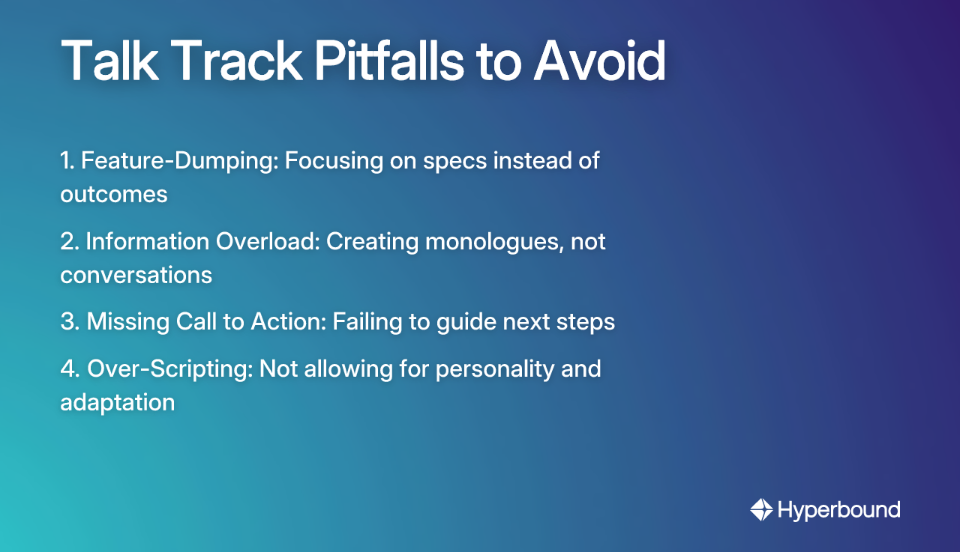
Pitfall 1: Feature-Dumping
Solution: Focus talk tracks on benefits and customer use cases, not a list of features. Your top reps don't win by reciting product specs—they win by connecting features to customer outcomes.
Pitfall 2: Information Overload
Solution: Keep it concise. A talk track is a guide, not a monologue. The best talk tracks leave room for two-way conversation and can be tailored to the prospect's specific needs.
Pitfall 3: Lack of a Clear Call to Action (CTA)
Solution: Every talk track should guide the conversation toward a clear, actionable next step. Without this direction, even the most persuasive language falls flat.
Pitfall 4: Treating Talk Tracks Like Inflexible Scripts
Solution: Reinforce that reps should infuse their own personality. As one rep noted, "It is a skill man, when you are confident and have experience you improvise and don't think about the script."
The goal is consistency in message, not monotony in delivery. This addresses the universal need for confidence and authenticity in sales conversations.
Building a Culture of Conversational Excellence
The most effective sales teams don't rely on luck or the natural talent of a few star performers. They follow a systematic process:
- Analyze real conversations to find what works (manually, then at scale with AI)
- Codify these findings into a dynamic playbook of winning talk tracks
- Practice these talk tracks in realistic, AI-powered scenarios until they become second nature
- Refine continuously with a data-driven feedback loop
This approach is particularly powerful because it addresses both ends of the performance spectrum. Your top performers get validation and recognition for their effective techniques, while those who struggle receive concrete guidance and practice opportunities.
"The top performers are continuously reinvesting in themselves, their education, sales mentorships, books, etc and they implement what they learn," observed one sales professional. By systematically extracting and sharing their winning talk tracks, you create an environment where everyone benefits from this mindset.
Extracting winning talk tracks isn't just about improving a few KPIs—it's about building a culture of continuous learning and empowering every single rep to perform like your best. As one manager put it, "You need to get to know them, understand what success is to them and then make it your mission to get them there."
By leveraging a platform like Hyperbound, you can build an end-to-end system that uncovers winning behaviors, scales best practices, and gives every rep the coaching and practice they need to master the conversations that close deals. When your entire team can confidently deliver your best talk tracks—adapted to their natural style—you'll see more consistent results across the board and watch your revenue climb accordingly.
Remember that at its core, this process is about human connection—understanding how your best reps build relationships with prospects and customers, then helping everyone else do the same. Technology simply makes it possible to scale that human excellence across your entire organization.
Frequently Asked Questions
What are sales talk tracks, and how are they different from scripts?
Sales talk tracks are flexible conversational frameworks that guide sales reps through key moments, unlike rigid scripts which dictate exact wording. They provide structure for situations like objection handling or feature explanations while allowing reps to maintain a natural, authentic conversational flow and adapt to the customer.
How do you identify winning talk tracks from top performers?
You can identify winning talk tracks by analyzing the sales calls of your best-performing reps. Start by manually listening to recordings to find patterns in how they handle common objections, explain complex topics, and build rapport. For a more scalable and data-driven approach, use AI-powered conversation intelligence tools to analyze thousands of calls and pinpoint the specific language that correlates with closed deals.
Why is AI better than manual analysis for creating talk tracks?
AI is better than manual analysis because it is faster, more scalable, and less biased. While manual review of call recordings is a good starting point, it's incredibly time-consuming and limited to a small sample size. AI tools can analyze every conversation, uncover patterns humans might miss, and provide objective, data-backed insights into what truly works across your entire sales team.
How can sales reps practice talk tracks effectively?
Sales reps can practice talk tracks most effectively using AI-powered sales simulators. Unlike traditional role-playing, which can be awkward and hard to scale, AI simulators provide a safe, on-demand environment for reps to practice difficult conversations with realistic AI buyer personas. These tools offer instant, objective feedback on performance, helping reps internalize the talk tracks until they become second nature.
What are the biggest mistakes to avoid when creating a talk track playbook?
The biggest mistakes to avoid are creating talk tracks that are over-scripted, focus on features instead of customer benefits (feature-dumping), overload the prospect with information, and lack a clear call to action. The goal is to create a guide that empowers conversation, not a monologue that stifles it, ensuring reps can adapt while maintaining a consistent message.
How do talk tracks help new or struggling sales reps?
Talk tracks provide a clear roadmap for new or struggling reps, giving them the confidence and language to navigate challenging sales conversations. By codifying the proven techniques of top performers, you provide a repeatable playbook that helps them handle objections, explain value, and guide the conversation effectively, accelerating their ramp-up time and improving their performance.

Book a demo with Hyperbound


