

.png)
You've rehearsed the conversation in your head a dozen times. You know the team member needs feedback on their performance, but your stomach tightens as you imagine their defensive reaction. Will they take it personally? Will this damage the trust you've worked so hard to build? You've tried the "sandwich method" before, but it felt forced and insincere—like they could see right through it.
If this scenario sounds familiar, you're not alone. Leaders often find it difficult to provide feedback without damaging trust with their team, especially when that feedback might be perceived as criticism rather than empowerment.
The truth is, truly effective feedback isn't about finding the perfect script or using a rigid framework that feels robotic. It's about building a foundation of trust, adopting an empathetic approach, and focusing on collaborative growth. This article will provide a clear roadmap to deliver feedback that actually sticks—the kind that inspires change rather than defensive reactions.
Why Most Feedback Fails (And Why It's So Hard to Give)
Before learning how to give feedback, it's crucial to understand the common pitfalls that make it ineffective.
The Trust Deficit
Feedback is only as good as the relationship it's delivered in. Without trust, even the best-phrased comments are heard as criticism.
As one leader noted on Reddit, "Ideally, constructive criticism is given within an established relationship of trust between the manager and the employee." When that foundation is missing, feedback rarely leads to meaningful change.
The Emotional Minefield
Giving feedback triggers anxiety about managing emotional reactions, while receiving it can prompt defensiveness. This emotional dimension is why, according to Harvard Business School research, sessions without emotional intelligence can quickly devolve into arguments or leave employees feeling demoralized rather than motivated.
Vague, Unactionable Advice
Comments like "be more strategic" or "show more initiative" are essentially useless without concrete examples. Effective feedback must focus on specific behaviors, not generalizations.
The "One and Done" Mistake
Feedback given without a plan for follow-up rarely sticks. A lack of follow-up signals that the issue wasn't that important, leading to a lack of accountability and little meaningful change.
The Foundation: Building a Culture of Trust and Growth
The most effective feedback happens in an environment where it's expected, regular, and geared toward development. This means creating a feedback culture rather than treating feedback as an occasional event.
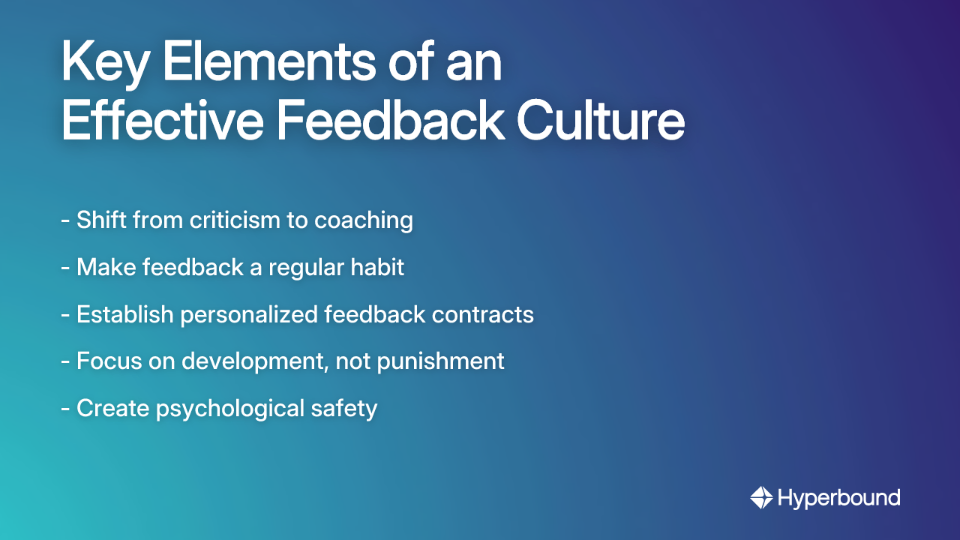
Shift from "Criticism" to "Coaching"
Frame feedback as an ongoing, personalized process aimed at developing each team member's unique skills. Effective sales coaching can increase win rates by up to 8%, according to research from Gartner.
The goal is to foster a growth mindset, where challenges are seen as opportunities to learn rather than evidence of failure.
Make Feedback a Regular Habit
Frequent, low-stakes check-ins reduce the pressure associated with feedback and normalize the process. Regular conversations build the feedback loop necessary for continuous improvement and prevent small issues from becoming major problems.
Establish a "Feedback Contract"
One powerful recommendation from leadership discussions is this: "You ask them how they prefer feedback. Don't use your secret sauce handy-dandy method."
Have a meta-conversation with each team member about how they prefer to receive feedback—do they want it direct or gentle? Public praise or private recognition? Written first, then discussed? This "contract" acknowledges that feedback is not one-size-fits-all and demonstrates respect for individual preferences.
A Practical, 4-Step Framework for Feedback that Sticks
Here's a step-by-step method that combines structure with empathy to ensure your message is heard, understood, and acted upon:
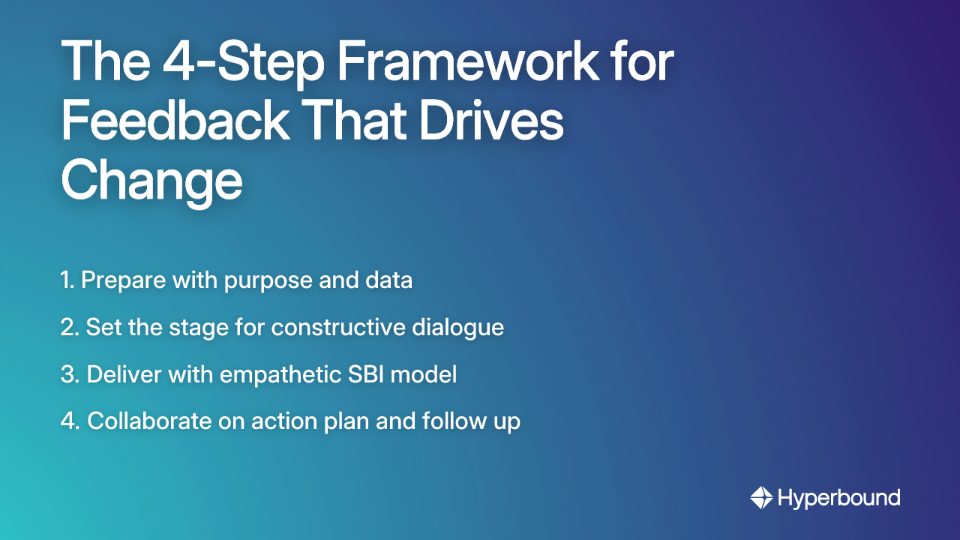
Step 1: Prepare with Purpose and Data
Define Your Goal: What is the one key behavior you want to see change? Effective feedback starts with clarity about the purpose of the conversation.
Gather Specific, Factual Examples: Instead of "Your discovery calls are weak," use "On the last three calls with prospects X and Y, I noticed we didn't uncover their budget or decision-making process." This focuses on actions, not the person.
Step 2: Set the Stage for a Constructive Dialogue
Choose the Right Time and Place: Criticism must be delivered in private to preserve dignity. Praise can be public to amplify positive behavior.
State Your Positive Intent: Open by framing the conversation around growth. For example: "I want to chat about our discovery call process because I see a huge opportunity for you to increase your pipeline, and I want to help you get there."
Step 3: Deliver the Message with an Empathetic SBI Model
Frameworks like SBI (Situation, Behavior, Impact) provide useful structure, but they can feel robotic without empathy. Here's how to use SBI with an important addition:
Situation: Be specific. "In the QBR with Acme Corp yesterday..."
Behavior: Describe the observable action. "...when they asked about our new feature, I noticed the explanation focused on the technical specs rather than the business value for them."
Impact: Explain the consequences. "...The impact was that their team seemed confused about how it would help them, and we missed a chance to create excitement for an upsell."
The Crucial Addition - Inquiry: Turn it into a two-way street. Ask questions like, "What was your perspective on that part of the conversation?" or "Help me understand your thought process there." Harvard Business School notes that this inquiry step encourages dialogue, not defensiveness.
Step 4: Collaborate on an Action Plan and Follow Up
Suggest Improvements, Don't Prescribe: Ask, "What are some ways we could approach that differently next time?" Collaborate on a solution rather than dictating one.
Offer Support: Make it clear you're invested in their success. Say, "I'm here to help. Would you like to roleplay a few scenarios before your next big call?"
Recap and Schedule a Follow-up: End the meeting by summarizing the agreed-upon action steps. Put a follow-up on the calendar to review progress. As one leader shared on Reddit, "that follow-up can sometimes make all the difference in the world."
Scaling Effective Feedback with Technology
The framework above is powerful but time-consuming. For busy sales leaders managing large or remote teams, technology has become essential for providing consistent, objective, and scalable coaching.
The Challenge of Scale and Objectivity
Managers can't be on every call or in every meeting. Manual reviews are inefficient and prone to human bias. This makes it hard to provide the timely, specific feedback needed for improvement, especially when managing large teams or remote workers.

How AI Bridges the Gap
Modern AI-powered tools can help leaders scale their coaching efforts while maintaining the human connection that makes feedback effective:
Data-Driven Objectivity
Hyperbound's AI Real Call Scoring automatically analyzes sales conversations against your methodology, providing objective data about rep performance. This gives managers factual examples to bring to feedback sessions, making the "Behavior" part of the SBI model evidence-based, not opinion-based.
For example, instead of saying "I feel like you're talking too much on calls," you can say "The data shows your talk-to-listen ratio is 80:20, while our top performers maintain a 60:40 ratio. Let's discuss how we might adjust this."
Personalized, On-Demand Coaching
Feedback is most effective when delivered immediately after the behavior occurs. Hyperbound's AI Coaching delivers instant, personalized feedback after each call, identifying missed opportunities and suggesting improvements.
This real-time feedback allows reps to self-correct and learn faster, while freeing up managers to focus on more strategic coaching conversations rather than basic skill correction.
A Safe Space to Practice and Improve
The best way to make feedback stick is through practice. Hyperbound's AI Sales Roleplays create a risk-free environment where reps can practice the exact skills discussed in their feedback sessions—from handling objections to navigating renewal conversations.
This directly addresses the "Offer Support" step in our framework, allowing reps to build confidence and muscle memory without risking real customer relationships.
Conclusion: From Dreaded Conversations to Growth Engines
Effective feedback is a skill that hinges on a foundation of trust and a culture of growth. By moving beyond rigid scripts to a collaborative, empathetic framework, you transform feedback from something your team dreads into a powerful catalyst for development.
Remember these key principles:
- Build trust before you need it
- Make feedback a regular, expected part of your team culture
- Use specific examples and focus on behaviors, not personality
- Turn monologues into dialogues through inquiry
- Create clear action plans with scheduled follow-ups
- Leverage technology to scale your coaching impact
By combining human-centric leadership with powerful AI tools, you can transform feedback from a dreaded event into your team's most powerful engine for growth and performance.
The ultimate goal isn't just to correct mistakes—it's to empower your team to reach their full potential. When done right, feedback doesn't diminish trust—it strengthens it by demonstrating your investment in each person's success.
What feedback conversation have you been putting off? With these tools in hand, perhaps it's time to schedule it.
Frequently Asked Questions
What is the most common mistake leaders make when giving feedback?
The most common mistake is delivering feedback without first establishing a foundation of trust. When a team member doesn't trust that your intent is to help them grow, even well-phrased feedback can be perceived as criticism. This "trust deficit" causes defensiveness and prevents the feedback from being acted upon.
How can I make feedback feel less like criticism and more like coaching?
You can make feedback feel like coaching by focusing on specific, observable behaviors rather than personal traits, and by framing the conversation around growth. Instead of saying "you need to be more proactive," point to a specific situation and its impact. Always state your positive intent upfront to shift the focus from judgment to a collaborative effort.
What is the SBI model for feedback?
The SBI model is a framework for structuring feedback that stands for Situation, Behavior, and Impact. It helps you deliver clear feedback by describing the specific Situation, the observable Behavior, and the Impact of that behavior. This article also recommends adding a fourth step, Inquiry, where you ask for their perspective to create a dialogue rather than a monologue.
How often should I give feedback to my team?
Feedback should be a regular and frequent habit, not a rare, formal event. Integrating feedback into frequent, low-stakes check-ins and one-on-one meetings normalizes the process, reduces anxiety, and reinforces a culture where continuous improvement is part of the daily routine.
What should I do if a team member gets defensive?
If a team member gets defensive, pause and shift to inquiry by asking open-ended questions to understand their perspective. A defensive reaction often comes from feeling misunderstood. Using phrases like, "Help me understand your thought process here," turns a monologue into a dialogue and allows you to find a path forward collaboratively.
Why is a "feedback contract" important?
A "feedback contract" is important because it establishes a personalized agreement on how an individual prefers to receive feedback, which demonstrates respect and increases their receptiveness. By asking team members about their preferences, you avoid a one-size-fits-all approach and ensure your message is delivered in the most effective way for each person.
How can I effectively give feedback to a remote team?
To give feedback effectively to a remote team, leverage technology for data-driven insights and hold dedicated, private video calls for important conversations. AI tools can analyze sales calls to provide objective data, making feedback more specific and factual. Always use a video call to maintain a human connection and pick up on non-verbal cues, which is crucial for building trust remotely.

Book a demo with Hyperbound


