.png)


.png)
Summary
- Generic sales roleplays often fail because they don't reflect the real challenges and objections reps face from their Ideal Customer Profile (ICP).
- Effective roleplay requires creating detailed scenarios based on your ICP, including their specific pain points, motivations, and common objections.
- Practicing with ICP-specific scenarios builds genuine confidence, reduces new hire ramp time, and prepares reps for real-world conversations.
- AI Sales Roleplays can scale this targeted training by providing a safe, repeatable environment for reps to master conversations with realistic AI buyer personas.
For many sales reps, the mere mention of "roleplay" triggers an immediate sense of dread. The awkward exchanges, the forced scenarios, the unrealistic objections—it's enough to make even seasoned professionals cringe.
"If a company pushes a lot of roleplay on the sales team... that's a red flag in their sales process," shares one sales professional on Reddit, capturing a sentiment echoed by many in the field.
But here's the truth: The problem isn't roleplay itself—it's poorly designed, generic scenarios that fail to reflect the real challenges your team faces when selling to your Ideal Customer Profile (ICP).
When done right, roleplay is one of the most effective ways to build the muscle memory needed for successful client interactions. The key is creating hyper-realistic scenarios that mirror the exact conversations your reps will have with your target customers.
Why Generic Roleplays Fail and ICP-Specific Scenarios Win
The Failures of Generic Roleplay
If you've ever participated in a "sell me this pen" exercise, you've experienced the fundamental flaw of generic roleplays. They simply don't prepare reps for the specific challenges they'll face in real-world situations:
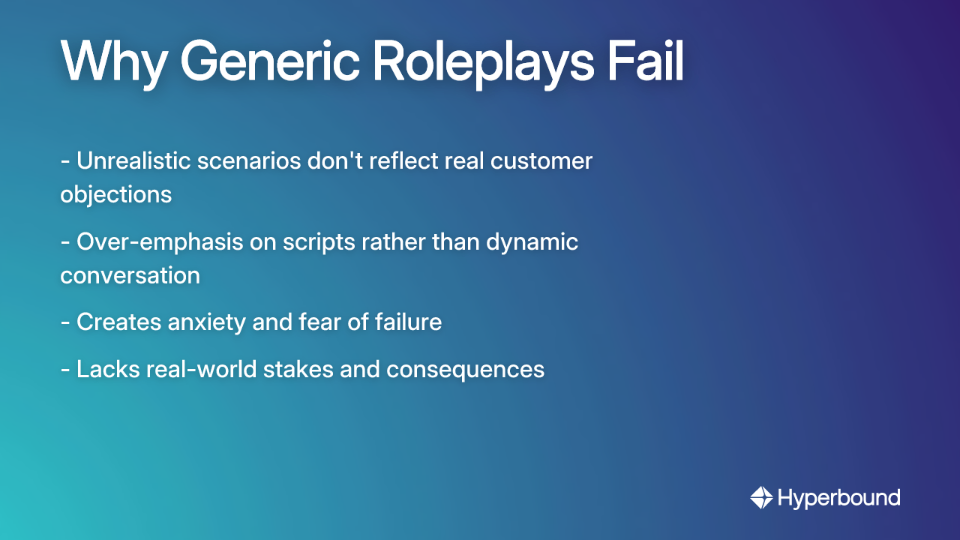
- Unrealistic Scenarios: Generic "softballs" don't reflect the tough objections your reps will actually encounter from your target customers. Realism is critical for genuine skill development.
- Focus on Scripts, Not Conversation: Many roleplays emphasize memorizing scripts rather than developing the ability to navigate dynamic conversations. This creates what one Reddit user called a "theatre production" rather than practical training.
- Breeds a Fear of Failure: When used as a test with negative reinforcement, roleplay creates anxiety rather than confidence. The environment becomes about avoiding mistakes instead of growth.
- No Real Stakes: Without consequences that mirror real-world implications, reps struggle to take the exercise seriously, diminishing its practical value.
The Wins of ICP-Specific Scenarios
When roleplay scenarios are meticulously tailored to your Ideal Customer Profile, everything changes:
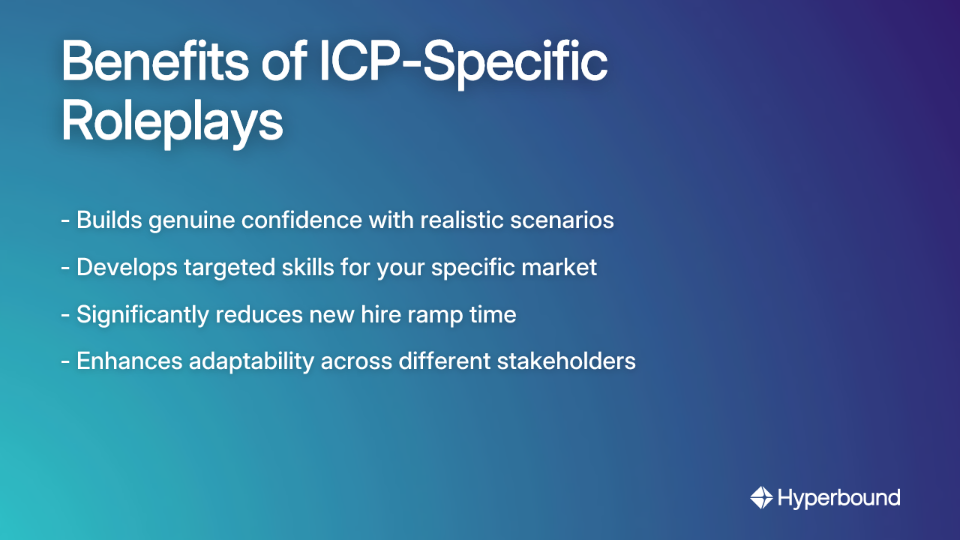
- Builds Real Confidence: Practicing with realistic objections from your specific buyer personas prepares reps to handle actual conversations with poise and adaptability. This targeted practice significantly boosts confidence in real-world settings.
- Develops Specific Skills: Rather than generic "sales skills," ICP-specific roleplay hones the exact techniques needed to address your customers' unique pain points and objections.
- Reduces Ramp Time: New hires learn the nuances of your market faster, shortening the path to productivity. They practice handling the exact objections and questions they'll face from your target customers.
- Enhances Adaptability: Reps learn to craft personalized pitches for different stakeholders within your ICP, improving their ability to navigate complex buying committees.
The 5-Step Blueprint for Crafting Powerful ICP Roleplay Scenarios
Let's break down exactly how to create roleplay scenarios that transform awkward practice sessions into powerful skill-building experiences:

Step 1: Define Your ICP Persona (Deeply)
Go beyond basic demographics and job titles. Create a comprehensive buyer persona that captures:
- Professional Motivations: What KPIs are they measured on? What would make them look good to their boss?
- Internal Pressures: What organizational challenges are they facing? Who are the key internal stakeholders they need to convince?
- Industry-Specific Language: What jargon and terminology do they use in their day-to-day work?
- Common Objections: What specific concerns do they typically raise during the sales process?
This deep understanding forms the foundation for creating realistic scenarios. The more detailed your buyer persona, the more effective your roleplay will be.
Step 2: Set a Clear, Specific Goal for the Roleplay
Don't just say "practice a cold call." Define a tangible objective that mirrors real-world success metrics:
- "Successfully book a 15-minute discovery call"
- "Uncover 3 priority pain points"
- "Handle the 'we have no budget' objection without offering a discount"
A clear goal keeps the session focused and measurable, allowing for more targeted feedback and improvement.
Step 3: Write the Scenario Background & Context
Provide a one-paragraph brief that sets the stage for the roleplay. For example:
"You are calling the VP of Marketing at a 500-person B2B SaaS company. They downloaded your whitepaper on 'Customer Acquisition Cost Optimization' last week but haven't engaged further. Your goal is to connect their potential interest in reducing CAC to a larger business challenge and secure a discovery call."
This context helps the rep mentally prepare and approach the conversation with the right framing.
Step 4: Script Key Objections and "Curve Balls"
This is where realism is won or lost. Mine your CRM and call recordings for the most common and difficult objections your team faces from this ICP. Include specific challenges like:
- The Price Haggler: "Your competitor is offering me a 25% discount. Can you match that?"
- The Feature Fanatic: "I like your product, but I really need a solution that has [specific feature your product lacks]."
- The Deadline Pusher: "I need this solution implemented within two weeks, or I'll have to go with another vendor."
- Getting Past the Gatekeeper: Practice building rapport to reach the decision-maker.
These objections should reflect the actual language and concerns your reps encounter in the field.
Step 5: Establish Clear Success Criteria
Define what "winning" looks like for this scenario. It's not always about closing the deal. Success could include:
- Maintaining a healthy talk-to-listen ratio
- Asking effective probing questions
- Successfully reframing an objection
- Establishing clear next steps
This makes feedback objective and actionable, focusing on specific skills rather than subjective impressions.
Putting It Into Practice: Real-World Scenario Examples
Let's see how this blueprint comes to life with two detailed examples:
Scenario 1: Outbound SDR - Cold Calling a Skeptical IT Director
ICP Persona: IT Director at a mid-sized manufacturing firm. Risk-averse, focused on security and integration capabilities. Annoyed by sales calls and believes their current homegrown system is "good enough."
Goal: Secure a 20-minute follow-up meeting with an engineer present.
Background: This is a pure cold call based on company firmographics. No prior engagement.
Key Objections:
- "We build everything in-house."
- "I don't have time for this."
- "We don't have budget allocated for new tools this year."
- "Send me an email."
Success Criteria: A meeting is confirmed on the calendar with the IT Director and one of their technical team members.
Scenario 2: Account Manager - Handling a Renewal with an At-Risk CSM
ICP Persona: A Customer Success Manager at an existing account. They've seen low adoption on their team and are being pressured by their finance department to cut costs.
Goal: Re-sell the value of the platform, address their concerns, and secure commitment for renewal.
Background: The contract is up for renewal in 90 days. Usage metrics have been trending down for the past quarter.
Key Objections:
- "My team isn't really using it."
- "We're not seeing the ROI you promised."
- "Your competitor is offering a similar tool for less."
- "Can we get a discount?"
Success Criteria: The CSM agrees to a joint success plan to re-engage their team and confirms they will recommend renewal internally.
Scaling Excellence: How AI Supercharges Your Roleplay Strategy
Creating these detailed scenarios is powerful, but it faces a significant challenge: scale. It's time-consuming for enablement teams and managers to run these sessions consistently and provide objective feedback for everyone. This is where many roleplay programs fall short.
AI-powered roleplay solutions offer a compelling answer to this challenge. Platforms like Hyperbound are transforming how teams approach sales practice by:
Solving the "Awkwardness" Problem: AI provides a safe, non-judgmental space for reps to practice, fail, and improve without fear of peer judgment. This is especially valuable for remote teams who may have fewer opportunities for in-person roleplay.
Ensuring Realism at Scale: Hyperbound allows you to create detailed ICP scenarios with dynamic AI buyer personas that respond naturally to different approaches. Reps can practice everything from cold calls and discovery to renewals and upsells with personas that mirror your actual customers.
Providing Instant, Objective Feedback: Unlike peer-to-peer roleplay, AI can deliver consistent, unbiased feedback. Hyperbound's AI-Powered Scorecards track key metrics like talk ratios and objection handling effectiveness, while their AI Coaching provides personalized guidance aligned with your sales methodology.
Driving Engagement: Gamified learning approaches with leaderboards transform the traditionally "boring" aspects of roleplay into engaging challenges that motivate continuous improvement.
From Practice to Performance
Moving away from generic, theatrical roleplays to structured, ICP-specific scenarios is the most effective way to prepare your sales team for the reality of your market. When your practice mirrors the actual conversations your reps will have with your ideal customers, real sales calls become a natural extension of training rather than a jarring shift to reality.
The goal is to make practice so realistic that when your reps engage with actual prospects, they've already built the muscle memory needed to navigate the conversation with confidence. This approach transforms roleplay from a dreaded exercise into a powerful development tool that directly impacts your bottom line.
Ready to eliminate awkward roleplays and build a sales training program that actually prepares your team for success? Start by implementing the 5-step blueprint outlined above, and consider how AI tools like Hyperbound can help you scale these realistic practices across your entire organization.
Remember: Your customers are unique, and your sales training should be too.
Frequently Asked Questions
What is ICP-specific sales roleplay?
ICP-specific sales roleplay is a targeted training method where practice scenarios are built around your Ideal Customer Profile (ICP). Instead of using generic situations, it involves creating detailed buyer personas, common objections, and business contexts that accurately reflect the real-world conversations your sales team has with your specific target customers.
Why do generic sales roleplays often fail?
Generic sales roleplays often fail because they are unrealistic and do not prepare reps for the specific challenges they will actually face. These exercises, like the classic "sell me this pen," tend to focus on memorizing scripts rather than developing conversational skills. They lack the specific objections, industry jargon, and internal pressures associated with your Ideal Customer Profile, which makes them less effective for building real confidence and skills.
How can I make my sales roleplay scenarios more realistic?
You can make roleplay scenarios more realistic by following a structured, five-step process. Start by defining a deep ICP persona, set a clear and specific goal for the session, write a detailed background and context for the call, script key objections and "curve balls" based on real customer interactions, and establish clear criteria for success that go beyond just closing a deal.
What are the key components of a strong ICP persona for training?
A strong ICP persona for roleplay training goes beyond basic demographics. It should include their professional motivations (like KPIs), internal pressures (like organizational challenges), the specific industry language they use, and a list of the most common objections and concerns they raise during the sales process. The more detailed the persona, the more effective the training will be.
How can AI improve our sales roleplay practice?
AI can significantly improve sales roleplay by providing a scalable, non-judgmental, and consistent training environment. AI-powered platforms allow reps to practice realistic ICP scenarios on-demand without the fear of peer judgment. They offer instant, objective feedback on performance metrics like talk-to-listen ratios and objection handling, and can provide personalized coaching to help reps improve faster.
How do I get experienced sales reps to engage with roleplay?
To get experienced reps to engage, focus on realism and value. Move away from generic exercises and create challenging, ICP-specific scenarios that mirror the complex deals they actually work on. Frame roleplay as a collaborative "sparring session" for skill refinement, not a test. Using AI tools can also help by providing a private space for practice, and incorporating gamification with leaderboards can foster healthy competition and engagement.

Book a demo with Hyperbound


