

.png)
Summary
- Sales reps forget 70% of training content within a week, making a consistent 15-minute daily practice routine more effective than infrequent, long sessions.
- Structure your daily practice into three phases: a 3-minute mindset warm-up, an 8-minute core skill workout (like roleplaying or call analysis), and a 4-minute reflection cool-down.
- This small daily commitment compounds into over 60 hours of focused training per year, building skills and confidence over time.
- Overcome common practice hurdles like awkward roleplays by using AI-powered tools like Hyperbound's AI Sales Roleplays for on-demand, realistic practice.
You've heard it countless times: top sales professionals are made, not born. Yet between prospecting calls, client meetings, and the endless sea of administrative tasks, when exactly are you supposed to find time to sharpen your skills?
The hard truth is that 70% of sales training content is forgotten after just one week without reinforcement. While your company might invest in quarterly training sessions or the occasional workshop, the real game-changer isn't more training—it's consistent, deliberate practice.
Think of the best athletes in the world. Even at the peak of their careers, they still dedicate hours daily to practicing fundamentals. As one sales professional aptly put it on Reddit, "You're a world champion and yet, there's a team of coaches working on you. No matter whether you're starting or on top of your game, a good coach is invaluable, right?"
The solution isn't finding more hours in your already packed day. It's establishing a focused, high-impact 15-minute daily practice routine that fits into any schedule and delivers outsized results.
In this article, we'll break down:
- Why 15 minutes of daily practice is your secret weapon for sales success
- A step-by-step framework for the perfect practice routine
- A sample weekly practice schedule you can implement immediately
- How to overcome common obstacles to consistent practice
Why 15 Minutes a Day is a Sales Superpower
The Science of Consistency Over Cramming
The forgetting curve in learning science shows that without reinforcement, we rapidly lose newly acquired information. This explains why that expensive two-day sales training your company invested in last quarter felt like a distant memory within weeks.
Short, daily practice sessions create what psychologists call "spaced repetition"—the most effective way to move skills from short-term to long-term memory. Unlike cramming, which overwhelms your brain, these micro-sessions allow for better retention and application.
The Compounding Effect
When you do the math, the power of this habit becomes clear:
- 15 minutes daily = 1.25 hours weekly
- That's 5 hours monthly of focused practice
- And over 60 hours annually—equivalent to a full workweek and a half of intensive training
This compounding effect transforms small, consistent efforts into mastery over time. As top performers know, excellence isn't achieved through occasional heroic efforts but through daily disciplines maintained over time.
Building Confidence and Defeating Call Reluctance
"If you are uncomfortable on the phone, I've heard that calling customer service or other sales reps to spark a conversation is good practice for negating that nervousness," shared one sales rep on Reddit.
This discomfort—known as call reluctance—affects many sales professionals at some point in their careers. Daily practice in a low-stakes environment builds the muscle memory and confidence needed to perform under pressure when real deals are on the line.
The Anatomy of a Perfect 15-Minute Sales Practice Routine
Let's break down the ideal daily practice routine into three distinct phases:
Phase 1: The Warm-Up (3 Minutes) - Mindset & Intent
Start by setting a specific, achievable focus for today's practice session. Research from C-Level Partners shows that successful sales professionals begin their day with intention and clarity.
Actions:
- Review one specific skill to focus on today (e.g., "I will practice handling the 'no budget' objection")
- Briefly recall a recent success to prime yourself for confidence
- Take three deep breaths to center yourself and prepare for focused practice
Phase 2: The Core Workout (8 Minutes) - Focused Skill Practice
This is where the real work happens. Choose ONE of these three practice methods each day:
Option A: Roleplay a Specific Scenario
Traditional roleplaying often feels awkward and requires a colleague's time. Modern solutions like Hyperbound's AI Sales Roleplays allow you to practice with an AI that simulates real prospects, providing a safe, on-demand environment to perfect your skills.
You might practice:
- Your opening 30 seconds for cold calls
- Handling a specific objection like "We're happy with our current solution"
- Asking powerful discovery questions
- Delivering a compelling value proposition
Option B: Call Analysis
Listen to a 5-minute segment of either your own recorded call or a top performer's call. Focus on one specific element:
- What questions were asked, and in what sequence?
- How was a particular objection handled?
- What was the talk-to-listen ratio?
- How effectively were next steps established?
Option C: Talk Track Refinement
Take one specific part of your sales messaging and refine it until it flows naturally:
- Your elevator pitch
- How you position against a specific competitor
- Your explanation of a complex feature
- Your ROI discussion
As one sales professional advised on Reddit, you need to "mix it up. Improv has taught me to be in the moment, do not be scripted, go with the flow." Practice your talk tracks until they sound natural, not memorized.

Phase 3: The Cool-Down (4 Minutes) - Feedback & Reflection
The final phase is perhaps the most crucial yet most overlooked. According to research from Aberdeen Group, teams that receive consistent coaching see a 16.7% increase in revenue growth. This reflection phase is your self-coaching moment.
Actions:
- Write down ONE key takeaway from today's practice
- Identify ONE specific opportunity to apply this learning in an upcoming call
- Consider what went well and what you'd improve next time
The power of this phase comes from immediate feedback. Traditionally, reps might wait days for manager feedback, but modern tools like Hyperbound's AI Coaching can provide instant, objective feedback on your roleplay performance, highlighting strengths and areas for improvement.
A Sample Weekly Practice Schedule
To make this concrete, here's how you might structure a week of practice:
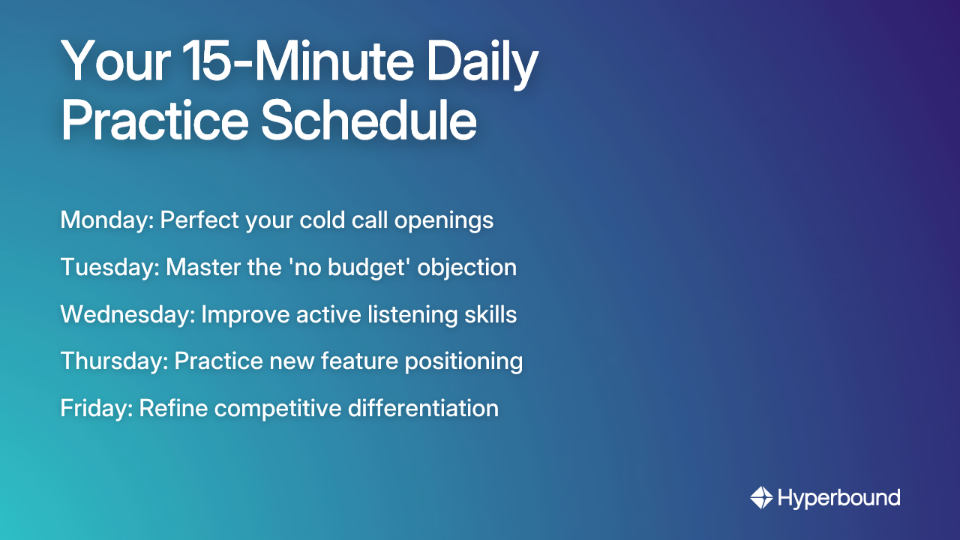
Monday: Cold Call Openings
- Warm-Up: Set intention to improve first 30 seconds of calls
- Core: Practice 3-4 different opening approaches using AI roleplay
- Cool-Down: Note which opening generated the most positive response
Tuesday: Handling "No Budget" Objection
- Warm-Up: Review your current approach to budget objections
- Core: Practice responding to this objection in 2-3 different scenarios
- Cool-Down: Document the most effective response for your playbook
Wednesday: Active Listening
- Warm-Up: Set intention to improve your talk-to-listen ratio
- Core: Analyze a top performer's discovery call, noting question techniques
- Cool-Down: Identify 2-3 powerful questions to incorporate into your calls
Thursday: New Feature Positioning
- Warm-Up: Review product documentation on newest feature
- Core: Refine your explanation of the feature's benefits, not just functions
- Cool-Down: Create a concise value statement for different buyer personas
Friday: Competitive Differentiation
- Warm-Up: Review common competitive objections you face
- Core: Practice responding to "Why should we choose you over Competitor X?"
- Cool-Down: Note the most compelling differentiators to emphasize
Making it Stick: Overcoming Common Hurdles
"I don't have time for this."
When you're struggling to hit quota, adding another task feels impossible. But as research shows, sales training is an investment with immediate benefits. This 15-minute practice isn't taking time away from selling—it's making every selling minute more effective.
Solution: Block these 15 minutes as a recurring calendar appointment, preferably first thing in the morning or right after lunch when energy is high.
"Practice feels awkward and inauthentic."
Many sales professionals avoid practice because traditional role-playing with colleagues feels uncomfortable and artificial.
Solution: Modern AI-powered practice tools create a judgment-free zone where you can try new approaches without the pressure of peer observation—a safe space many reps find more comfortable than peer role-playing.
"I don't know what to practice."
Without structure, practice can feel directionless and ineffective.
Solution:
- Review your lost deals from the past month. What patterns emerge?
- Ask your manager which skill would most impact your performance
- Look at your call recordings. Where do conversations consistently stall?
Tools like Hyperbound's AI Real Call Scoring can automatically analyze your calls and identify skill gaps to focus your practice.
Transform Your Sales Performance in Just 15 Minutes a Day
The most successful sales professionals aren't necessarily the most naturally gifted—they're the ones who commit to continuous improvement through deliberate practice. As one Reddit user put it, "Sales is very complex. There's many facets of the skill such as cold calling, writing eloquently, communication skills, presentation ability, social skills, listening, confidence..."
By establishing a 15-minute daily practice routine, you're addressing these skills systematically, building confidence through repetition, and developing the muscle memory needed to perform at your best when it matters most.
The routine is simple:
- 3 minutes to set your intention and mindset
- 8 minutes for focused skill practice
- 4 minutes to reflect and capture learnings
In today's competitive sales environment, technology has made this kind of focused practice more accessible than ever. Platforms like Hyperbound provide the AI-powered roleplays, real-call analysis, and instant feedback needed to maximize the impact of your practice time.
Block 15 minutes in your calendar for tomorrow. Choose one skill to focus on. And take the first step toward transforming your sales performance through the power of consistent, deliberate practice.

Frequently Asked Questions
Why is a 15-minute daily practice better than longer, infrequent training sessions?
A 15-minute daily practice is more effective because it leverages the principle of "spaced repetition," which helps embed skills into your long-term memory and combat the forgetting curve. Unlike long training sessions where up to 70% of information is forgotten within a week, short, consistent practice creates a powerful compounding effect. Over a year, these 15-minute sessions add up to over 60 hours of focused training, leading to sustained skill improvement and confidence.
What are the most important sales skills to practice first?
The most important skills to practice first are those that will have the biggest impact on your current performance, such as handling common objections, refining your cold call openings, and improving discovery questions. Start by analyzing your recent lost deals or asking your manager for feedback to identify your biggest opportunities for growth. Focus on one specific area each week, such as mastering the "no budget" objection or positioning against a key competitor.
How can I practice sales roleplays if I don't have a partner?
You can practice sales roleplays effectively on your own using AI-powered tools that simulate realistic prospect conversations. Modern solutions like Hyperbound's AI Sales Roleplays provide a safe, on-demand, and judgment-free environment to practice. This allows you to experiment with different approaches without the awkwardness or scheduling challenges of traditional peer role-playing.
How do I know if my sales practice is actually working?
You'll know your practice is working when you see improvements in your confidence, call performance metrics, and ultimately, your sales results. Track specific metrics related to the skills you're practicing. For example, if you're working on openings, monitor your hook rate on cold calls. The reflection phase of the 15-minute routine is also crucial for self-assessment and recognizing progress.
What if I miss a day of practice?
If you miss a day, simply resume your practice the next day without judgment. The goal is consistency, not perfection. The power of this routine comes from its long-term application. Missing one day will not derail your progress. The key is to not let one missed session turn into a week; just pick up where you left off and maintain the habit.
How can a sales manager implement this for their team?
As a sales manager, you can implement this by encouraging your team to block 15 minutes daily for practice and providing them with the necessary tools and focus areas. Facilitate this by suggesting weekly practice themes based on team-wide skill gaps you observe from call recordings and performance data. Furthermore, incorporating discussions about their practice takeaways into your 1-on-1s can reinforce the habit and show your commitment to their development.
Book a demo with Hyperbound


