.png)


Frontline managers sit at the center of everything.
They’re responsible for deal health, rep execution, and whether the team hits the number. At the same time, they’re expected to be coaches, forecasters, problem-solvers, and escalation points — often all in the same day.
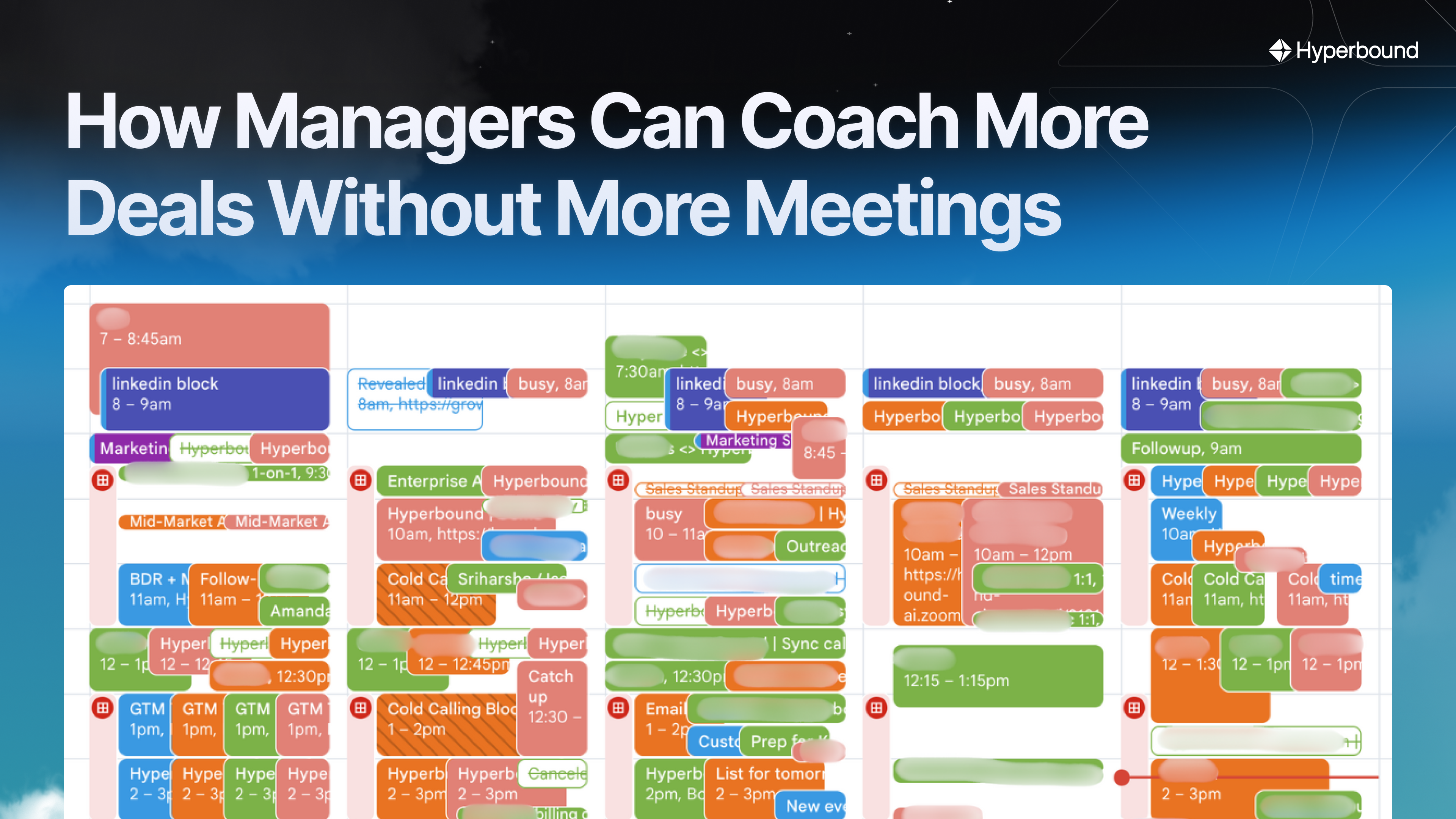
Their calendars reflect that reality.
Between 1:1s, pipeline reviews, forecast calls, and last-minute deal escalations, there’s very little open space left. And yet the expectation keeps rising: coach more reps, inspect more deals, catch risk earlier.
The problem isn’t effort or intent. Managers are already deeply involved.
The challenge is that as deal volume increases, the way coaching happens doesn’t actually scale with it.
And that’s where things start to break down.
.png)
The Hidden Coast of “Just Add Another Meeting”
When teams want managers to coach more deals, the default response is usually the same: add another meeting.
More deal reviews.More pipeline check-ins.More ad hoc syncs when something feels off.
On the surface, it sounds reasonable. If managers are closer to deals, coaching should improve.
But time is finite.
Every additional meeting comes with a tradeoff. Time spent talking through deals is time not spent actually reviewing them. Time spent in syncs is time not spent listening to calls, building context across a deal, or thinking through how a rep should prepare for what’s next.
Ironically, the more meetings managers sit in, the less time they have to do the work that leads to effective coaching.
So instead of creating better outcomes, meetings start to crowd out the very activities that would make coaching meaningful in the first place.
Why More Meetings Don’t Surface Better Insight
Adding more meetings doesn’t unlock better insight.
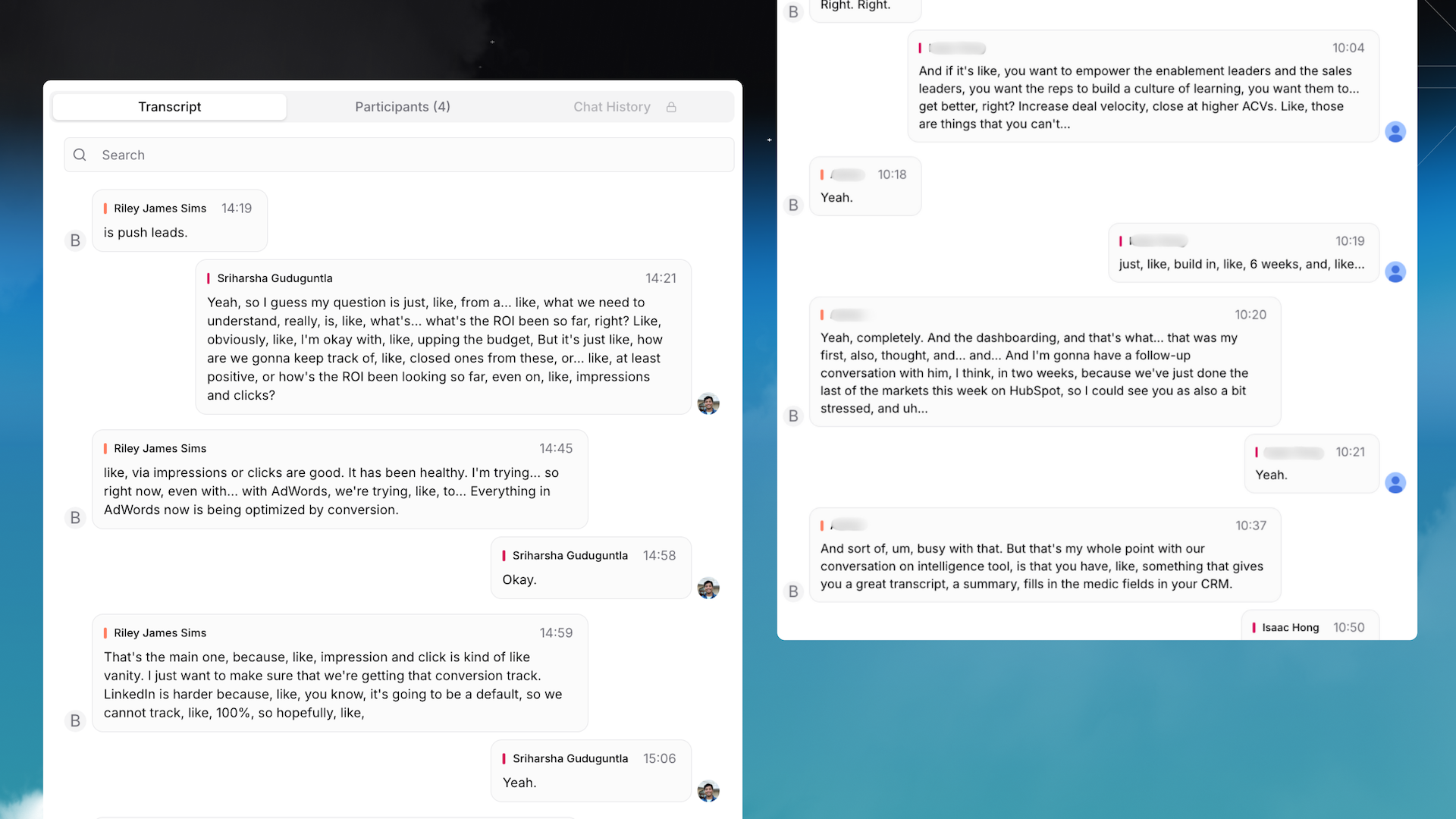
Call recording tools don’t magically reveal new signal just because a deal is discussed one more time. Dashboards don’t explain execution gaps on their own. They still require someone to listen, interpret, and connect context across calls.
What meetings usually add is rep perspective — not clarity.
Managers leave meetings with more rep-led intuition about a deal, but without clear, evidence-backed steps for how to change its trajectory.
That evidence lives across multiple calls, stakeholders, and moments in the deal. It’s buried in transcripts, recordings, and dashboards that were never designed to explain why a deal is stalling — or what should happen next.
And the irony is that the more time managers spend in meetings, the less time they have to do the work that would actually create that clarity: listening to calls, understanding patterns across a deal, and translating insight into concrete coaching and practice.
So instead of enabling better coaching, meetings often leave managers with more information — and no clearer path to action.
The Impossible Job Managers Are Being Asked to Do
To coach a single deal well, a manager would need to do a lot of work behind the scenes.
They’d need to listen to multiple calls across the deal — not just the most recent one. They’d need to understand how discovery evolved, which stakeholders showed up (and which didn’t), how objections changed over time, and where momentum started to slow.
Then they’d have to spot patterns across those conversations, identify what’s actually putting the deal at risk, decide what matters most before the next call, and coach the rep on how to handle it.
That’s already a heavy lift for one deal.
Now multiply that across dozens of active opportunities, each at a different stage, with different reps, buyers, and dynamics.
That’s the job managers are implicitly being asked to do today — often on top of a calendar packed with meetings.
So coaching becomes a tradeoff. Managers focus on the loudest deals, the most urgent escalations, or the reps asking for help. Other deals get less attention, not because they don’t matter, but because there’s no realistic way to inspect and coach everything manually.
This isn’t a failure of effort or experience.
It’s a system that doesn’t scale with the reality of modern deal volume.
What Actually Breaks At Scale
When the system doesn’t scale, coaching starts to break in predictable ways.
Managers don’t stop caring. They don’t stop trying. But without a consistent way to inspect deal health across all active opportunities, coaching becomes uneven.
Some deals get deep attention.
Others only get looked at once something feels wrong.
Decisions rely more heavily on intuition — what a rep says in a meeting, what feels risky, what’s top of mind — rather than evidence pulled from how buyers are actually engaging across the deal.
Risk gets identified late, often after momentum has already slowed or a deal has slipped. Coaching turns reactive, focused on damage control instead of prevention.
Over time, this leads to:
- inconsistent execution across reps
- missed warning signs in active deals
- surprise losses that feel preventable in hindsight
Not because managers aren’t doing their jobs — but because the tools and processes they’re given weren’t built to support deal-level coaching at scale.
What Effective Deal Coaching Looks Like Instead
Effective deal coaching doesn’t start with more meetings.
It starts with better signals.
Instead of trying to reconstruct what’s happening in a deal through meetings, notes, and gut feel, managers need a consistent way to understand deal health based on what’s actually happening in buyer conversations.
That means:
- seeing patterns across calls, not one call at a time
- understanding where risk is forming before it becomes obvious
- knowing which deals need attention — and what specifically needs to change
When that context exists, coaching shifts.
Managers don’t have to dig for insight or listen to hours of calls just to get oriented. They can focus their time on the moments that matter most — and coach reps on what will actually impact the next conversation.
Coaching becomes proactive instead of reactive.
Focused instead of scattered.
And it happens between meetings, not just inside them.
.png)
How Managers Can Increase Coaching Leverage
When managers have better signals, coaching stops being a time problem.
They don’t need to listen to every call. They don’t need to add more reviews. They don’t need to micromanage reps to stay informed.
Instead, they get leverage.
With clearer visibility into deal health and earlier signals of risk, managers can quickly see:
- which deals need attention
- where execution is breaking down
- what the rep should focus on before the next conversation
That focus changes how time gets spent.
Coaching becomes more targeted and more effective — even across a larger number of deals. Managers can intervene earlier, guide reps with confidence, and trust that preparation is happening where it matters most.
The result is more impact.
Managers coach more deals not by working longer hours or stacking meetings — but by spending their time on the moments that actually move deals forward.
Coaching More Deals Isn’t a Time Problem
Frontline managers don’t need more meetings.
They don’t need deeper pipeline reviews, longer deal calls, or more dashboards to scroll through.
What they need is a better way to turn what’s already happening in deals into clear, actionable coaching while there’s still time to change the outcome.
When deal coaching is built around real buyer behavior, managers get leverage back. They can focus on the right deals, coach the right moments, and help reps show up better in the conversations that matter most.
That’s how coaching scales.
Not by adding to the calendar — but by changing how insight turns into execution inside active deals.
Want to Go Deeper?
If this sounds familiar, you’re not alone.
A lot of teams are realizing that coaching more deals doesn’t mean adding more meetings — it means changing how deal insight turns into action.
If you want to explore what that looks like in practice, read about our deal coaching tool, Hyperbound Perform.
Book a demo with Hyperbound


