.png)


.png)
Summary
- By 2026, AI will shift CROs from reactive, "gut-feel" decision-making to a predictive strategy, addressing chronic issues like long ramp times and inconsistent team performance.
- AI will slash new hire ramp times by up to 50% by enabling reps to practice in hyper-realistic, risk-free environments and receive instant, objective feedback.
- The impact of AI will extend across the entire revenue lifecycle, from de-risking hiring with objective assessments to improving customer retention by training CSMs on difficult conversations.
- AI coaching platforms like Hyperbound are making this future a reality by providing AI-powered roleplays and personalized coaching that scales winning behaviors across your entire team.
You've invested in the latest CRM. You've hired a team of top-tier sales talent. You've meticulously crafted your sales playbook. Yet, your reps still take 6+ months to ramp up, your team's performance remains wildly inconsistent, and scaling effective coaching feels like an impossible task.
"I feel like it's a bit hyped up," is a common sentiment when discussing AI's role in sales leadership. Many CROs remain skeptical, having been burned by promises of silver bullet solutions that delivered marginal results.
But by 2026, this skepticism will be a distant memory. AI won't just be another tool in your tech stack—it will fundamentally redefine how Chief Revenue Officers architect their entire strategy, from hiring and onboarding to coaching and retention.
This isn't about replacing the human element or succumbing to technological determinism. Rather, it's about leveraging AI to enhance what your team already does well while systematically eliminating the inefficiencies that have plagued sales organizations for decades.
Let's explore how AI will transform the CRO's playbook across three critical dimensions: strategic decision-making, team readiness and coaching, and the full revenue lifecycle.
.png)
1. The End of "Gut Feel": AI-Powered Strategy and Decision-Making
Today's CROs are drowning in data but starving for insights. The average enterprise uses 976 different applications, generating an overwhelming volume of information that's challenging to synthesize into actionable strategy.
By 2026, AI will transform how CROs leverage this data in three fundamental ways:
From Pattern Recognition to Predictive Intelligence
AI systems won't just tell you what happened; they'll forecast what will happen with increasing accuracy. They'll identify which deals are truly at risk (not just the ones reps mark as such), predict which customers are primed for expansion, and highlight market shifts before they become obvious.
For example, analysis of call recordings might reveal that when prospects use certain phrases like "we're still evaluating options," it correlates with a 78% lower close rate unless specific objection handling techniques are employed immediately.
Uncovering the DNA of Success
Rather than relying on anecdotes from top performers, AI will objectively identify which behaviors, talk tracks, and techniques actually drive results. This moves sales from an art to a science.
"The biggest challenge is that most sales leaders don't actually know what makes their top performers successful," explains Abigail Maines, VP of Sales at RevTech Solutions. "They have theories, but when AI analyzes thousands of actual customer conversations, it often reveals surprising insights that contradict conventional wisdom."
Hyper-Personalization at Scale
According to Kameleoon, AI enables companies to adapt website content, messaging, and product recommendations based on real-time individual user behavior. This creates a seamless experience from first touch to closed deal to renewal—something that was previously impossible at scale.
2. Building the Unbeatable Revenue Team: AI-Driven Coaching and Enablement
The most transformative impact of AI will be on how sales teams learn, practice, and perform. By 2026, the old model of "sink-or-swim" onboarding and sporadic coaching will be obsolete.
Slashing Ramp Time with Risk-Free Practice
One Reddit user aptly described the current dilemma: "Real calls offer invaluable experience. However, with the stakes so high, I'm cautious about using real prospects for practice."
AI will resolve this tension by creating safe, scalable environments for practice. New reps will engage in dozens of hyper-realistic role-plays before ever speaking to a real prospect. They'll receive instant, objective feedback on everything from talk ratio to objection handling to discovery technique.
Hyperbound, for instance, offers AI Sales Roleplays that allow reps to practice everything from cold calls to discovery to complex objection handling against AI personas trained on specific ICPs. The result? Companies using these technologies report up to 50% faster ramp times and significantly higher first-year quota attainment.
Driving Consistency Across Your Team
A perennial challenge for CROs is ensuring every rep, regardless of location or tenure, delivers a consistent message and follows best practices. Currently, this hinges entirely on manager bandwidth and quality.
By 2026, AI will enforce playbook consistency by providing objective, scorecard-based feedback on every practice session and real call. This creates accountability and ensures methodologies are followed.
According to the Brooks Group, 83% of sales teams using AI experienced revenue growth, compared to only 66% of teams not using AI—highlighting the impact of this consistency.
Democratizing World-Class Coaching
"No, they are awful at context based coaching," one sales professional complained about early AI coaching tools. This criticism reflects a valid limitation of first-generation solutions.
However, by 2026, AI coaching will be deeply contextual, trained on your specific playbook and customer conversations. Every rep will have access to personalized, 24/7 coaching that rivals what even your best managers can provide.
Hyperbound's AI Coaching exemplifies this evolution, providing instant, personalized feedback after every call, identifying missed opportunities or weak responses. The system is tailored to your methodology, providing the context-based coaching that users demand.
This democratization of coaching addresses another key pain point: manager bandwidth. The average sales manager spends 20+ hours monthly on call reviews—time that could be better spent on high-value coaching activities. AI automates the routine aspects of coaching, freeing managers to focus on strategy and relationship-building.
3. Expanding the Playbook: AI's Impact Across the Full Revenue Lifecycle
By 2026, the CRO's AI strategy will extend far beyond traditional sales, encompassing the entire revenue lifecycle.
Fortifying Post-Sales to Drive Net Revenue Retention
As subscription models dominate, a CRO's responsibility extends far beyond the initial sale. Customer retention and expansion are critical metrics.
AI will revolutionize how post-sales teams prepare for critical conversations. CSMs will practice renewal negotiations, handle pricing objections, and navigate difficult customer situations in risk-free simulated environments.
Hyperbound's AI Post-Sales Roleplays allow customer success teams to master these challenging conversations, building the skills needed to reduce churn and identify upsell opportunities.
De-Risking Hiring with Objective Assessment
The cost of a bad sales hire is staggering—often exceeding $150,000 when accounting for salary, training, opportunity cost, and potential damage to customer relationships.
Traditional interviews reward charisma over actual selling ability. By 2026, AI will transform sales hiring by creating practical, performance-based assessments that reveal a candidate's true sales acumen.
AI Roleplay Hiring Assessments provide a scalable and objective way to screen candidates. Hiring managers can observe how applicants actually handle a pitch or objection, providing data-driven insights that go far beyond a resume.
The CRO's Action Plan for 2026: How to Prepare Today
The future arrives gradually, then suddenly. Forward-thinking CROs are already laying the groundwork for this AI-powered future. Here's your four-step action plan:
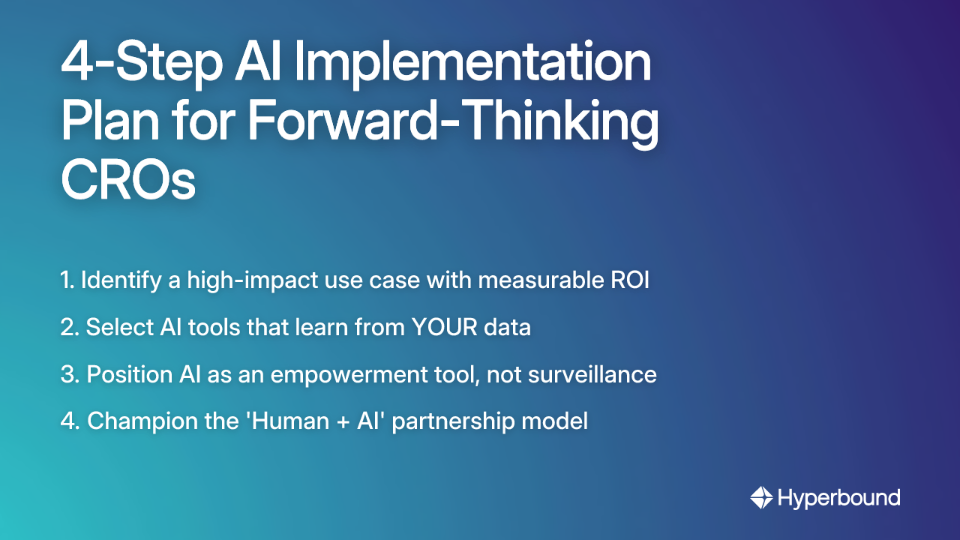
1. Identify and Target a High-Impact Use Case
Don't try to boil the ocean. Start with a specific, measurable problem. Is it SDR ramp time? AE closing consistency? CSM renewal rates? Select a clear target where AI can deliver tangible ROI.
2. Prioritize Tools That Learn From Your Data
The biggest user complaint about AI is a lack of context. To solve this, select AI platforms that integrate with your call recording tools and CRM.
As one Reddit user insightfully noted, "I think that can be fixed by training the model with call recording data." The AI should be trained on your winning conversations, not generic scripts.
3. Frame AI as an Empowerment Tool, Not a Surveillance Tool
Address the user concern that "being subjected to speak to a robot is going to offend" some salespeople. Position AI coaching as a personal performance tool that gives reps control over their own development with on-demand practice and instant feedback.
The most successful implementations emphasize how AI helps reps improve their skills and earnings, not how it helps management monitor activity.
4. Champion the "Human + AI" Model
AI complements, not replaces, great sales managers. The Brooks Group notes that AI handles the repetitive task of call review and skill drills, freeing up managers to provide the high-level strategic guidance, mentorship, and motivation that only a human can.
Make this division of labor explicit in your change management approach.
The AI Co-Pilot for Revenue Growth in 2026
By 2026, the CRO's playbook will be fundamentally rewritten. Strategy will be predictive, not reactive. World-class, data-driven coaching will be a universal standard, not a luxury for a few. And the entire revenue team, from new hires to seasoned CSMs, will be more effective and consistent.
The CROs who thrive in this new era will be those who see AI not as a threat or a magic bullet, but as an indispensable co-pilot—augmenting their team's skills, automating low-value tasks, and focusing their energy on the strategic leadership that truly drives growth.
One Reddit user expressed skepticism, asking, "Do these tools really help in real life sales situations?" By 2026, the answer will be an unequivocal yes. AI will have proven its value not through hype, but through measurable improvements in the metrics that matter most: faster ramp times, higher win rates, increased deal sizes, and improved retention.
The future of revenue leadership isn't human vs. machine—it's humans empowered by machines. And the time to start building that future is now.
Frequently Asked Questions
How will AI change the role of a Chief Revenue Officer (CRO)?
AI will fundamentally shift the CRO's role from being reactive to predictive by transforming data into actionable, forward-looking intelligence. Instead of relying on past performance and "gut feel," CROs will use AI to forecast market shifts, identify at-risk deals with high accuracy, and pinpoint the specific sales behaviors that drive success. This allows for a more scientific approach to strategy, coaching, and overall revenue generation.
What is the most significant impact of AI on sales team performance?
The most significant impact of AI is its ability to accelerate learning and drive consistent performance across the entire sales team. By providing safe, scalable, and hyper-realistic practice environments (like AI roleplays), AI allows reps to master skills much faster. It also enforces playbook consistency by delivering objective, data-driven feedback on every call, ensuring that best practices are adopted universally, not just by top performers.
Will AI sales coaching replace human sales managers?
No, AI is not designed to replace sales managers but to augment their capabilities, creating a "Human + AI" partnership. AI automates time-consuming, repetitive tasks like call reviews and basic skill drills. This frees up managers to focus on high-value activities that require a human touch, such as strategic guidance, complex deal coaching, mentorship, and team motivation.
How does AI help new sales reps ramp up faster?
AI drastically reduces ramp time by providing a risk-free environment for extensive practice before a new rep ever interacts with a real prospect. Through AI-powered roleplays, reps can practice handling objections, delivering pitches, and running discovery calls dozens of times. They receive instant, objective feedback, allowing them to rapidly correct mistakes and build confidence, leading to faster quota attainment.
Can AI be used for more than just sales coaching?
Yes, AI's impact extends across the entire revenue lifecycle, including hiring and post-sales. For hiring, AI-powered assessments can objectively measure a candidate's true selling skills, de-risking the hiring process. For post-sales, AI helps Customer Success Managers (CSMs) practice renewal negotiations and handle difficult customer conversations, which is crucial for improving net revenue retention.
What is the first step a CRO should take to implement AI?
The best first step is to identify a single, high-impact use case with a measurable return on investment (ROI). Instead of a broad, company-wide rollout, focus on a specific problem, such as reducing SDR ramp time or improving AE closing consistency. This allows you to prove the value of the technology, gain buy-in, and learn valuable lessons before scaling the initiative.

Want to see how AI is already transforming sales coaching and enablement? Hyperbound's AI Sales Coaching platform is helping leading sales organizations analyze winning behaviors, create hyper-realistic AI roleplays, and deliver personalized coaching at scale—providing a glimpse into what will become standard for every CRO's playbook by 2026.
Book a demo with Hyperbound


