

.png)
Summary
- The "Coaching Gap" is Widening: While 51% of top sales teams receive regular coaching, managers spend less than 8% of their time on it, leading to long ramp times and inconsistent performance.
- AI Provides a Scalable Solution: Modern AI has evolved beyond "robotic" simulations to offer hyper-realistic practice, objective call scoring, and instant, personalized feedback that closes the coaching gap.
- Reduce Ramp Time & Drive Consistency: Teams using AI for sales training can reduce new hire ramp time by up to 50% and ensure every rep masters key messaging and methodologies.
- Master Critical Conversations: AI-powered platforms like Hyperbound provide a safe, scalable way for reps to practice everything from cold calls to renewal negotiations.
You've seen the headlines. AI this, AI that. Vendors promising that their "revolutionary" AI sales tools will turn your team into quota-crushing machines overnight. And if you've been in sales leadership for any length of time, you've probably developed a healthy skepticism.
"AI tools are just reaching the point where you can ask them for help resetting your Gmail password," as one sales professional bluntly put it on Reddit. Others complain that AI simulations feel "robotic" and "unrealistic" - hardly the training environment needed to develop nuanced sales skills.
These criticisms were valid... in 2023. But as we look ahead to 2025, something remarkable has happened: Generative AI has crossed a critical threshold, moving from hyped-up novelty to essential infrastructure for building elite sales teams.
This isn't about replacing the human element in sales. It's about solving one of the most persistent and damaging problems in sales organizations: the widening "coaching gap" that leaves most reps figuring things out on their own, creates inconsistent customer experiences, and extends ramp times dangerously long.
The Widening "Coaching Gap" in Modern Sales
Here's a startling disconnect: According to RAIN Group, 51% of top-performing sales teams maintain a regular coaching cadence, yet less than 8% of a sales manager's workload is allocated to coaching.
This isn't because managers don't value coaching. It's because they're drowning in forecasting, deal reviews, reporting, hiring, and their own quota pressures. The math simply doesn't work - there aren't enough hours in the day for managers to provide the consistent, personalized coaching each rep needs.
The consequences are severe:
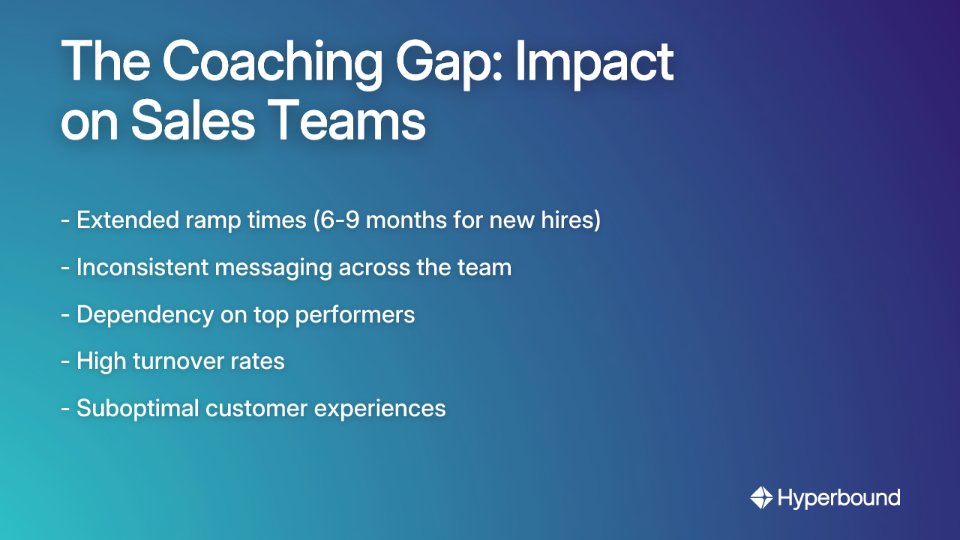
- New hires take 6-9 months to ramp up (often leaving before they become productive)
- Messaging consistency varies wildly across the team
- Top performers carry the team while others struggle to meet quota
- Turnover remains stubbornly high as reps feel unsupported
Without a scalable solution, this coaching gap continues to widen as teams grow and markets become more competitive. This is precisely where AI in 2025 delivers its transformative value.
The Four Pillars of AI's Transformation in Sales Training
By 2025, AI has revolutionized sales training through four key pillars that directly address the coaching gap:
Pillar 1: Hyper-Realistic Practice at Scale (AI Role-Playing)
Remember those complaints about "robotic" AI simulations? That problem has been solved. Today's advanced platforms like Hyperbound analyze thousands of your actual sales calls to build hyper-realistic AI buyer personas that respond dynamically to your reps' approaches.
This creates a safe, on-demand environment for reps to practice critical conversations without risking live deals. Instead of role-playing once a month with their manager (if they're lucky), reps can practice dozens of scenarios weekly, including:
- Cold calls that feel like talking to a genuine prospect
- Discovery conversations with personas trained on your actual buyers
- Demos tailored to specific use cases and industries
- Objection handling with responses based on real customer concerns
- Renewal and upsell conversations for account managers
"The key advancement is that the AI isn't using generic scripts," explains a sales enablement leader at a SaaS company using Hyperbound. "It's trained on our actual winning calls, so it knows exactly how our buyers speak, what objections they raise, and even the industry jargon they use."
Pillar 2: Objective, Data-Driven Feedback (AI Call Scoring)
The second pillar addresses another critical gap: the subjective, inconsistent, and time-consuming nature of call reviews.
In 2025, platforms like Hyperbound's AI Real Call Scoring automatically analyze both practice and real customer conversations against your defined sales methodology. This provides:
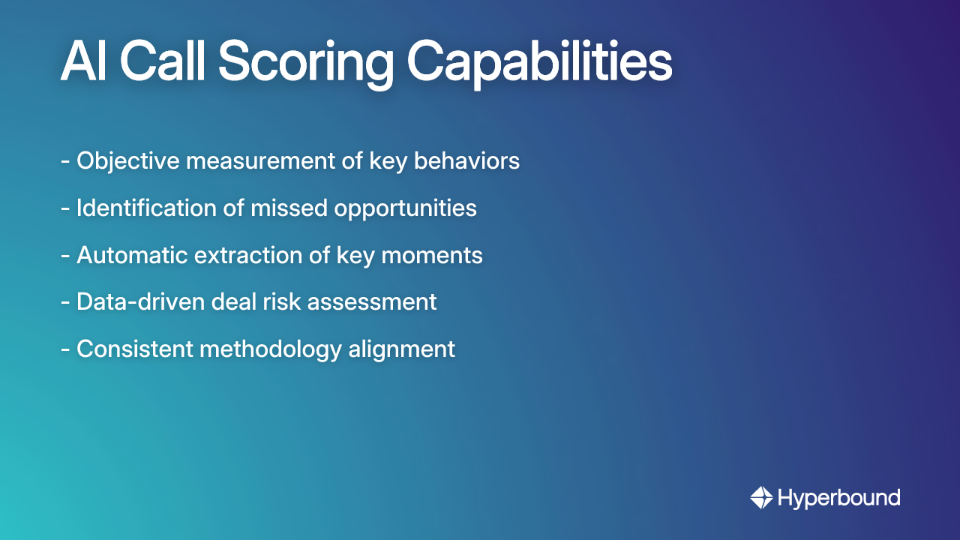
- Objective scoring on key behaviors (talk-to-listen ratio, discovery question quality)
- Identification of missed opportunities or off-track messaging
- Automatic extraction of key moments, objections, and next steps
- Deal risk assessment based on buyer language and engagement patterns
"Before AI scoring, I could review maybe 5% of my team's calls," says a sales manager at a mid-market tech company. "Now I can see how every rep is performing against our methodology, identify specific coaching needs, and focus my limited time on strategic guidance rather than basic call reviews."
Pillar 3: Instant, Personalized Coaching (Real-Time Guidance)
The third pillar shifts coaching from a sporadic event to a continuous improvement loop with instant feedback after every interaction.
Hyperbound's AI Coaching delivers immediate, personalized guidance aligned with your company's specific sales playbook. This allows reps to:
- Receive feedback moments after completing a call or roleplay
- Identify specific strengths and opportunities for improvement
- Get suggested language alternatives for weak responses
- Access targeted practice exercises to strengthen specific skills
"The immediacy is what makes this so powerful," notes a sales enablement expert. "When a rep gets feedback right after a call while the conversation is fresh in their mind, behavior change happens dramatically faster than waiting days for a manager review."
Pillar 4: Agile Content & Program Creation (Generative AI)
The final pillar addresses the enablement team's challenge of keeping training content current in rapidly changing markets.
According to Gartner, "Generative AI enhances sales enablement's agility in delivering training for critical commercial initiatives."
In 2025, AI can:
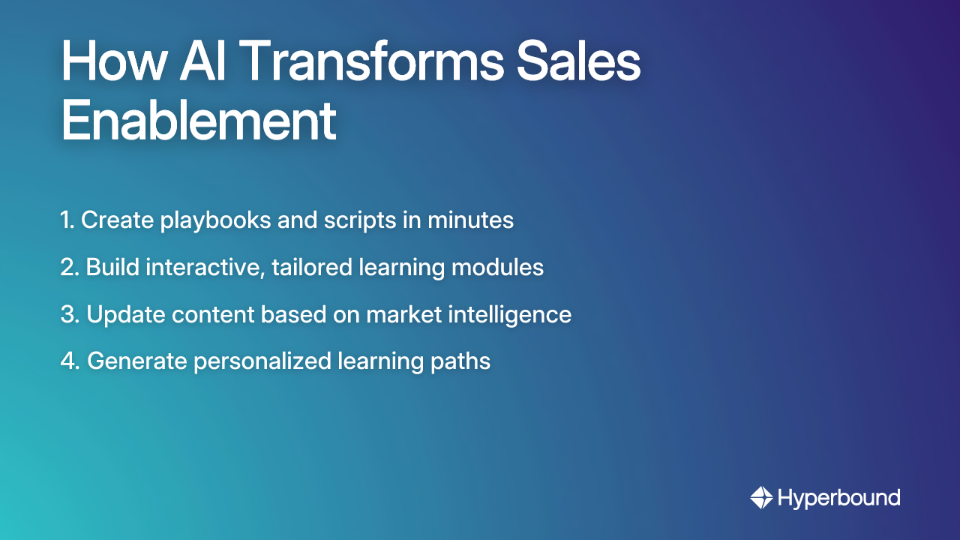
- Draft sales playbooks and call scripts in minutes
- Create interactive learning modules tailored to specific products or markets
- Automatically update content based on competitive intelligence and market shifts
- Generate personalized learning paths based on individual performance data
This allows enablement teams to keep pace with product launches, competitive moves, and market changes without the traditional weeks-long content creation cycles.
AI in Action: Practical Use Cases Across the Sales Organization
Let's examine how different teams are leveraging these AI capabilities in 2025:
Accelerating New Hire Onboarding
The traditional "drink from the firehose" onboarding approach is being replaced by structured, AI-driven practice. New hires at companies using platforms like Hyperbound can:
- Listen to AI-curated examples of top-performing calls
- Practice core conversations dozens of times with realistic AI buyers
- Receive immediate feedback on their approach and messaging
- Track their progress against key skills and competencies
The result? Hyperbound reports their customers are seeing up to a 50% reduction in ramp time for new sales hires.
Mastering Change Management
When rolling out new products, messaging, or methodologies, AI ensures consistent adoption across the team. Sales leaders can:
- Create customized roleplay scenarios for the new offering
- Certify that every rep can effectively articulate value propositions
- Identify which reps need additional support with specific aspects
- Track adoption metrics across the entire team
"In the past, we'd roll out new messaging and hope it stuck," explains a VP of Sales. "Now we can verify that every rep can execute it effectively before they talk to actual customers."
Elevating Post-Sales Conversations
Customer Success and Account Management teams are using tools like Hyperbound's AI Post-Sales Roleplays to master critical retention and expansion conversations:
- Practicing difficult renewal negotiations
- Rehearsing upsell conversations for different customer scenarios
- Handling tough customer complaints or escalations
- Conducting effective quarterly business reviews
This focus on post-sales conversations directly impacts customer retention and expansion revenue - the lifeblood of SaaS businesses.
Hiring Top Talent Objectively
Progressive companies are now using AI Roleplay Hiring Assessments to screen candidates more effectively than traditional interviews. This approach:
- Provides an objective evaluation of actual selling skills
- Creates a consistent assessment experience for all candidates
- Reveals how candidates actually perform in simulated sales scenarios
- Reduces bias in the hiring process by focusing on demonstrated ability
"We've had candidates with impressive resumes who couldn't articulate value in our roleplay assessments," notes a sales director. "This approach helps us identify true sales talent regardless of background or interview polish."
Implementing AI Training Successfully: Best Practices & Pitfalls
As with any transformative technology, successful implementation requires careful planning. Here are key considerations for organizations looking to leverage AI sales training effectively:
Blend Human and AI Coaching
The most successful organizations use AI to augment human coaching, not replace it. RAIN Group emphasizes that AI should handle the repetitive practice and initial feedback, freeing managers to focus on strategic, developmental coaching and nuanced skills.
As one sales leader put it: "AI gives us the scale and consistency we need, while our managers provide the context, nuance, and relationship that only humans can deliver."
Address Accuracy and Bias
AI is only as good as the data it's trained on. Organizations must ensure their AI systems are trained on high-quality, representative data from their actual sales conversations. To accomplish this, best practices include:
- Regular auditing of AI-generated content for accuracy
- Human oversight of AI-generated coaching recommendations
- Diverse training data to minimize bias in the AI's feedback
Customize for Your Context
The power of modern AI sales training lies in its customizability. RAIN Group advises against using generic, off-the-shelf scenarios. Instead, organizations should:
- Tailor AI personas to reflect their specific buyer types
- Customize evaluation criteria to match their sales methodology
- Create scenario libraries that address their unique selling challenges
Drive Engagement Through Gamification
To maximize adoption, leading organizations gamify their AI training programs with:
- Leaderboards showcasing top performers in different skill areas
- Certification badges for mastering specific conversation types
- Team challenges that foster friendly competition
- Recognition programs that celebrate improvement, not just results
"Making the training engaging is crucial," notes a sales enablement leader. "When reps see their scores improving and how it connects to real deal outcomes, they become addicted to getting better."
Your Sales Team, Supercharged by AI
As we look to 2025, AI has fundamentally transformed sales training from a sporadic, subjective process into one that is scalable, data-driven, personalized, and continuous.
This doesn't diminish the role of great sales managers. Rather, it elevates it. By automating the tedious parts of coaching (call review, repetitive practice), AI frees managers to do what they do best: provide strategic guidance, share contextual wisdom, and build the human relationships that drive team performance.
The competitive advantage is clear. Teams leveraging AI-powered platforms like Hyperbound can:
- Onboard new hires faster and get them contributing to revenue sooner
- Execute consistent messaging across the entire organization
- Adapt quickly to market changes and competitive pressures
- Deliver a more consistent, high-quality customer experience
- Scale coaching to every rep, not just the struggling or star performers
In an era where buyer expectations continue to rise and markets change with dizzying speed, the future belongs to the teams that learn the fastest. AI doesn't replace the human element in sales - it amplifies it, allowing your organization to build a true learning culture where every conversation, whether practice or real, becomes an opportunity for growth.
The skepticism around AI in sales was once justified. But in 2025, the question is no longer whether AI can effectively train sales teams - it's whether your organization can afford to fall behind those who are already using it to build their competitive advantage.
Frequently Asked Questions
Will AI replace sales managers?
No, AI does not replace sales managers. Instead, it augments their abilities by automating repetitive tasks like call reviews and basic practice sessions. This frees up managers to focus on high-value strategic coaching, deal strategy, and developing the nuanced skills of their team. AI handles the scale, while managers provide the essential human context and mentorship.
How is modern AI sales training different from older simulations?
Modern AI sales training is hyper-realistic and customized, unlike older, generic simulations. Platforms like Hyperbound train the AI on your company's actual sales calls. This means the AI buyer personas use your industry's jargon, raise common objections your team faces, and respond dynamically and realistically. The focus has shifted from canned scripts to simulating authentic conversations.
What is the main benefit of using AI for sales coaching?
The main benefit of using AI for sales coaching is its ability to provide personalized, scalable, and consistent training for every single rep. AI closes the "coaching gap" by giving every team member on-demand access to practice and objective feedback. This leads to faster onboarding, consistent messaging across the team, and continuous skill development that isn't limited by a manager's availability.
How does AI help with new hire onboarding?
AI significantly accelerates new hire onboarding by providing a safe, scalable environment for practice and immediate feedback. Instead of just shadowing calls, new hires can actively practice core conversations (like cold calls and discovery) dozens of times with realistic AI buyers. The AI provides instant, objective scoring against your sales methodology, helping them master key skills and messaging much faster than traditional methods.
Can experienced sales reps benefit from AI training?
Yes, experienced sales reps benefit greatly from AI training by using it to refine advanced skills and adapt to new challenges. Veteran reps can use AI to master new product messaging, practice navigating complex enterprise deals, prepare for difficult renewal negotiations, or sharpen their competitive positioning. It provides a platform for continuous improvement and helps even top performers stay at the top of their game.
What is the difference between AI role-playing and AI call scoring?
AI role-playing is a proactive training tool for practice, while AI call scoring is a reactive tool for analyzing real conversations. AI Role-Playing allows reps to practice sales scenarios with an AI buyer in a safe, simulated environment before talking to actual customers. AI Call Scoring analyzes and provides objective feedback on recorded conversations after they have happened, ensuring alignment with your sales methodology.
How do you ensure the AI feedback is accurate and relevant?
The accuracy and relevance of AI feedback are ensured by training the AI on your company's specific data and customizing it to your sales methodology. Effective platforms are not generic; they are configured by analyzing your top-performing sales calls and embedding your unique sales playbook into the system. This, combined with human oversight, ensures the AI's coaching is highly contextual and aligned with what drives success in your organization.

Want to see how AI sales coaching can transform your team's performance? Book a demo with Hyperbound to explore their AI Sales Coaching platform that analyzes winning behaviors, provides hyper-realistic AI roleplays, and delivers personalized coaching at scale.
Book a demo with Hyperbound


