

.png)
Summary
- Stuck at 19% conversion? The problem isn't your reps' scripts; it's the lack of specific, data-driven coaching from managers.
- Most hospitality sales training focuses on reps, but empowering managers with the right coaching capabilities is the true leverage point for team growth.
- Effective coaching moves beyond vague advice ("create urgency") to specific, behavioral feedback based on real sales conversations.
- Equip your managers to scale coaching and boost performance with Hyperbound's AI platform, which automates call analysis and provides tools for targeted practice.
Here's the uncomfortable truth the hospitality sales training industry doesn't want to admit: almost every program, course, and certification out there is built for the frontline rep.
Search "hotel sales training" and you'll find module after module on how to build rapport, overcome the "rate is too high" objection, and create urgency on a reservations call. All useful — but none of it addresses the actual leverage point in a hotel or resort sales team.
That leverage point is the manager.
When a rep on your team is stuck at 19% conversion against a 30% target, the problem usually isn't that they need another rebuttal script. It's that no one has given them specific, actionable feedback on why their calls aren't converting. As one hotel reservations agent put it: "The lack of support and knowledge from their part on how to improve is really grating on me." Management's default response? "Just create more urgency and use the rebuttals we taught you."
That's not coaching. That's noise.
The biggest unlock for a hospitality sales team isn't a better training module for reps — it's equipping managers with a completely different set of capabilities. Capabilities that most hospitality sales training programs never address.
This guide covers four of them:
- Running effective deal inspections on group sales pipelines
- Giving feedback after a corporate account call that reps actually use
- Identifying skill gaps across a distributed or seasonal team
- Scaling 1:1 coaching without burning out
.png)
Capability #1: Run Effective Deal Inspections on Group Sales Pipelines
Group sales in hospitality aren't like transient bookings. The cycles are longer, the stakeholders multiply — corporate travel managers, event planners, procurement teams — and deals stall in ways that CRM fields can't explain.
Most deal inspection sessions turn into a glorified status update: "Where are we on the Meridian Conference?" The rep says it's "in negotiation." The manager takes that at face value. The deal slips.
Effective deal inspection starts with a clear pipeline framework. A well-structured hospitality sales pipeline should track six key stages: Prospecting, Inquiry, Proposal, Negotiation, Booking, and Follow-up. Each stage should have defined exit criteria — not just a label a rep applies subjectively.
From there, managers need to monitor KPIs that actually signal deal health: conversion rate by stage (a healthy inquiry-to-booking rate sits around 20–25%), average sales cycle length, and win rate by segment (SMERF vs. corporate vs. association).
But here's where most hospitality sales coaching breaks down: managers are inspecting CRM fields, not conversations. A deal marked "Proposal Sent" tells you nothing about whether the rep actually uncovered the group's budget, confirmed the decision-maker was on the call, or handled the "we found a comparable venue for less" objection effectively.
Hyperbound's AI Real Call Scoring changes this dynamic. It analyzes 100% of the conversations within a deal — from the first inquiry call to the final negotiation — and surfaces early risk signals and deal momentum indicators grounded in actual buyer behavior. Instead of asking your rep if they discussed budget, you can see from AI Real Call Scoring exactly when (or whether) that conversation happened.
Deal inspection becomes a coaching conversation about specific behaviors, not a guessing game about CRM hygiene.
Capability #2: Give Feedback After Corporate Account Calls that Reps Actually Use
Here's a scenario most hospitality sales managers will recognize: a rep comes off a call with a corporate travel manager. You sit down for a debrief. You say something like, "You need to build more rapport before you go into the pitch." The rep nods. Nothing changes.
Vague feedback is one of the most corrosive forces in a sales culture — and it's endemic to hospitality. One of the most consistent gaps in hotel sales management is the absence of standardized, behavior-based feedback processes. Managers fall back on instinct. Reps receive impressions, not instructions.
Behavior-based feedback looks completely different. Instead of "build more rapport," it sounds like: "On the call with the Hartwell Group's event planner, you jumped straight to meeting space availability within the first 90 seconds. You didn't ask about their last event, their attendee profile, or what mattered most to their planning committee. Those three questions would have built the relational context you needed before pitching."
That's specific. That's actionable. That's the kind of feedback that changes what happens on the next call.
The problem is that most managers don't have the bandwidth — or the data — to deliver that level of granularity consistently. That's where Hyperbound's AI Real Call Scoring comes in. Every real call is automatically scored against your hotel or resort's sales methodology: Were key discovery questions asked? Was the value proposition positioned against rate objections? Did the rep confirm next steps before ending the call?
When a rep hears "your discovery is weak" from a manager, it's easy to dismiss. When they can see an objective scorecard showing they asked zero budget-qualifying questions across their last five corporate calls, the conversation moves from defensiveness to development.
Capability #3: Identify Skill Gaps Across a Distributed or Seasonal Sales Team
Here's a challenge that almost no hospitality sales training program addresses head-on: your team isn't static.
Hotel and resort sales teams are frequently distributed across properties, managed by regional directors who oversee multiple sites, and constantly rotating with seasonal hires who ramp up in the spring and fall off in the winter. What you're dealing with isn't just individual performance variation — it's systemic skill gaps that are invisible unless you're looking for them at scale.
A manager who oversees three properties and twelve reps can't personally listen to enough calls to know that the new cohort of event sales coordinators is consistently failing to position the value proposition when a prospect drops the "found it cheaper online" objection. They might catch it on one rep's call. But they won't see the pattern.
The shift from manager to mentor — one who provides supportive, individualized development — is what separates teams that plateau from teams that grow. But you can't mentor at scale without data.
This is where Hyperbound's AI Coaching changes the equation. The platform pulls together real call scoring data and roleplay performance data to surface patterns a manager would never catch on their own.
Rather than waiting for a quarterly review to discover your SMERF-focused reps are struggling with value-based selling, the platform proactively flags it: "Your team is scoring 38% lower on objection handling for rate-based objections compared to last quarter. Three reps in particular are consistently losing momentum after hearing 'the rate is too high.' Recommended intervention: assign targeted objection-handling roleplays."
That kind of proactive, team-wide diagnostic work — surfacing which reps are struggling with objection handling on event space deals and recommending targeted roleplay interventions — is something that used to require hundreds of hours of manual call reviews. Now it's automatic.
Capability #4: Scale 1:1 Coaching Without Burning Out
Ask any hospitality sales manager what the first thing to go is when the season gets busy: it's the 1:1s.
There's simply not enough time. When you're managing pipeline reviews, handling escalations from group sales accounts, coordinating with catering and events teams, and fielding calls from corporate clients yourself, individualized coaching becomes a luxury. Reps feel it too — that creeping sense that they're on their own, that management only shows up to check numbers, not to help them improve.
The fix isn't telling managers to "make time." It's changing what coaching actually requires of them.
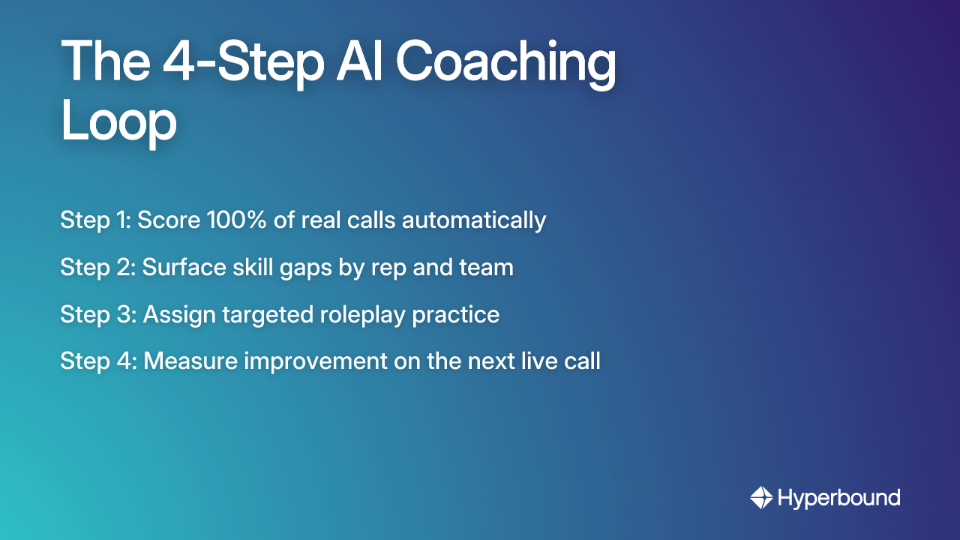
The modern hospitality sales coaching model offloads the diagnostic and practice work to technology, so that by the time a manager sits down with a rep, the conversation is already focused on what matters. Here's how that loop works in practice:
Step 1 — Score Real Calls: Hyperbound's AI Real Call Scoring automatically analyzes every live call your reps make, scoring it against your custom methodology scorecard. No manual review required.
Step 2 — Identify Skill Gaps: Hyperbound's AI Coaching platform flags which reps need attention and why — grounded in behavioral data from real conversations, not gut instinct.
Step 3 — Assign Targeted Practice: The manager assigns a specific Hyperbound Practice roleplay to the rep — for example, a scenario where an AI buyer persona playing a corporate event planner presents the "rate is too high" objection mid-proposal. The rep practices in a realistic, risk-free environment, receives an instant AI Scorecard, and gets behavior-level coaching feedback on what to improve.
Step 4 — Measure the Impact: The next real call is scored again. The manager can see directly whether the practice translated to better objection handling in a live deal.
This model means a 1:1 session isn't consumed by diagnosing the problem — the diagnosis is already done. Managers walk in with context, reps walk in prepared, and the conversation focuses on growth. That's how you scale coaching across a team of twelve without needing twelve hours a week.
Proof It Works at Scale
For managers who want to know whether this kind of AI-powered coaching actually moves the needle, the numbers speak for themselves.
LinkedIn uses Hyperbound to coach and develop 3,000+ sellers across three business units — LinkedIn Talent Solutions, LinkedIn Sales Solutions, and Sales Development — in both NAMER and EMEA. At that scale, consistency of coaching is everything. Hyperbound provides the infrastructure to deliver it.
Vanta, under CRO Stevie Case, leveraged Hyperbound to reduce ramp time by 60% — from 210 days down to 72 — while growing their BDR team 4x and driving 5x pipeline growth. The mechanism was the same loop described above: score real calls, identify gaps, practice targeted scenarios, measure improvement.
These results aren't from hospitality companies, but the underlying principle applies directly. In hotel and resort sales, the difference between a rep who ramps in 60 days versus 120 isn't talent — it's the quality and frequency of coaching they receive during that window.
The Real Hospitality Sales Training Opportunity
Every resource on hospitality sales training will tell you to train your reps on value positioning, teach them to handle the "found it cheaper online" objection, and build rapport before going into the pitch. That advice isn't wrong.
But it misses the leverage point entirely.
The managers who build high-performing hospitality sales teams aren't the ones with the best objection scripts. They're the ones who run deal inspections grounded in actual conversation data, deliver specific behavior-based feedback after every corporate account call, spot skill gaps across their distributed team before those gaps cost them a quarter, and coach consistently at scale without sacrificing their own capacity.
Those four capabilities are what separate teams that stay stuck at 19% conversion from teams that push past 30% — and the tools to develop them exist right now.
If you're ready to build that coaching infrastructure for your hospitality sales team, Hyperbound is the Revenue Activation Platform designed to make it happen.
Frequently Asked Questions
Why should hospitality sales training focus on managers instead of reps?
Hospitality sales training should focus on managers because they are the primary leverage point for improving team-wide performance. While rep-level skills are important, a manager's ability to coach, inspect deals, and identify skill gaps has a much larger and more scalable impact on conversion rates and revenue. Equipping managers with the right coaching capabilities is the most significant unlock for a sales team's success.
What is wrong with most current hotel sales training programs?
Most hotel sales training programs are flawed because they are designed almost exclusively for frontline representatives and focus on generic skills like objection handling, rather than addressing the strategic coaching capabilities managers need. These programs often lead to managers giving vague, unhelpful feedback ("create more urgency") instead of specific, actionable instructions. They fail to equip managers to run effective pipeline inspections or identify systemic skill gaps across their teams.
How can AI improve hospitality sales coaching?
AI improves hospitality sales coaching by automating the analysis of sales calls, identifying specific skill gaps, and providing a platform for targeted practice, which allows managers to scale their coaching efforts effectively. Tools like Hyperbound's AI Real Call Scoring analyze 100% of sales conversations to provide objective data on rep performance. This frees managers from manually reviewing calls and enables them to have data-driven, behavior-focused coaching conversations.
What is behavior-based feedback and why is it important for hotel sales?
Behavior-based feedback is a coaching method that focuses on specific, observable actions a sales rep took during a call, rather than offering vague, general advice. It is crucial for hotel sales because it provides clear, actionable instructions that reps can actually implement. For example, instead of saying "build more rapport," a manager using this method would say, "You missed the opportunity to ask about their last event's success, which would have built a stronger connection before you pitched our meeting spaces."
How does a platform like Hyperbound help manage distributed or seasonal sales teams?
A platform like Hyperbound helps manage distributed or seasonal teams by providing a centralized system to monitor performance, identify team-wide skill gaps, and deliver consistent coaching, regardless of location or tenure. Managers overseeing multiple properties or onboarding seasonal staff can't listen to every call. AI-powered platforms can automatically surface patterns—for instance, that new hires are struggling with a specific rate objection—and recommend targeted training interventions.
What are the first steps to implementing an AI coaching system for my team?
The first step is to shift the focus from training reps to empowering managers with the right tools and capabilities for data-driven coaching. This involves adopting a coaching loop where you can: 1) Automatically score real calls to establish a baseline, 2) Use AI to surface skill gaps, 3) Assign targeted practice roleplays, and 4) Measure improvement on subsequent live calls. Platforms like Hyperbound are designed to implement this entire workflow, starting with a demo to see how it can be tailored to your team's specific needs.
Book a demo with Hyperbound


