.png)


.png)
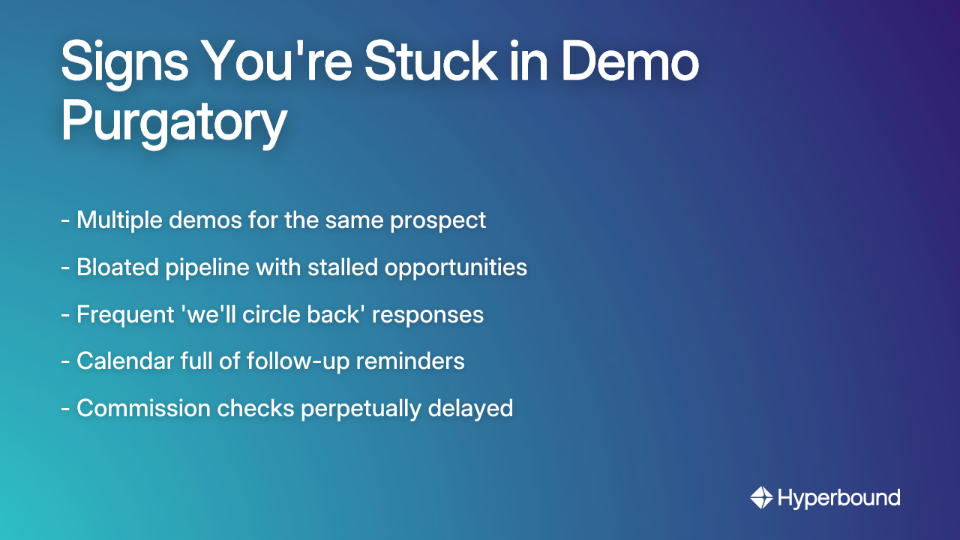
You've done it. The third demo for the same company. You know the product inside-out, you've answered every question, but the call ends with a familiar, non-committal phrase: "This looks great, we'll circle back internally and let you know."
Your calendar is filled with follow-up reminders. Your pipeline is bloated with opportunities stuck in the "demo completed" stage. And that commission check you've been counting on? It's still a distant dream.
Welcome to demo purgatory – the endless loop of presentations that never convert to sales.
The Diagnosis: Why You're Stuck in Demo Purgatory
The problem isn't your presentation skills or even your product. The issue begins much earlier in your sales process – specifically, with poor qualification.
Proper qualification means evaluating leads against an ideal customer profile to determine if they're worth pursuing. When qualification breaks down, the costs are significant:
- Wasted Time: Every hour spent on unqualified leads is an hour lost on real opportunities.
- Missed Opportunities: You're too busy with tire-kickers to recognize high-value prospects.
- Bad Deals: Closing with unsuitable clients leads to churn and damages your reputation.
The High Cost of Unqualified Demos
Your time has real monetary value. Consider this calculation from Visualize.com:
- Take your annual sales quota
- Divide it by 2,200 (approximate annual working hours)
- That's your hourly worth
For a salesperson with a $1 million quota, that's $455 per hour. Every demo in purgatory costs you real money.
Remember: Zero times anything is zero. If a key qualification element is missing, the deal is at risk, no matter how great your demo is.
The Escape Plan: Four Pillars to Break the Cycle

Pillar 1: Qualify Ruthlessly Before You Hit "Share Screen"
The goal of initial calls isn't to get the demo – it's to determine if the prospect deserves a demo.
Use prequalifiers like the BANT framework to assess:
- Budget: Do they have financial resources?
- Authority: Are you speaking with decision-makers?
- Need: Is there a genuine problem your product solves?
- Timing: Is there a timeline for making a decision?
Key Qualification Elements to Uncover:
- Access to Power: Direct access to decision-makers is non-negotiable. If you don't have it, your primary goal is to get it.
- Vision Match: Does your solution align with their strategic goals?
- Understanding the Decision-Making Process: Ask directly: "Can you help me understand the next steps you need to take internally?"
Red Flags to Watch For:
- Inconsistencies in answers
- Vague responses like "we're just exploring"
- Reluctance to discuss budget or decision-making process
Pillar 2: Master the "Next Steps" Conversation
According to sales intelligence research, not getting a commitment on next steps can lead to a 70% drop in close rates. Yet, spending just four extra minutes discussing next steps significantly improves your chances of closing.
Strategies for Establishing Clear Next Steps:
- Define Next Steps Before the Demo: Go into the meeting with a proposed plan.
- Example: "Following our demo, the typical next step is a technical review with your engineering lead. Does that align with your process?"
- Use the Q&A Session Strategically:
- Start with open-ended questions to understand their thoughts, then pivot to close-ended questions to lock down next steps.
- Closing questions to ask:
- "Is there anything else you need to see to help you make your decision?"
- "Can you help me understand the next steps you need to take internally?"
- "Do you think [stakeholder name] would want to see how our feature can reduce costs? Can we schedule a session with them for next week?"
- Get Verbal Confirmation: Don't end the call until the prospect has explicitly agreed to the next action and it's on both calendars. This creates shared responsibility.
Follow-Up vs. Next Steps:
- Next Steps are the roadmap forward, agreed upon during the call.
- Follow-Up is the email you send within 12 hours recapping the conversation and confirming those agreed-upon next steps.

Pillar 3: Create Genuine Urgency, Not Artificial Pressure
Many salespeople fear asking for the sale, mistakenly believing this will come off as pushy. This hesitation creates awkwardness and uncertainty that prospects can sense. The goal isn't to pressure, but to help the buyer discover their own urgency.
Uncover the "Why Now?" with Consultative Selling:
- Ask questions that force the prospect to contemplate the cost of doing nothing:
- "Why are you looking to solve this problem now?"
- "Who or what is affected by this problem if it's not solved in the next quarter?"
- "What happens if you do nothing?"
When they articulate the consequences of inaction themselves, you've created genuine urgency.
Ethical Urgency Tactics:
- Mention Promotional Deadlines: Be transparent and informative.
- Example: "Just so you're aware, we have an early adopter discount of 15% for clients who sign on by the end of this month. I wanted to make sure you had all the information as you evaluate."
- Leverage Scarcity and FOMO (Fear of Missing Out):
- If applicable, mention limited onboarding slots, beta programs, or limited-edition features.
- Use social proof like case studies to show how their competitors are already benefiting.
- Use the Pregnant Pause:
- After presenting pricing or asking a closing question, remain silent. Don't be the first to speak.
- This gives the prospect space to think and often reveals their true objections.
Pillar 4: The Power of Walking Away
Salespeople often struggle with knowing when to disengage, fearing they'll lose a potential deal. This often stems from desperation or what veterans call "commission breathe" – that anxious energy prospects can sense a mile away.
Reframe "Walking Away": It's not giving up; it's a strategic reallocation of your most valuable asset—time—towards more promising opportunities. It demonstrates that you value your solution and aren't desperate for just any deal.
When to Walk Away (Red Flags):
- The prospect repeatedly misses meetings or reschedules without good reason
- They refuse to grant access to decision-makers after multiple requests
- They cannot or will not define a clear timeline or decision-making process
- They go dark for an extended period despite clear, agreed-upon next steps
How to Walk Away Professionally (The Breakup Email):
- Be polite, professional, and leave the door open
- Example Template: "Hi [Prospect Name], I've tried to reach you a few times to discuss next steps regarding [your solution]. Since I haven't heard back, I'll assume your priorities have shifted and this is no longer a focus. I'm going to close your file for now, but please don't hesitate to reach out if things change in the future. Best, [Your Name]."
This "walking away tactic" often creates urgency and can re-engage a prospect who was simply procrastinating. The absent-minded beggar suddenly becomes attentive when they realize you're no longer chasing them.
From Presenter to Partner: Breaking the Demo Addiction Cycle
Escaping demo purgatory requires a shift from being a presenter to being a process driver who guides clients through a high-ticket sales journey:
- Qualify rigorously to ensure you're talking to the right people
- Define Next Steps explicitly to maintain momentum
- Create Urgency by highlighting the cost of inaction
- Walk Away from dead-end deals to protect your time
Remember that your value statement isn't just in your product demonstration – it's in your ability to guide prospects through a decision-making process that leads to solving their problems.
The mirror technique can be particularly powerful here: reflect back the prospect's own concerns and priorities to show you're truly listening and practicing consultative selling rather than just pitching.
By implementing these strategies, you stop being a victim of the endless loop and become a strategic partner who guides clients to confident decisions using permission-based closing. You'll spend less time in demo purgatory and more time handling objections that actually matter, leading to faster closes and more commissions.
Stop presenting. Start closing.

Frequently Asked Questions
What is demo purgatory in sales?
Demo purgatory is the endless cycle of giving product demonstrations to prospects who never convert into paying customers. It's characterized by bloated pipelines, numerous follow-ups, and deals stalling after the demo phase. This situation arises from engaging with unqualified leads who lack the budget, authority, need, or timeline to make a purchase.
Why do sales deals get stuck after the demo?
The primary reason sales deals get stuck after a demo is poor qualification. When a salesperson fails to properly assess a prospect's budget, authority, need, and timing (BANT) before the presentation, they end up demonstrating to individuals who are not in a position to buy. Other key factors include not establishing clear, agreed-upon next steps during the call and failing to create a sense of urgency.
How can I better qualify leads before a demo?
To better qualify leads, use a structured framework like BANT (Budget, Authority, Need, Timing) during your initial discovery calls. The goal is to determine if the prospect deserves a demo, not just to schedule one. Key actions include asking direct questions about their decision-making process, ensuring you have access to the ultimate decision-maker, and understanding if your solution aligns with their strategic goals.
What is the difference between a follow-up and next steps?
Next steps are the specific, agreed-upon actions that move the deal forward, which are established during the sales call. A follow-up is the communication (usually an email) sent after the call to recap the discussion and confirm those mutually agreed-upon next steps. Mastering the next steps conversation is crucial for maintaining momentum, while a follow-up is simply a summary of what's already been decided.
How do I create urgency without being pushy?
Create genuine urgency by helping the prospect realize the cost of inaction, rather than applying artificial pressure. This is achieved through consultative selling. Ask questions like, "What happens if you don't solve this problem in the next quarter?" or "Who is most affected by this issue?" When the prospect articulates the negative consequences themselves, the urgency becomes their own discovery, not your sales tactic.
When should a salesperson walk away from a deal?
A salesperson should strategically walk away from a deal when a prospect consistently shows signs of disengagement. Key red flags include repeatedly missing or rescheduling meetings, refusing to grant access to decision-makers, being unable to define a decision timeline, or "going dark" despite clear next steps. Walking away is not giving up; it's a strategic reallocation of your time to more promising opportunities.
Have you been stuck in demo purgatory? What techniques have worked for you to escape the endless presentation loop? Share your experiences in the comments below.
Book a demo with Hyperbound


