

Summary
- Enterprise sales teams face a performance crisis, with up to 70% of reps missing quota and sales cycles lengthening by over 30%.
- The traditional reliance on a few top performers—where 17% of reps drive 81% of revenue—is unsustainable, making it critical to scale winning behaviors across the entire team.
- AI is now a competitive necessity, with early adopters achieving over 30% improvements in win rates by using it to provide data-driven coaching and automate non-selling tasks.
- AI Sales Coaching platforms like Hyperbound help close the performance gap by analyzing top-performer calls and creating scalable roleplays and coaching for the whole team.
Executive Summary
In 2025, enterprise sales leaders face a critical inflection point. While the B2B SaaS market continues its explosive growth trajectory, traditional sales models are breaking under the strain of economic headwinds, rising costs, and a widening performance gap within sales teams.
The data paints a stark picture: up to 70% of reps are missing quota, sales cycles have lengthened by over 30%, and customer acquisition costs are soaring. Relying on the top 17% of reps who generate 81% of revenue is no longer a sustainable strategy.
However, a powerful solution has emerged. AI is no longer experimental; it's a core operational reality. Early adopters are already seeing 30%+ improvements in win rates and productivity. The question for 2025 is not if sales organizations should adopt AI, but how they can redesign their workflows around it to scale winning behaviors, close the performance gap, and capture market share.
This report provides the data-backed playbook to do just that.
The Macro Landscape: A Tale of Two Tides in B2B SaaS
The Structural Tailwind: Unprecedented Market Growth
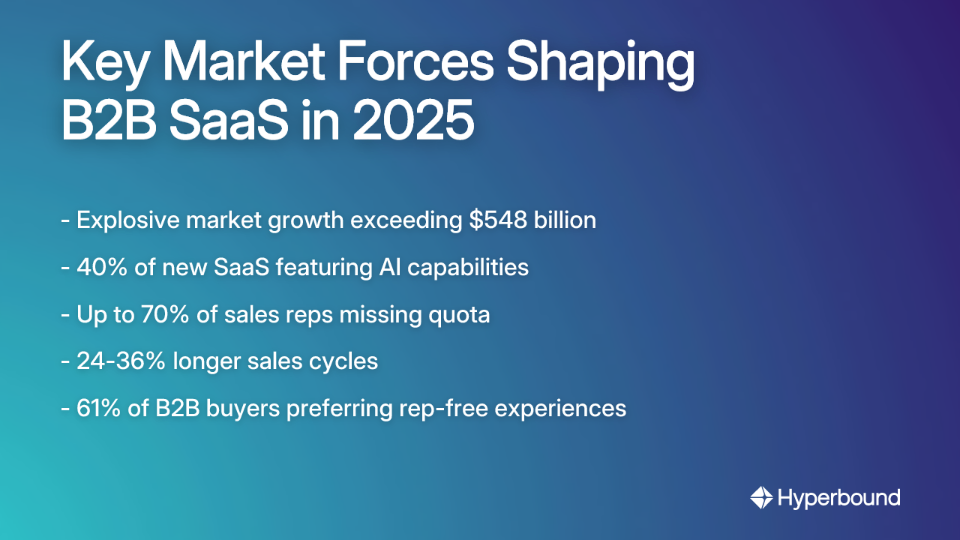
The B2B SaaS landscape is experiencing a period of extraordinary expansion, creating a fertile ground for growth-oriented sales organizations. The global B2B SaaS market is projected to hit US$548.12 billion in 2025 and is on a trajectory to exceed US$2.5 trillion by 2035.
Innovation continues to accelerate, with roughly 40% of new SaaS launches in 2024–2025 featuring AI-enhanced capabilities. This signals a market that increasingly expects and rewards technological sophistication.
For sectors including enterprise software, verticalized solutions, and AI-powered platforms, demand is expanding exponentially—creating significant opportunity for specialized platforms like Hyperbound that address specific, high-value use cases.
The Economic Headwinds: A More Challenging Selling Environment
Despite this growth, the reality on the sales floor tells a different story. Sales organizations are struggling against powerful headwinds:
The Quota Crisis: A significant portion of sales organizations are failing to meet targets. According to recent benchmarks, up to 70% of B2B sales reps missed their annual quota in 2024 (Sales Benchmark Index, 2024).
Rising Costs of Growth: Unit economics are deteriorating across the board. Median New Customer Acquisition Cost (CAC) ratios are hitting $2.00 (spending $2 to acquire $1 of ARR), making efficient growth paramount (Sales Performance Research, 2025).
Elongated Deal Cycles: Deals are taking longer to close, increasing risk and straining forecasts. Mid-market cycles have lengthened by ~24–32%, with enterprise cycles stretching up to 36% longer.
The Buyer Shift: Modern B2B buyers are radically changing their behavior. According to Gartner, 61% of B2B buyers now prefer a rep-free buying experience, especially in the early stages. This forces a re-evaluation of the rep's role, making every interaction more critical.
Implication for Leaders: The SaaS market offers a massive prize, but winning it requires a new approach. The old methods of "spray and pray" or simply hiring more reps are financially unsustainable. The focus must shift to systematic efficiency and effectiveness.
The Performance Paradox: A Widening Gap on the Sales Floor
The 80/20 Rule on Steroids: Over-reliance on Top Performers
Within sales organizations, the distribution of performance has become increasingly skewed, creating dangerous dependencies and limitations to scalable growth.
A 2025 survey reveals a stark imbalance: just 17% of sales reps generate 81% of the total revenue (Sales Performance Research, 2025). This creates immense risk. The departure of a single top performer can jeopardize a significant portion of the team's quota. This model is not scalable and is highly vulnerable to churn.
A Data-Driven Look at Key Sales KPIs (2024-2025)
Metric / Benchmark2024-2025 Data / TrendImplicationQuota AttainmentUp to 70% of reps missed quotaWidespread underperformance signals a systemic issue with training, coaching, or playbooksRevenue Concentration17% of reps drive ~81% of revenueNeed to democratize success and elevate the "middle 70%"Acquisition Cost (CAC)Ratios around $2.00 for new ARRROI on sales headcount and marketing spend is under intense scrutinySales Cycle VelocityCycles are 24-36% longer, with win rates droppingNeed for better qualification, deal management, and sales discipline
The data paints a clear picture: the traditional sales model is inefficient and high-risk. Sales leaders cannot afford to ignore the vast, untapped potential of their core performers. The central challenge is to identify what the top 17% do differently and scale those winning behaviors across the entire team.
The AI Revolution in Sales: The Primary Tailwind for 2025
From Experimentation to Operationalization: AI Adoption is Mainstream
AI has rapidly transitioned from an experimental technology to a core component of the modern sales tech stack. The market has moved decisively past the "pilot phase."
As of 2025, 78% of organizations use AI in at least one business function, and 71% regularly use generative AI. This trend is firmly established in sales, with 47% of sales teams reporting the use of AI tools (Fullview, 2025).
We're witnessing a strategic shift in how companies approach AI. According to McKinsey's 2025 AI survey, companies are now redesigning entire workflows to capture value from AI, viewing it as essential infrastructure, not just an add-on tool.
Quantifying the Impact: The ROI of AI in Sales
Early adopters of AI in sales are seeing compelling returns on their investments:
Win Rate Improvement: Research from Bain & Company shows early AI deployments are delivering 30% or more improvements in win rates.
Productivity & Revenue Gains: AI-driven sales tools are linked to up to 30% gains in productivity and up to 25% revenue uplift.
Unlocking Selling Time: AI promises to solve the "time spent not selling" problem. Reps currently spend only ~25% of their time on direct selling; AI can more than double that by automating administrative tasks (Bain & Company, 2023).
Leadership Consensus: This trend is backed by broad consensus among sales executives: 81% of sales leaders believe AI helps reduce time spent on manual tasks and admin work (Rev-Empire, 2025).
Implication: For sales leaders in 2025, ignoring AI is no longer an option. It has become a competitive necessity. The organizations that integrate AI deeply into their sales processes will be the ones who thrive despite market headwinds.
The 2025 AI-Powered Sales Enablement Stack: A Framework for Action
Understanding the theoretical benefits of AI is one thing, but how does it specifically address the challenges sales teams face? Here's how the modern AI-powered sales stack is solving these critical pain points:
From Manual to Scalable Selling: Intelligent Automation
Problem: Sales reps are bogged down by non-revenue-generating tasks. CRM updates, call logging, and note-taking consume valuable time that could be spent engaging with prospects.
AI Solution: AI tools automate these administrative burdens, freeing up reps to focus on what they do best: selling. This directly addresses the goal of doubling selling time from <25% today (Bain & Company, 2023).
"By automating administrative tasks, we've been able to give our reps back approximately 15 hours per week," notes a VP of Sales at a mid-market SaaS company. "That's almost two full days of additional selling time."
From Gut-Feel to Data-Driven: AI Coaching & Conversation Intelligence
Problem: Traditional coaching is often ad-hoc, unscalable, and based on a manager's intuition rather than comprehensive data. The winning behaviors of the top 17% remain tribal knowledge that doesn't spread through the organization.
AI Solution: AI-powered coaching and conversation intelligence platforms like Hyperbound analyze thousands of calls to identify what works and what doesn't. This allows for the democratization of "top rep behavior" and consistent, data-driven coaching at scale.
According to Bain & Company, this is how teams achieve the >30% win-rate improvement seen in early AI deployments. By identifying specific language patterns, objection handling techniques, and discovery frameworks used by top performers, AI can help codify success and make it repeatable.
From Guesswork to Predictability: AI for Forecasting & Deal Intelligence
Problem: Lengthening sales cycles and rising CAC demand better resource allocation. Leaders can't afford to chase low-probability deals or be surprised by last-minute slips.
AI Solution: AI-powered deal intelligence tools score opportunities, predict pipeline health, and improve forecasting accuracy. This helps leaders focus resources on opportunities most likely to close, driving the 25% revenue uplift and 30% productivity gains cited in recent research.
"Before implementing AI deal scoring, our forecast accuracy was around 65%," reports a CRO of a high-growth tech company. "Within two quarters of adoption, we improved to 89% accuracy, dramatically reducing surprises and improving our ability to make strategic decisions."
From Slow Ramps to Rapid Readiness: AI-Powered Onboarding & Training
Problem: Traditional onboarding is slow, inconsistent, and relies heavily on manager availability. In high-growth organizations or those experiencing turnover, this creates significant risk to revenue attainment.
AI Solution: Structured, AI-driven training provides consistency and scale. New hires can practice realistic scenarios through AI roleplay platforms like Hyperbound, receive instant feedback, and get certified on playbooks faster without consuming valuable manager time.
Leading organizations in 2025 are reporting 50% faster ramp times for new sales hires through AI-driven onboarding and training platforms. This accelerated productivity translates directly to faster time-to-value for each sales headcount investment.
From New Logos to Customer Lifetime Value: AI in Post-Sales
Problem: In a subscription economy, retention and expansion are as critical as new sales. Customer Success teams need the same level of coaching and enablement as frontline sellers.
AI Solution: AI platforms like Hyperbound can analyze customer success calls, identify churn risks, and train CSMs on renewal and upsell conversations through AI-powered roleplays. This ensures that the entire customer lifecycle is optimized, not just the initial sale.
Research shows that companies with AI-enhanced customer success operations see 18-24% higher net revenue retention compared to those without (Gainsight, 2024).
Navigating the AI Frontier: Risks, Roadblocks, and Realism
While the potential of AI in sales is transformative, it's important to acknowledge that implementation is not without challenges.
The ROI Lag: From Adoption to EBIT Impact
Despite the compelling use-case benefits, the path to organization-wide financial impact can take time. According to McKinsey's 2025 AI survey, while most companies see use-case benefits, only ~39% say their AI investment has delivered noticeable EBIT-level impact yet.
This "ROI lag" has several causes. Most commonly, organizations implement AI tools as point solutions without redesigning the underlying workflows. Success requires more than just buying software; leaders must be prepared to redesign workflows and not just bolt AI onto broken processes.
The Implementation Gap: Avoiding "Pilot Purgatory"
While AI adoption is widespread, excellence in implementation is not. Many enterprises adopt AI, but only a minority become true "AI high-performers" (McKinsey, 2025).
AI projects often fail to deliver expected returns due to:
- Weak data infrastructure and quality issues
- Poor change management and training
- Lack of clear success metrics and ROI tracking
- Inability to integrate insights into existing workflows
- Organizational resistance to data-driven decision making
"The difference between AI success and failure isn't usually the technology," notes a leading sales operations executive. "It's whether the organization is willing to change how it works based on what the AI reveals."
The Compliance Imperative: Data, Privacy, and Security
Sales conversations contain sensitive customer data, pricing details, and competitive intelligence. Improperly managed AI tools can introduce significant compliance and privacy risks, especially in regulated industries or when dealing with international customers.
Enterprise-grade platforms must provide:
- SOC 2 Type II compliance
- ISO27001 certification
- Enterprise single sign-on (SSO)
- Strong encryption and secure data handling
- Clear data governance policies
- Regional data storage options for compliance with GDPR, CCPA, and other regulations
"When evaluating AI sales platforms, security and compliance capabilities were as important as the core AI functionality," reports a VP of Sales Enablement at an enterprise software company. "Without those enterprise-ready features, we couldn't have moved forward regardless of the potential benefits."
The 2025 Winning Playbook: Strategic Imperatives for Sales Leaders
Based on our analysis of market trends, performance data, and early adopter results, we've identified five strategic imperatives for sales leaders looking to thrive in 2025 and beyond:
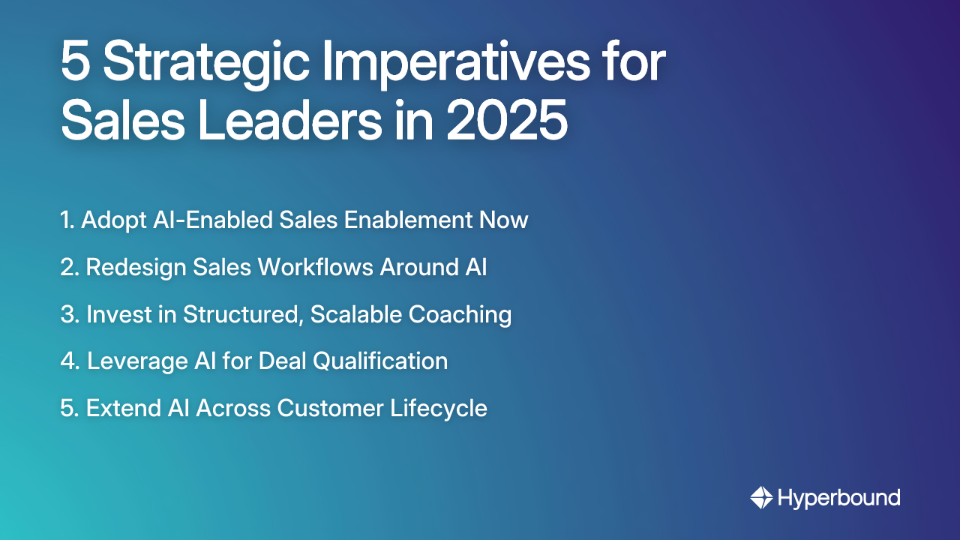
1. Adopt AI-Enabled Sales Enablement Platforms Now, Not Later
The market has shifted from pilot to production. Delaying adoption is a competitive risk that becomes more significant with each quarter. Prioritize platforms that integrate deeply with your existing tech stack (CRM, call recorders, etc.) to minimize friction and maximize data leverage.
"We initially thought we could wait another year before implementing AI coaching," admits a sales director at a growth-stage company. "Six months later, we realized we were falling behind as competitors who adopted earlier were seeing significant improvements in productivity and results."
2. Redesign Sales Workflows Around AI—Don't Just Bolt It On
To capture the full potential of AI, organizations must rethink how work gets done. Use AI to systematically extract the winning behaviors of your top reps and codify them into scalable training, coaching, and playbooks. This is the core path to closing the performance gap between your stars and the rest of the team.
Leading organizations are creating AI Centers of Excellence within their sales operations functions to ensure that AI tools are integrated into core workflows rather than treated as separate systems.
3. Invest in Structured, Scalable Coaching and Onboarding
Move away from ad-hoc coaching dependent on manager availability and skill. Use AI-driven tools to provide consistent, personalized feedback that elevates mid-tier performers and reduces the risk of rep turnover.
"Our coaching was previously limited by manager bandwidth," explains a Head of Sales Enablement. "Now with AI-powered coaching, every rep can receive personalized feedback on every call, and managers can focus their time on the highest-impact coaching moments rather than basic skills development."
4. Leverage AI for Rigorous Deal Qualification and Forecasting
In a tough economic climate, use AI deal intelligence to focus resources on high-probability opportunities, improving pipeline hygiene and protecting margins. Organizations that score and prioritize deals based on AI-driven insights report not only higher win rates but also shorter sales cycles and reduced discounting pressure.
5. Extend AI Enablement Across the Entire Customer Lifecycle
Recognize that in a SaaS model, success is defined by lifetime value, not just the initial sale. Apply the same AI-driven coaching principles to customer success and account management teams to reduce churn and drive expansion.
"We initially deployed AI coaching just for our new business teams," shares a CRO at a leading SaaS company. "When we extended the same capabilities to our customer success teams, we saw a 17% increase in expansion revenue and a 9% decrease in churn within two quarters."
The Future is Now: Seizing the AI Advantage
The enterprise sales landscape in 2025 presents a complex picture: a growing market fraught with performance challenges and rising costs. The data is clear that the traditional approaches to sales leadership—relying on intuition, accepting wide performance gaps, and treating coaching as an occasional activity—are no longer sufficient.
AI-powered sales enablement has emerged not merely as a tool, but as a fundamental business strategy. It is the most effective way to scale excellence, improve efficiency, and build a resilient, high-performing sales organization that can thrive despite market headwinds.
The leaders who win in the coming years will be those who embrace data, empower their entire team with the tools to succeed, and move from intuition-based selling to a systematic, AI-driven revenue engine. The time to build that engine is now.
Frequently Asked Questions
What is AI-powered sales enablement?
AI-powered sales enablement refers to the use of artificial intelligence tools and platforms to make sales teams more efficient and effective. It helps automate administrative tasks, provides data-driven coaching at scale, improves forecast accuracy, and accelerates new hire onboarding. The goal is to use technology to replicate the behaviors of top performers across the entire sales force.
Why is AI critical for sales teams in 2025?
AI is critical for sales teams in 2025 because traditional sales models are struggling to keep up with economic headwinds and changing buyer behavior. With up to 70% of reps missing quota and customer acquisition costs soaring, AI offers a proven way to increase productivity, improve win rates by over 30%, and scale winning behaviors without simply adding more headcount.
How does AI help close the sales performance gap?
AI helps close the performance gap by democratizing the skills of top-performing reps. It analyzes thousands of sales conversations to identify the specific language, questions, and techniques that lead to success. This data is then used to create scalable, personalized coaching and training for the middle 70% of the team, systematically elevating their performance.
What are the first steps to implementing AI in a sales organization?
The best first step is to identify your most critical pain point and start with a focused use case. Instead of a broad, company-wide rollout, target a specific area like improving discovery calls, reducing new hire ramp time, or increasing forecast accuracy. Choose an AI platform that integrates with your existing CRM and call recording systems to ensure seamless data flow and faster adoption.
How do you measure the ROI of AI sales tools?
The ROI of AI sales tools is measured by tracking improvements in key sales metrics. These include lead-to-close conversion rates, quota attainment, sales cycle length, and the time it takes for new hires to become fully productive. For example, organizations using AI coaching see tangible results like 30%+ higher win rates and 50% faster ramp times.
Will AI replace sales managers or reps?
No, AI is designed to augment, not replace, sales managers and reps. It automates repetitive tasks and data analysis, freeing up reps to spend more time selling and managers to focus on high-impact strategic coaching. AI acts as a co-pilot, providing data-driven insights that empower human decision-making and enhance skills.
What are the biggest risks when adopting sales AI?
The biggest risks are poor implementation and a lack of change management. Simply purchasing an AI tool without redesigning workflows to incorporate its insights often leads to low adoption and a poor return on investment. Other key risks include starting with low-quality data, failing to set clear success metrics, and overlooking critical enterprise-grade security and compliance requirements.
About Hyperbound
Hyperbound is the AI sales coaching platform built for the modern sales organization. By analyzing thousands of sales calls, we help you scale your team's winning behaviors. Our platform features AI-driven Roleplays, Real Call Scoring, and personalized Coaching to reduce ramp time by 50%, increase close rates, and ensure playbook consistency. Trusted by leading B2B SaaS companies, Hyperbound provides the enterprise-grade security and deep integrations needed to turn your sales team into an unstoppable revenue engine.
Appendix: Research Methodology and Sources
This report combines analysis from multiple industry sources, market research firms, and our own proprietary data to provide a comprehensive view of the enterprise sales landscape in 2025. Key sources include:
Market Size and Growth:
- Business Research Insights (2025): B2B SaaS market size and forecast
- Global Growth Insights (2025): Report on AI capabilities in new SaaS launches
Performance Benchmarks:
- Sales Performance Research (2025): Research on sales performance, CAC, revenue concentration, and sales cycles
- Ebsta (2024): B2B Sales Benchmarks report (citing Sales Benchmark Index)
- Gartner (2025): Press release on B2B buyer preferences
AI Impact and Adoption:
- McKinsey & Company (2025): Global AI survey on EBIT impact and high-performers
- Bain & Company (2023): Report on AI in sales, productivity, and selling time
- Fullview (2025): AI statistics on organizational use
- Rev-Empire (2025): AI in sales statistics on leadership consensus
- Markets and Markets (2025): Sales enablement market analysis
- Gainsight (2024): Customer success AI impact study
The data points and trends highlighted in this report represent the most current information available at the time of publication. As with any forward-looking analysis, actual results may vary based on specific industry, company size, go-to-market model, and implementation factors.
Book a demo with Hyperbound


