.png)


.png)
Summary
- Using call recordings for coaching is more effective than live shadowing as it provides objective, scalable feedback and can improve employee performance by up to 23%.
- Improve discovery calls by following a structured 7-step framework focused on qualifying prospects, uncovering pain points, and building urgency before pitching a solution.
- Implement a coaching process where reps self-evaluate their calls, managers use scorecards for objective feedback, and personalized training plans are created from a "game tape" library.
- Leverage AI to analyze recordings for winning behaviors and use platforms like Hyperbound to create personalized AI Sales Roleplays for reps to practice and master discovery skills.
You've invested in sales training, spent hours perfecting your pitch, and your team keeps jumping on discovery calls—yet your sales conversion rates remain stubbornly low. Your reps struggle with the discovery phase, often diving into calls without a clear plan, while marketing creates content that seems disconnected from what prospects actually care about.
Sound familiar?
If you're nodding your head right now, it's time to stop guessing and start coaching with precision—using the goldmine of insights already at your fingertips: your call recordings.
Why Call Recordings Beat Live Shadowing for Coaching
Traditional sales coaching relies heavily on call shadowing—where managers join live calls to observe and provide feedback. But this approach has significant limitations that recordings overcome:
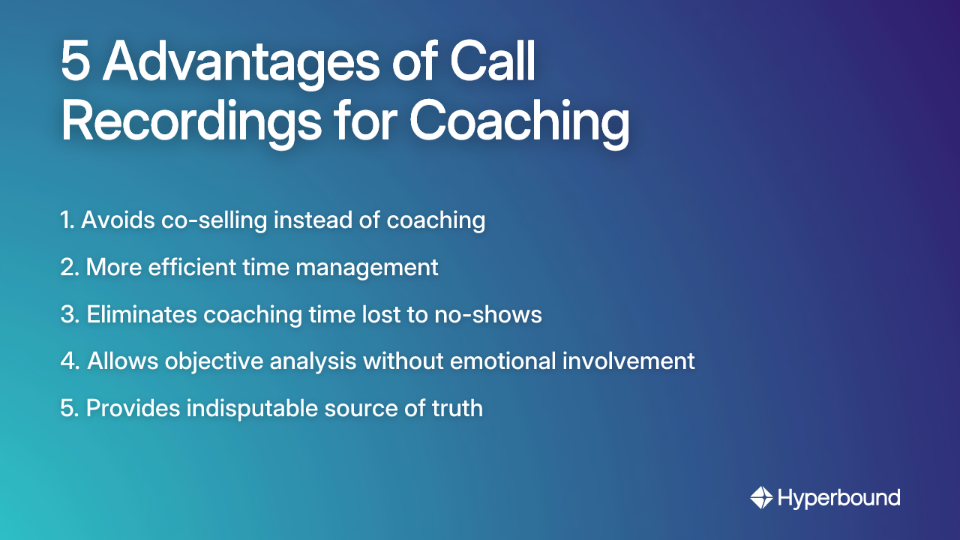
1. Live Shadowing Isn't Coaching; It's Co-Selling
During live shadowing, sales managers often feel pressured to jump in and rescue struggling conversations. What starts as a coaching opportunity quickly becomes a co-selling session. Even "whisper" features can disrupt the rep's flow and confidence.
As one sales leader put it: "I found myself taking over calls instead of letting my rep learn through experience."
2. Time Management: More Calls in Less Time
Shadowing is inefficient, leading to what experts call "Random Acts of Coaching." You might spend an hour observing a call that offers minimal coaching opportunities.
With recordings, managers can "binge watch" multiple calls, skipping to key moments and creating a structured coaching cadence that scales across the team.
3. Combatting Sales Call "No Shows"
We've all been there—you block your calendar for a shadow session, only for the prospect to be a no-show. That's time you'll never get back. Recordings eliminate this problem entirely.
4. "Heat of the Moment" Skews Perceptions
Live emotional involvement clouds judgment. Watching a recording later allows for calm, objective analysis—both for the manager and the rep.
5. Capture of Facts is Crucial
Human memory is fallible. As one sales rep laments: "I found this out the hard way when a call I thought was being recorded was not, and I lost a bunch of important info it's now going to take significant time to recompile."
Recordings provide an indisputable source of truth, preventing disagreements about what was said and fostering productive conversations about improvement.
The Blueprint: Anatomy of a Perfect Discovery Call
Before you can coach effectively, you need to define what "good" looks like. A discovery call isn't a free consulting session—its purpose is to "discover if you and a potential client are a good fit," according to sales coach Luisa Zhou.
Here's a step-by-step guide to a high-converting discovery call:
.png)
Step 1: Do Your Homework
Research their company, role, recent activities, and competitors before the call. This preparation demonstrates professionalism and helps you ask more insightful questions.
Step 2: Set the Agenda
Start by clearly stating the call's purpose. For example: "The purpose of this conversation is to understand your situation and see if and how we can help."
Step 3: Ask Qualifying Questions
Remember that at least 50% of prospects aren't the right fit. Use thoughtful questions to qualify them:
- "How does this challenge affect your business?"
- "What processes do you currently use to tackle this challenge?"
Step 4: Dig into Pain Points
Use open-ended questions to understand their core challenges:
- "What is the biggest challenge you're trying to solve?"
- "How is this issue impacting your team's productivity?"
Step 5: Build Urgency
Help the prospect understand the consequences of inaction:
- "How much is slow onboarding costing your organization?"
- "What happens if this problem isn't addressed in the next quarter?"
Step 6: Pitch Your Product (as a Solution)
Connect your product's benefits directly to their stated pain points. Avoid selling features—focus on solutions to their specific problems.
Step 7: Outline Next Steps
Always end with a clear call to action, whether that's scheduling a demo, sending additional information, or planning a follow-up conversation.
The Coaching Framework: A 4-Step Process for Using Recordings
Now that you understand what makes a great discovery call, here's how to use recordings to systematically improve your team's performance:
Step 1: Build Your "Game Tape" Library
Create a repository of both good and bad calls to serve as a training resource. According to Ameyo, reviewing both successful and unsuccessful calls provides a comprehensive learning experience:
- Use exemplary calls to show underperforming reps what best practices look like in action
- Analyze unsuccessful calls to pinpoint specific mistakes and improvement areas
As one sales leader noted: "Most sales reps struggle with the discovery part of sales calls." Your game tape library provides concrete examples of what works and what doesn't.
Step 2: Stimulate Self-Evaluation
Before providing feedback, have the rep listen to their own call first and come prepared with their assessment. This approach:
- Encourages ownership of performance
- Makes them more receptive to constructive feedback
- Often results in self-identified improvement areas
Ask questions like: "What do you think went well?" and "Where do you see opportunities to improve?"
Step 3: Identify Areas for Improvement with a Scorecard
Use call recordings to systematically assess skills using a consistent scorecard. Include timestamps for specific examples, focusing on:
- Greeting customers and building rapport
- Evaluating customer needs (asking effective discovery questions)
- Listening skills and phone etiquette (e.g., talk-to-listen ratio)
- Handling objections
- Adherence to the sales process
- Product knowledge
This data-driven approach transforms subjective feedback into objective coaching.
Step 4: Develop Customized Individual Training Plans
Move beyond one-size-fits-all coaching. Create personalized plans tailored to each rep's unique strengths and weaknesses. In fact, companies using this approach see employee performance improvements of up to 23%.
For example, if a rep consistently struggles with handling price objections, create a focused training plan that includes:
- Listening to successful calls where price objections were handled effectively
- Practicing with AI-powered roleplays on platforms like Hyperbound that simulate realistic buyer objections in a safe environment
- Incremental goals for improvement in this specific area
Beyond Sales: Bridging the Gap Between Marketing and Sales
One of the most valuable applications of call recordings is addressing what one marketer describes as the "massive disconnect between what marketers think prospects want and what sales teams actually hear on calls."
Here's how to create an effective feedback loop:
- Share the Voice of the Customer: Use AI transcribe tools to create easily digestible summaries of key customer pain points and objections from calls.
- Inform Marketing Campaigns: If prospects consistently raise cost concerns, marketing can create content addressing ROAS (Return on Ad Spend) or develop case studies highlighting cost-effectiveness.
- Refine Messaging: Use the exact language customers use to describe their problems in your marketing materials. This authenticity resonates more powerfully than corporate jargon.
As one PPC specialist noted: "Listening to sales calls has become a must for improving campaigns" and is "one of the most underutilized optimization tactics."
Tools and Tech: From Recording to AI Coaching
While the framework is important, you'll need the right tools to implement it effectively:
Core Technology
While many teams use call recording platforms, the real value comes from an AI coaching layer that sits on top. Platforms like Hyperbound integrate with your existing call recorders (like Gong or Salesloft) and CRM to:
- Analyze call data to identify winning behaviors
- Score calls against your custom sales methodology
- Create personalized AI-powered roleplays to address skill gaps
- Deliver automated, objective coaching feedback
The Promise and Peril of AI Call Coaching
AI-powered tools promise to revolutionize coaching by providing:
- Real-time alerts for talk time imbalances
- Detection of filler words and hesitations
- Contextual cues and suggested responses
However, be aware of limitations. As one user points out: "By the time the tool actually processes the conversation and makes a suggestion, the conversation has moved further." This latency can disrupt the natural flow of conversation.
Recommendation: Instead of relying on disruptive real-time alerts, leverage AI for what it does best today: post-call analysis and scalable practice. Platforms like Hyperbound excel here, using insights from your real calls to create AI-powered roleplays. This allows reps to practice handling objections, pitching new products, and mastering their talk tracks in a safe, repeatable environment before they talk to a live prospect.
Building a Winning Culture (And Avoiding Pitfalls)
Implementing call recording coaching requires careful attention to culture. Some sales engineers report that conversation intelligence tools can be "a culture killer" when improperly implemented, making team members "hesitant to share candid feedback."
How to Foster a Positive Coaching Culture:
- Frame it for Development: Position recording as a tool for growth, not punishment or micromanagement.
- Focus on Wins: Celebrate and share great calls, not just mistakes. Create a "Hall of Fame" for exceptional examples.
- Involve the Team: Make self-evaluation central to the process, giving reps agency in their development.
- Respect Privacy Concerns: Be transparent about how recordings will be used and stored.
Don't forget compliance requirements—the average cost of non-compliance is a staggering $14.8 million.
Your Path to Better Discovery Calls
Call recordings offer an objective, scalable, and fact-based alternative to traditional coaching methods. By defining what a great discovery call looks like and implementing a structured coaching framework, you can unlock your team's potential and drive measurable improvements in performance.
The results speak for themselves:
- Improved employee performance of up to 23%
- A 16% increase in sales conversion rates
- Greater alignment between marketing and sales
- More satisfied prospects who feel genuinely understood
Stop guessing and start using the data at your fingertips. Implement a call recording coaching program today, and watch your team's discovery calls—and your bottom line—transform.

Remember: The most successful sales teams aren't born; they're coached—one call recording at a time.
Frequently Asked Questions
What is call recording coaching?
Call recording coaching is a method where sales managers use recordings of actual sales calls to provide objective, data-driven feedback and training to their sales representatives. Unlike live shadowing, this approach allows for more efficient, scalable, and unbiased analysis of a rep's performance, enabling highly targeted and personalized skill development.
Why use call recordings for sales coaching instead of live shadowing?
Call recordings are more effective than live shadowing because they provide an objective source of truth, prevent managers from interfering and turning coaching into co-selling, and are far more time-efficient. With recordings, you avoid time lost to prospect no-shows and can analyze calls without the "heat of the moment" emotional bias, leading to calmer, more productive feedback sessions.
What makes a discovery call successful?
A successful discovery call is a structured conversation designed to determine if a prospect is a good fit by uncovering their core challenges and building urgency around solving them. It follows a clear framework: setting an agenda, asking qualifying questions, digging into pain points, connecting your product as a solution to those specific pains, and outlining clear next steps.
How do I start a call recording coaching program?
To start a call recording coaching program, begin by creating a "game tape" library of both good and bad calls that can serve as training examples. From there, implement a structured process that includes having reps self-evaluate their calls first, using a consistent scorecard to identify improvement areas, and developing customized training plans for each individual.
How can AI improve the call coaching process?
AI significantly improves call coaching by automating the analysis of call recordings to identify winning behaviors, score performance against a methodology, and create personalized practice scenarios. While real-time AI alerts can be disruptive, AI excels at post-call analysis. It can generate AI-powered roleplays based on real call data, allowing reps to practice handling specific objections or refining their pitch in a safe, repeatable environment.
How can I ensure call recording doesn't create a negative culture?
To avoid a negative culture, you must frame the call recording program as a tool for professional development and growth, not for micromanagement or punishment. Foster a positive environment by focusing on wins, celebrating great calls, and making rep self-evaluation a core part of the process. Being transparent about how recordings are used helps build trust and encourages team members to embrace coaching.
Book a demo with Hyperbound


