.png)


.png)
Summary
- The conversational AI market is set to hit $32.6 billion by 2030, but many rollouts fail due to low sales rep adoption, not technology flaws.
- A successful AI implementation focuses on the human element, augmenting reps by automating routine tasks so they can concentrate on high-value activities like building relationships and closing deals.
- Follow a proven 5-step playbook for success: identify high-impact use cases, choose the right technology, establish a realistic timeline, drive adoption through enablement, and measure ROI.
- The most critical step is ensuring rep readiness. Prepare your team for new AI tools by providing risk-free practice with AI Sales Roleplays to build skills and confidence.
You've seen the headlines and heard the hype about conversational AI revolutionizing sales. Yet if you've attempted implementation, you may have experienced what one sales leader described to me as "enthusiasm followed by disappointment." The way conversational AI is often promoted feels "pretty disconnected from what actually works" in the real sales trenches.
This disconnect isn't surprising. According to research from sales forums, many teams struggle with "low engagement and utilization among sales staff" despite significant investments in AI technology. The fundamental problem? Most conversational AI implementations focus exclusively on the technology while neglecting the human element that makes or breaks adoption.
In this comprehensive guide, we'll walk through a proven, step-by-step playbook for successfully implementing conversational AI in your sales organization—with a special focus on the critical (and often overlooked) enablement layer that ensures your team is ready to excel with these new tools.
What is Conversational AI for Sales (And Why Should You Care)?
At its core, conversational AI uses natural language processing (NLP) and machine learning to enable human-like interactions between your sales team, prospects, and technology. It powers everything from customer-facing chatbots to internal tools that coach reps on their calls.
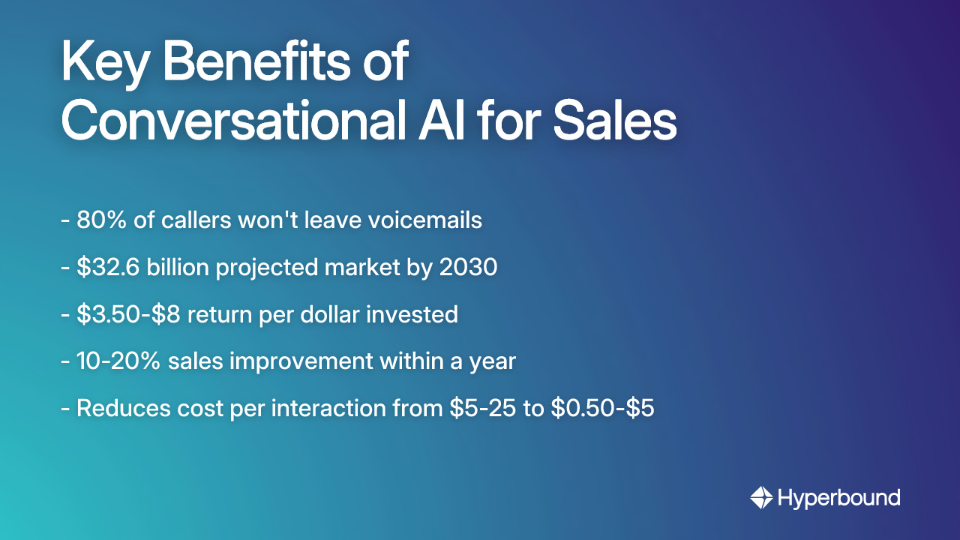
The market for this technology is exploding, projected to reach $32.6 billion by 2030 according to IBM research. But beyond the impressive market growth, what matters is the tangible impact on your sales performance:
- Efficiency gains: Automate routine tasks so your reps can focus on high-value activities
- Revenue growth: Capture leads you'd otherwise miss (80% of callers won't leave voicemails)
- Enhanced personalization: Deliver tailored interactions by integrating with your CRM
- Data-driven insights: Gain valuable information on customer needs to inform strategy
Many sales leaders understand these benefits conceptually, but stumble during implementation. The reason? As one sales operations professional put it, "The real opportunity with AI isn't replacing reps so much as it's improving the rest of the sales process." Successful implementation requires a human-centric approach that augments, rather than replaces, your sales team.
The 5-Step Implementation Playbook
Step 1: Identify High-Impact Use Cases
The goal isn't to automate everything—it's to strategically apply conversational AI where it will deliver the most value. Focus on areas that align with business needs and tangibly improve the rep or customer experience.
Common high-impact use cases include:
Top-of-Funnel:
- Engaging website visitors and qualifying leads
- Booking initial discovery calls
- Answering common product questions
Mid-Funnel:
- Automating follow-ups
- Providing real-time support during the buying journey
- Qualifying opportunities before rep involvement
Post-Sales:
- Assisting with customer onboarding
- Handling routine support queries
- Identifying upsell/renewal opportunities
Key Action: Involve your team in this process. Ask your reps where they spend the most time on repetitive tasks and where they feel prospects drop off. Their front-line insights are invaluable for identifying the right use cases.
Step 2: Choose the Right Technology & Prepare Your Data
Once you've identified your use cases, it's time to select the right conversational AI solution. Key evaluation criteria include:
- Integration: Does it connect seamlessly with your CRM, call recording platforms, and other sales tech?
- Customization: Can you tailor the AI to your specific sales methodology and ideal customer profile? This is crucial to avoid the "robotic" feel that undermines effectiveness.
- Scalability: Can the platform grow with your team and evolving business needs?
A common pain point expressed by sales professionals is that "the AI has to know the answer to all the questions or it's no use." This highlights the importance of data preparation. Ensure you have clean, relevant data to train your AI, including call transcripts, emails, and CRM data. The quality of your data directly impacts the accuracy and effectiveness of your conversational AI.
Step 3: Establish a Realistic Implementation Timeline
Successful conversational AI implementations don't happen overnight. Here's a realistic timeline to guide your planning:
Weeks 1-2: Setup and Customization
- Technical setup and integration with your CRM
- Begin customizing the AI with your sales methodologies and product information
Weeks 3-4: Pilot Program & Rep Training
- Select a small pilot group to test the tool
- Train them thoroughly (this is where many implementations fail)
Month 2: Go-Live and Feedback Loop
- Roll out to the entire team
- Establish a clear channel for reps to provide feedback
Ongoing: Monitor, Refine, and Optimize
- Regularly update the AI with new data and user feedback
- Track performance metrics and make adjustments
Step 4: The Critical Missing Link: Drive Adoption with Rep Readiness
This is where most conversational AI implementations fail. Even the most powerful AI tool is useless if your reps don't trust it or know how to use it effectively. According to research from sales communities, "low engagement and utilization among sales staff" is a major challenge despite significant investments in AI.
The solution? An intentional enablement layer that prepares your reps for success with conversational AI. This is where Hyperbound's AI Sales Coaching platform becomes invaluable:
1. Build Skills in a Safe Environment with AI Sales Roleplays
Before your reps use conversational AI with live prospects, they need unlimited, risk-free practice. Hyperbound's AI Sales Roleplays allow your team to practice everything from cold calls to objection handling with AI personas tailored to your ideal customer profiles.
These roleplays build the muscle memory and confidence needed to work alongside AI tools. As one sales professional noted, "the differentiation is usually in how customizable the scenarios are," and Hyperbound excels at creating hyper-realistic, customized practice environments.
2. Provide Scalable, Data-Driven Feedback with AI Coaching
Managers can't review every interaction, but Hyperbound's AI Coaching and AI Real Call Scoring can. These tools provide instant, personalized feedback on both practice roleplays and real customer calls, scoring interactions against your specific methodology and highlighting exactly where reps excel and where they need improvement.
This makes coaching continuous and scalable, ensuring your entire team masters the new workflows necessary for effective conversational AI implementation.
Step 5: Measure What Matters - Tracking True ROI
Successful measurement of conversational AI goes beyond surface-level metrics to track true business impact across three key areas:
Revenue & Growth:
- Lead-to-Meeting Conversion Rate: Has the AI improved your ability to book qualified meetings?
- Increase in Sales Productivity: Are reps spending more time on revenue-generating activities?
- Overall Revenue Impact: Companies can see a 10-20% improvement in sales within a year of effective deployment according to research on conversational AI ROI.
Cost & Efficiency:
- Cost Per Interaction: Traditional methods can cost $5-25 per interaction, while AI can lower this to $0.50-$5.
- Reduced New Hire Ramp Time: Effective AI-powered training significantly decreases time to productivity.
User & Customer Satisfaction:
- Rep Engagement Rate: Are your reps actively using the tool?
- Customer Satisfaction Scores (CSAT): Is the AI-assisted experience positive for customers?
For calculating overall ROI, use the standard formula: ROI = (Benefits - Costs) / Costs × 100%. Include all costs: subscriptions, setup, and maintenance. Companies implementing conversational AI for sales effectively can see an average return of $3.50-$8 per dollar invested.
Common Pitfalls to Avoid
As you implement conversational AI in your sales organization, watch out for these frequent stumbling blocks:
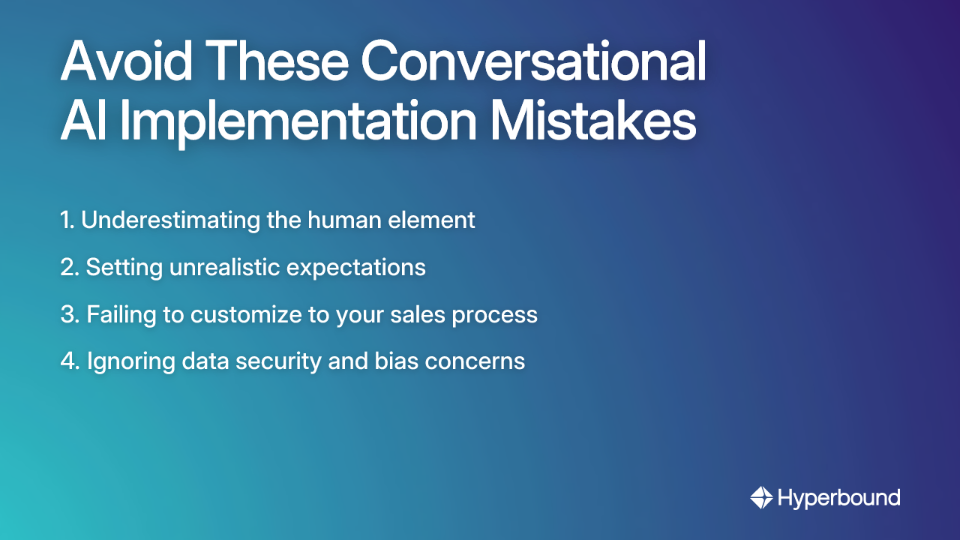
1. Underestimating the Human Element
The most common mistake is rolling out technology without a plan for training and adoption. Your reps' readiness is paramount. Invest in tools like Hyperbound that prepare your team through AI roleplays and coaching before expecting them to embrace new conversational AI tools.
2. Setting Unrealistic Expectations
Don't expect perfection overnight. As one sales leader noted, "AI needs to get less robotic before it truly helps." Recognize that AI requires time to learn and ongoing optimization. Set realistic expectations with leadership and your team about the timeline for realizing full benefits.
3. Failing to Customize
Using an out-of-the-box solution without tailoring it to your specific sales process leads to generic, ineffective interactions. This directly addresses the feedback from sales professionals that "differentiation is usually in how customizable the scenarios are." Ensure your conversational AI solution allows for customization to your unique sales methodology and customer profiles.
4. Ignoring Data Security & Bias
Ensure your platform is secure (e.g., SOC 2 compliant) and regularly monitor AI responses to mitigate potential biases. This protects both your sensitive data and your brand reputation.
From Implementation to Transformation
Successful conversational AI implementation is a strategic initiative that balances technology, process, and people. It's not just about installing software; it's about transforming how your team sells.
The ultimate success of your conversational AI investment hinges on your team's ability to use it effectively. Technology provides the what, but rep readiness provides the how.
Investing in an enablement platform like Hyperbound isn't an extra cost—it's the insurance policy on your entire conversational AI investment. By ensuring your team is prepared, confident, and ready to succeed with new AI tools, you maximize the return on your technology investment and position your sales organization for sustained growth.
Ready to implement conversational AI for sales with confidence? Explore Hyperbound's AI Sales Roleplays and Coaching to build the rep readiness necessary for success in the age of AI-augmented selling.
Frequently Asked Questions
What is conversational AI for sales?
Conversational AI for sales refers to technology that uses natural language processing (NLP) to automate and enhance interactions between sales teams, prospects, and customers. This includes tools like customer-facing chatbots that qualify leads, internal assistants that provide real-time coaching, and platforms that automate routine follow-ups. The goal is to increase efficiency and personalize engagement to augment the sales process.
Why do conversational AI implementations often fail?
The most common reason conversational AI implementations fail is a focus on technology alone while neglecting the human element—specifically, the training and enablement of the sales team. Even the most advanced AI tool is ineffective if reps don't trust it or know how to use it correctly. Low adoption by sales staff is a major pitfall, which is why a dedicated rep readiness strategy is critical for success.
How can I ensure my sales team adopts a new conversational AI tool?
To ensure adoption, you must build a comprehensive enablement plan that prepares your team to work alongside the new AI. This involves providing a safe environment for practice, like AI-powered roleplays, to build confidence and skills. It also requires continuous, scalable coaching to reinforce new workflows and demonstrate the tool's value in helping reps achieve their targets.
What are the most impactful use cases for conversational AI in sales?
The most impactful use cases are typically those that automate high-volume, repetitive tasks, allowing reps to focus on more strategic activities. These often include top-of-funnel activities like engaging website visitors to qualify leads and book meetings, mid-funnel tasks like automating follow-up sequences, and post-sales support like answering routine customer questions.
How long does it take to implement conversational AI for sales?
A realistic timeline for a full implementation, from initial setup to a team-wide rollout, is typically around two months. This can be broken down into phases: Weeks 1-2 for technical setup and customization, Weeks 3-4 for a pilot program and initial rep training, and Month 2 for the full go-live, feedback collection, and initial optimization.
How do I measure the ROI of conversational AI?
You can measure the ROI of conversational AI by tracking its impact on revenue, cost savings, and user satisfaction using the formula: ROI = (Benefits - Costs) / Costs × 100%. Key metrics to track include lead-to-meeting conversion rates, increases in sales productivity, and cost per interaction. Companies often see a return of $3.50 to $8 for every dollar invested.
Can conversational AI replace my sales reps?
No, the goal of modern conversational AI is not to replace sales reps but to augment their capabilities. AI excels at handling repetitive, data-driven tasks, which frees up human reps to focus on what they do best: building relationships, handling complex negotiations, and closing strategic deals. The most successful implementations use AI as a powerful assistant that makes the entire sales team more effective.
Book a demo with Hyperbound


