

.png)
Summary
- Traditional sales training fails because reps forget nearly 90% of new information within a week without consistent reinforcement.
- To make training stick, move from isolated workshops to a continuous learning model focused on daily practice and immediate feedback.
- A successful program starts by using AI to define what "good" looks like from your top reps' calls, then uses that data to build realistic practice scenarios.
- AI Sales Roleplays provide a scalable way for reps to practice risk-free, receive instant feedback, and master winning behaviors.
You've invested thousands in that sales workshop. Your team seemed energized and motivated for a week. Then reality hit—they've reverted to their old habits, and those expensive training materials are collecting dust on a shelf.
Sound familiar?
If you're like most sales leaders, you've experienced the frustration of "one-and-done" training events that create temporary excitement but fail to deliver lasting impact. The statistics are sobering: 80% of managers sacrifice long-term performance for short-term earnings targets (University of Western Ontario), leading to an endless cycle of training that never quite sticks.
The problem isn't your team's motivation or the quality of the training content. It's the delivery method itself.
In this guide, we'll show you how to move beyond episodic training events to create a continuous learning environment powered by AI coaching. This framework ensures your team doesn't just learn selling techniques but actually applies them consistently in the field.
Why "One-and-Done" Sales Training Fails
Traditional sales training follows a predictable pattern: Schedule a workshop, pull reps off the phones, deliver content in a concentrated burst, then send everyone back to their desks expecting transformation.
Here's why this approach consistently disappoints:
.png)
The Forgetting Curve
Research shows that without reinforcement, people forget approximately 70% of new information within 24 hours and nearly 90% within a week. Your expensive sales training literally evaporates from your team's minds.
Skill Drift and Inconsistency
Without regular practice and feedback, reps naturally drift away from the methodology you've established. As one sales professional on Reddit put it, "All those training courses are absolutely useless unless you actually do the selling." (Source)
The Practice Gap
Most training programs focus heavily on theory but provide limited opportunities for safe practice. Many reps feel like another Reddit user who confessed, "I was too scared to answer the phone and only made one sale the first week." (Source) Traditional training doesn't address this confidence gap.
Coaching Bottlenecks
Even with the best intentions, sales managers can't possibly provide personalized coaching to every rep on every call. This creates inconsistent skill development across the team.
The solution isn't to abandon training altogether but to reimagine how it's delivered. Let's explore a framework that transforms episodic training into a continuous learning environment.
The 5-Step Framework for Building a Continuous AI Coaching Program
Step 1: Use AI to Analyze Winning Behaviors & Establish a Baseline
Before you can improve performance, you need to understand what "good" looks like in your specific selling context and how your current team measures up.
Action steps:
- Gather your call data: Collect recordings of both successful and unsuccessful sales conversations from your team.
- Implement AI call analysis: Use artificial intelligence to analyze these conversations at scale, identifying patterns that distinguish your top performers.
- Document winning behaviors: Create a clear profile of what success looks like across key moments in your sales process.
- Assess current performance: Establish baseline metrics for each rep against these winning behaviors.
Platforms like Hyperbound can analyze thousands of your actual sales calls to uncover the specific techniques and talk tracks that make your top representatives successful. This data becomes the foundation for your continuous training program.
Step 2: Implement AI-Scored Roleplays for Risk-Free Practice
The core challenge in sales training is providing enough safe practice opportunities. As one sales professional noted, "If you just prospect, pick up a phone, do discos and meetings, with no real training, you will fail unless you're insanely lucky." (Source)
AI-powered roleplays solve this problem by creating a risk-free environment where reps can practice extensively without jeopardizing actual customer relationships.
Action steps:
- Deploy AI roleplay technology: Hyperbound's AI Sales Roleplays allow reps to simulate realistic conversations across the entire sales cycle, from cold calls to demos to objection handling.
- Customize scenarios: Tailor these roleplays to reflect your specific:
- Customer personas and ICPs
- Product messaging
- Common objections
- Competitive landscape
- Sales methodology (SPIN selling, MEDDICC, Challenger, etc.)
- Schedule dedicated practice time: Allocate protected time in reps' calendars for regular practice sessions.
- Create progressive difficulty levels: Start with basic scenarios and gradually increase complexity as skills develop.
Unlike traditional roleplays that depend on manager availability or peer participation, AI roleplays provide unlimited, on-demand practice that's scored consistently against your established framework.
Step 3: Create Custom Scorecards Aligned with Your Sales Methodology
For training to be effective, you need objective measurement that clearly shows whether reps are applying your sales methodology correctly.
Action steps:
- Define key behaviors: Identify the specific actions, questions, and talking points that align with your sales playbook.
- Build methodology-aligned scorecards: Create evaluation criteria that reflect your unique sales approach, not generic best practices.
- Apply consistent scoring: Use AI to score both practice sessions and real customer conversations against these consistent criteria.
- Track trend data: Monitor improvement over time on specific skills and behaviors.
Custom scorecards might track elements like:
- Talk-to-listen ratios
- Discovery question quality and quantity
- Value proposition articulation
- Feature-to-benefit transitions
- Objection handling techniques
- Next steps clarity and commitment
With platforms like Hyperbound, these scorecards automatically evaluate both roleplays and real calls, highlighting specific strengths and areas for improvement against your established methodology.
Step 4: Deliver Instant, Personalized Feedback to Drive Self-Correction
The power of continuous training comes from immediate feedback that allows reps to self-correct before bad habits form.
Action steps:
- Implement real-time feedback tools: Use AI coaching technology that can provide instant guidance after (or even during) sales conversations.
- Focus on actionable insights: Ensure feedback identifies specific moments where improvement is needed, not just general assessments.
- Provide model examples: Give reps access to "gold standard" examples of how to handle specific situations.
- Enable self-directed learning: Create a system where reps can independently identify and work on their weak spots.
Hyperbound's AI Coaching delivers methodology-aligned feedback immediately after each interaction, identifying missed opportunities, weak responses, and off-track messaging. This empowers reps to take ownership of their development without waiting for manager intervention.
Step 5: Design Progressive Skill Paths and Foster Collaborative Learning
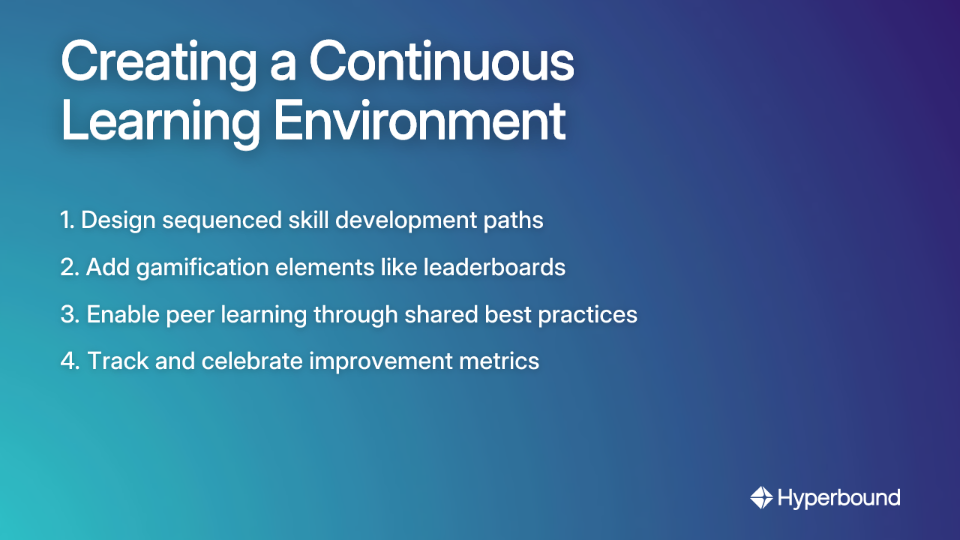
The final piece of continuous training is creating structured development journeys that build skills progressively while leveraging the collective wisdom of your team.
Action steps:
- Create skill development paths: Design sequenced learning journeys that build competencies in a logical order.
- Implement gamification: Add competitive elements like leaderboards and achievement badges to increase engagement.
- Enable peer learning: Use AI tools to identify and share exemplary call recordings across the team.
- Track improvement metrics: Measure and celebrate progress to reinforce the value of ongoing practice.
With Hyperbound's gamified leaderboards, reps are motivated through healthy competition to accelerate skill development. The platform also surfaces top-performing calls and successful techniques for collaborative learning, ensuring best practices spread organically throughout your organization.
The Transformative Benefits of Continuous AI Coaching
Implementing this framework delivers substantial, measurable advantages for both individual reps and your organization as a whole:
For Sales Representatives
- Confidence through competence: Reps develop genuine confidence based on proven skills rather than false bravado.
- Accelerated proficiency: New techniques are mastered in days or weeks instead of months.
- Personalized development: Each rep receives coaching tailored to their specific strengths and weaknesses.
- Reduced performance anxiety: The fear of "going live" with new techniques is minimized through extensive practice.
- Greater autonomy: Self-directed learning reduces dependence on manager availability.
For Sales Organizations
- Reduced ramp time: New hires become productive and quota-achieving significantly faster.
- Consistent execution: Every rep delivers your message effectively and adheres to best practices.
- Improved key metrics: Close rates, meeting conversions, and overall productivity increase.
- More efficient coaching: Managers focus their limited time on strategic guidance rather than basic skill correction.
- Enhanced sales readiness: Teams are prepared for any scenario, from tough objections to complex negotiations.
- Data-driven strategy: Performance insights inform continuous refinement of sales approaches.
Conclusion: The Future of Sales Training Is Continuous
The shift from episodic training to continuous learning represents a fundamental change in how we develop sales talent. Rather than treating training as an event, forward-thinking organizations are building environments where practice, feedback, and improvement are woven into the daily work routine.
AI coaching technology makes this approach scalable and sustainable by providing the consistent practice and feedback that human coaches alone simply cannot deliver at scale. As Arnav Sahu, Partner at Peak XV Partners, noted: "Sales reps love using the platform to close faster and improve productivity—the product is a 10x leap over the status quo." (Source)
The most successful sales organizations are no longer asking whether they need continuous training—they're racing to implement it before their competitors do. The question isn't if your training should be continuous, but how quickly you can make the shift.
Ready to build a continuous training program for your sales team?
Explore a demo of Hyperbound's AI Coaching platform to see how AI-powered practice and feedback can transform your sales training approach.
Frequently Asked Questions
What is continuous AI coaching for sales teams?
Continuous AI coaching is a modern approach to sales training that uses artificial intelligence to provide ongoing, personalized practice, feedback, and skill development for sales representatives within their daily workflow. Unlike traditional "one-and-done" workshops, this model focuses on reinforcing learning through consistent, AI-scored roleplays and analysis of real customer calls. This ensures that training concepts are not forgotten but are actively applied and refined over time.
Why does traditional "one-and-done" sales training fail?
Traditional sales training often fails because it doesn't account for the "Forgetting Curve," where reps lose up to 90% of what they've learned within a week without reinforcement. This approach also suffers from a lack of safe practice opportunities, inconsistent coaching from busy managers, and the tendency for reps to revert to old habits (skill drift) once the initial training excitement wears off.
How does AI coaching improve sales performance?
AI coaching improves sales performance by providing scalable, consistent, and personalized feedback that helps reps master winning behaviors and apply them consistently. It accelerates proficiency by allowing for unlimited, risk-free practice in realistic scenarios. This leads to increased confidence, reduced ramp time for new hires, higher conversion rates, and more consistent execution of your sales methodology across the entire team.
What is the first step to implementing an AI coaching program?
The first step is to establish a performance baseline by using AI to analyze recordings of your team's actual sales calls. Before you can improve, you must understand what "good" looks like for your specific products and customers. By analyzing successful and unsuccessful conversations, you can identify the key winning behaviors of your top performers, which becomes the foundation for your coaching program.
Can AI coaching replace human sales managers?
No, AI coaching is designed to augment, not replace, human sales managers. AI excels at providing consistent, data-driven feedback on foundational skills at scale—a task that is impossible for managers to do for every rep on every call. This frees up managers from repetitive skill correction and allows them to focus on higher-value activities like strategic deal coaching, motivation, and career development.
How is AI-powered roleplay different from traditional roleplay?
AI-powered roleplay offers on-demand, scalable, and consistently scored practice, whereas traditional roleplay is dependent on the limited availability of managers or peers. With AI, a sales rep can practice handling any objection or sales scenario at any time, receiving instant, objective feedback aligned with the company's sales methodology. AI provides a safe, private, and endlessly repeatable practice environment.
How do you measure the ROI of a continuous AI coaching program?
The ROI of a continuous AI coaching program is measured by tracking improvements in key sales metrics like new hire ramp time, quota attainment, meeting conversion rates, and overall revenue. By establishing baseline metrics before implementation, you can directly correlate the adoption of the coaching program with positive trends in these KPIs, demonstrating a clear return on investment.
Book a demo with Hyperbound


