

.png)
Summary
- Cold calling remains highly effective, with conversion rates recently increasing by 140%. Success in modern B2B sales relies on a well-researched, conversational approach, not just high call volume.
- The first five seconds determine call success; immediately state your name and the reason for your call to increase your success rate by 2.1X. Avoid asking "Did I catch you at a bad time?" which cuts effectiveness by 40%.
- The primary goal is to sell the next meeting, not the product. Treat the conversation like a dialogue—successful calls have 77% more speaker switches than unsuccessful ones.
- Master objection handling by scripting and practicing responses to common brush-offs. You can accelerate this skill development with unlimited, risk-free practice using AI Sales Roleplays.
You've been staring at your phone for the last five minutes, your finger hovering over the dial button. Your heart races as you imagine another rejection, another hang-up, or worse—the dreaded "send me some information" brush-off. The thought of sounding like a robotic salesperson makes you cringe, and you can feel your confidence shrinking with each passing second.
Sound familiar? You're not alone.
The good news? Cold calling isn't dead—it's evolving. In fact, conversion rates for cold calling increased from 2% to 4.82% in just one year—a staggering 140% increase, according to Cognism. And the RAIN Group's latest report identifies live phone conversations as one of the top five most effective prospecting tactics.
This step-by-step training guide will transform your cold calling skills from anxiety-inducing to confidence-building, helping you master the art and science of modern B2B cold calling.
Part 1: The Mindset Reset: Conquering Call Reluctance
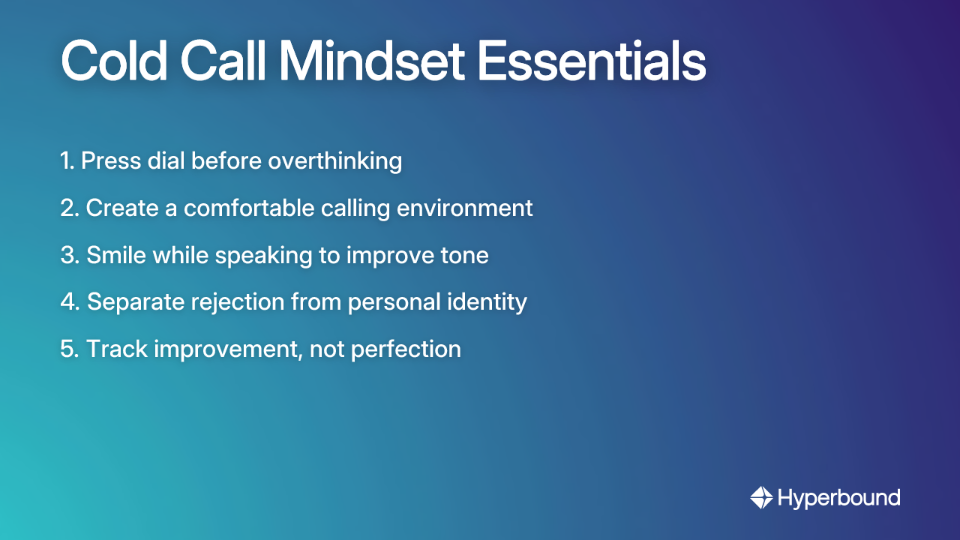
Just Press Dial: Overcoming Overthinking
The best advice often comes in the simplest package: "When you start thinking about it, JUST PRESS DIAL. You will think yourself out of it if you let it linger," shares one sales professional on Reddit.
Overthinking leads to procrastination. Set a timer for your calling blocks and commit to hitting dial as soon as the name appears on your screen. No analyzing, no rehearsing—just dial.
Create Your "Comfort Studio Environment"
Your physical space dramatically impacts your mental state. One creative sales rep recommends: "I have some calming lights, soft humming white noise, some music playing on my earphones and essential oils vaporizer! That's my personal tip for ya!"
This isn't just feel-good advice—it's practical psychology. A comfortable environment reduces stress and improves your vocal tone and confidence.
"Smile and Dial": The Power of Positivity
It sounds cliché, but forcing yourself to smile physically changes your voice. Try this experiment: Record yourself saying the same phrase with and without smiling. The difference is remarkable—and your prospects can hear it.
Depersonalize Rejection
"They're not rejecting you, they're just rejecting what you're proposing." This mental shift is crucial for emotional resilience.
Effective cold call training emphasizes that learning to handle rejection turns challenges into opportunities. Each "no" provides valuable data—not a personal indictment.
Part 2: The Pre-Call Playbook: Your Foundation for Success
Do Your Research
Cold calling should never be completely "cold." Before dialing, research your prospect and their company through LinkedIn, their website, and recent news. Understanding their role, challenges, and industry transforms a cold call into a warm conversation.
Industry data reinforces that research-backed calls dramatically outperform generic pitches.
Develop a Flexible Script (Not a Cage)
Your script should be a compass, not handcuffs. It should include:
- A natural opener
- Your reason for calling
- 2-3 key value propositions
- Common objection responses
- A clear call-to-action
Remember: "Do not sound scripted. Sound like a normal human."
Define Your Goal: Sell the Meeting, Not the Product
A common mistake is trying to close the entire sale on the first call. Instead, focus on securing the next meeting.
As one sales veteran wisely advises, you need to be "selling the outcome not the steps. Sell the vacation not the plane ride."
Data from millions of calls confirms successful cold calls focus on scheduling the next conversation, not closing the deal.
Part 3: The Anatomy of a High-Converting Cold Call
.png)
The Opener (The First 5 Seconds)
The beginning of your call sets the tone for everything that follows. According to an analysis of millions of cold calls:
- DO: State your full name and company confidently. "Hi John, this is Jane Smith calling from Acme Corp."
- DON'T: Ask "Did I catch you at a bad time?" This reduces success rates by 40% and leads to a dismal 0.9% meeting success rate.
- DO: Try "How've you been?" This pattern interrupt has a 10.01% success rate—that's 6.6X higher than "Did I catch you at a bad time?" Even a simple "How are you?" correlates with 3.4X higher likelihood of booking a meeting.
- CRUCIAL: Immediately state the reason for your call. This increases your success rate by 2.1X.
The Pitch & Conversation Flow
Successful cold calls are dialogues, not monologues. Call data shows that conversations which convert to meetings have 77% more speaker switches than unsuccessful ones.
One Reddit user recommends: "Talk to them like they're your favorite cousin that just showed up on Thanksgiving." This casual, friendly approach builds rapport faster than any sales technique.
Interestingly, successful calls have shorter prospect monologues (3.5 seconds on average) compared to unsuccessful ones (8 seconds). This means you're keeping them engaged with quick, interactive questions rather than letting them ramble through objections.
The Close: Securing the Next Step
The goal is booking the next meeting, not selling your product right away. Analysis shows that asking "Do you have your calendar handy?" is highly effective for transitioning to scheduling.
Spend more time discussing next steps to solidify the commitment. A vague "I'll follow up" is far less effective than a specific "How does Tuesday at 2 PM sound for a deeper discussion?"
Part 4: Mastering Objection Handling: Your Guide to Turning "No" into Opportunity
Preparation is Key
One of the most valuable pieces of advice from experienced sales professionals: "Write down the top five brush offs and objections you get, plan out how you'd like to respond going forward, and practice it over and over again."
This systematic approach transforms objection handling from reactive panic to confident conversation.
A Framework for Any Objection
Research into objection handling suggests this three-step framework:
- Agree with the Objection: Validate their concern to lower defenses.
- Incentivize Conversation: Encourage them to share more.
- Sell the Test Drive: Focus on exploration, not purchase.
Handling Common Objections (with Scripts)
For "Send me some information":
Try this response: "I'd be happy to. So I can send the most relevant information, could you tell me what you're most interested in? ... Great, I'll send that over. Would you be open to a 15-minute call next Tuesday to review it together?"
For "We don't have the budget":
Removing pressure: "I understand, and many of our best clients said the exact same thing initially. We're not asking for a commitment now, but many find that a quick 20-minute look at how we're saving [Similar Company] money is a valuable use of time for future planning."
For "We're already using a competitor":
Agree, then ask thoughtful questions: "That's great, they're a solid company. We actually share a lot of customers with them. Typically, companies work with us when they're looking to achieve [Unique Benefit 1] or [Unique Benefit 2]. Are either of those a priority for you right now?"
Part 5: The Continuous Training Loop: From Good to Great
Embrace Roleplaying with AI
"I found doing a bunch of roleplaying helped a ton," shares a sales rep who transformed from anxious novice to confident caller. Roleplaying builds muscle memory for conversation flows and objection handling.
While practicing with colleagues is valuable, it's often difficult to scale. This is where AI-powered tools excel. Platforms like Hyperbound allow reps to practice with hyper-realistic AI buyer personas 24/7. These AI roleplays provide a safe, repeatable environment to master messaging and handle any objection without risking live deals.

Analyze Call Recordings
One of the most powerful training tools is listening to your own calls. Review recordings to identify:
- Talk-to-listen ratio (aim for 40:60)
- Filler words and hesitations
- Tone and energy level
- Objection handling effectiveness
Advanced platforms like Hyperbound's AI Real Call Scoring can analyze and score your team's calls against your custom methodology automatically. This provides objective, scalable feedback to identify coaching opportunities and track skill progression.
Implement a Training Blueprint
Consider this proven training framework:
- Peer Coaching: Have top performers mentor newer reps
- Shadowing: Listen to successful calls in real-time
- Active Listening Training: Focus on asking open-ended questions
- Regular Feedback: Schedule structured review sessions
Part 6: Optimizing Your Outreach: Data-Driven Timing and Persistence
Best Time to Call
Not all calling hours are created equal. Data from millions of calls shows:
- Best Days: Wednesdays and Thursdays
- Best Times: Between 4:00-5:00 PM or 11:00 AM-12:00 PM in the prospect's time zone
These windows typically catch prospects when they're most receptive to conversations.
The Power of Persistence
The data is clear: don't give up after one or two tries. Sales data suggests making at least 6 call attempts for optimal results. A good motto is: "Always Make One More Cold Call."
A follow-up email after a cold call can nearly double response rates, according to industry research.
Navigating the Gatekeeper (GK)
A common B2B challenge is getting past the receptionist to reach the decision maker (DM). The key? Treat the gatekeeper with respect, almost like a client.
One successful approach from Reddit: "You call in, GK picks up, say '(first name of DM) please'." A firm, friendly tone suggests you're expected rather than an unwelcome solicitor.
Conclusion: Dialing for Dollars: Make Cold Calling Your Superpower
Cold calling isn't dead—it's a craft that rewards skill, preparation, and resilience. By implementing these strategies, you can transform it from a dreaded task into one of your most effective tools for building connections and driving sales:
- Mindset: Overcome fear through preparation and positivity
- Preparation: Research prospects and develop flexible scripts
- Execution: Follow a proven call structure that drives conversation
- Objection Handling: Turn pushback into productive dialogue
- Training: Commit to continuous improvement through practice
Remember the simple but profound advice that started our journey: "When you start thinking about it, JUST PRESS DIAL." Your next great client is waiting on the other end of that call.
Now pick up the phone. It makes you money.
Frequently Asked Questions
Is cold calling still effective in B2B sales?
Yes, cold calling is still highly effective and is evolving. Recent data shows a significant increase in conversion rates, and live phone conversations are ranked among the top five most effective prospecting tactics by sales leaders. The key to modern success is a well-researched, conversational approach rather than a generic, robotic pitch.
How can I overcome the fear of cold calling?
You can overcome the fear of cold calling by adopting a "just press dial" mindset to avoid overthinking. Creating a comfortable physical environment, smiling while you speak to improve your tone, and mentally separating rejection of your proposal from personal rejection are crucial steps. This transforms anxiety into a manageable challenge focused on improvement.
What is the primary goal of a successful cold call?
The primary goal of a successful cold call is to sell the next meeting, not the product itself. Trying to close a deal on the initial call is a common mistake. Instead, your focus should be on building enough rapport and interest to secure a follow-up discovery call or demo where a more in-depth conversation can take place.
Should I use a script when cold calling?
Yes, you should use a flexible script as a guide, not a rigid cage. A good script provides a compass for your call, outlining your opener, key value propositions, common objection responses, and a clear call-to-action. However, it's essential to sound like a normal human and adapt to the flow of the conversation, rather than reading verbatim.
What is the best way to open a cold call?
The best way to open a cold call is to confidently state your full name and company, followed immediately by the reason for your call. Avoid questions like "Did I catch you at a bad time?" which drastically reduce success rates. Instead, using a pattern-interrupt like "How've you been?" has been shown to be significantly more effective at booking meetings.
How can I handle the "send me some information" brush-off?
You can handle this common objection by agreeing to send information, but using it as an opportunity to qualify the prospect further. A great response is: "I'd be happy to. So I can send the most relevant information, could you tell me what you're most interested in?" This opens the door for a real conversation and allows you to pivot back to scheduling a follow-up call.
How can I practice and improve my cold calling skills?
You can practice and improve your skills through consistent roleplaying and call analysis. Roleplaying with colleagues or AI-powered platforms helps build muscle memory for handling objections and managing conversation flow. Additionally, analyzing your own call recordings helps you identify areas for improvement, such as your talk-to-listen ratio, tone, and use of filler words.

Book a demo with Hyperbound


