.png)


.png)
Summary
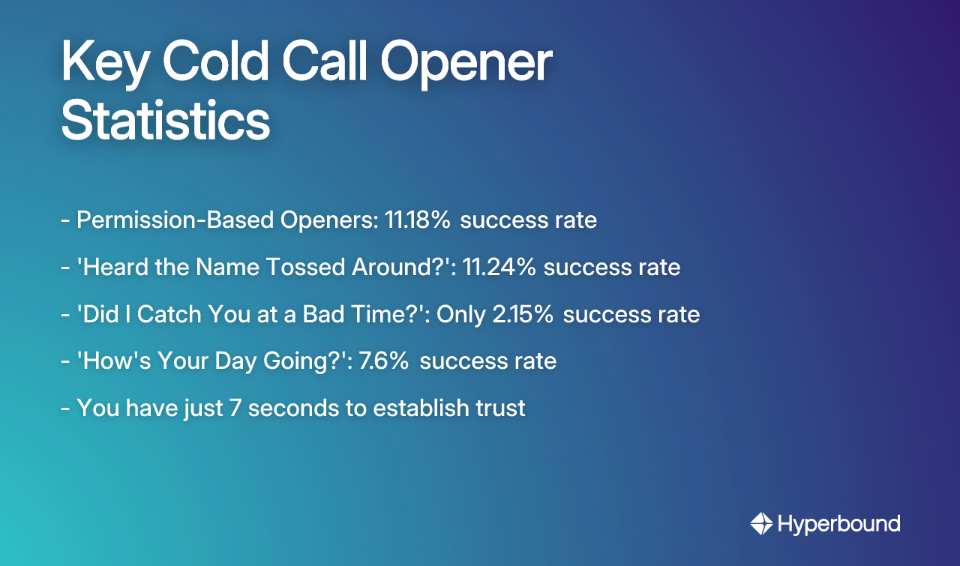
- You have just seven seconds to establish trust on a cold call. Permission-Based Openers (PBOs) that respectfully ask for a moment of time are most effective, with a success rate of over 11%.
- Avoid common but ineffective questions like "Did I catch you at a bad time?" (2.15% success rate) or "How's your day going?" which invite immediate rejection.
- The best openers are authentic and human. By acknowledging the interruption and breaking the pattern of a typical sales call, you can disarm the prospect and earn the right to continue.
- Mastering these openers requires practice. You can use AI Sales Roleplays to rehearse these scripts in a risk-free environment until they sound natural and confident.
You've dialed the number and your heart rate quickens as the phone rings. The prospect picks up, and suddenly you're scrambling to remember your opening line. Within seconds, you can feel them becoming defensive, preparing to hang up. Sound familiar?
The truth is, you have just seven seconds to disarm your prospect and establish enough trust to keep the conversation going. Fail in this critical window, and you've lost your chance to engage, according to Chris Beall, CEO of ConnectAndSell.
In this guide, we'll explore how to transform those nerve-wracking first moments into opportunities for genuine conversation, backed by insights from millions of analyzed sales calls and real experiences from sales professionals.
The Great Opener Debate: Permission vs. Assumption
Before diving into specific scripts, let's understand the two main schools of thought for cold call openers:
Assumptive Openers
Definition: A casual, confident opening that assumes the prospect has a moment to talk.
Example: "Hey, this is Connor from MaxCompany—how are you?"
Philosophy: This approach helps build momentum and sounds more natural, less like a scripted sales call. Proponents believe it creates a casual atmosphere that puts prospects at ease.
Permission-Based Openers (PBOs)
Definition: An opener that acknowledges the interruption and explicitly asks for permission to proceed.
Example: "Hi [Name], I know I'm catching you out of the blue—can I take 21 seconds to tell you why I called?"
Philosophy: This approach reduces defensiveness, fosters collaboration, and disarms the prospect with honesty.
What Does the Data Say?
According to a Gong.io study of 300 million sales calls, Permission-Based Openers have a success rate of 11.18%, making them one of the most effective approaches. The data suggests that owning the interruption and asking for permission is statistically superior to assuming attention.
The Best Cold Call Openers (Backed by Data)
Let's examine the top-performing cold call openers based on Gong.io's extensive analysis:
1. The "Heard the Name Tossed Around?" Opener
Success Rate: 11.24%
This opener creates familiarity by implying you work with the prospect's peers, helping to quickly establish common ground.
Script and Steps:
- Lead with context: "Hi Bob, this is Shaq from NBA. We work with a few other VPs of Sales in the SaaS space..."
- Introduce yourself after establishing common ground.
- Ask the question: "...I was curious, have you heard our name tossed around?"
How to Respond:
- If yes: "Oh good, what did you hear?"
- If no: "No worries. The reason I'm reaching out is we help VPs of Sales at companies like X and Y to..."
2. The Permission-Based Opener (PBO)
Success Rate: 11.18%
This opener disarms the prospect with honesty and respect for their time, addressing the immediate defensiveness many prospects feel.
Script and Steps:
- Lead with context: "Hi Bob, my name is Shaq, calling from NBA."
- Own the cold call: "Look, I'll be honest, this is a cold call."
- Get permission to pitch: "Would it be okay if I take 30 seconds to tell you why I'm calling? If after that you're not interested, you can hang up. Sound fair?"
7 Peculiar But Powerful Scripts that Disarm Prospects
Sometimes, breaking from convention creates the most memorable connections. These unconventional openers leverage honesty, empathy, and even humor to disarm prospects:
1. The Empathy Opener
"Look, I know nobody likes a cold call, especially on a Monday afternoon. Can I share with you why I'm calling?"
2. The Dice Roller
"This is a cold call. Want to roll the dice?"
3. The Time-Respecter
"It's fair if I give you a 27-second spiel. If it sounds interesting, we can talk more; if not, you can tell me to go kick rocks. Does that work?"
4. The Self-Aware Caller
"I'm hyper-aware I'm literally cold-calling you out of the blue. Can I give you my reason for the call?"
5. The Human Touch
"So I know nobody likes a cold call. Honestly, me included. Is it cool if I tell you why I'm calling?"
6. The Confidence Play
"Is it cool if I give my absolute best 27-second pitch? If you hate it, you can hang up on me right after. Does that work?"
7. The Brief Introducer
"Hey, it's [your name]. We haven't spoken before, but do you have a second to hear why I called? I promise to be brief."
What makes these openers effective is their authenticity. They acknowledge the reality of the situation—you're interrupting someone's day—while creating a path to continue the conversation. By being transparent and human, you differentiate yourself from the robotic cold callers prospects are used to hanging up on.
Fatal Flaws: Openers and Mistakes to Avoid at All Costs
Just as important as knowing what works is understanding what doesn't. Let's examine the most common cold call blunders that kill conversations before they begin:
The #1 Mistake: "Is this Bob?"
This question is mentioned as a key pitfall in almost every research source. Why? It immediately puts the prospect on the defensive and signals an unsolicited sales call. Instead, confidently state their name and your purpose.
As one sales professional on Reddit put it: "If it's not Bob, they'll tell you." There's no need to create uncertainty from the start.
The Worst Performing Openers (from Gong's data):
"Did I Catch You at a Bad Time?"
Success Rate: An abysmal 2.15%.
While this seems polite, it actually lowers your status and makes it incredibly easy for the prospect to say "yes" and hang up. You're essentially offering them an easy out before you've delivered any value.
"How's Your Day Going?"
Success Rate: 7.6%.
Prospects can sense the insincerity from a mile away and often respond defensively with, "What's this regarding?" This pleasantry feels like a time-wasting prelude to a sales pitch.
Other Critical Mistakes:
- Skipping Research: Don't call blind. Understanding your prospect's business, company size, and potential pain points before calling can dramatically improve your success rate. Use tools like LinkedIn Sales Navigator to find the right person.
- Sounding Robotic: Avoid sounding over-rehearsed. Letting your personality show through creates a human connection. Confidence in your voice is key—aim for clear diction and a steady pace. The best way to achieve this is through practice. Using AI sales roleplay tools allows you to rehearse your openers until they feel natural and conversational, not scripted.
- Trying to Sell on the First Call: As one Redditor bluntly put it, "You interrupted their day. Don't try to sell them anything but the appointment on the cold call." The goal is to secure the next conversation, not close a deal.
Beyond the Opener: A Framework for the First 45 Seconds
Once you've successfully opened the call, you need structure. Here's a proven framework for the crucial first 45 seconds:
The 3-Part Value Statement Framework:
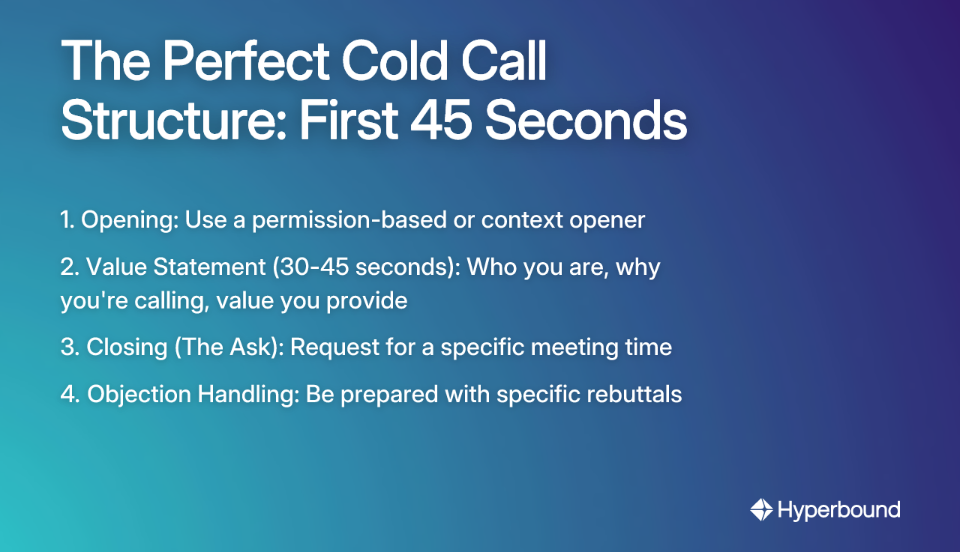
- Opening: Your proven, natural opener from the options above.
- Value Statement (30–45 seconds): Clearly and concisely state who you are, why you're calling, and the value you provide.
- Example: "I'm part of the team that supports life science companies on back office financial applications. We help reduce reliance on spreadsheets and automate month-end reporting."
- Closing (The Ask): Politely ask for a meeting.
- Example: "Based on your role as [Title], I thought this might be a priority for you. How's your calendar next week on Wednesday or Thursday for a brief chat?"
Handling Objections Within the Framework:
If a prospect says, "We already work with a competitor," don't fold.
Example Rebuttal: "That's exactly why I'm reaching out; many of our best customers used to work with [Competitor]. We often support them to align on priorities where [Competitor] falls short. Would Wednesday or Thursday work to see if it's a fit?"
From Cold Call to Real Conversation
The most effective cold calls don't feel like sales calls—they feel like the beginning of meaningful conversations. By leading with permission and context, avoiding common pitfalls, being authentically human, and following a clear framework, you transform cold calling from a dreaded task into a valuable skill.
Remember, your goal isn't to sell your product in those first seven seconds. It's to sell the idea that you're worth talking to. Master that, and the rest of the conversation becomes infinitely easier.
The next time your prospect picks up the phone, they won't be met with another robotic salesperson—they'll connect with someone who respects their time, understands their challenges, and might actually have something valuable to offer.
Mastering these techniques requires practice. Platforms like Hyperbound allow your sales team to rehearse these scripts in realistic AI-powered roleplays, ensuring every rep can turn a daunting cold call into a valuable conversation.
That's a call worth taking.
Frequently Asked Questions
What is the most effective type of cold call opener?
Based on data from millions of sales calls, permission-based openers (PBOs) are the most effective. These openers, which ask for a moment of the prospect's time (e.g., "Can I take 21 seconds to tell you why I called?"), have a success rate of over 11%. They work because they acknowledge the interruption, reduce defensiveness, and establish trust by respecting the prospect's time.
Why should I avoid asking "Did I catch you at a bad time?"
You should avoid this question because it has an extremely low success rate (around 2.15%) and makes it too easy for the prospect to end the call. By asking if it's a "bad time," you are essentially offering an immediate exit. A more confident, permission-based approach that owns the interruption is far more effective at keeping the conversation going.
How do I structure the first 45 seconds of a cold call?
A proven structure for the first 45 seconds follows a simple three-part framework. First, use a strong, permission-based opener. Second, deliver a concise Value Statement (30-45 seconds) that explains who you are, why you're calling, and the value you provide. Finally, close with a clear "Ask," such as requesting a specific meeting time.
What is the biggest mistake sales reps make when starting a cold call?
One of the most common and damaging mistakes is starting the call with "Is this [Name]?" This immediately signals an unsolicited sales call and puts the prospect on the defensive. Instead, confidently state their name and your purpose. This assumes you've reached the right person, and if you haven't, they will correct you.
How can I make my cold call opener sound more natural and less robotic?
To sound more natural, you must practice your opener until it becomes second nature. Use AI sales roleplay tools like Hyperbound to rehearse without risking live deals. Focus on your tone, pace, and inflection rather than just reciting words from a script. Authenticity is key; let your personality show through to create a genuine human connection.
What is the main goal of a cold call opener?
The primary goal of a cold call opener is not to sell your product but to sell the next 30 seconds of the conversation. In the first seven seconds, your objective is to disarm the prospect, establish a baseline of trust, and earn permission to briefly state your value proposition. The ultimate goal of the entire call is to book a meeting, not to close a deal.
Book a demo with Hyperbound


