

.png)
Summary
- With 80% of cold calls going to voicemail, a well-crafted message is essential and can increase callback rates by up to 22%.
- Technology like Apple's Live Voicemail transcribes messages in real-time, making your first few words critical to avoid being instantly dismissed.
- Effective voicemails are brief (18-30 seconds), focus on a value proposition instead of a pitch, and guide prospects to another channel like email.
- To perfect a natural, confident delivery, reps can use AI Sales Roleplays to practice scripts and receive instant feedback on their tone and pacing.
You've left dozens of voicemails this week, but your phone remains eerily silent. No callbacks. No engagement. Just the frustrating realization that your carefully crafted messages are disappearing into the void—or worse, actively annoying your prospects.
"I have only seen it create pissed off prospects," reports one sales veteran on Reddit. "Nobody wants to call somebody back only to find they called a sales pitch. Person immediately on tilt and FU mode."
This pain is all too familiar for Sales Development Representatives (SDRs) and Account Executives (AEs) who rely on cold calling. With 80% of cold calls going straight to voicemail according to Cognism, mastering the art of the voicemail isn't optional—it's essential.
But here's the good news: a well-crafted voicemail can increase callback rates by up to 22%. And as we approach 2026, understanding the evolving technology and psychology of voicemail becomes even more critical.
The New Rules of Engagement: Why Your Old Voicemail Strategy Is Obsolete in 2026
The Technology Hurdle: Apple's Live Voicemail
In 2026, you're not just leaving a message; you're contending with sophisticated screening technology. Apple's Live Voicemail feature sends calls from unknown numbers straight to voicemail while displaying a real-time transcription on the recipient's lock screen.
This means your prospect is making a split-second judgment about your message based on the first few transcribed words. If those initial seconds don't immediately communicate value, your message will be dismissed before it's even fully heard.
The Prospect Mindset
High-level decision-makers are drowning in outreach attempts. As one sales professional noted, "I can't see C-levels down to VP at a Fortune 100 company ever calling back a stranger... I feel like they get 50 VM per day."
This reality is compounded by a growing trust deficit. Prospects have become increasingly wary of deceptive tactics that waste their time. Another sales rep confessed that such approaches felt like a "wet fart in the wind," adding that "being above board was the only way I could sleep at night."
In 2026, generic "spray and pray" approaches are not just ineffective—they're counterproductive. One Reddit user put it bluntly: "This will not work if you just spam call and leave voicemails."
.png)
The Anatomy of a High-Impact Voicemail Script
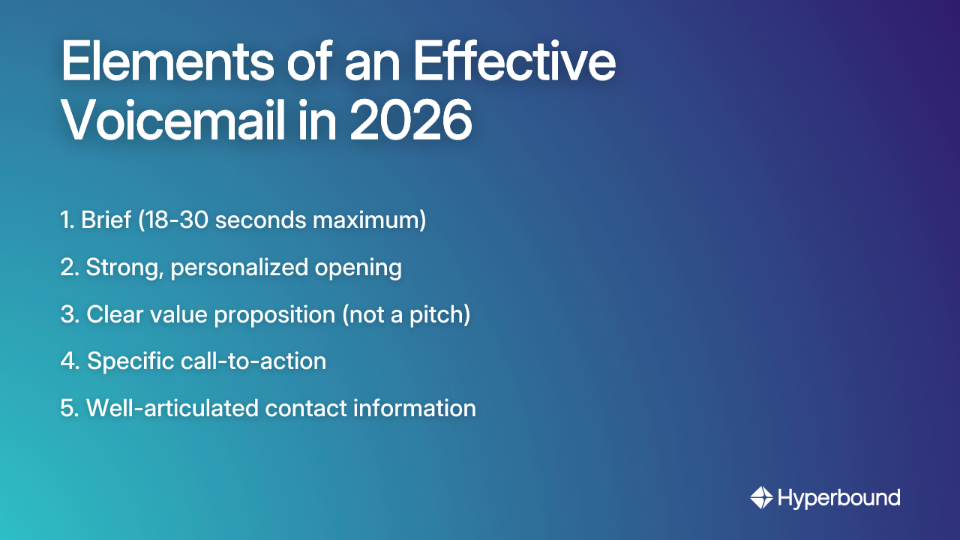
Optimal Length: Brevity is Your Friend
The ideal voicemail should be concise and impactful, lasting between 18-30 seconds according to UserGems. Some experts from Cognism even suggest tightening this to 10-20 seconds.
The Critical Opening
Begin by stating your name, company, and the prospect's name immediately. Follow this with a personalized hook that demonstrates you've done your homework. This initial impression is more important than ever in the era of Live Voicemail transcription, where the first few seconds can make or break your chances.
The Value Proposition (Not a Pitch)
Focus on the outcomes or benefits your solution provides, not the features of your product. Remember, you're not pitching your product directly—you're selling the next conversation.
As Cognism advises, avoid sounding "salesy" at all costs. Your goal is to present yourself as a valuable resource, not a desperate salesperson.
The Crystal-Clear Call-to-Action (CTA)
Don't be vague with your closing. Instead of simply saying "call me back," provide clear guidance on the next step. A particularly effective approach is the multi-channel CTA, where you direct prospects to another communication channel: "I've also sent you an email with the subject line '[Subject]' that has more information."
This aligns with user insights that voicemails accompanied by email tend to be more effective. As one Reddit user noted, "The ones that work are those that are accompanied by an email since it's easier for me to reply to."
Contact Information Best Practices
One major pain point expressed by prospects is unclear contact information. "If I cannot decipher what you want... I will NOT call you back," warns one frustrated executive on Reddit.
To avoid this pitfall:
- State your phone number twice—once at the beginning and once at the end
- Speak slowly and articulate each digit (say "five-five-five, one-six-eight-zero," not "five-five-five, sixteen-eighty")
- Leave a direct line, not your organization's general phone tree
10 Battle-Tested Voicemail Scripts for Any Cold Calling Scenario
Value-First Approaches
1. The Pain Point Solution: "Hi [name], this is [your name] from [company]. I understand you're looking for [service] to help solve the [problem] issues you've been having. I believe I have a solution that can help... My number is [number]..."
2. The Success Story:"Hi [name], this is [your name] from [company]. I've been working with [similar company] and they've [specific success] with the help of our solution. I'd like to do the same for you. Call me back at [number]."
3. The Value Offer: "Hi [name], [your name] from [company] here. [Client company name] just increased [specific win] by 20% and I know I can help you do the same at [company name]. Please call me back at [phone number]."
Connection-Based Approaches
4. The Referral Mention: "Hi [name], this is [your name] calling from [company]. [Referrer's name] told me I should call regarding [service/product]. Kindly return my call at [number]."
5. The Internal Contact Leverage: "Hi [name], [your name] from [company] here. I've been working with [name of someone else in the company] at [company name] and need to chat with you briefly. Please call me back at [number]."
6. The Content Feedback Request: "Hi [name], [your name] calling from [company]. I'm calling because you downloaded [name of gated content]. I wanted your feedback on our content and see if there's anything else we can offer you..."
Modern, Multi-Channel Scripts
7. The Email Nudge: "Hi [prospect name]! Sent over an email with [subject] and didn't want it to get lost in the inbox. This is [sales rep] from [company]."
8. The Confident Follow-Up: "Hi [name], [your name] getting back to you from [company]. I was hoping to catch you to continue our conversation about [product/service]. We've just introduced [latest product] which I think you'll love... I'm available until 5:30 PM today at [number]."
9. The Oversight Mention: "Hey [Prospect Name], this is [Your Name] with [Company], calling in regards to your oversight of the [specific team, e.g., 'demand generation'] team. If you could give me a call back at your nearest convenience at [number]..."
This approach, recommended on Reddit, triggers curiosity and responsibility by referencing the prospect's role.
The Art of Delivery: Pro-Level Dos and Don'ts
DO:
Personalize Deeply: Go beyond just using the prospect's name. Reference their LinkedIn profile or recent company news. As Paul Chesterman of EthOS states via UserGems, "Showing you did your research helps the prospect feel like they're not just a number."
Be Conversational: Maintain a confident, warm, and friendly tone. User research suggests talking to prospects "like they're your favorite cousin that just showed up on Thanksgiving." Stand up while speaking and speak slower than you think you need to for maximum impact.
Use a Multi-Channel Strategy: State your follow-up plans in the voicemail ("I'll also send an email tomorrow"). According to Nutshell, voicemails are effective for boosting email engagement when used as part of a coordinated approach.
Create a "Comfort Studio Environment": Address the psychological difficulty of cold calling. One Reddit user recommends "calming lights, soft humming white noise... essential oils vaporizer" to create the right mindset for effective calls.
DON'T:
Don't Pitch the Product: Remember, you're selling the next conversation, not the product itself.
Don't Sound Scripted: Write out your script, but practice it until it sounds natural. To master your delivery, you can use a platform like Hyperbound to practice scripts in realistic AI-powered roleplays. This allows you to get instant feedback on your tone and pacing, ensuring you have the emotional intelligence and genuine delivery needed for a live call.

Don't Leave Too Many Voicemails: Nutshell advises that leaving three or more voicemails can significantly decrease your response rates. Stick to a two-message maximum.
Don't Be Generic: Every single message must be personalized to stand any chance of success.
Making Every Voicemail a Strategic Touchpoint
The world of cold calling has evolved dramatically, and success in 2026 requires adapting to new technology like Live Voicemail and addressing heightened prospect skepticism.
The path to more callbacks is paved with brevity, deep personalization, clear value, and a confident, human tone. Most importantly, stop thinking of a voicemail as a failed call. It is a strategic touchpoint designed to warm up a lead and build a bridge to a real conversation.
As one Reddit user advises, the goal is to "book a meeting NOT answer any questions they might have." With the right script, delivery, and follow-up strategy—honed through practice and AI coaching—your voicemails can transform from annoying interruptions into valuable touchpoints that prospects actually want to respond to.

Frequently Asked Questions
Why are sales voicemails still important in 2026?
Yes, sales voicemails are still highly important as they can increase callback rates by up to 22% when executed correctly. In an era of sophisticated call screening and prospect skepticism, a well-crafted voicemail serves as a strategic touchpoint. It's not just a missed call; it's an opportunity to warm up a lead, demonstrate value, and guide them to another channel like email, ultimately building a bridge to a real conversation.
What is the ideal length for a sales voicemail?
The ideal length for a sales voicemail is between 18 and 30 seconds. This concise timeframe respects the prospect's time and forces you to deliver your message with clarity and impact. Some experts even recommend keeping it under 20 seconds to ensure your core message is heard before the listener loses interest.
How does Apple's Live Voicemail change cold calling strategy?
Apple's Live Voicemail requires a new strategy because it transcribes your message in real-time on the prospect's lock screen. Prospects can now read the first few words of your voicemail as you're leaving it and decide whether to answer or dismiss the call. This makes your opening line more critical than ever; it must immediately communicate value and personalization to capture their attention.
What is the single most important part of a voicemail script?
The single most important part of a voicemail script is the opening. The first 5-10 seconds are crucial for grabbing the prospect's attention, especially with features like Live Voicemail. A strong opening should state your name, company, and the prospect's name, followed immediately by a personalized hook that shows you've done your research.
Should I pitch my product in a voicemail?
No, you should never pitch your product directly in a voicemail. The goal of a voicemail is not to make a sale; it's to sell the next conversation. Focus on the value or outcome your solution provides rather than its features. Presenting yourself as a helpful resource is far more effective than coming across as a salesperson pushing a product.
How can I avoid sounding scripted or robotic?
To avoid sounding scripted, practice your delivery until the message feels natural and conversational. Write out your script, but don't read it verbatim—internalize the key points. Practice your tone and pacing, perhaps by standing up while you speak or using AI-powered roleplay tools for instant feedback. The goal is to sound confident, warm, and authentic.
How many voicemails are too many for one prospect?
You should leave a maximum of two voicemails for a single prospect. Research suggests that leaving three or more voicemails can significantly decrease your chances of getting a response and may annoy your prospect. A multi-channel approach is more effective; follow up with an email or a social media touchpoint instead of leaving a third voicemail.
Book a demo with Hyperbound


