.png)


Sales teams believe in roleplays.
Practicing difficult conversations before they happen should improve execution in live deals. If reps rehearse objections, pricing pushback, or discovery moments ahead of time, they should be more confident when those situations arise.
But in reality, roleplays rarely happen.
Traditional roleplays are long. They require scheduling time with a manager. And they usually simulate an entire sales conversation rather than the specific moment a rep is preparing for.
Even teams that value practice struggle to make it consistent.
So practice becomes occasional instead of habitual.
Reps may know that pricing pressure is coming or that a stakeholder is likely to push back on ROI. But there’s rarely a quick way to rehearse that moment before the next call.
When practice is too heavy, it simply doesn’t happen.
The Problem With Full-Conversation Roleplays
Most roleplays are designed to simulate an entire sales conversation.
A rep walks through discovery, positioning, objections, and closing as if the goal is to rehearse the full call from start to finish.
But deals rarely hinge on an entire conversation.
They hinge on specific execution moments.
A pricing objection that shifts momentum.
A stakeholder question that changes the direction of the deal.
A discovery follow-up that either deepens the problem or leaves it vague.
Those moments are where deals are actually won or lost.
When roleplays focus on full conversations, practice becomes diluted. Reps spend time on parts of the call that aren’t the real challenge instead of focusing on the moments that determine momentum.
What reps need isn’t longer practice.
They need more targeted practice.
Introducing Bitesized Roleplays
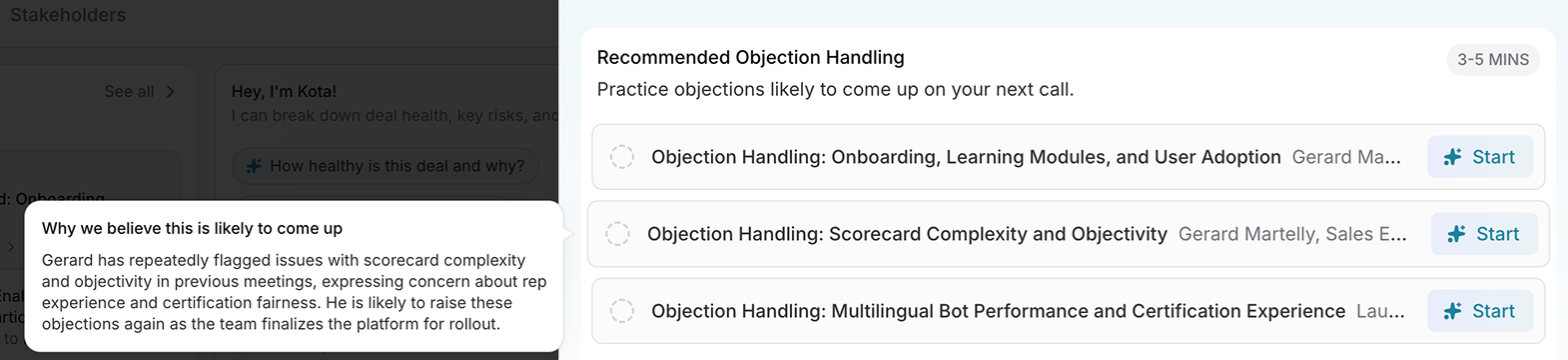
Bitesized roleplays are short, targeted practice scenarios designed to help reps rehearse specific moments before they happen.
Each roleplay focuses on a single skill, objection, or conversation pattern — not an entire sales call. A rep might practice responding to pricing pushback, reinforcing ROI, or navigating a stakeholder question that surfaced in a recent conversation.
Every scenario takes about three to five minutes to complete.
That small shift changes how practice fits into a rep’s day. Instead of blocking time for long roleplay sessions, reps can run a quick scenario between calls or before an important conversation.
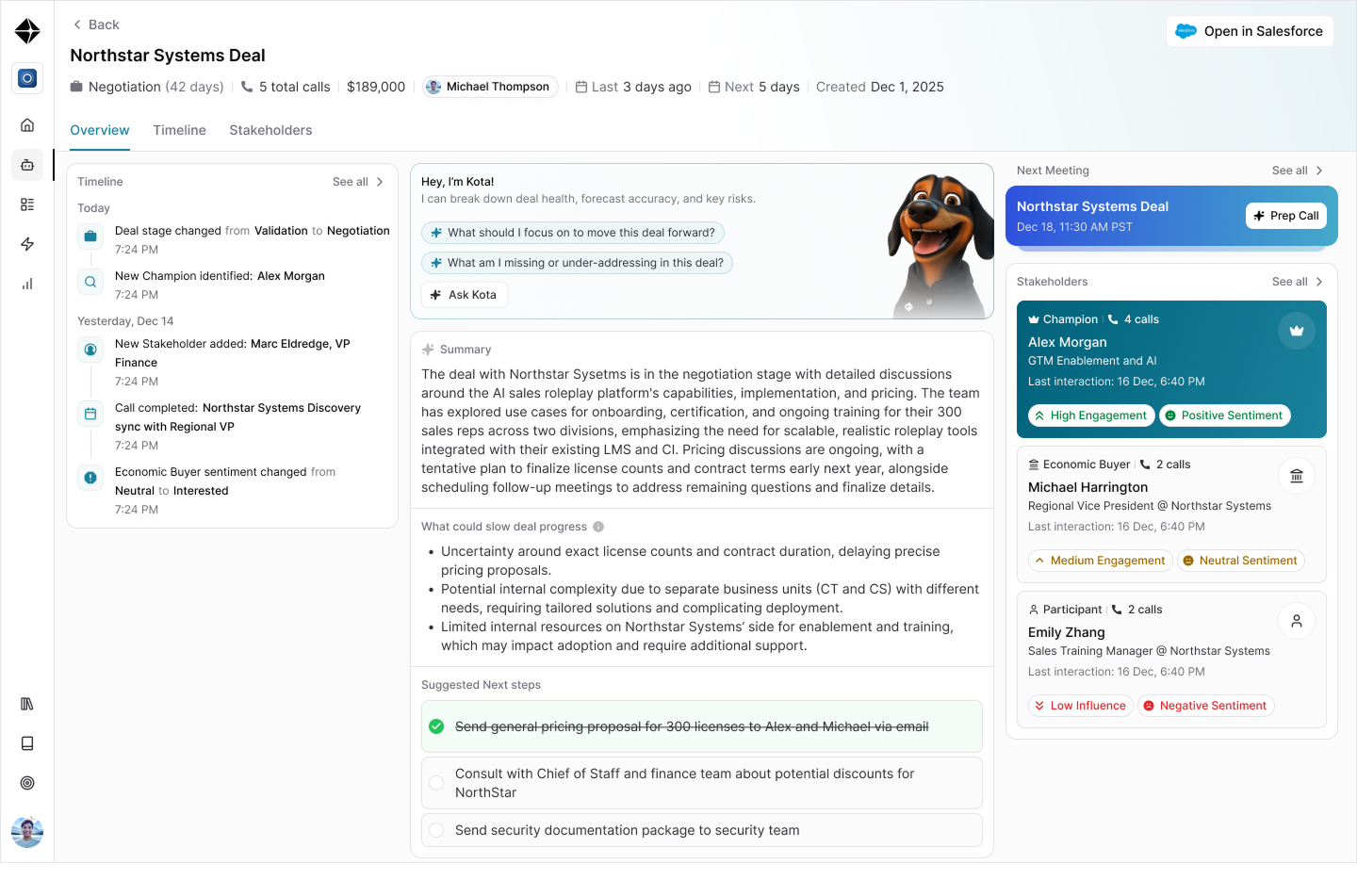
Bitesized roleplays can also be generated directly from real deal signals. When patterns emerge across calls — repeated objections, softening urgency, or stakeholder hesitation — a targeted roleplay can be created to rehearse that exact moment.
Practice becomes shorter, more relevant, and tied directly to what’s happening inside the deal.
Preparation Before the Next Call
Most reps don’t have time to run a full roleplay session in the middle of their day.
But they often have a few minutes before a call.
That’s the moment bitesized roleplays are designed for.
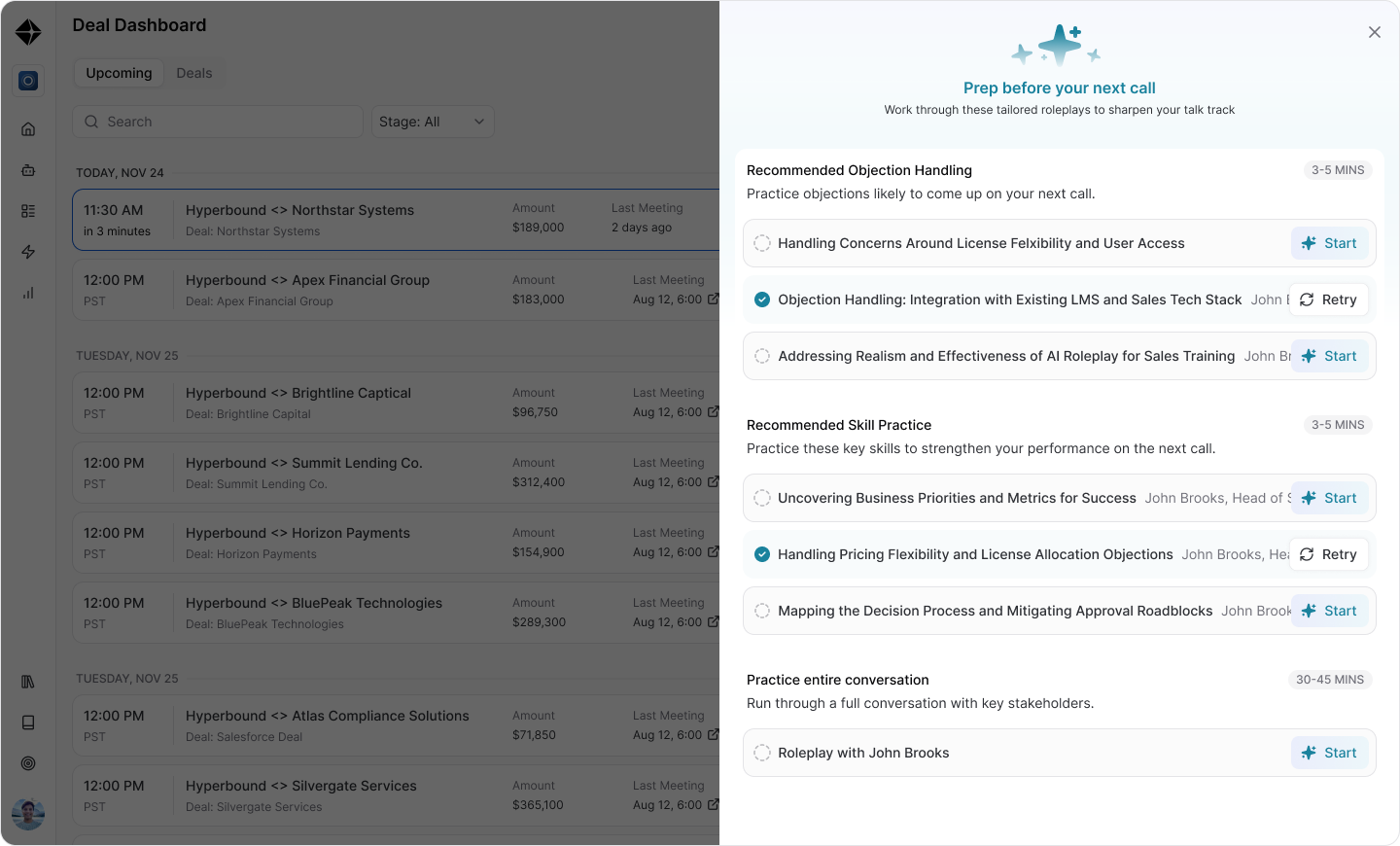
Before a discovery call, a rep might rehearse asking deeper follow-up questions. Before a pricing conversation, they might practice responding to budget pushback. After a call where an objection surfaced, they can immediately rehearse a stronger response before the next interaction.
Instead of re-listening to recordings or skimming transcripts, reps can quickly practice the scenario they’re most likely to face next.
Preparation becomes something reps can do on demand — not something that requires scheduling or coordination.
And because each roleplay only takes a few minutes, preparation can happen as often as the deal requires.
Roleplays Grounded in Real Deal Signals
Most roleplays are hypothetical.
They’re based on common scenarios that might happen in a sales conversation — pricing pushback, a skeptical buyer, or a discovery question that needs deeper follow-up.
But in live deals, the signals are rarely hypothetical.
Patterns start to surface across calls. A buyer questions ROI. Pricing concerns appear repeatedly. Stakeholders raise new objections that weren’t part of earlier conversations.
Those signals shape the trajectory of the deal.
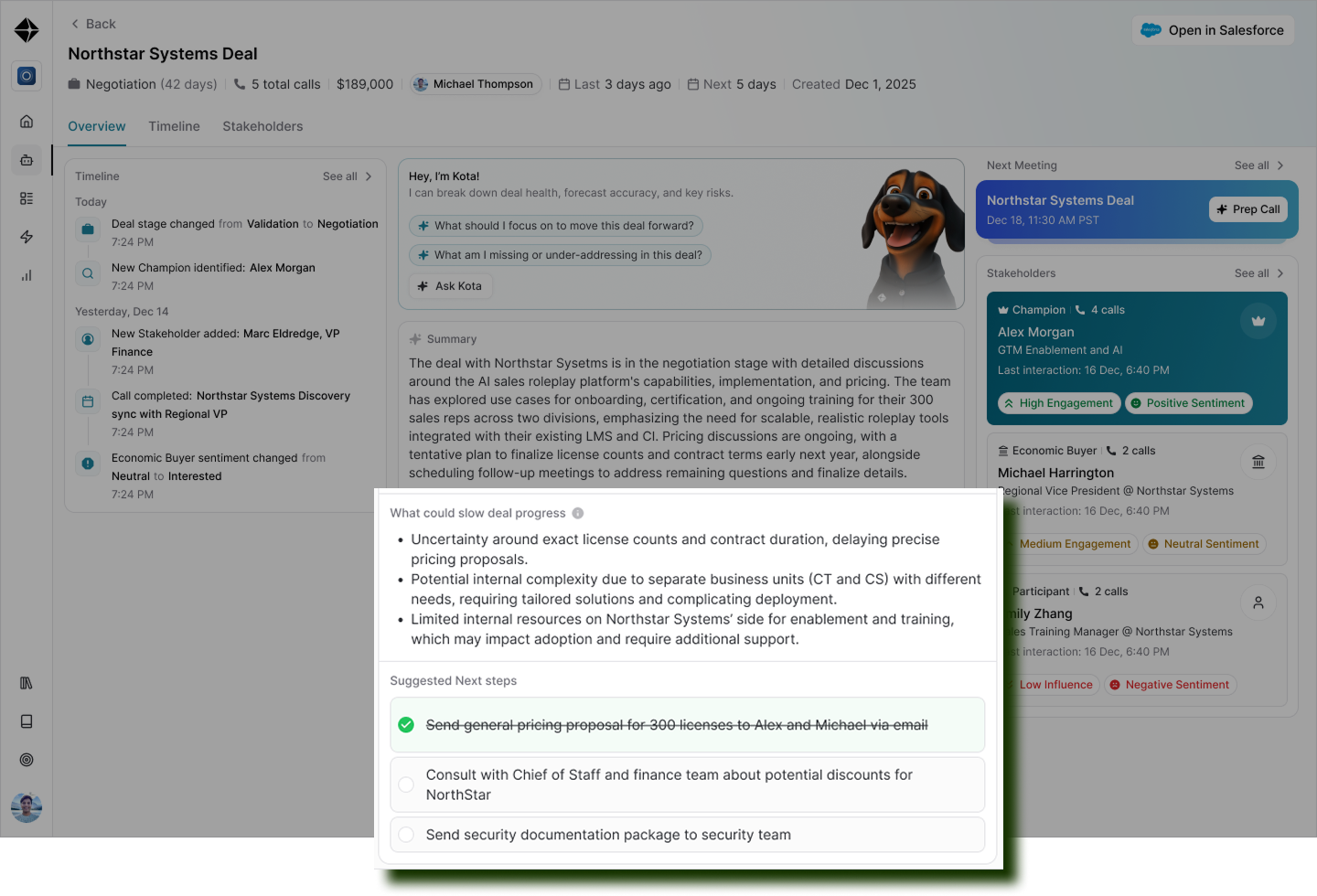
Bitesized roleplays can be generated directly from those patterns.
If pricing concerns keep appearing in recent calls, the roleplay focuses on handling pricing pushback. If urgency starts softening, the scenario shifts toward reinforcing value and business impact.
Practice becomes grounded in the reality of the opportunity — not a generic training scenario.
Reps aren’t rehearsing a theoretical objection.
They’re preparing for the one that’s most likely coming next.
Short Practice Drives Repetition
One of the biggest barriers to practice is time.
When roleplays take 20 or 30 minutes, they require scheduling. They depend on a manager being available. And they tend to happen occasionally rather than consistently.
Short practice removes that friction.
A three-minute scenario can happen between calls. A rep can retry the same objection multiple times. They can run through several variations of a scenario in just a few minutes.
That repetition is what actually improves execution.
Instead of practicing once and moving on, reps can refine how they respond to the exact moments that show up most often in their deals.
Practice stops being a scheduled training activity.
It becomes part of the rhythm of selling.
From Insight to Preparation
Conversation data can reveal what’s happening inside a deal.
It can show when objections start surfacing, when urgency weakens, or when a stakeholder introduces new friction. Those signals provide valuable insight into the trajectory of the opportunity.
But insight alone doesn’t prepare a rep for the next conversation.
Reps still need to handle that moment well when it arrives.
Bitesized roleplays close that gap. They turn signals from real conversations into targeted practice that reps can complete in just a few minutes.
Instead of simply seeing where a deal is at risk, reps can rehearse the response before the next call.
Insight shows what’s happening.
Practice prepares reps for what happens next.
Book a demo with Hyperbound


