

.png)
Summary
- Traditional sales training often fails because it's passive and doesn't change behavior on live calls, leading to low adoption.
- The most effective platforms connect practice to performance by analyzing real calls to find skill gaps and then providing realistic AI roleplays to fix them.
- This closed-loop approach demonstrably reduces ramp time (by up to 60%) and increases key conversion rates (by 150%).
- Hyperbound's Revenue Activation platform combines AI Real Call Scoring with AI Sales Roleplays to turn call insights into measurable team performance.
You've invested in sales training. You've run workshops, bought software licenses, and watched your reps nod along in onboarding sessions. But when you pull up call recordings two weeks later, the same objection-handling mistakes are still there. The same ramp timelines. The same conversion rates.
This is the core frustration driving sales leaders in 2026: most training doesn't change behavior on live calls. As one sales manager put it in a recent community discussion, "we spent $$ rolling out one of the big names and it ended up being 15% of the people actually logging in." Another noted that "most of the 'all-in-one' training platforms looked great in a demo but then just became another tab my reps ignored."
The platforms that actually move the needle are the ones that plug into daily workflows, simulate real buyer pressure, score actual calls, and give managers a clear line of sight between coaching activity and revenue outcomes.
.png)
This list is built for sales leaders and enablement managers — not individual reps hunting for career certifications. Each platform is evaluated on four criteria that matter most for SaaS teams:
- AI Roleplay Fidelity — How realistic is the practice environment?
- Real Call Scoring — Can it analyze live calls to surface skill gaps?
- Ramp Time Reduction — Does it demonstrably shorten time-to-productivity?
- Coaching Scalability — Can managers coach an entire team without burning out?
1. Hyperbound — Best Overall for Revenue Activation
Best for: Sales and enablement leaders who need to prove coaching ROI through measurable team-level outcomes.
Hyperbound coined the Revenue Activation category to describe what happens when teams stop just analyzing call data and start using it to actually change outcomes. Founded in 2024 and backed by Y Combinator, it's the only platform that closes the full loop: score real calls → identify skill gaps → practice roleplays → score real calls again.
The platform combines several core capabilities:
- AI Sales Roleplays: AI buyer personas trained on millions of real B2B sales conversations give reps a risk-free environment to master cold calls, discovery, objection handling, demos, and renewals. Unlike platforms with generic scripts, Hyperbound builds personas from what your top reps actually say on winning calls. Reps practice in bitesized 5–10 minute sessions that embed directly in their CRM, calendar, LMS, and Slack — which is exactly why one manager noted it was "the first thing they actually stick with because it feels like practicing with a tough prospect."
- AI Real Call Scoring: Deploys AI scorecards across 100% of real customer conversations — integrating with Gong, Salesloft, Chorus, or Hyperbound's own call recorder. Unlike tools that analyze calls in isolation, it connects every touchpoint in a deal to surface deal-level coaching insights: what's helping, what's hurting, and what the rep should work on next.
- AI Coaching: An AI coaching layer sits above roleplays and call scoring, recommending personalized coaching interventions to managers at the right moment — turning insights into closed-won outcomes.
The proof points are hard to argue with:
- Vanta reduced BDR ramp time by 60% (from 210 to 72 days), grew the BDR team 4x, and drove 5x pipeline growth — Stevie Case, CRO
- Nivoda achieved a 150% increase in demo conversion rates, cut ramp time by 50%, and doubled revenue YoY — Rob Rangel, Director of Sales Performance
- LinkedIn deployed Hyperbound across 3,000+ sellers across three business units in NAMER and EMEA
These aren't vanity metrics. They're the kind of team-level ROI that justifies a board conversation.
.png)
2. Gong — Best for Conversation Intelligence at Enterprise Scale
Best for: Enterprise teams needing deep analysis of calls, emails, and meetings to identify deal risk and winning behaviors.
Gong is the market standard for conversation intelligence. It excels at surfacing what's happening across your pipeline — talk ratios, topic analysis, competitor mentions, and deal risk signals — and its coaching workflows help managers identify which reps need attention.
The gap: Gong is exceptional at identifying what to fix. It doesn't offer a dedicated practice environment to actually fix it. Teams using Gong for tech sales coaching often pair it with a roleplay tool like Hyperbound to close that loop.
.png)
3. Chorus by ZoomInfo — Best for Teams Embedded in the ZoomInfo Ecosystem
Best for: Revenue teams that want call analysis tied directly to ZoomInfo's contact and market intelligence.
Chorus brings strong real-time transcription, relationship mapping, and CRM-connected call analysis. Its integration with ZoomInfo's GTM data gives account-level context that standalone call recorders can't match.
The gap: Like Gong, Chorus identifies patterns but doesn't offer a practice environment. It also lacks the deal-level coaching layer that surfaces risk across an entire deal lifecycle rather than call by call.
.png)
4. Mindtickle — Best for Structured Onboarding Programs
Best for: Organizations building formal, multi-stage onboarding and readiness programs at scale.
Mindtickle is a comprehensive sales readiness platform covering content management, skills assessments, call coaching, and AI role-plays. It's a strong fit for teams that need a centralized place for every script, process, and training material — a pain point frequently cited by enablement managers.
The gap: Roleplay is part of a broad suite rather than the core product, which can dilute the fidelity of simulations. Hyperbound's practice scenarios built from real call data tend to produce more realistic, contextually relevant practice than broader platform roleplays.
.png)
5. Second Nature — Best Standalone AI Roleplay Tool
Best for: Teams looking for a dedicated AI simulation tool outside of a full enablement suite.
Second Nature built its product around sales simulations, with an AI persona ("Jenny") that walks reps through realistic conversations and provides personalized feedback. It's a focused tool with certification capabilities that work well for structured practice programs.
The gap: Second Nature's AI personas aren't trained on your team's actual winning conversations — they're built from general sales scenarios. Hyperbound's differentiation here is meaningful: when the AI buyer sounds like the actual persona your reps are selling to, practice converts to performance faster.
.png)
6. Balto — Best for Real-Time In-Call Guidance
Best for: Contact center and inside sales teams needing live prompts and compliance checklists during conversations.
Balto is built for the moment — it listens to live calls and surfaces real-time guidance, dynamic playbooks, and alerts when reps go off-script or miss critical steps. For teams handling high volumes of short, transactional calls, it provides coaching at scale without requiring manager review.
The gap: Balto is reactive. It helps reps respond correctly during the call, but it doesn't build the muscle memory that comes from pre-call practice. Tech sales coaching for SaaS teams often requires preparing reps for complex, multi-stakeholder conversations — and that preparation happens before the call starts.
.png)
7. Highspot — Best for Unifying Content and Coaching
Best for: Enablement teams that want content management, sales plays, and coaching all in one platform.
Highspot is a mature enablement platform that connects training to content delivery and rep guidance. If your biggest pain point is reps not finding or using the right content at the right time, Highspot addresses that effectively. Its analytics also give enablement leaders insight into which content is actually being used.
The gap: Highspot is designed for content enablement first, coaching second. Its roleplay and practice capabilities are less dynamic than purpose-built simulation tools. Teams focused on accelerating ramp and changing conversation behavior will find Highspot's coaching layer less targeted than dedicated platforms.
.png)
8. Allego — Best for Video-Based Peer Learning
Best for: Teams that value asynchronous, video-first practice and peer-to-peer feedback.
Allego takes a mobile-first, video-centric approach to sales learning. Reps record practice pitches, receive peer and manager feedback, and access just-in-time content on mobile. It's particularly effective for distributed teams with strong coaching cultures. Research indicates that effective sales training can yield a significant ROI — underscoring how critical it is to choose a platform that can actually prove its value.
The gap: Allego's practice model relies on reps recording themselves, not interacting with a dynamic AI buyer. For teams that need reps to handle real-time pushback, interruptions, and objections in practice — the video format doesn't replicate live conversation dynamics the way AI roleplay does.
.png)
9. Clari Copilot — Best for Connecting Call Data to Pipeline Health
Best for: Sales leaders and RevOps teams who want call behavior tied directly to deal progression and pipeline visibility.
Clari Copilot sits at the intersection of conversation intelligence and revenue operations. It analyzes calls, automatically updates CRM fields, and surfaces deal risk signals that connect to Clari's broader pipeline platform. For leaders who live in pipeline reviews, it adds a behavior layer to forecast discussions.
The gap: Copilot identifies deal risk but doesn't offer a practice environment to remediate the skill gaps it surfaces. Like most conversation intelligence tools, it answers "what went wrong?" — not "how do we fix it before the next call?"
.png)
How to Choose the Right Tech Sales Coaching Platform
The right platform isn't the one with the longest feature list — it's the one your reps will actually use, and that your managers can tie to outcomes. Research shows that effective training requires hands-on delivery like AI roleplays, not just static content. Here are three questions worth asking before you sign a contract:
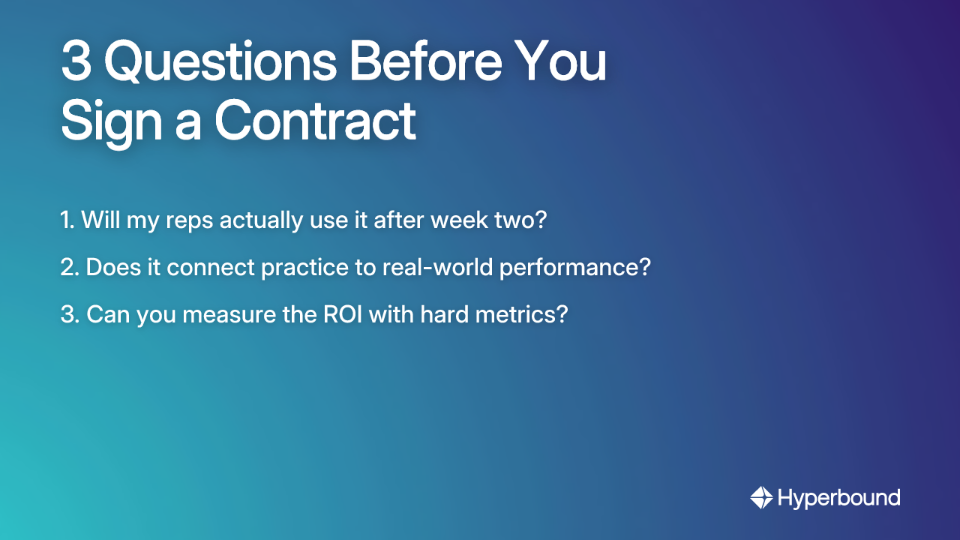
1. Will my reps use it after week two? Adoption is where most platforms fail. As one sales leader noted, the tools that last are the ones that "plug right into daily workflows" — not ones that require reps to navigate yet another login. Look for platforms that embed in Slack, CRM, and calendar, and offer micro-scenarios reps can complete in 5–10 minutes rather than 90-minute video modules.
2. Does it connect practice to real-world performance? The most dangerous gap in sales training is the space between what reps do in a coaching session and what they do on a live call. A platform should analyze real calls to inform what needs practicing — closing the feedback loop rather than leaving managers to guess. Behavior change on live calls is the most reliable leading indicator of revenue impact, yet it's the hardest thing for most platforms to prove.
3. Can you measure the ROI? Demand numbers. The right platform should connect usage data to KPIs like ramp time, conversion rates, and win rates. If your vendor can't show you a customer story with hard metrics, that's a signal to keep looking.
The Bottom Line
The era of passive learning in sales is over. Reps don't retain skills from watching recordings or sitting in enablement sessions — they build them through repeated, realistic practice tied to feedback from real conversations.
The best SaaS sales teams in 2026 aren't just analyzing their calls. They're activating them — using every conversation to identify gaps, drive targeted practice, and close the loop between coaching and closed-won deals.
If you're ready to move from insight to action — and prove the ROI of your coaching investment with metrics like Vanta's 60% ramp reduction and Nivoda's 150% demo rate increase — see how Hyperbound's Revenue Activation Platform works.
Frequently Asked Questions
What is a tech sales coaching platform?
A tech sales coaching platform is a software tool designed to improve the performance of sales representatives through features like AI-powered role-playing, real call analysis, and personalized coaching feedback. Unlike traditional training methods, these platforms integrate into a rep's daily workflow to build and reinforce skills in a practical, measurable way.
Why doesn't traditional sales training stick?
Traditional sales training often fails because it is passive and disconnected from a sales rep's daily reality. Reps sit through workshops or watch videos but lack a safe, realistic environment to practice what they've learned. Effective platforms solve this by providing on-demand, AI-driven practice that simulates real buyer conversations and reinforces new behaviors until they become second nature.
How does AI roleplay help sales reps improve?
AI roleplay helps sales reps improve by providing a risk-free, scalable environment to practice handling objections, navigating difficult conversations, and mastering their talk tracks. This allows reps to build muscle memory and confidence before they ever speak to a real prospect, leading to better performance and higher conversion rates on live calls.
What's the difference between Conversation Intelligence and Revenue Activation?
Conversation Intelligence (CI) tools are primarily diagnostic; they analyze calls to tell you what happened and identify skill gaps. A Revenue Activation platform closes the loop by connecting those insights to action. It not only analyzes real calls to find gaps but also provides a dedicated AI practice environment to fix them, then measures the impact on subsequent calls to ensure behaviors actually change and drive revenue.
How can you measure the effectiveness of a sales coaching tool?
The effectiveness of a sales coaching tool should be measured by tangible business outcomes, not just user activity. Key metrics to track include reduced ramp time, increased conversion rates, improved win rates, and growth in deal size. Look for platforms that can directly correlate their usage to these revenue-driving KPIs.
What key features should I look for in a sales coaching platform?
When evaluating a sales coaching platform, prioritize features that directly connect practice to performance. Look for high-fidelity AI roleplay, real call scoring, a closed feedback loop that uses call insights to inform practice, and deep integration into your team's existing workflows to maximize adoption.

Book a demo with Hyperbound


