

.png)
Summary
- True deal intelligence platforms go beyond simple call recording by analyzing conversations across the entire deal lifecycle to surface risks and recommend actions while deals are still winnable.
- Choosing the right tool requires identifying your main challenge, whether it's inaccurate forecasting (Clari), lack of conversational insights at scale (Gong), or inconsistent rep performance in live calls.
- Companies that focus on improving conversation quality see significant results, with Vanta reducing rep ramp time by 60% and Nivoda increasing demo conversion rates by 150%.
- For teams losing deals due to conversation gaps, Hyperbound Perform connects real call analysis with targeted, AI-powered practice to improve rep performance and close more deals.
You're on a discovery call. The prospect asks a question you weren't expecting, the conversation shifts, and the next time you check your CRM, the deal is still marked "Stage 3 — Active." Nothing flags that you just lost momentum. Nothing tells your rep what to fix before the next touchpoint.
That's the gap most sales tools leave wide open.
B2B sales teams today have more data than ever — call recordings, CRM fields, activity logs — but as sales reps across Reddit sales forums point out, "prep tools are solid, but real-time support is still lacking." Data alone doesn't change outcomes. The conversations do.
What Separates a True Deal Intelligence Platform from a Call Recorder or CRM Add-On
.png)
A call recorder gives you a transcript. A CRM add-on gives you activity data. A true deal intelligence platform does something fundamentally different: it surfaces risk and recommends action while deals are still winnable.
That means analyzing the actual buyer conversations happening across a deal's lifecycle — not just the last call, and not just what a rep remembered to log. It means identifying when a competitor objection didn't get handled, when a champion went quiet, or when urgency was never established. And critically, it means telling the rep — or their manager — what to do about it before the deal goes cold.
Not all six platforms on this list do all of those things. But each earns its place by solving a specific, high-priority problem for B2B sales teams. Here's how they stack up.
1. Hyperbound Perform — Best for Deal Intelligence Grounded in Buyer Conversations
Hyperbound Perform is purpose-built for teams that have identified their deal risk at the source: rep behavior and conversation gaps, not pipeline math.
Most deal intelligence tools analyze calls in isolation — one recording, one scorecard, one set of notes. Perform takes a different approach. It rolls up insights across every call and touchpoint in a deal's lifecycle, from first cold call to closing conversation, and surfaces what's helping or hurting the opportunity in context. Think of it as the missing layer between call-level coaching and pipeline outcomes.
Key capabilities:
- AI Deal Coaching: Looks across all calls in a deal to identify what's working, what's stalling momentum, and what the rep should focus on next. Recommendations are grounded in observed buyer behavior — not CRM stage or manager intuition.
- AI Real Call Scoring: Automatically scores 100% of real customer conversations against your custom methodology scorecards. Works alongside existing tools — it integrates with Gong, Salesloft, Chorus, and other call recording systems, including Hyperbound's own built-in call recorder.
- Bitesized Roleplays: When a skill gap surfaces in a real call (say, a rep consistently failing to handle pricing objections), Perform recommends targeted practice sessions from Hyperbound Practice. The loop is direct: score real calls → identify gaps → practice → perform better.
- Auto-CRM Fill: Automatically updates CRM fields from conversation data. No manual entry, no stale fields, no forecasts built on guesswork.
- Deal Health Analytics: Dashboards grounded in actual conversation data, giving managers reliable pipeline visibility tied to leading behavioral signals rather than lagging activity metrics.
Hyperbound coins this the Revenue Activation category — the idea that teams shouldn't just analyze call data, they should use it to change outcomes.
Proof it works:
- Vanta reduced rep ramp time by 60% (from 210 to 72 days), scaled their BDR team 4x, and drove 5x pipeline growth — results attributed to Hyperbound's coaching and deal intelligence loop by CRO Stevie Case.
- Nivoda cut ramp time by 50%, doubled revenue year-over-year, and increased demo conversion rates by 150% — reported by Director of Sales Performance Rob Rangel.
Best for: Account Executives and frontline managers who need to catch deal risk early, while deals are still winnable — and who want coaching recommendations grounded in what buyers are actually saying, not what reps are logging.
2. Gong — Best for Conversation Intelligence at Scale
Gong is a well-known name in conversation intelligence. It records, transcribes, and analyzes sales calls and meetings, giving sales leadership a macro-level view of what's happening across the entire revenue organization.
Gong's AI analyzes conversations to surface deal risks, track competitor mentions, and benchmark rep behavior against top performers. Its trackers let teams monitor specific topics — pricing, competitors, objections — across thousands of calls at once.
Where it excels is pattern recognition at volume. Where it requires more effort is in bridging the gap between insight and action. Reviewing dashboards and translating observations into specific, rep-level coaching steps is still largely a manual process for managers.
Best for: Enterprise sales teams and revenue leaders who need visibility into patterns across thousands of conversations and want market intelligence extracted from call data at scale.
3. Clari — Best for AI-Powered Revenue Forecasting
If your primary challenge is forecast accuracy and pipeline predictability, Clari is a tool built for this purpose. It aggregates data from your CRM, email, calendar, and call systems to produce roll-up forecasts with an AI scoring layer on top.
Clari is excellent at answering the question: "What is our number this quarter, and which deals are at risk of slipping?" It surfaces deals that have gone quiet, flags stage progression anomalies, and gives RevOps and sales leadership the visibility they need to commit to a number with confidence.
What Clari doesn't provide is the conversational "why." It can tell you a deal has been stagnant for 14 days; it can't tell you that the rep failed to establish urgency on the last call or that a competitor was mentioned and never addressed. That behavioral layer — the root cause — is where Hyperbound Perform picks up.
Best for: Sales leadership and RevOps teams focused on improving forecast accuracy, managing pipeline hygiene, and getting predictable revenue outcomes at a business level.
4. Salesforce Einstein — Best for Native CRM Intelligence
For teams living inside Salesforce, Einstein is the intelligence layer that requires the least adoption friction. It offers native opportunity and lead scoring, activity capture that automatically logs emails and calendar events, and next-step recommendations derived from CRM data patterns.
Einstein's core advantage is context — your sales data, your history, your object relationships, all within the platform your team already uses daily. There's no new system to log into.
Its core limitation is the same: it's only as good as the data in Salesforce. If reps aren't logging activities consistently, or if CRM fields reflect what should have happened rather than what did, Einstein's insights reflect that noise. Hyperbound Perform's Auto-CRM Fill actually helps address this — pulling factual data from buyer conversations directly into Salesforce rather than relying on rep inputs.
Best for: Salesforce-native teams that want AI-driven deal prioritization and workflow automation without adding a separate platform to their stack.
5. Outreach — Best for High-Velocity Sales Engagement
Outreach is a leading sales engagement platform designed to manage the cadence and volume of outbound sales interactions. It helps SDR and AE teams build multi-channel sequences, automate follow-ups, and track engagement across email, phone, and social.
Its conversation intelligence feature, Kaia™, provides call analysis and real-time assistance during live calls — a capability that sales reps on Reddit specifically called out as a differentiator: "real-time guidance has been a lifesaver."
Where Outreach is optimized for throughput, Hyperbound Perform is optimized for quality. Outreach answers: "Are we reaching enough buyers, fast enough?" Perform answers: "When we get them on the phone, are we having the right conversation?"
Best for: High-volume sales development teams focused on outbound sequence execution, engagement tracking, and optimizing touchpoint cadence across large prospect lists.
6. HubSpot Sales Hub — Best for All-in-One Sales Pipeline Management
HubSpot Sales Hub remains one of the most accessible and well-integrated platforms for small to mid-market B2B teams. It combines CRM, deal tracking, email sequences, meeting scheduling, and call recording into a single interface — with a relatively fast implementation timeline compared to enterprise alternatives.
Higher tiers include conversation intelligence features, predictive deal scoring, and workflow automation. For teams that don't want the complexity of assembling a multi-tool stack, HubSpot provides a strong baseline across nearly every function.
The tradeoff is depth. HubSpot's deal intelligence capabilities are general-purpose by design. They lack the behavioral specificity of a purpose-built tool trained on millions of real B2B sales conversations. For teams whose biggest lever is improving how reps perform in buyer conversations — not just managing a pipeline — HubSpot alone won't close that gap.
Best for: SMB and mid-market teams that want a single, unified platform covering CRM, engagement, and basic deal intelligence without the overhead of integrating multiple enterprise tools.
Decision Framework: Which Platform Is Right for Your Team?
.png)
Before evaluating features, ask one question: When you lose deals, is it because of your math or your conversations?
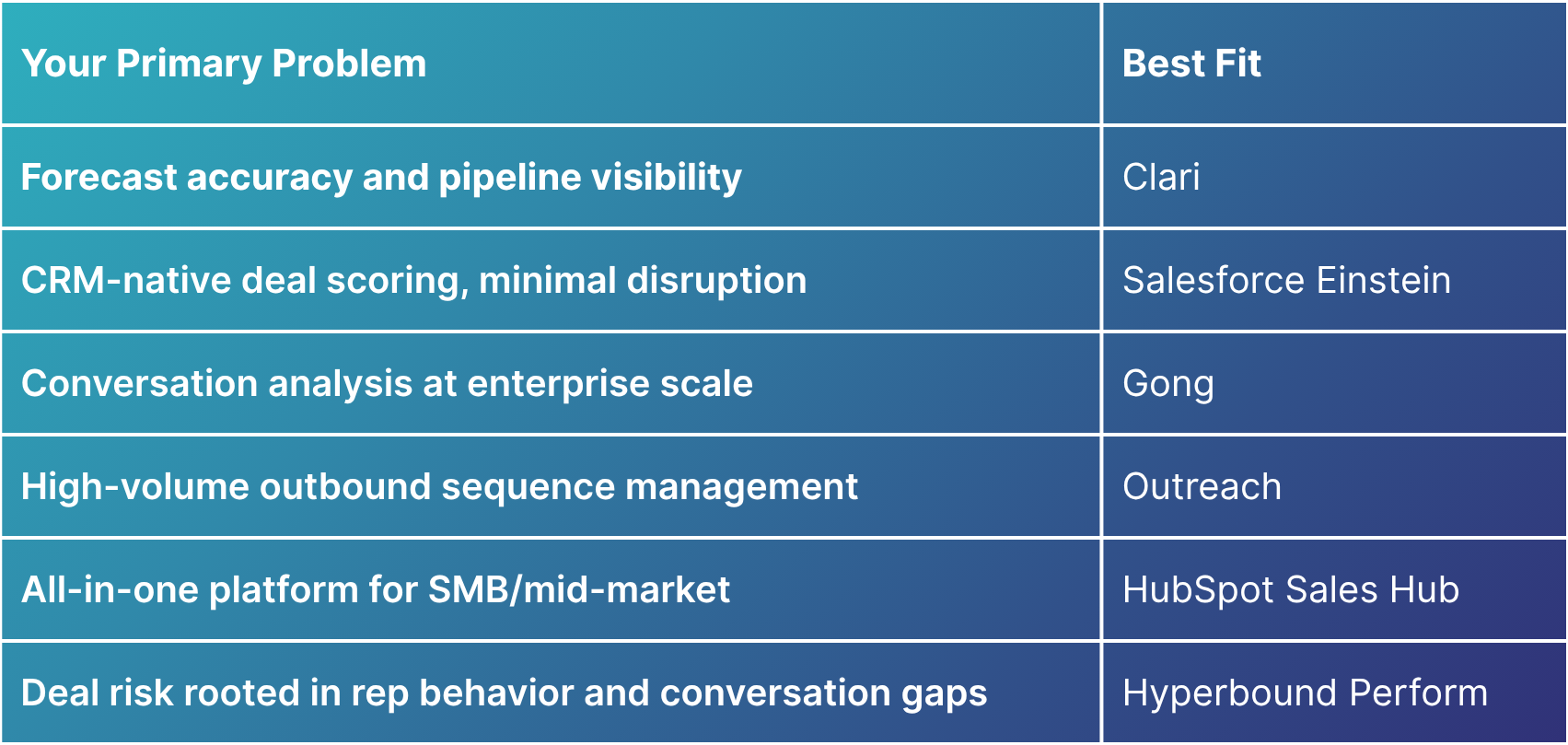
If your reps are reaching enough buyers but struggling to convert them — if deals stall because objections don't get handled, champions go cold, and urgency is never established — the problem isn't your pipeline math. It's what's happening inside the conversations.
That's the problem Hyperbound Perform was built for. Not as a forecasting tool, and not as a call archive — but as a deal-level intelligence layer that catches behavioral risk early, surfaces guided actions while there's still time to act, and closes the loop between what reps practice and how they perform on live deals.
The results at Vanta and Nivoda aren't just about ramp time — they reflect what happens when teams stop treating conversation data as a reporting artifact and start using it to actively change outcomes.
From Analyzing Calls to Activating Revenue
The B2B sales landscape is crowded with tools that tell you what happened. The category that's harder to find — and more valuable — is the one that tells you what to do next, while the deal is still in play.
Platforms like Gong, Clari, and Outreach each solve a real problem. But if your win rates are being held back by how your reps show up in conversations — not how well you're managing the spreadsheet — a true deal intelligence platform needs to be built on conversation data from the ground up.
That's what Hyperbound's Revenue Activation Platform delivers: a continuous loop where real calls get scored, gaps get identified, targeted practice builds the skill, and better conversations move deals forward.
Ready to see deal-level intelligence grounded in real buyer conversations? Explore Hyperbound Perform →
Frequently Asked Questions
What is a deal intelligence platform?
A deal intelligence platform is a tool that analyzes sales data, particularly buyer conversations, to identify risks and provide actionable recommendations to win more deals. Unlike simple call recorders or CRM activity logs, it focuses on surfacing insights from the entire deal lifecycle to guide sales reps on what to do next before a deal is lost.
How does deal intelligence differ from conversation intelligence?
Deal intelligence focuses on the entire deal lifecycle, while conversation intelligence typically analyzes individual calls in isolation. A deal intelligence platform like Hyperbound Perform connects insights from every touchpoint (multiple calls, emails) to understand the deal's health and momentum, providing context-aware coaching. Conversation intelligence tools are powerful for analyzing patterns across thousands of individual calls.
Who is a deal intelligence platform for?
Deal intelligence platforms are designed primarily for Account Executives, frontline sales managers, and sales enablement leaders. AEs use it for real-time coaching and next-step recommendations, while managers use it to identify deal risks, scale coaching, and gain accurate pipeline visibility based on actual rep behavior.
Can a deal intelligence platform replace my CRM?
No, a deal intelligence platform does not replace your CRM; it enhances it. It integrates with your CRM (like Salesforce or HubSpot) to pull in deal data and, more importantly, pushes conversation-based insights back into it. For example, Hyperbound Perform's Auto-CRM Fill feature updates CRM fields automatically based on what was said in a call, ensuring your data is always accurate and up-to-date.
What is the main benefit of analyzing buyer conversations for deal intelligence?
The main benefit of analyzing buyer conversations is gaining direct, unfiltered insight into deal health and risk. Rep-logged notes and CRM fields can be subjective or incomplete. By analyzing the actual words of the buyer, a deal intelligence platform can identify unhandled objections, waning interest, or the presence of a competitor, providing an objective foundation for coaching and forecasting.
How does Hyperbound Perform help improve sales rep skills?
Hyperbound Perform improves sales rep skills by creating a direct feedback loop between performance and practice. The platform's AI scores real customer calls against a team's sales methodology, identifies specific skill gaps (like handling pricing objections), and then automatically recommends targeted, AI-powered roleplays. This allows reps to practice exactly what they need to improve on, based on data from their own deals.
How does a platform like Hyperbound Perform differ from Gong?
Hyperbound Perform differs from Gong by focusing on deal-level coaching and revenue activation, whereas Gong excels at conversation analysis at an enterprise scale. Gong is excellent for spotting market trends and patterns across thousands of calls. Hyperbound Perform analyzes all touchpoints within a single deal to surface risks and provide reps with specific, actionable guidance on how to move that specific deal forward.
Book a demo with Hyperbound


