

.png)
Summary
- Most AI sales coaches only analyze individual calls, missing the deal-level context where wins and losses are actually determined.
- Effective coaching requires an opportunity-level view, connecting behavioral patterns across all buyer interactions to identify deal risk and guide reps.
- Hyperbound's AI coaching platform provides true deal-level coaching, analyzing the entire sales cycle to help reps close more deals.
Here's a frustration you've probably heard from a sales leader recently — or maybe said yourself: "Most AI coaches are just fancy dashboards with alerts."
That blunt take from a sales ops community discussion cuts straight to a real problem. The market is flooded with tools that analyze a single call, surface a few keywords, and call it coaching. But a great discovery call doesn't guarantee a win. A stumble on one demo doesn't mean the deal is dead. What actually determines outcomes is the full arc of every interaction, the pattern of buyer behavior across the entire opportunity.
And yet, the majority of "AI sales coaching" tools on the market today are still stuck at the call level — reviewing conversations in isolation, missing the momentum shifts and risk signals that only surface when you look at the whole deal.
That gap is exactly what AI deal coaching is designed to close. For 2026, the bar has shifted. A tool that genuinely helps sales teams win more deals needs to do three things:
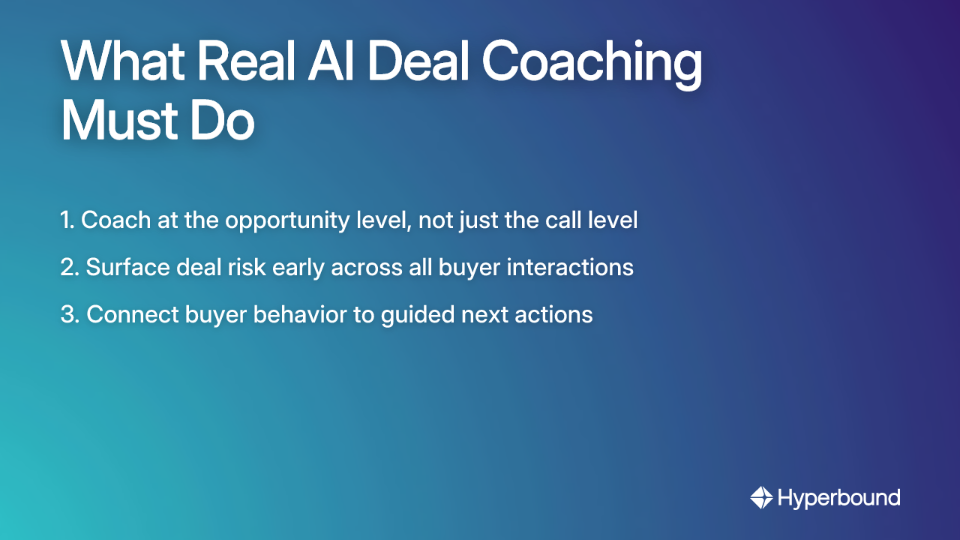
- Coach at the opportunity level, not just the call level.
- Surface deal risk early, by reading patterns across all buyer interactions.
- Connect buyer behavior to guided next actions — not just flags, but actual direction.
This article cuts through the noise and highlights the 7 tools worth evaluating — and how they each stack up against that deal-level standard.
1. Hyperbound Perform
Best for: True deal lifecycle coaching
Hyperbound Perform is built for exactly the problem this article opens with. Where other tools analyze calls, Perform analyzes deals — rolling up insights from every conversation touchpoint across an entire opportunity, from the first cold call to the closing conversation.
This is the core of what Hyperbound calls the Revenue Activation Platform — a category it coined to describe what happens when teams stop merely analyzing data and start using it to change outcomes. The logic is simple: data alone doesn't win deals. Behavior does. And behavior has to be coached at the deal level, not the call level.
What makes it stand out for deal coaching:
- AI Deal Coaching: This is the differentiator. Instead of grading a single call, Perform looks across all the interactions tied to a specific opportunity and surfaces what's helping or hurting deal momentum. It tells reps and managers what to work on next — not in the abstract, but in the context of a live, active deal.
- AI Real Call Scoring: Every customer conversation is automatically scored against your team's custom sales methodology scorecards — 100% coverage, no cherry-picking. It integrates directly with Gong, Chorus, Salesloft, and other recording systems so you're not ripping and replacing your existing stack.
- Bitesized Roleplays: Here's where Perform becomes a closed-loop system. When it identifies a skill gap on a live deal — say, a rep failing to surface economic buyer pain — it recommends a targeted practice session from Hyperbound Practice. The practice ties directly back to what's happening in real deals, not a generic training library.
- Deal Health Dashboards: Pipeline visibility grounded in actual buyer conversations, not just CRM field updates or gut feel.
This solves what sales leaders consistently point to as the real need: "The key is to find a solution that connects call analysis, performance metrics, and enablement into one seamless workflow." (source)
Proof points that back it up:
- Vanta cut ramp time by 60% (from 210 to 72 days) while scaling their BDR team 4x — Stevie Case, CRO at Vanta
- Nivoda achieved 2x year-over-year revenue growth and a 50% ramp reduction — Rob Rangel, Director of Sales Performance
- LinkedIn deployed Hyperbound across 3,000+ sellers to standardize deal execution across multiple business units
Hyperbound Perform launched in March 2026 and is purpose-built as a deal-winning tool — not a forecasting tool. The goal isn't to predict outcomes; it's to influence them.
2. Gong
Best for: Call analytics and conversation intelligence at scale
Gong is the established leader in conversational intelligence. For larger organizations with the budget (think six figures annually), it delivers powerful call recording, transcription, and analysis that helps teams understand what's happening in their customer conversations at scale.
Where Gong shines: identifying keywords, tracking talk ratios, surfacing topic trends across hundreds of calls, and helping managers understand what top performers do differently.
Where it falls short for deal coaching: Gong's primary lens is still the individual call. As one practitioner put it, "Gong still misses a ton of context from Salesforce, documents, and other integrations." (source) It can tell you what happened on a call — but connecting behavioral patterns across an entire deal's lifecycle and prescribing the next best action for that specific opportunity isn't its core motion.
3. Clari
Best for: Pipeline management and forecast visibility
Clari is a strong Revenue Operations platform that aggregates CRM, email, and calendar data to give leaders a reliable picture of their pipeline. Its AI surfaces deal risk and signals which opportunities need attention — making it genuinely useful at the opportunity level.
The limitation: Clari answers the what and when questions well ("what's the status, when will it close?"), but not the how. It can flag a stalled deal without explaining that the rep never properly addressed the economic buyer's concerns across three consecutive calls. It's a powerful complement to a deal coaching tool, but not a replacement for the behavioral analysis layer.
4. Outreach
Best for: Sales engagement and activity-based deal health
Outreach is one of the most capable sales engagement platforms available — and its Deal Insights feature brings a legitimate deal-level perspective to the table. It scores deals based on various activity signals and suggests next-step actions like sending a follow-up or booking a call.
The gap: Outreach's signals are primarily activity-based — emails sent, meetings booked, response rates. That's valuable context, but it doesn't tell you why engagement dropped. It won't analyze call transcripts to surface that a rep is consistently failing to address pricing objections before they become blockers. It's strong for managing engagement momentum; it stops short of behavioral, conversation-grounded deal coaching.
5. Chorus (by ZoomInfo)
Best for: Conversation insights and post-call rep feedback
Chorus is Gong's closest analog — a conversation intelligence platform that records, transcribes, and analyzes sales meetings. Acquired by ZoomInfo, it provides solid analytics on what separates top performers from the rest and is effective for coaching reps on specific call-based skills.
Like Gong, though, Chorus operates primarily at the call level. It delivers strong retrospective analysis of individual interactions but doesn't natively connect the dots across multiple touchpoints to give a true picture of deal health or prescribe the next best action for an opportunity as a whole. Great for what happened; less equipped to tell you what to do next in the deal.
6. Salesloft
Best for: Engagement workflow and pipeline visibility
Salesloft is a comprehensive platform combining cadence management, a dialer, and conversation intelligence. Its Deals feature gives managers a pipeline view and supports deal inspection workflows. It's a genuinely useful tool for structuring how reps execute against a playbook.
Where it hits its ceiling: Salesloft's coaching capabilities are built around guiding reps through a prescribed process rather than delivering dynamic, behavior-driven coaching based on what's actually happening in a specific live deal. It's more process-enforcer than insight generator — which is valuable in its own right, but a different problem than AI deal coaching.
7. AI Sales Simulators
Best for: Sales simulation and practice scenarios
AI-powered sales simulators are a growing category of tools focused on helping reps practice conversations through simulated roleplays. They cover pitching, objection handling, and discovery scenarios — all important building blocks of sales readiness.
The key distinction: These tools are for practice, not performance on live deals. They don't analyze real customer conversations or connect to live deal data. A rep can sharpen their pitch in a simulation and still miss critical signals in an active opportunity. They cover the practice side of the equation but don't close the loop to real-deal outcomes.
If you're looking for a platform that combines simulation-quality practice with live deal analysis, that's where Hyperbound Practice and Perform work together as a connected system — practice sessions informed by what's actually happening in your pipeline.
Comparison Table
.png)
.png)
Frequently Asked Questions (FAQ)
What is the difference between AI deal coaching and AI call coaching?
AI deal coaching analyzes all buyer interactions across an entire opportunity, while AI call coaching focuses on analyzing individual sales calls in isolation. The key difference is the scope. Call coaching tools provide insights on a single conversation (e.g., talk-to-listen ratio, keyword mentions). Deal coaching connects the dots between multiple touchpoints—like discovery calls, demos, and follow-up emails—to identify behavioral patterns and momentum shifts that determine whether a deal is won or lost.
Why is opportunity-level coaching more effective than call-level coaching?
Opportunity-level coaching is more effective because a single successful call doesn't guarantee a win, and one bad call doesn't mean a deal is lost. Real success is determined by the pattern of interactions over the entire sales cycle. By analyzing the full arc of buyer engagement, deal coaching platforms can spot critical risks that call-level tools miss, such as a key objection that goes unaddressed across multiple conversations.
How does an AI deal coach identify deal risk?
An AI deal coach identifies risk by analyzing behavioral patterns across all conversations and interactions related to an opportunity, not just activity metrics or keywords from a single call. It looks for subtle but critical signals, such as a buyer's concerns not being addressed over multiple calls, a lack of engagement from the economic buyer, or a failure to establish clear next steps. This allows sales teams to intervene before a deal stalls.
Will an AI deal coaching platform replace my CRM or a tool like Gong?
No, an AI deal coaching platform is designed to integrate with and enhance your existing sales stack, not replace it. It acts as an intelligence layer on top of your current tools. For example, it pulls call recordings from conversation intelligence platforms like Gong or Chorus and connects them with opportunity data from your CRM to create a unified, behavior-driven view of deal health.
What kind of "guided next actions" does a deal coach provide?
A deal coach provides specific, context-aware actions based on behavioral gaps identified within a live deal. Instead of simply suggesting "send a follow-up," an AI deal coach might recommend a targeted action like, "In your next call, address the budget concerns raised by the VP of Finance, which were not resolved in the last two meetings." It can even connect these gaps to specific training or roleplay exercises to help the rep build the necessary skills.
Is AI deal coaching just another forecasting tool?
No, AI deal coaching is focused on influencing outcomes, while forecasting tools are designed to predict them. A forecasting tool analyzes data to predict the likelihood of a deal closing. An AI deal coaching tool analyzes the same data to tell you why a deal is at risk and what specific actions your rep can take to get it back on track. The goal is to change behavior to improve the outcome, not just report on its probable future.
Stop Coaching Calls. Start Coaching Deals.
Relying on call-level coaching to win deals is like trying to win a chess match by only studying your last move. The context that matters — the full arc of buyer engagement, the momentum shifts across touchpoints, the behavioral patterns that signal risk while you can still act — only shows up when you look at the entire deal.
Tools like Gong and Chorus transformed how teams understand individual conversations. Clari brought rigor to pipeline visibility. But none of them close the loop between how reps behave on calls and what that means for a specific live opportunity — and none of them connect that insight back to targeted practice to fix it.
That's the gap AI deal coaching is built to fill. And in 2026, closing that gap is what separates teams that generate pipeline from teams that consistently turn it into revenue.

Book a demo with Hyperbound


