

.png)
Summary
- Sales managers only hear 2-5% of their team's calls, meaning coaching is often based on an incomplete and potentially biased sample.
- Most AI call scoring tools excel at identifying what went wrong on calls but fail to provide a direct path for reps to practice and improve those specific skills.
- The critical question when evaluating tools is whether they just provide dashboards or if they "close the loop" by connecting insights to a targeted practice environment.
- Revenue activation platforms like Hyperbound bridge this gap, using AI-driven scoring to identify weaknesses and then assigning targeted AI roleplays to fix them.
Your sales managers are working hard — but statistically, they're only hearing 2-5% of their team's calls. The other 95%? A black box. That means coaching is reactive, based on a tiny and potentially biased sample, and the winning behaviors of your top reps aren't being replicated across the team.
AI call scoring software was supposed to fix this. And it has — partially. The best tools now automatically score 100% of conversations, surface deal risk signals, and flag coaching moments. But here's the frustration most sales teams run into: many tools stop at the dashboard. They tell you what went wrong on a call. They don't give you a direct path to actually fixing it.
This guide cuts through a crowded market. We've evaluated 15 of the best AI call scoring tools across three distinct categories, using a rubric that goes beyond features to focus on what actually moves the needle: turning insights into behavior change.
How to Evaluate AI Call Scoring Tools
Before diving into the list, it helps to understand the landscape. Not all tools are built for the same job.
Three main categories:
- Call Center QA Tools — Built for high-volume environments. Focused on compliance, script adherence, and evaluating agent interactions against strict rubrics.
- Sales Conversation Intelligence — The dominant category. These platforms capture, transcribe, and analyze calls to surface insights, track deal health, and identify coaching opportunities.
- Revenue Activation Platforms — The evolution. These don't just analyze calls; they connect insights directly to a practice environment so reps can actually improve the skills the data surfaces.
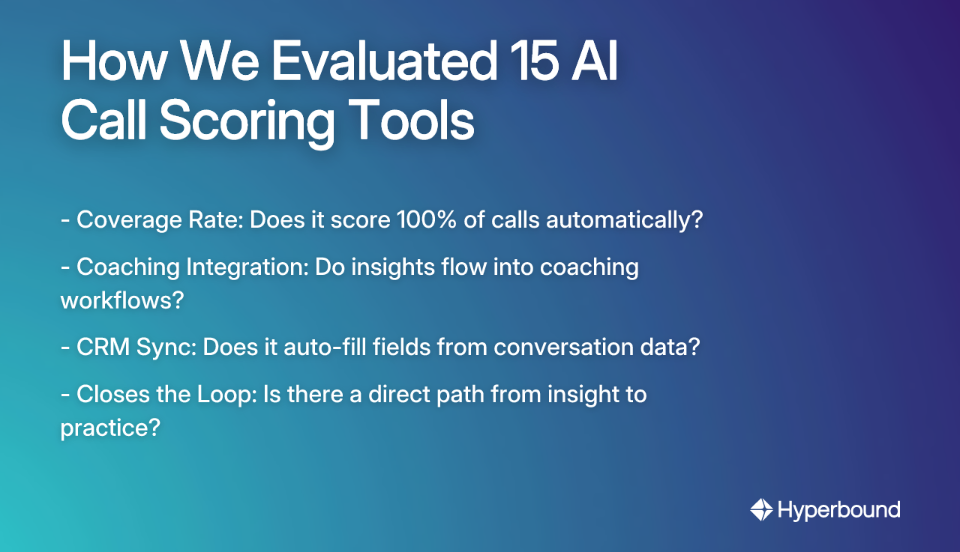
- Coverage Rate — Does it score 100% of calls automatically, or does it still rely on spot-checking?
- Coaching Integration — How easily do insights flow into coaching workflows? Can a manager act directly from a flagged call?
- CRM Sync — Does it auto-fill fields from conversation data, or just log activity?
- Closes the Loop (Insight to Practice) — This is the critical one. When the tool identifies a skill gap, does it provide a direct path to practicing that specific skill — or does the insight just sit on a dashboard?
The 15 Best AI Call Scoring Software Tools
1. Hyperbound Perform
Category: Revenue Activation Platform Best For: Sales teams that want AI call scoring and a direct path to behavior change — not just analytics.
Hyperbound Perform sits at the center of what Hyperbound calls the Revenue Activation loop: Score Real Calls → Identify Skill Gaps → Practice Roleplays → Score Real Calls again. It's the only platform purpose-built to close the gap between call performance data and actual rep improvement.
Key Features:
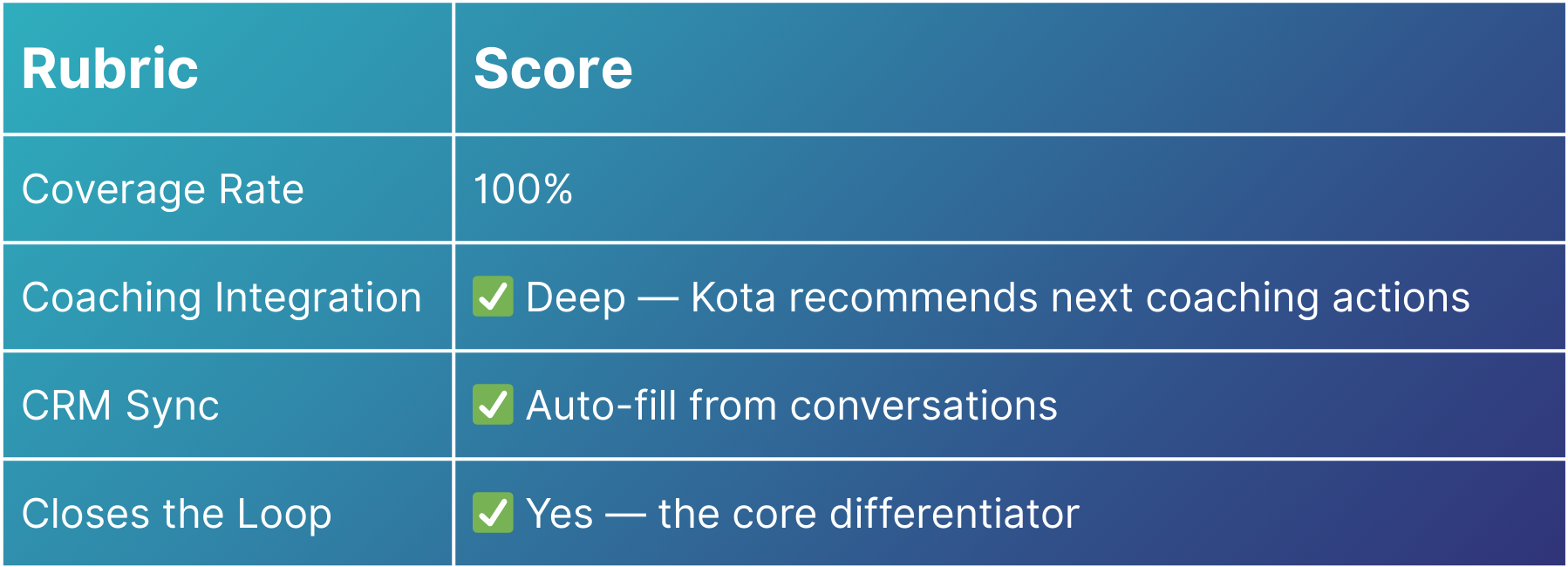
- AI Real Call Scoring: Automatically scores 100% of customer conversations using custom methodology scorecards (MEDDIC, BANT, or your own framework). Integrates with Gong, Salesloft, Chorus, and other recorders.
- AI Deal Coaching: Goes beyond single-call analysis. Looks across all calls in a deal to surface deal health signals, identify what's helping or hurting momentum, and recommend deal-winning next steps.
- Bitesized Roleplays: When Perform identifies a skill gap — say, weak objection handling on pricing — it recommends a targeted AI roleplay from Hyperbound Practice to address it directly.
- Auto-CRM Fill: Updates CRM fields automatically from call content, eliminating manual data entry and improving data hygiene.
- Kota Activate: Hyperbound's AI assistant that sits above Practice and Perform, orchestrating personalized coaching interventions at the right moment.
Results: Vanta used Hyperbound to cut ramp time by 60% (from 210 to 72 days). Nivoda saw a 150% increase in demo conversion rates and 2x revenue YoY. These aren't dashboard metrics — they're revenue outcomes driven by behavior change.
2. Gong.io
Category: Sales Conversation Intelligence Best For: Enterprise teams wanting a robust revenue intelligence platform with strong deal analysis and forecasting.
Gong is the category leader in conversation intelligence. It captures and analyzes calls, meetings, and emails — surfacing keyword trends, deal risk signals, and rep performance patterns at scale.
Key Features: AI-powered topic and keyword detection, automated CRM updates and call summaries, deal risk flagging, and coaching libraries with best-practice call examples.
.png)
Gong is exceptional at telling you what happened and why a deal might be at risk. The gap: when it identifies that a rep struggles with multi-threading or late-stage objections, there's no place within Gong for that rep to practice those specific skills.
3. Chorus.ai (by ZoomInfo)
Category: Sales Conversation Intelligence Best For: Teams in the ZoomInfo ecosystem who want enriched call data and deal intelligence.
Chorus analyzes calls for key moments, talk-listen ratios, filler words, and deal risk signals — with the added benefit of ZoomInfo's contact and company data enriching call context.
.png)
4. Observe.AI
Category: Call Center QA Tool Best For: High-volume contact centers focused on compliance, agent quality, and script adherence.
Observe.AI's Auto QA automatically evaluates 100% of customer-agent interactions using custom, rules-based scorecards — eliminating manual spot-checking and human bias in evaluations. Across 350+ enterprises, the company reports a 23% reduction in Average Handle Time and 97% improvement in compliance monitoring.
.png)
5. Ambition
Category: Sales Performance Management Best For: Sales leaders who want to automate coaching workflows and gamify performance metrics.
Ambition orchestrates coaching sessions, action plans, and performance check-ins based on data pulled from call recordings and CRMs. Its Coaching Orchestration™ feature turns performance signals into structured manager workflows. Users have reported 33% time savings for managers and 90% of new SDR hires meeting onboarding quotas.
.png)
6. Balto
Category: Real-Time Guidance Best For: Call centers wanting in-the-moment on-screen prompts during live conversations.
Balto listens to live calls and surfaces real-time suggestions for discovery questions, objection handling, and compliance checklists. It's genuinely useful for ensuring reps don't miss key steps — but worth noting that live coaching tools can disrupt natural conversation flow, and real-time prompts can make reps sound scripted. Best used as a safety net, not a substitute for practiced skills.
.png)
7. Dialpad AI
Category: Unified Communications (UCaaS) Best For: Teams wanting an all-in-one phone system with built-in AI call scoring and transcription.
Dialpad AI offers real-time transcription, sentiment analysis, and custom "Real-Time Assist" cards that surface when specific keywords are detected. Post-call summaries and analytics make it a solid choice for teams that want a communication platform with native AI features, rather than a dedicated analysis tool.
.png)
8. GTM Buddy
Category: Revenue Activation / Sales Enablement Best For: Teams focused on reducing ramp time through contextual content delivery and just-in-time learning.
GTM Buddy activates revenue capacity through five "Readiness Levers," including coaching precision and revenue proof. Strong on content enablement and coaching workflows, though its conversational practice capabilities are less developed than a dedicated AI call scoring and roleplay platform.
.png)
9. Salesloft
Category: Sales Engagement Best For: Teams that want call recording and basic AI call scoring integrated into their outreach cadence platform.
Salesloft includes call recording, transcription, and performance insights within its broader sales engagement suite. Coaching features are present but aren't as deep as dedicated tools. Best for teams that want one fewer tool to manage, not the most rigorous scoring depth.
10. Outreach
Category: Sales Engagement Best For: Teams running outbound sequences who want basic call intelligence without a separate platform.
Outreach's "Kaia" AI provides real-time assistance and post-call summaries, similar in scope to Salesloft. Strong for pipeline management and sequence execution — not the primary choice if AI call scoring depth is your main need.
11. MiaRec
Category: Call Center QA Best For: Contact centers needing a cost-effective, compliance-focused recording and auto-QA solution.
MiaRec delivers reliable call recording and automated quality management for contact centers. A practical choice for teams that need compliance tracking at volume without the complexity of enterprise platforms.
12. Second Nature
Category: AI Sales Roleplay Best For: Teams that want AI-simulated practice but aren't yet focused on real call scoring.
Second Nature focuses on AI roleplay simulations for sales training. It's a direct alternative to Hyperbound Practice, but lacks the connection to real call scoring data that gives Hyperbound its closed-loop advantage — the AI scenarios aren't grounded in your actual call performance.
13. Cresta
Category: Real-Time Guidance Best For: Contact centers wanting AI-assisted conversations with real-time agent suggestions.
Cresta is similar to Balto in its real-time approach — AI listens and surfaces suggestions during live calls. Well-suited for contact center environments with high script adherence needs.
14. ExecVision
Category: Conversation Intelligence Best For: Teams focused on building call libraries and onboarding new reps with curated best-practice examples.
One of the earlier conversation intelligence platforms. ExecVision's strength is in organizing recorded calls into coaching libraries. Less focused on automated scoring at scale, more on human-guided coaching workflows.
15. Fathom
Category: AI Meeting Assistant Best For: Individual reps or small teams wanting automated note-taking and call summaries.
Fathom excels at transcription and meeting summaries. Its analysis can surface informal coaching insights, but it's not purpose-built for systematic AI call scoring or sales performance management. A great free-tier starting point, not the destination.
The Decision Framework: Do You Want a Score, or Do You Want a Behavior Change?
Here's the honest reality: reviewing 2-5% of calls manually isn't scalable. You already know that. The question isn't whether to invest in AI call scoring software — it's which kind of tool actually solves your problem.
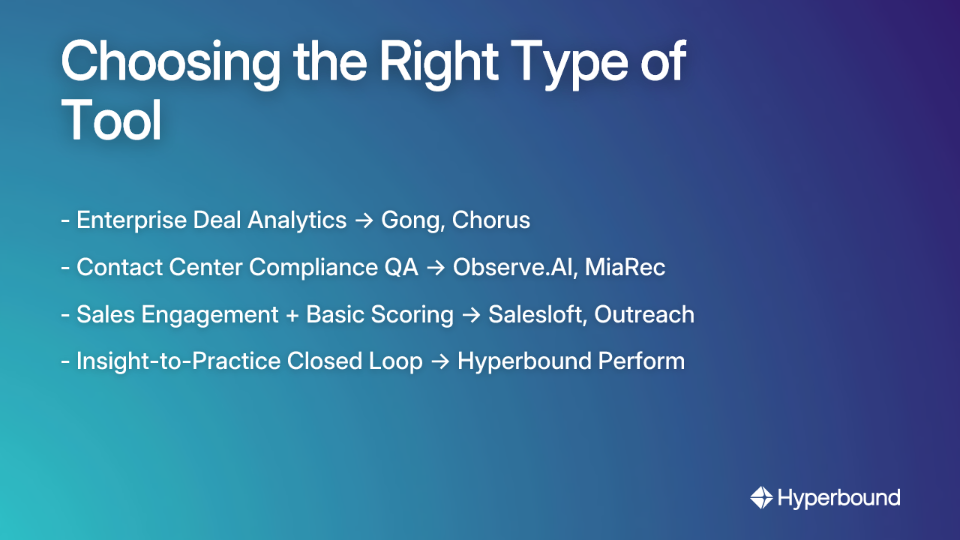
If you need enterprise-grade conversation intelligence and deal analytics, Gong and Chorus are market leaders. They build powerful dashboards, surface deal risk signals, and give managers rich context for coaching conversations. They're exceptional at answering: "What is happening in our pipeline?"
If you're running a high-volume contact center focused on compliance, Observe.AI and MiaRec are purpose-built to evaluate 100% of interactions against strict QA rubrics. They answer the question: "Are our agents following the playbook?"
But here's where most coaching initiatives hit a wall. A dashboard that shows a rep has a weak talk-listen ratio doesn't automatically improve that rep's next call. An insight that flags pricing objections as a consistent gap doesn't build the muscle memory to handle them better. This is the action gap — the distance between knowing and doing — and it's where most AI call scoring tools leave you on your own.
If you just want a score, the tools above are excellent. If you want the score to actually change rep behavior, you need a platform that closes the loop.
That's the difference Hyperbound was built to address. Hyperbound Perform scores real calls and surfaces deal-level insights. Hyperbound Practice turns those insights into AI-powered roleplays — trained on 2M+ hours of real B2B sales conversations — so reps can practice the exact skills the data says they need. And Kota Activate orchestrates the whole cycle, recommending the right coaching intervention at the right time.
The cycle looks like this: Hire → Onboard & Certify → Score Real Calls → Identify Gaps → Practice Those Gaps → Repeat. Every loop makes the team better. Every score creates a direct path to improvement, not just a record of what went wrong.
That's what Revenue Activation means in practice. And it's why teams like Vanta cut ramp time by 60%, and Nivoda doubled revenue year over year.
Frequently Asked Questions
What is AI call scoring software?
AI call scoring software is a tool that automatically listens to, transcribes, and analyzes sales calls to evaluate performance against a predefined scorecard. It moves beyond manual, random call reviews by covering 100% of conversations. This technology identifies key moments, tracks script adherence, flags deal risks, and surfaces specific coaching opportunities for sales managers, ensuring consistent and data-driven feedback.
Why is AI call scoring better than manual reviews?
AI call scoring is superior to manual reviews because it eliminates bias and provides 100% coverage, whereas managers typically only hear 2-5% of their team's calls. This comprehensive analysis ensures that coaching is based on complete data, not just a small, potentially unrepresentative sample. It saves managers significant time, allows for consistent evaluation across the entire team, and uncovers winning patterns from top performers that can be replicated.
How does AI call scoring improve sales coaching?
AI call scoring improves sales coaching by automatically identifying specific, data-backed skill gaps and coaching moments from every sales call. Instead of relying on guesswork, managers can see exactly where a rep struggles—for example, with pricing objections or discovery questions. The best platforms then link these insights directly to targeted training or practice exercises, turning a generic "do better" into a specific, actionable improvement plan.
What is the difference between conversation intelligence and revenue activation platforms?
The main difference is that conversation intelligence tools are primarily for analysis, while revenue activation platforms connect analysis directly to action and skill development. Conversation intelligence platforms like Gong are excellent at telling you what happened on a call and surfacing insights. Revenue activation platforms like Hyperbound take it a step further by not only identifying a skill gap but also providing an integrated environment (like AI roleplays) for the rep to practice and improve that specific skill, effectively closing the loop between insight and behavior change.
What does it mean to "close the loop" in sales coaching?
"Closing the loop" refers to creating a direct, automated path from identifying a performance issue on a call to providing the specific practice needed to fix it. Many tools stop at the "insight" stage—they show you a dashboard highlighting a problem. A closed-loop system, like Hyperbound, takes that insight (e.g., "rep struggled with competitor mentions") and immediately prompts a targeted AI roleplay simulation to practice handling that exact scenario. This ensures insights don't just sit on a dashboard but lead to tangible skill improvement.
Can AI call scoring integrate with my existing CRM and call recorder?
Yes, most leading AI call scoring platforms are designed to integrate seamlessly with popular CRMs and call recording systems. These integrations are crucial for a complete picture. Tools like Hyperbound can connect with recorders like Gong, Chorus, and Salesloft to analyze call data, and then sync key information, such as deal risks or updated customer information, back to your CRM automatically. This reduces manual data entry and enriches your CRM data.
Ready to stop admiring insights and start activating your team? See how Hyperbound Perform works →
Book a demo with Hyperbound


