.png)


.png)
You've just closed your biggest deal of the quarter. Your name sits at the top of the sales leaderboard. Your pipeline is healthier than ever. By all external measures, you're crushing it.
So why do you feel so hollow inside?
"I am in the midst of a depressive episode with my current role," confessed one sales professional on Reddit. "Things are objectively good, nice coworkers, positive environment, I got a base salary raise and I had my best month ever. But I've been miserable."
If this resonates with you, you're not alone. Many successful salespeople find themselves in this paradoxical position: excelling at their jobs while feeling increasingly empty, unmotivated, or even depressed.
You might even feel trapped, thinking, "I'd be a complete idiot to walk away cause I'm incredibly lucky to be here." Yet each day, you watch the clock, get minimal work done, and ask yourself, "What am I doing?"
This article will help you diagnose the root cause of your sales misery—whether it's burnout, product misalignment, or a toxic environment—and provide a framework for making meaningful changes that restore your sense of purpose and wellbeing.
The High Cost of Unhappiness in Sales
This isn't just a feeling—it's an epidemic. A Gartner Sales Survey found that nearly 90% of sales employees experience burnout.
The impact extends beyond personal wellbeing to business outcomes. Research shows that happy salespeople can close up to 37% more deals, while unhappy sellers negatively affect customer loyalty and contribute to high turnover rates.
This proves that prioritizing employee wellbeing isn't just a "soft" consideration—it's a strategic imperative with direct impact on the bottom line.
Diagnose Your Discontent: A Self-Assessment Framework
Before you can fix the problem, you need to identify its source. Here are three common diagnoses for sales misery:
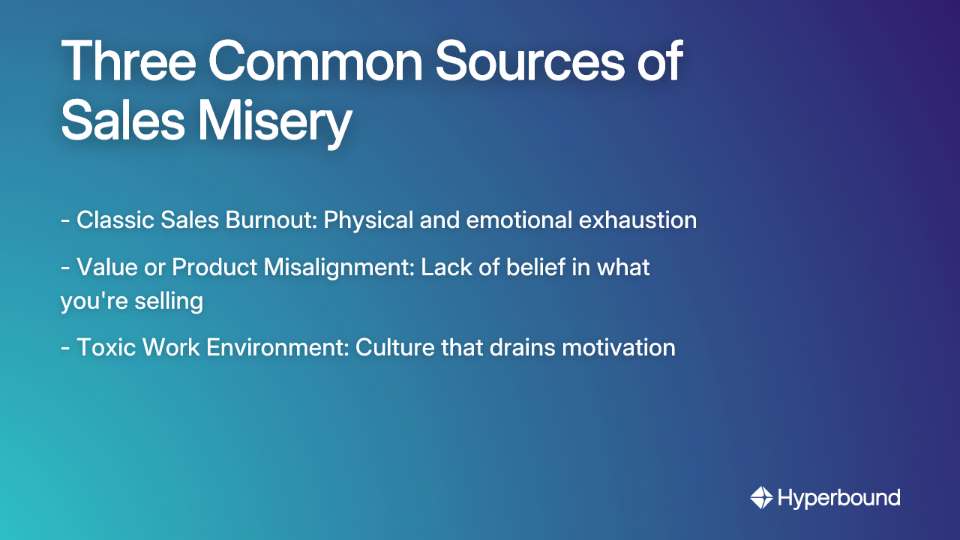
Diagnosis A: You're Experiencing Classic Sales Burnout
Burnout is a state of "physical, emotional, and mental exhaustion caused by prolonged stress and overwork in sales." It erodes performance, motivation, and can even make you physically ill.
Ask yourself:
- Does the constant rejection from cold calls erode your confidence daily?
- Are your KPIs and quota creating chronic, unending stress?
- Do you feel stagnant in your career progression, with nothing to look forward to?
- Is your work-life balance practically non-existent?
Signs to look for:
- You persistently lack energy and motivation
- Meeting your sales quota feels increasingly difficult
- You over-rely on caffeine to get through the day
- You feel the need to take mental health days just to cope
Diagnosis B: You're Facing Value or Product Misalignment
The core symptom here is the feeling, "I do not believe in our product." This fundamental disconnect creates a persistent cognitive dissonance that drains your emotional energy.
Ask yourself:
- Does your product genuinely meet customer needs, or does the sales grind feel like you're constantly trying to force a fit?
- Is there a disconnect between what your company says it values and what your customers actually value?
- Do you feel inauthentic during sales presentations because you wouldn't use the product yourself?
This misalignment leads to emotional exhaustion because it forces you to sell something that feels inauthentic, whether you're in B2B sales or covering regions like EMEA.
Diagnosis C: You're Trapped in a Toxic Work Environment
Even with a great product, a toxic culture can drain your will to succeed. It's the feeling that management "only ultimately care[s] about your result," not your wellbeing.
Ask yourself:
- Is there micromanagement that stifles your creativity and autonomy?
- Do you receive recognition for your achievements, or are your wins met with a yawn?
- Is the culture overly competitive? Over 66% of sales leaders agree that typical competitive cultures are counterproductive to happiness.
- Does leadership model the values they preach, or do they focus solely on performance metrics?
As one salesperson put it on Reddit: "If you close the biggest deal of your career and your VPs and managers yawn... you get burnt out quick even while still successful."
The Action Plan: How to Reclaim Your Career and Well-being
Now that you've identified the likely source of your misery, here's how to address each diagnosis:
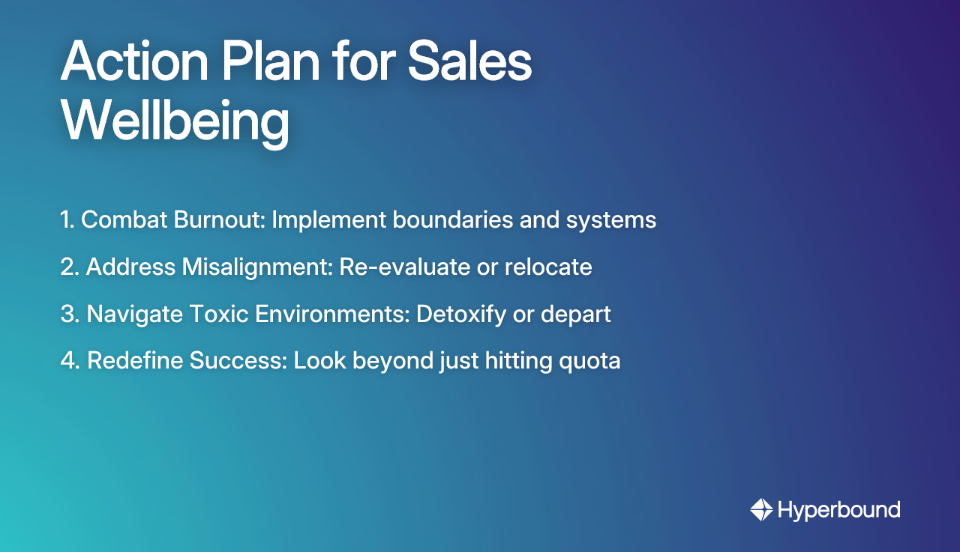
Solution A: Combating Burnout with Boundaries and Systems
Time Blocking: Organize your work hours with intention. Dedicate specific blocks for lead generation, follow-ups, and administrative tasks to create structure and reduce overwhelm.
Set Healthy Boundaries:
- Establish a firm start and end time for your workday
- Avoid after-hours work communications to protect your personal time
- Take real time off—not just superficial mental health days that are "loaded with issues"
Eliminate Chaos: Streamline your tasks and declutter your physical and digital workspace to create a more focused environment. This reduces the cognitive load that contributes to burnout.
Seek Support: Don't hesitate to engage with sales coaching or performance feedback sessions that focus on sustainable practices, not just hitting numbers. Platforms like Hyperbound's AI Coaching can provide objective feedback and a safe space to practice, helping reps build confidence without the pressure of live calls.

Solution B: Addressing Misalignment by Re-evaluating or Relocating
If You Stay: Advocate for Change
- Use customer feedback to make a case for aligning product development with actual customer needs
- Explore internal career progression opportunities like product marketing or sales enablement where you can influence the product you sell
- Get involved in refining the sales pipeline to better match customer journeys
If You Go: Find Your Fit
- Start looking for companies where you genuinely believe in the mission and product
- During interviews, ask probing questions about product-market fit and customer satisfaction
- Take advice from a fellow salesperson: "Just be you and learn to listen to what your heart truly desires. Sacrifice the deals and sales for your mental health, not the other way around," as one Redditor advised.
Solution C: Navigating a Toxic Environment by Detoxing or Departing
Attempt to Detoxify Your Current Space:
- Foster open communication with your manager about challenges and offer constructive feedback
- Lead by example: recognize the achievements of your peers and model the positive behavior you want to see
- Push for transparency in how PEPs (Performance Evaluation Plans) are developed and implemented
Plan Your Departure:
- Recognize the truth in the saying, "A bad manager will ruin the best of companies." Sometimes, you cannot fix a toxic culture.
- Interview your next company thoroughly about their culture, management style, and how they support employee wellbeing
- Look for organizations that celebrate wins authentically and invest in sales coaching and development
Redefining Success Beyond the Quota
Hitting your quota is a KPI, but it's not the only measure of a successful career. Your mental health, fulfillment, and work-life balance are the leading indicators of long-term success.
As one sales professional put it: "I feel like I'm selling my soul every day at my desk, just to be able to travel 2 weeks a year." This sentiment captures the emptiness that can come from pursuing financial success at the expense of personal fulfillment.
Feeling empty despite being successful is a valid signal that something needs to change. You now have a framework to diagnose the issue and the tools to take decisive action.
Whether you set new boundaries, find a product you believe in, or join a culture that supports you, the goal is to build a career that is both profitable and personally fulfilling. As the old adage goes, "Happiness is the key to success"—not the other way around.
Remember that the relentless sales grind of cold calls, maintaining a healthy sales pipeline, and constantly chasing your quota doesn't have to come at the expense of your wellbeing. The best salespeople don't just hit their numbers—they find sustainable ways to thrive in their roles and lives.
Your next great sales achievement might not be closing a massive deal but rather creating a work life that energizes rather than depletes you. That's a target worth hitting.
FAQs
What are the main causes of unhappiness in successful salespeople?
The primary causes of unhappiness in successful salespeople are classic sales burnout, a misalignment with the product or company values, and a toxic work environment. These factors can lead to feelings of emptiness and exhaustion, even when sales targets are being met. Burnout stems from chronic stress and overwork, misalignment from a lack of belief in what you're selling, and a toxic culture drains motivation through micromanagement or lack of recognition.
How can I tell if I'm experiencing sales burnout?
You can tell you're experiencing sales burnout if you feel a persistent lack of energy, motivation, and emotional exhaustion, even on good days. Other key signs include finding it increasingly difficult to meet your quota, feeling cynical about your work, over-relying on caffeine, and needing to take mental health days just to cope with the stress of your job.
What's the difference between product misalignment and just having a tough sales month?
Product misalignment is a fundamental lack of belief in the product's value, whereas a tough sales month is a temporary performance dip. With misalignment, you feel inauthentic and drained because you doubt the product genuinely helps customers. A tough month is stressful, but you still believe in the solution and see a path forward. Misalignment is a chronic issue; a bad month is a short-term challenge.
How can I improve my situation in a toxic sales culture if I can't leave immediately?
To improve your situation in a toxic culture, focus on what you can control by setting firm boundaries and seeking support from trusted peers. Document issues, provide constructive feedback to management if it's safe to do so, and lead by example by celebrating colleagues' wins. While you plan your exit, creating these micro-environments of positivity can help protect your mental well-being.
What practical steps can I take to combat sales burnout?
To combat sales burnout, you should implement strict boundaries, organize your schedule with time blocking, and streamline your workflow to reduce chaos. Establish firm start and end times for your workday, avoid after-hours communication, and take genuine time off. Additionally, decluttering your workspace and using tools to automate repetitive tasks can reduce cognitive load and help you regain control.
How can I redefine success in my sales career beyond hitting quota?
You can redefine success in sales by focusing on long-term, sustainable metrics that contribute to your overall well-being, not just short-term targets. This includes prioritizing work-life balance, measuring your personal and professional growth, building meaningful customer relationships, and finding fulfillment in your work. True success is creating a career that energizes you rather than one that just pays the bills.

Book a demo with Hyperbound


