

Summary
- Most B2B sales training fails teams by focusing on passive learning that is difficult to scale, measure, and connect to on-the-job performance.
- Effective programs prioritize active practice; companies that reinforce training with consistent coaching see up to 32% higher win rates.
- When evaluating solutions, ask if they provide a safe place to practice, offer objective behavioral metrics, and integrate with your team's workflow.
- AI-powered platforms like Hyperbound bridge the gap between learning and doing, helping teams reduce ramp time by up to 50% through realistic, scalable practice.
Search "B2B sales training" and you'll get a flood of self-paced video courses designed for the individual rep grinding through modules on their lunch break. Great for a solo founder trying to close their first deal. Not so great when you're a sales manager or enablement leader trying to upskill an entire SDR or AE team, track who's actually improving, and prove that the investment is changing behavior on live calls.
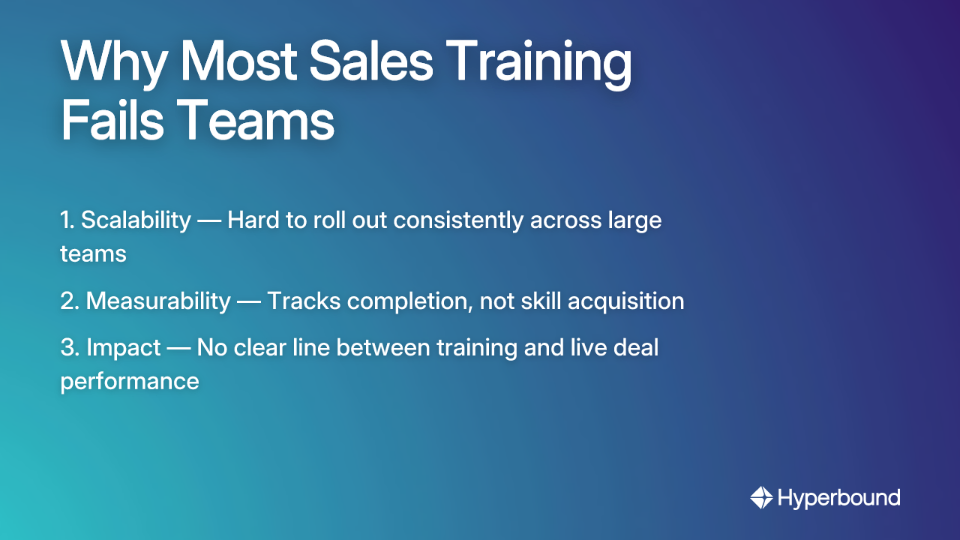
Here's the problem nobody talks about: most training programs fail teams in three specific ways.
As one sales professional on Reddit put it: "you learn B2B sales by doing it badly first" — but when you're managing a team, you can't afford to have your reps burning real deals as their training ground.
This list is different. We're evaluating programs built for teams, not solo learners. Each one is assessed on team deployment, measurability, and behavioral change — not just content quality. We've also structured the list by role, so you can match the right program to the right stage of your team's development.
1. Hyperbound Practice — For SDR & AE Onboarding, Methodology Rollouts, and Continuous Skill Development
Best for: SDR onboarding, AE discovery mastery, new product launches, and ongoing rep readiness across the full revenue team.
Hyperbound Practice is the only B2B sales training solution that lets reps practice against AI buyer personas built from analysis of 2M+ hours of real B2B sales conversations — not generic scripts. That distinction matters. When your SDR practices a cold call with an AI persona that actually pushes back like a real CFO, they learn faster and retain more than they would from any video course.
Team Deployment: Hyperbound integrates directly with your existing LMS and CMS, so you can embed AI roleplays into structured onboarding paths and certification tracks. A centralized analytics dashboard lets managers track performance, skill development, and training completion across the entire organization. For global teams, multilingual support across 25+ languages means you can roll out a consistent program whether your reps are in San Francisco or Singapore.
Measurability: After every simulation, reps and managers receive AI scorecards with objective, instant feedback — covering talk ratios, key selling moments, and adherence to your specific sales methodology (MEDDIC, Challenger, SPIN, whatever your team runs). You're not guessing whether training landed. You have data tied to your actual playbook.
Behavioral Change: This is where Hyperbound earns its place at the top of this list. Reps can practice cold calls, discovery, demos, objection handling, renewals, and upsells hundreds of times in a risk-free environment before touching a live deal. The AI personas respond dynamically, creating realistic pressure without the cost of a blown opportunity.
The results speak for themselves:
- 50% faster ramp across customers
- 150% increase in DM → demo conversion rate
- Vanta achieved a 60% ramp reduction (from 210 days down to 72 days) while scaling their BDR team 4x and 5x pipeline — Stevie Case, CRO at Vanta
- Nivoda saw 50% ramp reduction and 2x revenue YoY — Rob Rangel, Director of Sales Performance
Hyperbound also forms the foundation of a continuous improvement loop: real call data from Hyperbound Perform surfaces skill gaps, which feed directly into targeted practice scenarios, closing the gap between what reps practice and what they face on live calls.
2. HubSpot Academy / LinkedIn Learning — For Foundational Knowledge
Best for: New hire onboarding on sales fundamentals, product knowledge, and company processes.
Free resources like HubSpot Academy and LinkedIn Learning are solid starting points for getting SDRs up to speed on the absolute basics — the sales funnel, ICP, cold outreach mechanics, and CRM hygiene. The community consensus is clear: "Start with free courses on HubSpot Academy or LinkedIn Learning to grasp the basics."
Team Deployment: Both platforms support team assignments and manager dashboards, making it easy to assign courses to new hire cohorts and track completion at scale.
Measurability: Progress is tracked through quizzes and completion rates — useful for confirming knowledge transfer, but limited in assessing whether reps can apply what they've learned in a real conversation.
Behavioral Change: These platforms deliver the "what" and the "why." They don't deliver the "how." Reps who finish a course on cold calling still need somewhere to practice cold calling. Pair these programs with a simulation environment like Hyperbound to bridge that gap.
3. Challenger Sale / SPIN Selling — For Advanced AE Discovery Mastery
Best for: Tenured AEs navigating complex, multi-stakeholder deals where insight-led selling matters.
Methodology programs like Challenger and SPIN Selling are designed to transform experienced AEs from order-takers into trusted advisors. This matters most in the mid-market and enterprise, where — as real practitioners note — "larger deals attract more competition, and champions can only do so much."
Team Deployment: Typically delivered through certified third-party trainers via multi-day workshops (virtual or in-person), followed by manager-led reinforcement coaching. Rollout quality depends heavily on manager buy-in.
Measurability: Challenging to measure in the short term. Teams typically track deal size, win rates, and sales cycle length as lagging indicators. Roleplay exercises exist within these programs, but scoring tends to be subjective.
Behavioral Change: When it sticks, it's transformational — reps genuinely change how they run discovery and handle objections. But retention drops sharply without consistent reinforcement. The methodology training tells reps what to do; they still need repetitions to make it automatic.
4. MEDDIC / MEDDPICC Frameworks — For Mid-Market and Enterprise Teams
Best for: AE and SE teams executing account-based motions in complex, multi-stakeholder deals.
When your reps are chasing deals that require "many departments to approve the spend," MEDDIC gives teams a shared language and qualification framework for managing that complexity. It's less of a training program and more of a structured operating model for the sales floor.
Team Deployment: MEDDIC workshops are often customized to the company's specific deal motion and CRM configuration, ensuring that qualification criteria map directly to fields your team tracks in Salesforce or HubSpot. The framework becomes most powerful when it's embedded in your deal review process — not just a standalone training.
Measurability: The most measurable output is CRM field adherence. Are your AEs identifying the economic buyer? Is the decision criteria documented? Managers can inspect pipeline quality using MEDDIC as a diagnostic, making this one of the more operationally traceable frameworks on this list.
Behavioral Change: MEDDIC fosters more disciplined, multi-threaded selling. Reps stop relying on a single champion and start mapping the full buying committee — a critical shift for mid-market teams moving upmarket.
5. Conversation Intelligence Platforms — For Data-Driven Coaching
Best for: Frontline managers who want to coach from evidence, not intuition.
Conversation intelligence platforms record, transcribe, and analyze 100% of a team's calls — surfacing what top reps do differently and flagging coaching opportunities across the board. For managers who can't sit on every call, it's a scalable way to stay connected to what's actually happening in deals.
Team Deployment: Platform-wide rollout with automatic call ingestion, team dashboards, and coaching playlists. Integration with Salesforce and other CRMs means deal context travels with the call data.
Measurability: Highly measurable. Track talk-to-listen ratios, competitor mentions, topic coverage, and call outcome trends at the individual and team level.
Behavioral Change: Here's the important caveat — conversation intelligence shows you what to fix. It does not give reps a place to practice fixing it. Seeing a clip of yourself fumbling an objection is humbling; but without a structured way to rehearse a better response, the insight often doesn't translate to the next live call. This is why teams increasingly pair conversation intelligence platforms with Hyperbound Practice: one diagnoses the gap, the other closes it.
6. AI Post-Sales Roleplays — For Customer Success and Account Management Teams
Best for: CSMs and AMs preparing for renewals, QBRs, upsells, and difficult customer conversations.
Post-sales teams are often left out of the B2B sales training conversation entirely. But the conversations that drive Net Revenue Retention are just as high-stakes as any cold call. Hyperbound's AI Post-Sales Roleplays give CSMs and AMs a dedicated practice environment for the scenarios that matter most — renewal negotiations, executive QBRs, churn risk de-escalation, and expansion conversations.
Team Deployment: Purpose-built scenarios for post-sales teams can be rolled out organization-wide using the same LMS integrations as Hyperbound Practice, creating consistency in how your entire customer-facing organization handles critical touchpoints.
Measurability: Custom scorecards built for customer conversations — not recycled sales scorecards — track improvement in value articulation, pricing objection handling, and expansion positioning. The upstream metric that matters: NRR.
Behavioral Change: Practicing a difficult renewal conversation with a frustrated churning customer AI persona — before doing it live — is the difference between a CSM who freezes and one who leads with confidence. The safe-to-fail environment builds the muscle memory that high-stakes conversations demand.
7. Sales Manager Coaching Development — For Frontline Leaders
Best for: Sales managers who need to shift from deal inspection to behavior-focused coaching.
You can invest in the best B2B sales training programs in the world and still see mediocre results if your frontline managers don't know how to reinforce what reps are learning. Research consistently shows that companies with consistent sales coaching see 32% higher win rates and 28% higher quota attainment.
Team Deployment: Leadership development programs are typically delivered through cohort-based workshops, peer coaching circles, and structured manager mentorship. The most effective versions are tied directly to the team's training program — so managers are coaching to the same competencies reps are practicing.
Measurability: Manager impact shows up in lagging indicators: quota attainment, rep retention, deal velocity on their team. Some programs use 360-degree feedback and coaching frequency metrics to add leading indicators.
Behavioral Change: The goal is a fundamental shift — from managers who review deals to managers who develop people. When that shift happens, the training your reps receive stops being a one-time event and becomes part of how your team operates every day.
How to Choose the Right B2B Sales Training Program: A 4-Question Buying Framework
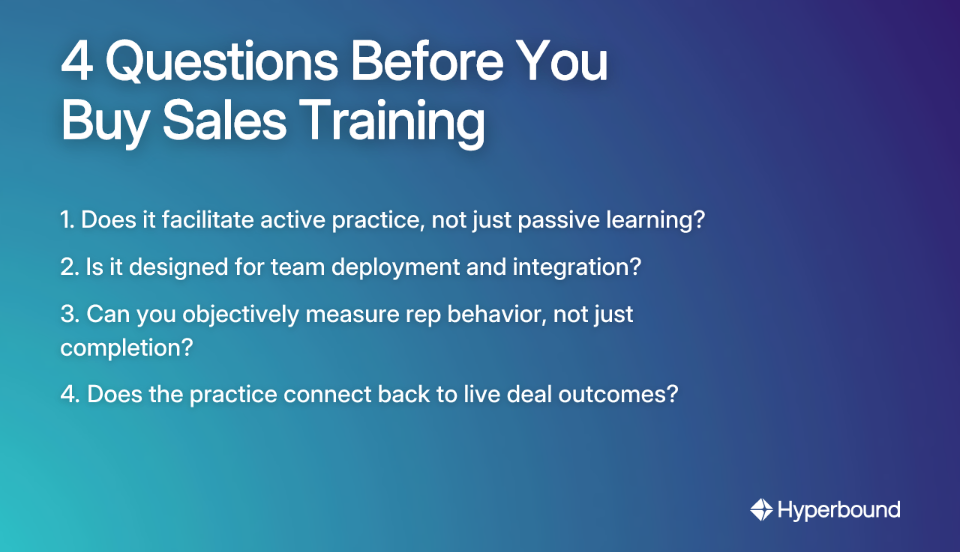
Before you sign a contract, run any program through these four questions. They're designed to separate programs built for team impact from programs built for solo learners dressed up in enterprise packaging.
1. Does it facilitate active practice, not just passive learning?
Most programs deliver content. Your team needs a place to apply it. Ask vendors whether their platform offers a safe, repeatable environment where reps can practice new skills before taking them to live calls — and whether that practice is realistic enough to actually build the right habits. AI roleplays with dynamically responsive buyer personas are the current gold standard.
2. Is it designed for team deployment and integration?
Can you roll this out to 100 reps without a custom implementation project? Does it integrate with your CRM and LMS so it lives inside your team's existing workflow — not as a separate tab no one opens? A program that operates outside your team's daily systems will be ignored within 60 days of launch.
3. Can you objectively measure rep behavior, not just completion?
This is the most important question most buyers forget to ask. Push past "we track completion rates" and ask: "Can you measure my reps' behavior before and after the training?" Look for platforms that score reps against your actual sales methodology — so you get objective, comparable data on whether behavior is changing, not just whether boxes are checked.
4. Does the practice connect back to live deal outcomes?
This is the ultimate test of any training program. The best systems close the loop: they analyze real calls to identify skill gaps, assign targeted practice for those exact gaps, and then measure whether performance improves on the next live deal. That closed loop — from real call behavior to practice to improved performance — is the core idea behind Hyperbound's Revenue Activation Platform, where data doesn't sit in a dashboard; it drives outcomes.
The Bottom Line
The era of treating B2B sales training as a self-paced video library is over — at least for teams that want to win. The programs on this list earn their place because they're built for scale, measure behavior rather than just completion, and create real pathways from practice to performance.
The right combination will look different for every team. But the through line is the same: your reps need to practice real conversations, managers need data to coach from, and the system needs to close the loop between what happens in training and what happens on live deals. When you make that shift — from informing your team to actually transforming them — you stop treating training as an expense and start treating it as the engine behind your revenue.
Frequently Asked Questions
What is the best B2B sales training program for teams?
The best B2B sales training program for teams is one that prioritizes active practice, is built for team-wide deployment, allows for objective measurement of behavior, and connects directly to live deal outcomes. While the ideal program depends on your team's specific needs, platforms that offer AI-powered practice like Hyperbound are often most effective for skill development, while methodologies like MEDDIC or Challenger are suited for advanced strategic selling.
Why do most B2B sales training programs fail?
Most B2B sales training programs fail because they focus on passive learning and lack the infrastructure for team-wide scalability, objective measurability, and demonstrating a clear impact on performance. They often track course completion rather than true skill acquisition, and they don't provide a way for reps to practice what they've learned, meaning the knowledge isn't retained or applied on live calls.
How can I measure the ROI of sales training?
You can measure the ROI of sales training by tracking changes in leading indicators (rep behaviors like methodology adherence or talk-to-listen ratios) and connecting them to improvements in lagging indicators (business outcomes like quota attainment, win rates, and ramp time). Modern training platforms provide objective scorecards and analytics that move beyond simple completion rates to measure actual behavioral change.
How do AI roleplays improve sales training?
AI roleplays improve sales training by giving reps a safe, scalable, and consistent environment to practice real-world conversations. Unlike roleplaying with a manager, an AI can provide instant, unbiased feedback and can be used by reps hundreds of times to build muscle memory for handling objections, running discovery calls, and navigating difficult negotiations before they face a live customer.
What training is best for new SDRs vs. tenured AEs?
New SDRs benefit most from foundational training combined with high-repetition practice on core tasks like cold calling and objection handling. Tenured AEs require more advanced training focused on mastering complex sales methodologies like Challenger or SPIN to navigate multi-stakeholder deals. The key is matching the training to the role's specific challenges and skill requirements.
How does sales coaching fit into a training program?
Sales coaching is essential for reinforcing what reps learn in a training program. Effective coaching uses data and evidence from platforms like conversation intelligence or AI practice tools to identify specific skill gaps. Managers can then provide targeted feedback and use the training platform as a tool for reps to practice and improve, creating a continuous development loop rather than a one-time training event.
Book a demo with Hyperbound


