

.png)
You're on a discovery call that's going well. The conversation flows naturally, rapport is building, and you're making good progress understanding your prospect's needs. Then, you ask what seems like a simple question: "Why haven't you addressed this issue before?"
Suddenly, the mood shifts. Your prospect becomes guarded, their answers get shorter, and the momentum dies. What happened?
The culprit might be hiding in plain sight: the word "why."
As one sales professional on Reddit puts it, "Questions that start with 'Why' are always the heaviest and should be seldom used." This single word can feel confrontational and discourage the open dialogue needed to advance your sales cycle.
In this article, we'll explore the psychology behind why 'why' questions kill deals and, more importantly, provide powerful alternatives using 'what' and 'how' that transform interrogations into collaborative conversations.
The Psychology of the 'Heavy' Question: Why 'Why' Puts Prospects on Defense
'Why' Implies Judgment
'Why' questions are considered the "heaviest" in sales because they often trigger defensive responses, making prospects feel cornered or judged. According to Firestarter Solutions, these questions force the prospect to justify past actions or decisions, which can feel like an accusation.
Consider questions like:
- "Why did you choose that vendor?"
- "Why haven't you solved this problem yet?"
- "Why is your current process set up this way?"
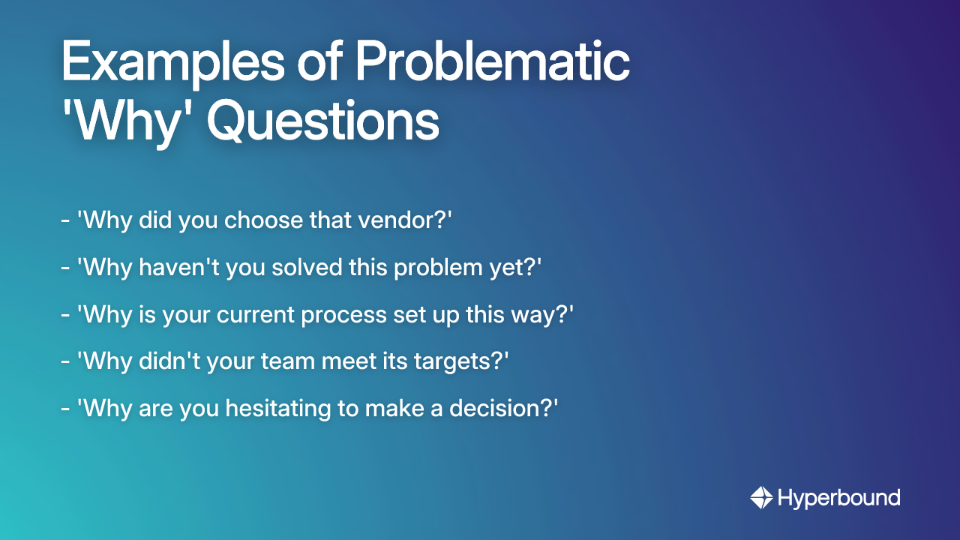
Each implies there might be something wrong with the prospect's decision-making, triggering a need for justification.
The Defensive Reaction
When faced with a 'why' question, a prospect's protective instincts kick in. RAIN Sales Training notes that this often leads to guarded, less truthful answers that kill the rapport you've worked to build.
This defensive posture is particularly problematic because, as sales professionals have observed, reps already "struggle to get clear answers from prospects." When the walls go up, genuine discovery stops.
The Empathy Imperative
Harvard's Mark Roberge emphasizes that the key to better sales is empathy. As reported by Forbes, successful conversations should be centered on understanding the prospect's world, not pushing a product or challenging their history.
Asking 'why' often runs counter to this empathetic approach, creating distance rather than connection.
The Strategic Shift: Unlocking Conversations with 'What' and 'How'
Using 'What' Questions for Fact-Based Exploration
'What' questions aim to explore possibilities and gather factual information without the emotional weight of blame or pressure. They seek clarity rather than justification, allowing you to peel back the layers of the onion without triggering defensiveness.
According to Aslan Training, this subtle shift makes a profound difference in how prospects respond:
Instead of: "Why do you feel this way?"
Ask: "What led you to this conclusion?"
The first asks for an emotional defense; the second asks for a logical story.
Using 'How' Questions for Process and Vision
'How' questions encourage prospects to elaborate on their processes, thoughts, and future strategies. They help the prospect visualize a path forward, often with your solution as part of it.
Instead of: "Why haven't you implemented this yet?" (which implies failure)
Ask: "How do you currently address this challenge?"
This reframes the conversation from a past shortcoming to a future collaboration, a key aspect of Sandler thinking that emphasizes partnership rather than interrogation.
From Interrogation to Conversation: Your Script for Better Questions
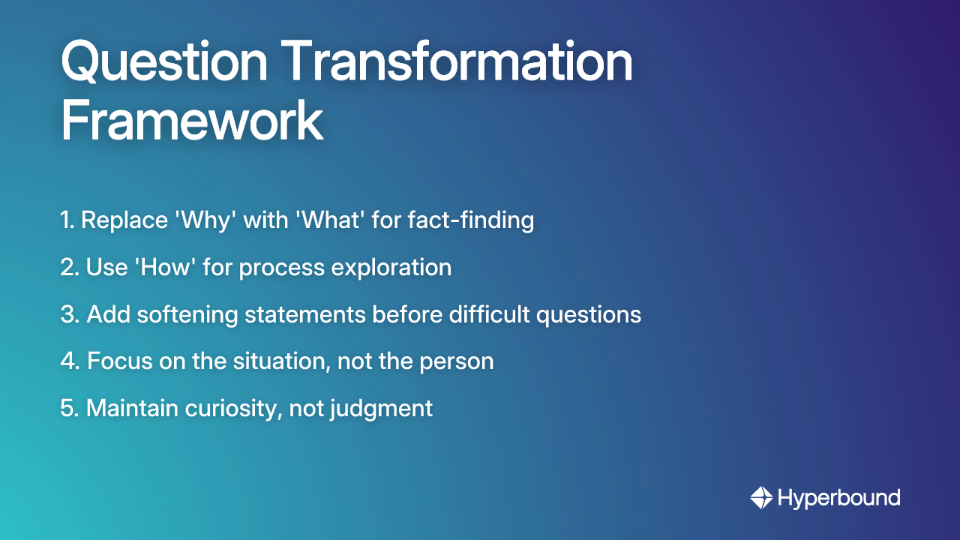
This shift isn't just theoretical—it's practical. Here's how to rephrase common 'why' questions into more effective alternatives:
Uncovering Priorities and Motivations
Instead of: "Why is this important to you?"
Ask: "What makes this a priority for you right now?"
Instead of: "Why are you looking to change vendors?"
Ask: "What inspired you to look for a solution now?"
These open-ended questions encourage prospects to share their motivations without feeling interrogated.
Diagnosing Past Challenges
Instead of: "Why wasn't your last initiative successful?"
Ask: "What challenges did you face with your previous initiative?"
Instead of: "Why did your previous vendor fail to meet your needs?"
Ask: "What specific needs were not met by your previous vendor?"
Notice how these questions focus on the situation rather than the person, removing implied blame.
Understanding Decision-Making Factors
Instead of: "Why did you decide to change suppliers?"
Ask: "What factors influenced your decision to explore new options?"
Instead of: "Why aren't you considering our solution?"
Ask: "What factors are most important to you in choosing a solution?"
These alternatives maintain the goal-oriented questioning approach while eliminating the accusatory tone that can derail conversations.

Beyond Word Swapping: Building a Truly Consultative Dialogue
Transforming your questioning technique isn't just about swapping words—it's about adopting a truly consultative mindset. Here are four big general rules to elevate your approach:
Tip 1: Use a "Nurturing Statement" to Soften Your Approach
Direct questioning can feel confrontational even with the right words. A softener or nurturing statement creates a safe space for honest answers.
Without softener: "What challenges are you facing with your current solution?"
With softener: "Many teams we work with struggle with similar systems. What challenges have you encountered with your current solution?"
This approach acknowledges the prospect's experience before you probe deeper, creating space for honest responses. It demonstrates empathy while maintaining your position as a trusted advisor.
Tip 2: Master the Balance of Inquiry and Advocacy
Great sales conversations are a two-way street. Don't just extract information; provide value. Balance asking questions (inquiry) with educating and advising (advocacy).
RAIN Sales Training suggests using the Reciprocity Principle: By providing insightful answers using stories, metaphors, or clear procedures, you encourage prospects to engage more deeply and ask you questions in return.
For example, after a prospect shares a challenge, respond with: "That's interesting. We've seen similar situations with other clients. Here's what typically causes that issue..." This demonstrates value before asking your next question.
Tip 3: Sequence Your Questions for a Natural Flow
As suggested by Spotio, effective conversations often move from broad to narrow, creating a natural progression that doesn't feel like an interrogation:
- General Discovery: "What's the most challenging part of your current process?"
- Needs or Pain-based: "What prevents you from hitting your goals with the current approach?"
- Impact or Benefit-driven: "How would solving this problem impact your team's performance?"
- Quiet Assumptive Close: "What would it take to implement a solution in the next quarter?"
This sequence helps you use springboard questions that naturally lead from one topic to the next, creating a conversation rather than an interrogation.
Tip 4: Practice Active Listening to Make Questions Count
The most powerful open-ended questions are useless if you're just waiting for your turn to talk. Show genuine curiosity and give the prospect space to think and speak without interruption.
Many salespeople fail to thoroughly investigate buyers' problems, missing key opportunities. Resist the urge to rush through your list of questions or immediately pitch solutions. Instead, listen intently and ask thoughtful follow-up questions that demonstrate you're processing what they're saying. For reps looking to build this muscle, practicing with AI sales roleplay tools can provide a safe environment to hone active listening skills without risking live deals.
This approach builds the trust required for prospects to share their real pain points and creates the finesse needed for successful sales interactions.
Transform Your Sales Conversations Today
Swapping accusatory 'why' questions for exploratory 'what' and 'how' questions is a simple yet profound shift that moves you from salesperson to trusted advisor. By using TED questioning (Tell me, Explain to me, Describe to me), you create space for prospects to open up rather than defend.
This technique reduces resistance, encourages openness, and allows you to uncover the critical information needed to solve your prospect's actual problems, not just sell your product.
Before your next sales call, review your script. Find just one "why" question. Replace it with a "what" or "how" alternative from this guide. Observe the change in tone and the depth of the response you receive. With practice, this small change in your questioning technique will yield significantly better results in your sales conversations. To accelerate this learning curve, tools like Hyperbound's AI Sales Roleplays provide a space for reps to practice and master these skills in a simulated, risk-free environment.
Remember, the goal isn't just to gather information—it's to build the kind of relationship where prospects willingly share their challenges because they trust you to help solve them. That's the true power of asking the right questions.
Frequently Asked Questions
Why are 'why' questions considered bad in sales?
'Why' questions are considered bad in sales because they often sound accusatory and put prospects on the defensive. This happens because asking "why" can imply judgment, forcing the prospect to justify their past decisions or actions, which shuts down open and honest conversation.
What are good alternatives to asking 'why' in sales?
The best alternatives to 'why' questions are 'what' and 'how' questions. 'What' questions are excellent for fact-based exploration (e.g., "What led you to this conclusion?"), while 'how' questions help you understand processes and future plans (e.g., "How do you currently address this challenge?").
How can I rephrase a question like "Why haven't you solved this problem yet?"
You can rephrase "Why haven't you solved this problem yet?" to be more collaborative and less confrontational. A better alternative is, "What challenges have you faced when trying to address this problem in the past?" or "How have you been managing this issue so far?" This shifts the focus from blame to understanding their situation.
How do 'what' and 'how' questions improve sales discovery calls?
'What' and 'how' questions improve discovery calls by transforming an interrogation into a collaborative conversation. They encourage prospects to share information about their needs, processes, and motivations without feeling judged, which helps you build rapport and uncover the critical details needed to provide a valuable solution.
What is a "nurturing statement" and how does it work?
A nurturing statement is a phrase used to soften a direct question and show empathy. For example, instead of just asking about challenges, you could say, "Many teams we work with face similar issues. What challenges have you encountered?" This technique validates the prospect's experience and creates a safer environment for them to share openly.
Is it ever okay to ask 'why' in a sales conversation?
While it should be used sparingly, a 'why' question can be effective if you have already built strong rapport and trust with the prospect. In these cases, it should be framed with genuine curiosity to understand their deeper motivations, such as, "That's a really interesting point. Can you tell me a bit more about why that's such a key priority for the business right now?"
How can I get better at asking the right sales questions?
You can get better at asking sales questions through conscious practice and active listening. Start by reviewing your call script to replace 'why' questions with 'what' and 'how' alternatives. Practicing in a low-stakes environment, such as with colleagues or using AI sales roleplay tools, can help you master these techniques without risking live deals.

Book a demo with Hyperbound


