.png)


.png)
Summary
- Manual sales personalization is unsustainable; reps often spend 20 minutes per prospect for a mere 2% response rate, making it impossible to build a pipeline at scale.
- AI telemarketing solves this by automating personalized outreach, allowing you to engage thousands of prospects daily with dynamic, human-like conversations.
- The most effective strategy is a hybrid model: use AI for top-of-funnel qualification and transfer warm, interested leads to human reps for closing.
- To maximize conversions from AI-qualified leads, your sales team must be prepared for the warm handoff. Use AI Sales Roleplays to ensure your reps can master the critical conversations that close deals.
You've spent another evening crafting meticulously personalized emails to prospects. Twenty minutes per email, careful research on each company, thoughtful references to their recent achievements. And what do you have to show for it? A measly 2% response rate and a growing pile of untouched leads that's giving you anxiety every time you look at your CRM.
"It takes me like 20 minutes to write one good email, and I just can't send enough volume to make it worth it," as one frustrated sales professional put it on Reddit. If this sounds familiar, you're caught in the personalization paradox: the very strategy meant to help you connect with prospects is actually preventing you from reaching enough of them to build a sustainable pipeline.
The truth is, that level of manual personalization is simply not sustainable. Many sales professionals have tried this approach only to burn out fast, watching their lead lists pile up while their conversion rates remain stubbornly low.
But here's the good news: there's a better way. AI telemarketing is revolutionizing how businesses approach personalized outreach by delivering the human touch at a scale that was previously impossible.
This isn't about blasting robotic, pre-recorded messages to unwilling recipients. Modern AI telemarketing uses conversational AI to create dynamic, personalized interactions that feel natural while dramatically increasing your reach. Best of all, it frees your human team to focus on what they do best—building relationships and closing deals.
In this article, you'll discover how to implement an AI telemarketing strategy that automates outreach, qualifies leads, and books appointments, all while maintaining a natural, human-like feel that your customers will appreciate.
The Personalization Problem: Why Manual Outreach Fails at Scale
"Twenty minutes per email is insane and you'll never build a real pipeline at that pace," noted one business owner in an online discussion about outreach strategies. This perfectly captures the inefficiency trap of manual personalization.
Let's do the math: At 20 minutes per prospect, a sales rep working 8 hours can only reach 24 prospects per day. Factor in other responsibilities, and that number drops even lower. With conversion rates hovering around 2%, you'd need to contact hundreds of prospects to generate meaningful results—a nearly impossible task for a manual approach.
Yet despite these challenges, personalization remains essential. The initial moments of a call are critical for building rapport and trust. Using a prospect's name, referencing past interactions, and acknowledging their specific pain points makes them feel valued and creates an instant connection.
Research consistently shows that personalized offers lead to significantly higher conversion rates and improved customer retention. Generic, one-size-fits-all approaches simply don't cut it in today's competitive landscape.
The challenge, then, isn't to abandon personalization but to find a way to execute it efficiently and at scale. This is precisely where AI telemarketing enters the picture.
What Is AI Telemarketing? (And Why It's Not Your Grandfather's Robocall)
Before we dive deeper, let's clarify what modern AI telemarketing actually entails:
AI Telemarketing involves using virtual agents to handle repetitive sales tasks like initiating contact, lead qualification, answering inquiries, and following up with prospects. The goal is to enhance outreach by automating routine telemarketing and engaging prospects consistently. These systems can operate 24/7, eliminating hold queues and dramatically expanding your reach.
More specifically, an AI Sales Development Representative (SDR) automates outbound sales prospecting, outreach, and meeting scheduling. It uses machine learning and natural language processing (NLP) to engage prospects with human-like personalization at scale.
It's crucial to understand that modern AI telemarketing is worlds apart from old-school robocalls. Those static, pre-recorded messages that interrupted dinner with offers for duct cleaning services have given way to dynamic, interactive conversations powered by advanced NLP.
Today's systems can understand context, intent, and even handle interruptions, providing a genuinely human-like conversational experience. This isn't about blasting a scripted message; it's about having a real conversation driven by intelligent software.
The Power of AI: Tangible Results from Personalization at Scale
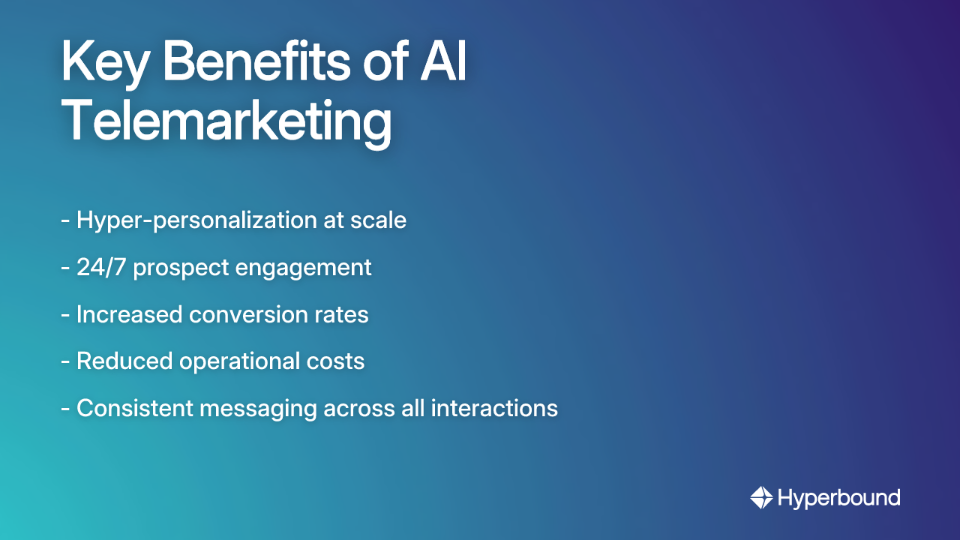
The benefits of AI telemarketing aren't theoretical—they're measurable and significant:
Unmatched Efficiency and Scalability
While a human SDR can manage 50-100 prospects per day, an AI SDR can handle thousands simultaneously while maintaining hyper-personalized messaging. AI agents are available 24/7, engaging prospects outside traditional business hours and eliminating the limitations of human capacity.
Proven Performance Uplift
Real-world case studies demonstrate the impact of AI telemarketing:
- A Medical Clinic achieved a +60% increase in scheduling efficiency, 2.5x more booked appointments, a -30% reduction in no-show rates, and a +25% rise in patient satisfaction in one notable case study.
- Freshworks (SaaS) automated 65% of their routine calls, saw a 75% reduction in customer wait times, and doubled their response rate.
Broader Business Impact
Beyond these direct benefits, AI telemarketing delivers:
- Increased ROI: AI-driven personalization engines reduce wasted efforts on irrelevant outreach, focusing your resources where they'll have the most impact.
- Cost Reduction: AI eliminates the hiring, training, and overhead costs associated with a large human telemarketing team.
The data is clear: AI telemarketing delivers personalization at scale without sacrificing quality, resulting in better business outcomes across multiple metrics.
The Human Touch: A Blueprint for Avoiding the "Robotic" Feel
One of the most common concerns about AI telemarketing is captured in this question from a Reddit user: "How's the 'natural conversations' piece hold up in a long call or tricky scheduling scenarios?"
It's a valid concern. For AI telemarketing to be effective, it must maintain that human touch. Here's how to ensure your implementation avoids the robotic feel:
Principle 1: It All Starts with Data
The biggest challenge to personalization at scale is data fragmentation. To overcome this, build Unified Customer Profiles using a Customer Data Platform (CDP) to consolidate first-party and zero-party data. This gives the AI a complete picture of each customer.
This unified data allows for more than just inserting a prospect's name. Train your AI to reference purchase history, previous interactions, and known preferences to create truly relevant conversations.
Principle 2: Invest in Advanced Conversational AI
Not all AI platforms are created equal. Seek out solutions that can:
- Understand context and intent
- Handle interruptions gracefully
- Maintain a friendly, natural tone
Look for voice customization features that allow you to select an AI voice that aligns with your brand for consistency and trust.
Principle 3: Embrace the Hybrid Model
The most effective approach combines AI and human expertise:
- AI excels at automating early-stage, repetitive tasks: lead qualification, answering common questions, and scheduling follow-ups.
- Human agents are irreplaceable for tasks requiring emotional intelligence, complex negotiation, and building deep relationships—especially for closing high-value deals.
But for this hybrid model to succeed, your human reps must be ready to perform at their best when that warm transfer happens. This is where AI Sales Coaching platforms like Hyperbound become essential. By analyzing your top performers' calls, Hyperbound helps you codify what "good" looks like and then scales that coaching across your entire team. Reps can practice critical conversations in hyper-realistic AI roleplays, ensuring they're prepared to handle any scenario and turn qualified leads into closed deals.
Use AI to sift through leads and handle initial outreach, then implement warm transfers to pass qualified, interested prospects seamlessly to a live agent who has been trained to win.
Putting It Into Practice: Launching Your AI Telemarketing Campaign
Ready to implement AI telemarketing in your business? Follow these steps:
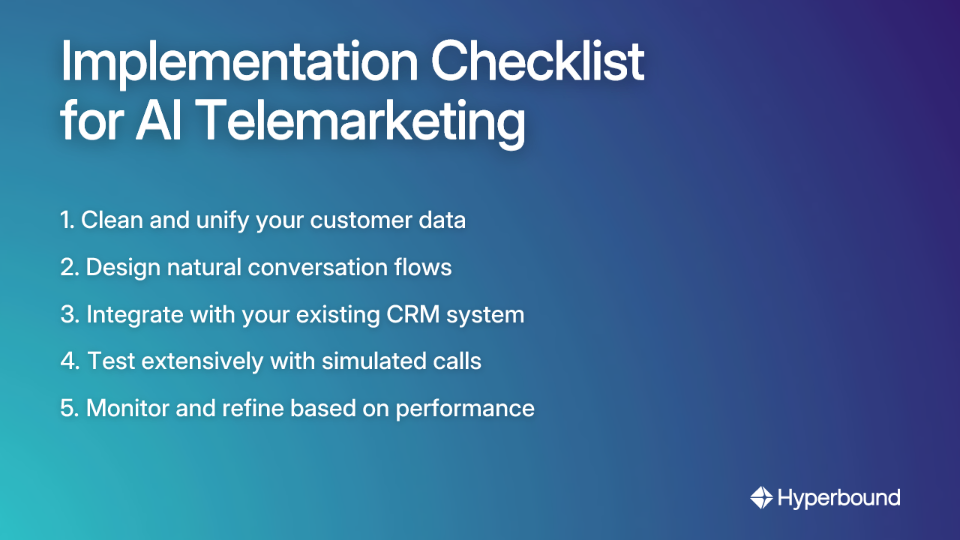
Step 1: Build Your Data Foundation
Integrate your CRM and other data sources into your chosen AI platform. This is the bedrock of effective personalization. Without clean, unified data, your AI will be flying blind.
Step 2: Design Your AI Agent
Use a no-code voice flow builder to map out conversation paths. Then, train the agent by feeding it your product knowledge, customer data, FAQs, and common objections. This creates a knowledge-base syncing system for your agent.
Step 3: Integrate Into Your Workflow
As one Reddit user pointed out, "It's not just about conversations but also how it fits into the whole sales workflow." Ensure your AI solution includes:
- CRM Integration: The AI should read and write data to your CRM in real time to avoid duplicate outreach and maintain visibility.
- Actionable Capabilities: Leverage Cal integration to check availability, book, confirm, and reschedule appointments live on the call.
Step 4: Evaluate, Launch, and Learn
Before full deployment:
- Evaluate: Simulate real calls to test for quality, compliance, and naturalness.
- Launch: Deploy your AI agent with a reliable provider.
- Learn: Continuously monitor performance analytics and use real-time feedback to refine the AI's scripts and responses.
Choosing the Right Platform: Key Features to Look For
When selecting an AI telemarketing platform, prioritize these features:
- Versatility: Look for an AI receptionist or AI appointment setter that can handle outbound sales, surveys, lead qualification, and customer service workflows.
- Seamless Integration: Deep CRM integration is non-negotiable. Also look for calendar integrations (Cal integration) and other tools via real-time APIs.
- Conversation Quality: The AI must sound human. Prioritize platforms with superior natural language understanding and interruption handling.
- Security & Compliance: If you handle sensitive data, look for platforms with SOC 2 compliance, HIPAA compliance, and GDPR compliance.
- Actionable Agents: The AI should book meetings, update records, and trigger follow-up actions.
- Language Support: For global operations, ensure the platform supports multilingual callers.
Your AI Co-Pilot for Smarter Sales
AI telemarketing is the solution to the personalization-at-scale paradox. It's not about replacing your sales team but augmenting them, freeing them from repetitive, top-of-funnel tasks so they can focus on what they do best: building relationships and closing deals.
The most effective sales strategies combine the efficiency of AI outreach with the finely-tuned skill of an expert human agent. While AI acts as a co-pilot to handle initial outreach and qualification, your team must be ready to capitalize on those high-value interactions.
By embracing this dual-AI strategy—using one system for scalable outreach and another like Hyperbound for scalable coaching—you can build a truly robust sales pipeline. You'll reduce costs and eliminate burnout while ensuring every customer conversation is a world-class experience. The future of sales isn't just automation; it's about using AI to unlock the full potential of both technology and people.
Frequently Asked Questions
What is AI telemarketing?
AI telemarketing is the use of conversational AI virtual agents to automate repetitive sales tasks such as initial outreach, lead qualification, and appointment scheduling. It allows businesses to engage with thousands of prospects simultaneously with personalized, human-like conversations, operating 24/7 to expand reach and improve efficiency.
How is AI telemarketing different from robocalling?
AI telemarketing is fundamentally different from traditional robocalling because it uses advanced natural language processing (NLP) to facilitate dynamic, two-way conversations. Unlike robocalls, which play static, pre-recorded messages, modern AI agents can understand context, handle interruptions, and respond intelligently, creating a genuinely interactive and natural-feeling experience for the prospect.
Will AI telemarketing replace my human sales team?
No, AI telemarketing is designed to augment your human sales team, not replace it. The most effective strategy is a hybrid model where AI handles repetitive, top-of-funnel tasks like initial contact and lead qualification. This frees up your human agents to focus on high-value activities that require emotional intelligence and complex negotiation, such as closing deals with qualified, warm leads.
How can I ensure my AI agent sounds human and not robotic?
To ensure an AI agent sounds human, you should focus on three key principles: First, use unified customer data to enable deep personalization beyond just a name. Second, invest in an advanced conversational AI platform that can understand context and handle interruptions gracefully. Finally, use voice customization features to select a tone that aligns with your brand.
What are the first steps to implement an AI telemarketing strategy?
The first steps to implementing AI telemarketing are to build a solid data foundation by integrating your CRM and other data sources. Next, design your AI agent's conversation flows and train it with your product knowledge and customer FAQs. Finally, integrate the AI into your sales workflow, ensuring it can read/write to your CRM and book appointments, then test, launch, and continuously refine its performance.
What results can I expect from AI telemarketing?
Businesses using AI telemarketing can expect significant, measurable results, including increased efficiency, higher conversion rates, and reduced operational costs. Case studies show outcomes like a 60% increase in scheduling efficiency, 2.5 times more booked appointments, a 75% reduction in customer wait times, and a doubled response rate, ultimately leading to a stronger sales pipeline and higher ROI.
Book a demo with Hyperbound


