

.png)
Summary
- With Gartner predicting 95% of seller workflows will start with AI by 2027, integrating your disconnected CRM, coaching, and forecasting tools is no longer optional.
- AI connects these tools into a virtuous cycle: better CRM data leads to accurate forecasts, which informs targeted coaching, and improved reps feed better data back into the CRM.
- To avoid common pitfalls, ensure your data is clean and balance automation with human oversight, using AI to augment—not replace—your team's skills.
- AI coaching platforms like Hyperbound bridge the gap between data and performance by analyzing calls and providing reps with AI roleplays to master critical conversations.
You've invested in top-tier sales tools: a robust CRM, coaching software, and forecasting solutions. Yet somehow, your sales engine still feels disjointed and inefficient. Your reps jump between platforms, data falls through the cracks, and you can't shake the feeling that these powerful tools should be working together more seamlessly.
As one frustrated sales leader put it on Reddit: "The key is to find a solution that connects call analysis, performance metrics, and enablement into one seamless workflow."
This disconnection isn't just annoying—it's costing you money, time, and competitive advantage. But there's good news: Artificial Intelligence has emerged as the connective tissue that can finally integrate these critical sales functions into a cohesive, self-improving system.
The stakes couldn't be higher. According to Gartner, by 2027, an estimated 95% of seller research workflows will start with AI—a dramatic increase from less than 20% in 2024. Organizations that fail to adopt integrated AI systems risk falling irreparably behind.
In this article, we'll explore how AI transforms each component of your sales tech stack and—more importantly—how it creates powerful synergies between them, generating a virtuous cycle of improvement across your entire sales operation.
The Foundation – An AI-Supercharged CRM
The CRM has long been the central nervous system of sales operations, but traditional CRMs are essentially passive databases. They store information but require significant human effort to maintain and extract value from. AI changes this fundamentally, transforming your CRM from a digital filing cabinet into an active, intelligent partner.
From Data Entry to Strategic Insights
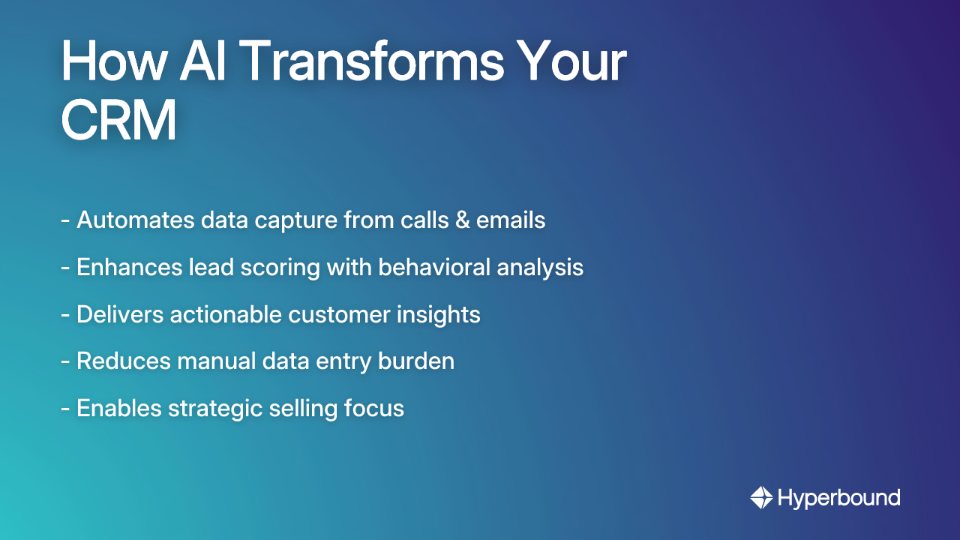
AI-powered CRMs automate the mundane aspects of data management while enhancing the strategic elements:
- Automated Data Capture and Organization: AI can automatically extract and organize customer data from calls, emails, and meetings, dramatically reducing manual entry. This addresses a common pain point expressed by sales teams: the burden of data administration taking time away from selling.
- Enhanced Lead Scoring and Qualification: Rather than relying on basic rules, AI analyzes historical patterns and customer behaviors to rank leads by their likelihood to convert. This helps teams prioritize outbound prospecting efforts more effectively.
- Personalized Customer Insights: AI synthesizes complex customer data into simple, actionable insights for sellers. As Gartner notes, these "Atomic Insights" allow reps to focus on delivering customer value rather than conducting extensive research.
Tackling the Data Quality Challenge
The effectiveness of AI in your CRM hinges on data quality—a challenge many organizations face. One sales professional on Reddit shared: "We initially got irrelevant information—the AI agent was adding everything into the CRM. Even noise, and that was not helpful."
To avoid this "dirty data" problem:
- Establish clear parameters for what constitutes valuable information
- Regularly audit and clean your CRM data
- Train your AI tools with high-quality, relevant examples
- Maintain human oversight of AI-generated entries
Integration Considerations
Many users report technical hurdles when implementing AI in their existing CRM: "Some custom fields didn't map well, so we had to do manual data checks," noted one Reddit user. Another mentioned "some weird credential quirks with HubSpot."
When integrating AI with your CRM, consider working with experienced IT professionals who understand API requirements and can ensure seamless data flow between systems. Alternatively, look for AI tools specifically designed to integrate with your existing CRM to minimize compatibility issues.
From Data to Development – AI-Driven Sales Coaching at Scale
With a clean, AI-enhanced CRM establishing your data foundation, the natural next step is leveraging this information to develop your team's skills through AI-powered coaching.
The Coaching Gap
Traditional sales coaching faces significant limitations: it's inconsistent, depends heavily on manager bandwidth, and often focuses on individual deals rather than systematic skill development. As one sales professional lamented on Reddit: "I am looking for how to improve rep skill gaps not just on a deal or call... help me recommend what to change across all rep calls."
This gap is particularly concerning given that studies show 75% of sellers desire more coaching than they currently receive.
How AI Transforms Sales Coaching
AI coaching systems work through a continuous process of data collection, analysis, and personalized feedback:
- Data Collection: The system gathers information from your CRM, call recordings, emails, and other interactions.
- Advanced Analysis: Machine learning algorithms analyze this data to identify patterns in rep behavior, assessing elements such as:
- Question quality and frequency
- Objection handling techniques
- Customer sentiment during interactions
- Talk-to-listen ratios
- Competitive mention handling
- Personalized Feedback and Learning Plans: Based on this analysis, the AI provides tailored feedback and suggests specific learning paths calibrated to each rep's performance profile.
One Reddit user highlighted this comprehensive approach: "It doesn't just flag one call, it gives you the common threads so you can coach more strategically."
Measurable Benefits
Organizations implementing AI coaching are seeing significant results:
- Faster onboarding: New reps reach productivity benchmarks more quickly
- Revenue impact: Industry reports indicate that 63% of teams using AI coaching see increased revenue
- Consistent training: All reps receive the same quality of coaching, regardless of manager bandwidth
- Manager efficiency: Sales managers can focus on strategic initiatives rather than basic coaching
Essential Features in a Modern AI Coaching Platform
When evaluating AI coaching tools, look for platforms that offer a comprehensive solution. For example, Hyperbound integrates several key capabilities that drive performance:
- AI-Powered Roleplays: Allows reps to practice critical conversations—from cold calls to objection handling—in a safe, repeatable environment.
- Real Call Analysis: Goes beyond basic metrics to analyze winning behaviors from your top reps' actual sales calls, identifying the specific techniques that lead to success.
- Personalized, Scalable Coaching: Delivers instant, data-driven feedback on both practice roleplays and real customer conversations, helping reps improve continuously.
- Seamless CRM Integration: Connects with your existing systems to provide coaching that is contextual and relevant to each deal.
.png)
Predicting the Future – AI-Augmented Sales Forecasting
With your CRM optimized and your team's skills sharpened through AI coaching, you're now positioned to dramatically improve the accuracy of your sales forecasting—an area where most organizations struggle mightily.
According to Gartner, only 7% of sales teams achieve 90% accuracy in forecasts. This dismal statistic reveals how challenging prediction remains, even for sophisticated sales organizations.
How AI Elevates Forecasting
AI transforms forecasting through several key capabilities:
- Advanced Data Processing: AI can rapidly analyze vast datasets, correlating historical sales data with external market indicators to uncover subtle patterns humans might miss.
- Pattern Recognition: By examining historical performance, AI identifies trends that impact sales, such as seasonal demands or economic indicators, allowing for more nuanced planning.
- Sentiment Analysis: AI evaluates customer emotions from emails and call transcripts to forecast reactions to new features or identify deals at risk before traditional metrics would reveal problems.
Implementing AI in Your Forecasting Process
To successfully integrate AI into your forecasting workflow, experts recommend this step-by-step approach:
.png)
- Define Clear Objectives: Establish specific goals for your AI forecasting initiative.
- Prepare Your Data: Ensure your historical sales data is clean, consistent, and properly structured.
- Select Appropriate Tools: Choose AI forecasting solutions that integrate with your existing systems.
- Train Your Model: Allow the AI to learn from your specific sales patterns and data.
- Deploy and Monitor: Implement the model while continuously evaluating its accuracy.
- Establish Feedback Loops: Regularly update the model with new data to improve its predictive power over time.
The Synergy – Creating a Virtuous Cycle
While each AI-powered component delivers standalone value, the true magic happens when they work in concert. This integration creates a self-reinforcing system where improvements in one area automatically enhance the others.
How the Components Feed Each Other
The cycle works as follows:
CRM → Forecasting: A clean, AI-enriched CRM provides high-quality, structured data—the essential fuel for accurate AI forecasting models. With better data quality comes more reliable predictions.
Forecasting → Coaching: AI-powered forecasts identify deals at risk and reps who consistently underperform against targets. This triggers personalized AI coaching modules or alerts managers to intervene with targeted support.
Coaching → CRM: As reps improve their skills through AI coaching platforms like Hyperbound (better lead qualification, objection handling, etc.), the quality of information they input into the CRM naturally improves. They capture more insightful notes and log more meaningful interactions, enriching the entire dataset.
This virtuous cycle continuously improves your sales operation: better CRM data leads to more accurate forecasts, which enables more targeted coaching, which produces better rep performance, which generates even richer CRM data—and the cycle continues.

Navigating the Pitfalls – Best Practices for Implementation
Despite its tremendous potential, AI implementation comes with challenges. Here are key practices to ensure success:
Balance Automation with Human Touch
As one Reddit user wisely advised: "The best setup is having AI handle initial outreach + qualifying, then humans step in for the relationship building."
AI should augment human capabilities, not replace them. Another user warned: "I'd avoid any AI tool that completely removes humans from the sales process—that's where I've seen the biggest fails."
Nail the Fundamentals First
AI amplifies your existing sales fundamentals—for better or worse. If your underlying processes are flawed, AI will simply automate those flaws at scale.
One sales professional put it bluntly: "AI agents actually make sense when the basics are nailed like right ICP (Ideal Customer Profile), timing, and something real to offer—otherwise it's just automation noise."
Maintain Human Oversight
The challenge of generic AI content was highlighted by several users: "ChatGPT-generated messages still needed human review... the tone can feel off or too generic."
All automated outreach should be reviewed by humans to ensure personalization and proper tone. Invest in good prompt engineering to minimize generic responses.
Adopt a Strategic Vision
Gartner recommends several best practices:
- Establish a clear vision for how AI aligns with business goals
- Audit existing forecasting and sales processes before implementation
- Engage leadership to foster a culture supportive of technology integration
Building the Future of Sales
AI systems are creating an integrated sales engine where CRM, coaching, and forecasting work in concert, generating a powerful, self-improving cycle that drives revenue and efficiency.
Looking ahead, the emergence of Agentic AI—described by Gartner as "a significant advancement allowing software to autonomously execute tasks"—suggests that this integration will only become deeper and more intelligent.
The most successful sales organizations will be those that masterfully blend advanced AI technology with irreplaceable human insight and a solid strategic foundation. By connecting these critical components through AI, you're not just optimizing individual functions—you're creating an intelligent sales ecosystem that continuously learns, adapts, and improves.
Frequently Asked Questions
What is an integrated AI sales stack?
An integrated AI sales stack is a system where AI connects your CRM, sales coaching software, and forecasting tools, allowing them to share data and work together seamlessly. Instead of being separate platforms, they form a cohesive, self-improving ecosystem where insights from one tool automatically enhance the others, creating a virtuous cycle of improvement.
How does AI improve sales coaching?
AI improves sales coaching by analyzing data from calls and CRM interactions to provide personalized, scalable feedback to each sales representative. It identifies specific skill gaps, such as poor objection handling or low talk-to-listen ratios, and suggests targeted learning paths. This allows for consistent coaching across the entire team without being limited by manager bandwidth.
What is the biggest challenge when implementing AI in a CRM?
The biggest challenge when implementing AI in a CRM is ensuring high-quality data. AI systems are only as good as the data they learn from. If your CRM is filled with incomplete or irrelevant information ("dirty data"), the AI will produce unhelpful insights and automate flawed processes. It's crucial to establish clear data entry parameters and regularly clean your data before and during AI implementation.
Can I use AI for just one part of my sales process, like forecasting?
Yes, you can absolutely implement AI in a single area, such as sales forecasting, to see immediate benefits. However, the true transformative power of AI is realized when these components are integrated. An AI forecasting tool becomes significantly more accurate when it's fed clean, rich data from an AI-enhanced CRM. While standalone AI tools are valuable, a connected system creates exponential returns.
Will AI replace human sales representatives?
No, the goal of AI in sales is not to replace human representatives but to augment their capabilities. AI excels at handling repetitive, data-intensive tasks like data entry, lead scoring, and initial analysis. This frees up sales reps to focus on high-value activities that require human skills, such as building relationships, strategic negotiation, and closing complex deals.
How do I get started with integrating AI into my sales stack?
The best way to start is by identifying your biggest pain point and establishing a clear vision for what you want to achieve. Begin by auditing your existing processes. Is your biggest challenge inaccurate forecasting, inconsistent coaching, or the administrative burden of your CRM? Once you have a clear objective, you can select an AI tool that addresses that specific need and integrates with your existing systems.
What is the "virtuous cycle" of an AI-powered sales stack?
The "virtuous cycle" describes how integrated AI tools create a self-reinforcing loop of improvement across your sales operations. It works like this: an AI-enhanced CRM provides clean data for more accurate forecasts. These forecasts highlight areas for improvement, which triggers targeted AI coaching. Better coaching leads to improved rep performance and higher-quality data entry back into the CRM, and the cycle begins again.
Book a demo with Hyperbound


